5 Chair-of-thought
Chair-of-thought is presented as a way to improve reasoning when a decision is trapped inside one dominant frame. Rather than treating a discussion as neutral, it recognizes that people evaluate the same problem through different constraints, incentives, and success criteria. By deliberately changing the “seat” from which a problem is examined, a team can surface hidden assumptions, expose blind spots, and see how the shape of the solution changes with perspective.
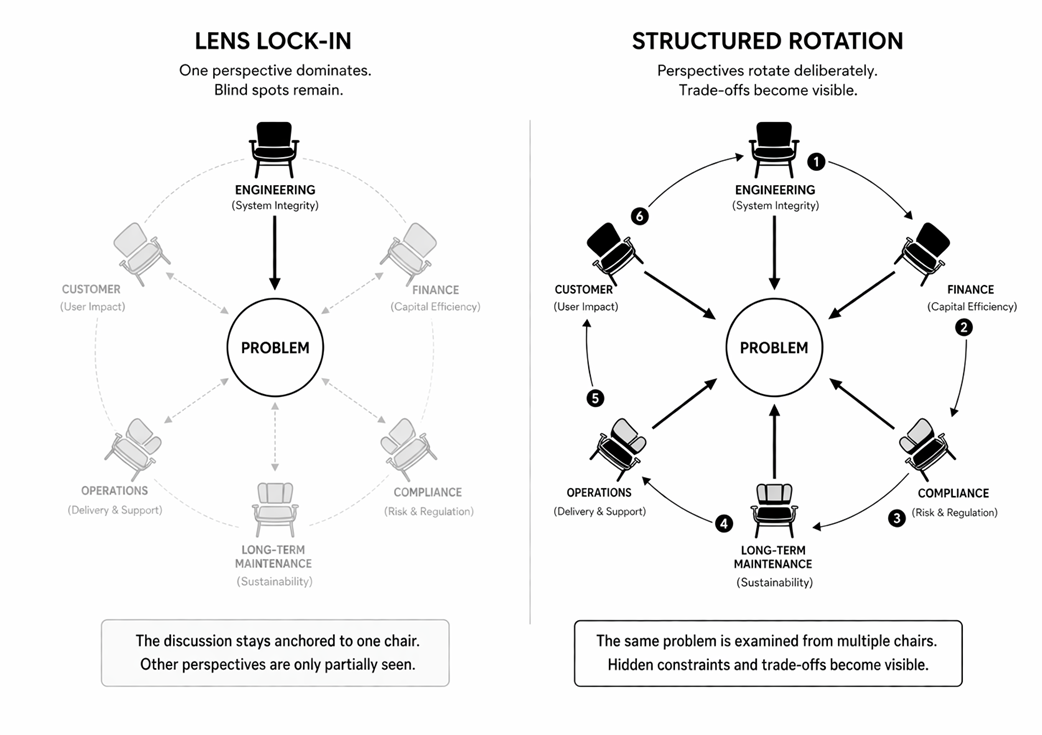
The chapter argues that perspective is not a minor preference but a structural variable in reasoning. A single lens can produce coherent conclusions while still missing important trade-offs, especially when optimization goals conflict across roles such as product, finance, operations, compliance, or customer success. Without structured rotation, teams can fall into lens lock-in, expert dominance, token diversity, moral drift, or retrospective shock, all of which create the illusion of alignment while leaving critical constraints unexplored.
To make rotation effective, the book recommends keeping the problem fixed while moving sequentially through a small number of clearly defined chairs, each representing a materially different optimization frame. This works best when used before commitment, with simple prompts, explicit comparison, and conscious convergence afterward. The method is lightweight but fragile: it depends on status balance, psychological safety, and enough cognitive bandwidth to hold multiple views, yet when it is applied well, it turns perspective from an hidden bias into a deliberate part of the reasoning architecture.
Lens lock-in vs structural rotation. The different perspectives of the chairs and their optimization variables are shown
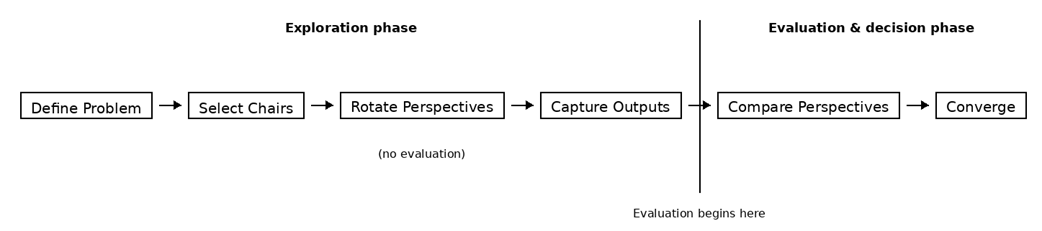
Chair-of-Thought separates exploration from evaluation by rotating through perspectives sequentially, capturing each view before comparison begins, so trade-offs are surfaced explicitly rather than collapsed into early consensus.
Summary
- Chair-of-thought expands reasoning by rotating between distinct perspectives, rather than adding more options or deeper chains.
- Decisions become fragile when reasoning remains anchored to a single optimization frame, even when that reasoning appears rigorous.
- Deliberate rotation separates viewpoint from identity, allowing disagreement to shift from individuals to constraints.
- Different chairs reveal different risks, trade-offs, and success criteria, making optimization tensions visible before commitment.
- The model is most valuable when optimization variables conflict, when impact extends over time, or when signals indicate missing perspectives.
- Without the right conditions, rotation degrades into patterns such as lens lock-in, expert dominance, or superficial coverage rather than improving decision quality.
FAQ
```htmlWhat is chair-of-thought in Chapter 5?
Chair-of-thought is a structured way of deliberately rotating perspectives while keeping the problem fixed. Instead of letting one dominant optimization frame govern the discussion, the group temporarily reasons from different “chairs” or lenses.
Why does the chapter say perspective is a structural variable?
Because perspective changes how a problem is interpreted, which constraints matter most, what information seems relevant, and which outcomes are acceptable. It shapes the decision space itself, not just the wording of the discussion.
What goes wrong when a team does not rotate perspectives?
Without structured rotation, teams can experience lens lock-in, expert dominance, token diversity, moral drift, or retrospective shock. The discussion may feel coherent, but it remains anchored to a single frame and misses important constraints.
How is a chair different from a person?
A chair is not the person occupying it. It is the optimization frame associated with a role or perspective. For example, an engineer can occupy the customer chair, and a product manager can occupy the security chair.
When is structured rotation actually necessary?
It becomes necessary when decisions involve multiple competing optimization variables, long time horizons, cross-functional impact, persistent disagreement, or signals like emotional intensity and ethical concern. In those cases, one perspective is usually not enough.
How should a team rotate through chairs?
The rotation should be sequential. The group holds the problem constant, explores one chair at a time, records what each lens reveals, and only then compares perspectives and converges on a decision.
What are the practical steps for using chair-of-thought?
First, frame the problem clearly. Second, select a small number of materially different chairs. Third, reason from each chair in sequence. Fourth, compare the tensions between lenses. Finally, converge deliberately by choosing which trade-offs to accept.
What questions help activate chair-of-thought in a live conversation?
Useful prompts include: “Which chair are we currently reasoning from?”, “Which chair would disagree most strongly with this direction?”, “Can we look at this from a different seat for a minute?”, and “Before we decide, can we check this from a couple of other lenses?”
What environmental conditions help chair-of-thought work well?
It works best when status differences are managed, the group is safe enough to express provisional or conflicting views, and there is enough cognitive bandwidth to compare multiple lenses. Without those conditions, rotation can collapse back into a single dominant perspective.
What are the main failure modes of structured rotation?
The main failure modes are superficial rotation, defensive entrenchment, over-rotation, abstract ethical positioning without concrete consequences, and paralysis from trying to satisfy every chair equally. The goal is not endless debate, but visible trade-offs and conscious convergence.

 The Architecture of Reasoning ebook for free
