Tree-of-thought is presented as a way to improve reasoning by widening the problem space before narrowing it. Rather than following one line of thought to a conclusion, it deliberately generates several distinct paths, keeps them separate long enough to understand them, and only then evaluates which one best fits the situation. The chapter argues that this sequencing matters most in complex, high-stakes settings where early framing can quietly determine the outcome long before anyone realizes the space has been constrained.
A central theme is that many decision failures come from false binaries. In the architecture review example, the team quickly reduced a complicated service problem to “rewrite or refactor,” and the discussion then became a defense of those two positions instead of an exploration of the broader landscape. The text shows how this kind of narrowing encourages premature convergence, identity attachment, and argumentative escalation, while hiding other viable structures such as extraction, targeted performance intervention, hybrid approaches, or even a temporary hold with explicit risk modeling. Tree-of-thought interrupts that pattern by separating generation from evaluation so that alternatives can exist before they are judged.
The chapter also explains why branching can improve both decision quality and durability when used with discipline. It reduces path dependence, makes assumptions and trade-offs visible, and helps teams compare options against explicit criteria rather than instinct or rhetoric. At the same time, it warns that branching must be bounded: too many branches create cognitive overload, hierarchy can suppress real divergence, and some problems do not need this method at all. Used well, tree-of-thought is not about producing more ideas for their own sake, but about making sure commitment is based on a genuinely visible set of possibilities.
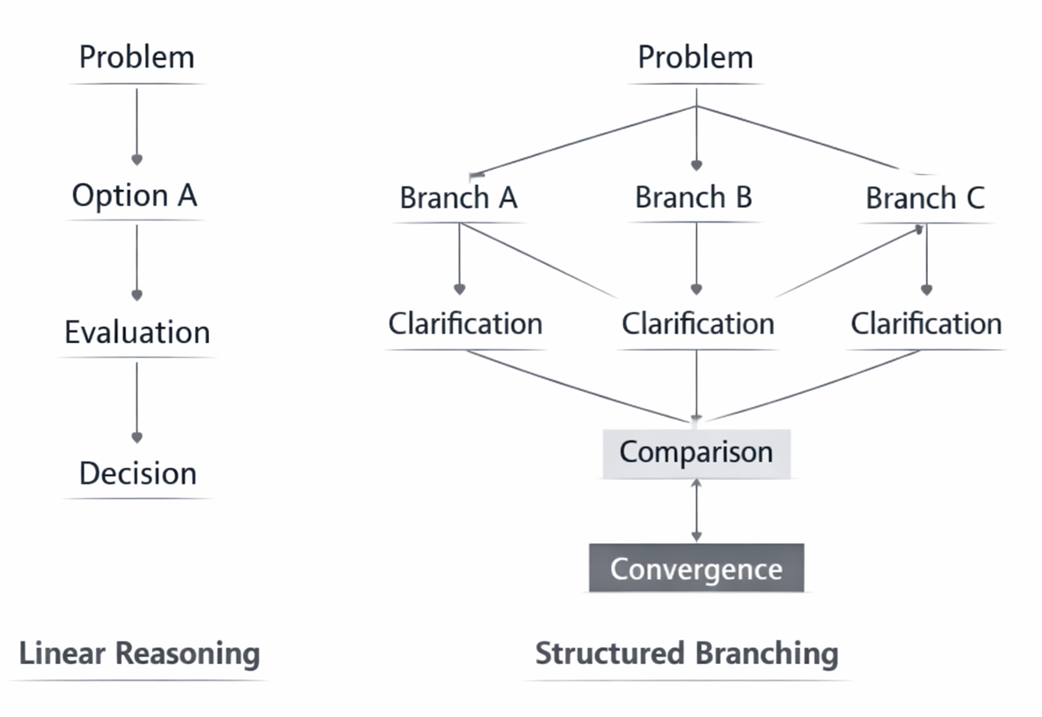
Linear reasoning compresses possible paths. Structured branching introduces possibilities before convergence.
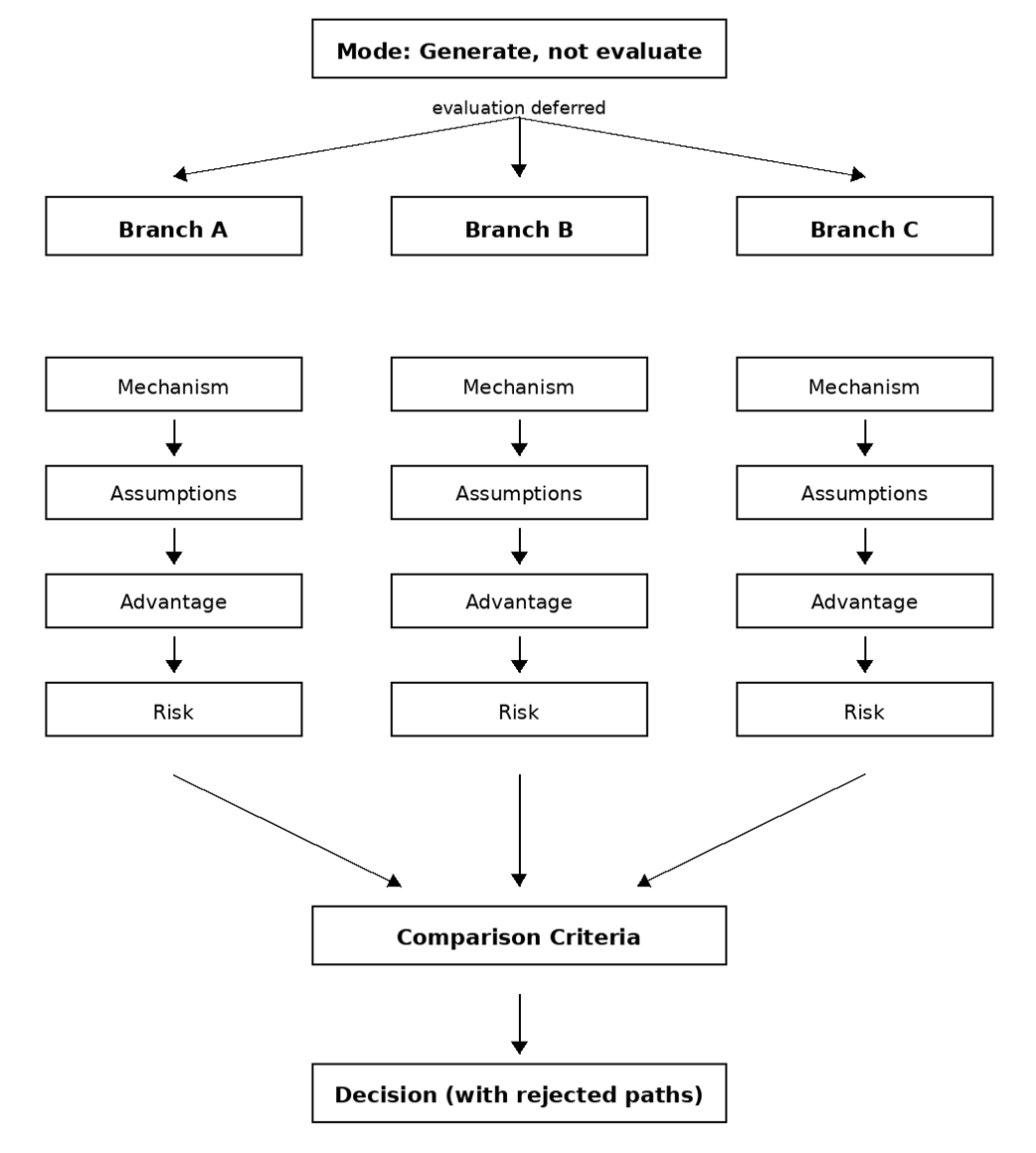
The reasoning landscape is captured, showing the mode explicitly named at the top, branches clearly separated, each branch structured (mechanism, assumptions, advantage, risk), comparison introduced only after branches are formed, and convergence as a distinct final step.
Summary
Tree-of-thought expands reasoning by generating multiple structurally distinct paths before convergence.
Binary framing creates false dilemmas, narrowing the solution space before it is fully explored.
Premature convergence feels efficient but often produces fragile decisions and later rework.
Separating generation from evaluation allows alternatives to form before being tested or dismissed.
Branching reduces identity attachment, shifting debate from defense to comparison.
Decision quality improves through structurally different options, not just more ideas.
Tree-of-thought is most valuable in ambiguous, high-stakes, or low-reversibility decisions.
Effective use requires disciplined branching, bounded exploration, and explicit convergence.
FAQ
What is tree-of-thought in this chapter?Tree-of-thought is a reasoning structure that deliberately generates multiple distinct paths before convergence. Instead of following one line of logic immediately, it widens the solution space first and only then evaluates the options.How is tree-of-thought different from chain-of-thought?Chain-of-thought expands a single line of reasoning, while tree-of-thought expands the number of lines available. It introduces branching before convergence, so the team can compare genuinely different paths rather than refining only the first plausible one.Why is branching important before making a decision?Branching helps prevent premature narrowing of the problem. By making multiple paths visible first, teams are less likely to get trapped by the first framing that seems reasonable and more likely to consider the full range of viable options.What problem does tree-of-thought solve in decision-making?It addresses premature convergence and false binaries. Many decisions fail because the solution space is collapsed too early, so tree-of-thought ensures alternatives are generated before evaluation begins.Why does binary framing create problems?Binary framing makes complexity look manageable, but it often hides other possible structures. It pushes people into defending one side or the other, which narrows the discussion before the real problem has been fully explored.How does tree-of-thought improve decision quality?It improves decision quality by reducing identity attachment, exposing hidden assumptions, making success criteria explicit, and lowering path dependency. This leads to decisions that are more durable and better matched to the actual problem.How many branches should be considered in tree-of-thought?Usually three or four genuinely distinct branches are enough. More than that can overload working memory and make comparison harder, so the goal is not many options but meaningfully different ones.When is structured divergence most useful?It is most useful when the problem shape is uncertain, the stakes are high, the decision has long-term consequences, the choice is hard to reverse, or multiple perspectives bring competing constraints. These are the situations where narrow framing is most risky.What is the role of separating generation from evaluation?Generation and evaluation should happen in sequence, not at the same time. First, branches are created and clarified; then they are compared. This protects weaker but potentially valuable ideas from being dismissed too early.What are the practical steps for applying tree-of-thought?First, name the mode and ask for structurally different approaches. Then protect the generation phase, strengthen each branch by clarifying its mechanism, assumptions, upside, and risk, compare branches against explicit criteria, and finally converge while recording why alternatives were rejected.
pro $24.99 per month
access to all Manning books, MEAPs, liveVideos, liveProjects, and audiobooks!

 The Architecture of Reasoning ebook for free
