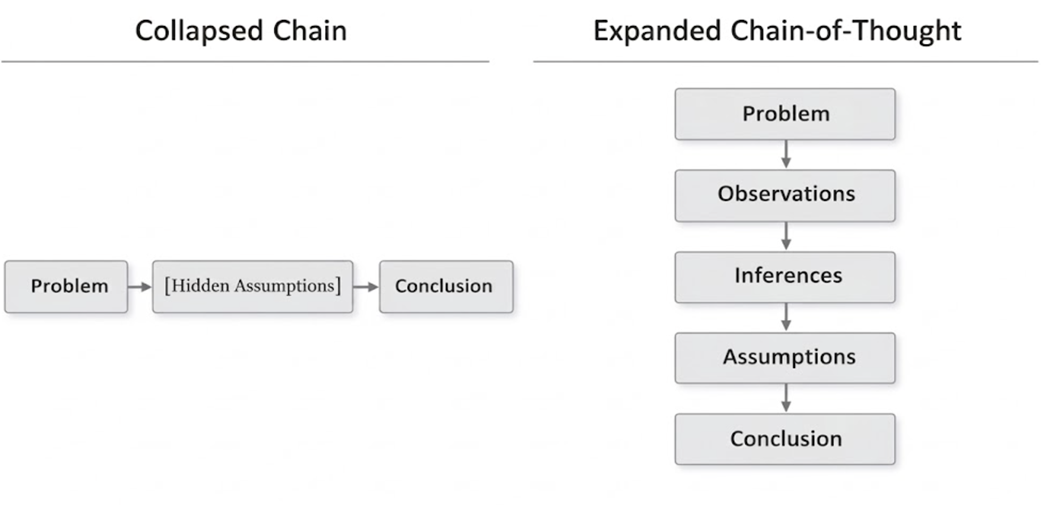
Chain-of-thought is presented as a way to make reasoning visible rather than jumping straight from question to answer. The chapter begins by contrasting simple direct responses with situations where complexity makes compression risky, showing that when intermediate steps are hidden, people may accept plausible conclusions without seeing the logic that produced them. By slowing the move from observation to conclusion, this approach exposes the structure of thought and makes it possible for others to inspect how a claim is formed.
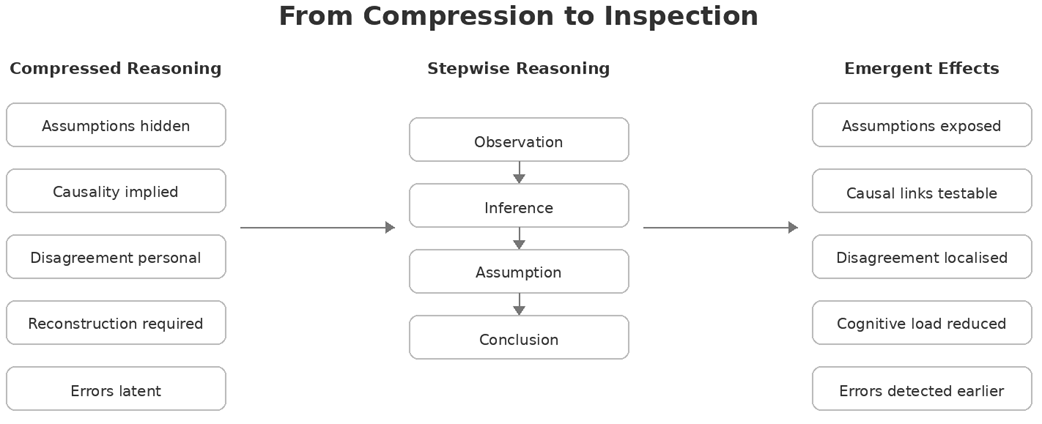
The central value of this stepwise approach is reliability. When reasoning is laid out in sequence, assumptions surface, causal links can be tested, and disagreement can focus on specific weak points instead of becoming personal. The chapter argues that this helps teams diagnose errors earlier, reduce silent misalignment, and improve shared understanding, especially in technical, strategic, or leadership decisions where the cost of being wrong can compound over time. In this sense, the method is not about producing more elaborate answers, but about making the thinking behind them visible enough to evaluate.
The chapter also warns that when reasoning stays compressed, organizations drift toward hidden leaps, retrospective explanations, and strategic fragility. Over time, people learn to present polished conclusions instead of incomplete thinking, which weakens learning and makes decisions harder to trust or revise. Chain-of-thought is therefore recommended when problems are ambiguous, stakes are high, or perspectives diverge, but it must be used with discipline and proportion. The goal is not to narrate every thought, but to surface the critical steps, assumptions, and vulnerabilities before a decision hardens.
Compression hides joints and assumptions in the thought chain. Expansion and sequencing exposes them for inspection.
Expanding reasoning into explicit steps transforms how groups think: assumptions surface, causality becomes testable, disagreement becomes precise, and errors are detected earlier rather than downstream.
Summary
Chain-of-thought makes intermediate reasoning visible, shifting discussion from answers to the structure that produces them.
By expanding the path from observation to conclusion, it exposes assumptions, inferences, and dependencies that would otherwise remain implicit.
Making reasoning steps explicit allows teams to test causal links, reducing hidden leaps and misattributed causes.
Shared visibility replaces private reconstruction with collective evaluation, reducing misalignment.
Stepwise articulation lowers the social cost of challenge by focusing disagreement on specific links rather than positions.
It improves error detection by introducing checkpoints where weak logic can be identified and corrected earlier.
Reliability increases without requiring greater intelligence, only more structured expression of existing thinking.
It's most valuable in ambiguous, high-stakes, or cross-functional contexts where the cost of being wrong is high.
It complements Direct Q&A rather than replacing it, introducing depth when compression becomes risky.
FAQ
What is chain-of-thought in the context of reasoning?Chain-of-thought is a way of making intermediate reasoning steps visible before arriving at a conclusion. Instead of jumping directly from observation to answer, it lays out assumptions, inferences, and causal links so the logic can be inspected.How does chain-of-thought differ from direct Q&A?Direct Q&A asks for the answer, while chain-of-thought asks how the answer was formed. The first compresses reasoning into a conclusion; the second expands the pathway so the reasoning can be examined step by step.Why does making reasoning visible improve decision-making?Visible reasoning makes assumptions and weak links easier to detect early. It helps groups evaluate the logic behind a decision instead of debating only the final conclusion, which improves reliability and alignment.What problem does chain-of-thought solve in complex situations?It prevents important reasoning from being hidden inside compressed conclusions. In complex or high-stakes situations, stepwise reasoning exposes assumptions, clarifies causality, and reduces the risk of acting on a flawed leap in logic.Why can compressed reasoning lead to errors?When reasoning is compressed, people may mistake symptoms for causes, accept correlations as explanations, or rely on unstated assumptions. Because the pathway is hidden, errors are harder to notice until they affect action.What happens when teams use chain-of-thought in group discussions?The discussion shifts from defending positions to inspecting structure. Disagreement can attach to a specific assumption or step, which lowers defensiveness and makes it easier for the group to converge on a better understanding.When is chain-of-thought especially necessary?It is most useful when the problem is unclear, when the cost of being wrong compounds over time, or when perspectives diverge across people or domains. In those cases, compressed reasoning is more likely to hide important dependencies.What are some practical ways to encourage chain-of-thought?Useful prompts include: “Walk me through that step by step,” “What happened between that signal and this conclusion?,” “What must be true for that to hold?,” and “Where is the weakest link in this reasoning?” These questions shift attention to the reasoning path.What can go wrong if an organization does not use chain-of-thought?Organizations may drift into hidden leaps, retrospective explanations, strategic fragility, and a culture where people present polished conclusions instead of developing reasoning. Over time, this reduces learning and decision quality.Does chain-of-thought replace intuition or guarantee correctness?No. It does not eliminate error or replace judgment. Its value is that it makes reasoning inspectable, so weak logic can be challenged earlier and intuition can be examined rather than merely accepted.
pro $24.99 per month
access to all Manning books, MEAPs, liveVideos, liveProjects, and audiobooks!

 The Architecture of Reasoning ebook for free
