Direct Q&A is presented as the familiar pattern in which teams move from a question straight to an answer, creating the impression of speed, alignment, and leadership. The chapter shows that this efficiency is often real but deceptive: the visible exchange hides the framing choices, assumptions, constraints, trade-offs, and confidence levels that actually shape the decision. When the issue is simple, this compressed mode works well; when the issue is ambiguous or complex, it can produce confident action on fragile foundations.
The chapter explains why organizations rely on this style so often. Time pressure, status dynamics, discomfort with ambiguity, and cognitive shortcuts all encourage people to reward immediate, fluent answers over slower, more explicit reasoning. In such environments, some thinking styles are favored while others are undervalued, especially bottom-up reasoning that builds understanding step by step. The result is that groups may appear aligned while actually holding different mental models and different interpretations of the same decision.
When Direct Q&A dominates, several failure modes emerge: premature convergence, silent divergence, narrative lock-in, and recurring rework. The chapter argues that the remedy is not to abandon Direct Q&A, but to use it more deliberately by checking the frame, surfacing assumptions, briefly generating alternatives, and testing reversibility before committing. These small interventions preserve speed while making reasoning visible enough to inspect, helping teams choose when compression is sufficient and when deeper reasoning is needed.
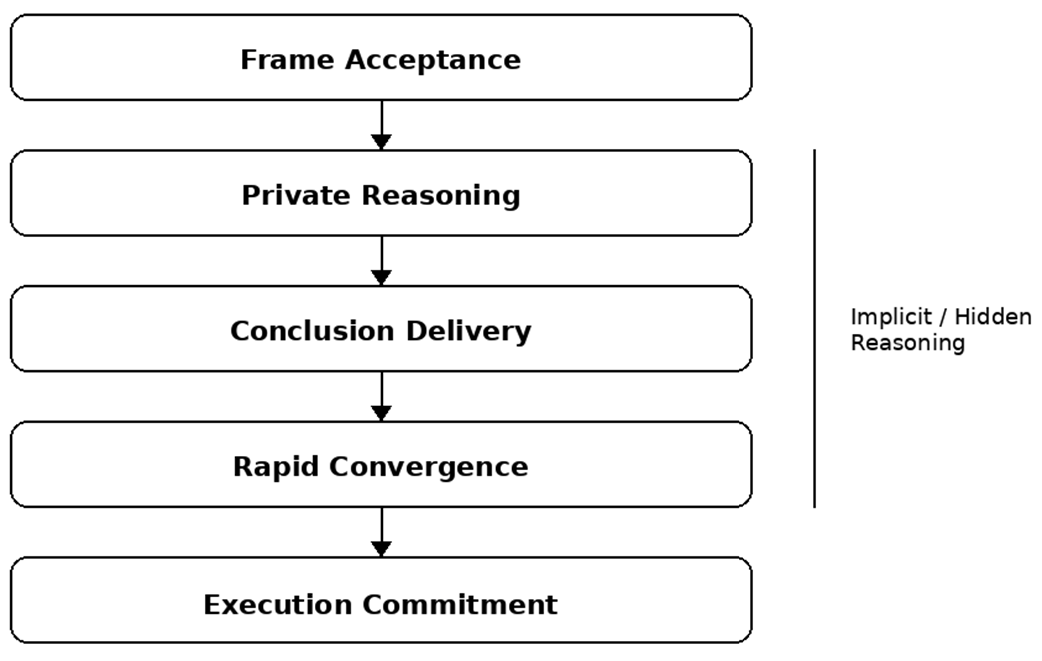
Direct Q&A compresses reasoning into a visible sequence of steps while keeping the underlying logic private. The group aligns on answers, not on the reasoning that produced them, creating speed at the expense of shared understanding.
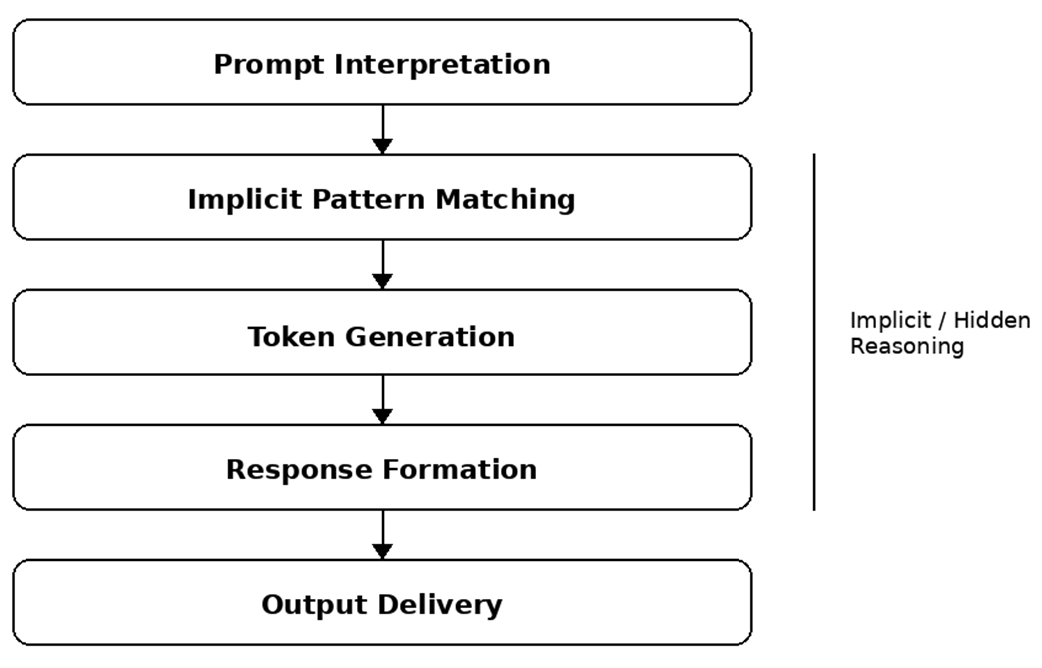
In zero-shot prompting, the hidden reasoning layers are different to Direct Q&A but the result is the same. Input and output are the only visible steps.
Summary
Direct Q&A collapses reasoning into a single visible step, moving from question to conclusion while leaving assumptions, alternatives, and trade-offs implicit.
Its effectiveness depends on the framing of the question, which defines the scope of what the group considers possible.
The mode feels efficient because it produces rapid alignment and progress, but that efficiency often masks shallow or incomplete reasoning.
When applied beyond its limits, Direct Q&A produces recurring failure patterns including premature convergence, silent divergence, narrative lock-in, and rework.
Direct Q&A remains effective for well-defined problems, time-critical decisions, reversible actions, and domains with calibrated expertise, where the cost of being wrong is low.
Small interventions such as reframing questions, surfacing assumptions, and introducing minimal alternatives can expand reasoning without derailing momentum.
The effectiveness of Direct Q&A depends on environmental conditions, including clarity of scope, psychological ease, shared success criteria, and reliable feedback.
The discipline is in recognizing when Direct Q&A is insufficient and making the intermediate reasoning visible before committing to action.
FAQ
What is Direct Q&A in organizational reasoning?Direct Q&A is a reasoning architecture where a question is asked and an answer is given quickly, compressing the path from problem to action into a single visible step. The hidden framing choices, assumptions, trade-offs, and confidence levels usually remain implicit.Why can Direct Q&A feel effective even when it hides important reasoning?It feels effective because it creates speed, alignment, and momentum. The group sees a clean exchange of question and answer, but not the deeper reasoning behind it, so the interaction appears decisive even when the underlying logic has not been inspected.What is the main risk of relying too heavily on Direct Q&A?The main risk is premature convergence on a plausible but incomplete answer. When the problem is ambiguous or complex, the group may commit before exploring alternatives, assumptions, or trade-offs, leading to fragile decisions.Why does question framing matter so much in Direct Q&A?Because the framing of the question shapes what the group can see and what kinds of answers become likely. A question like “What’s the fastest way to get the numbers up?” narrows the reasoning space much more than “What is driving the decline?”What organizational pressures cause teams to default to Direct Q&A?Velocity, status dynamics, and discomfort with ambiguity all reinforce it. Fast answers are rewarded, hesitation can be misread as uncertainty, and teams often prefer to collapse uncertainty quickly rather than slow down to examine the reasoning.When is Direct Q&A actually the right tool?It works well when the question is well-defined, the stakes are low or the decision is reversible, feedback is fast, or the domain is familiar and expertise is strong. In those cases, extra reasoning structure may add friction without much value.What goes wrong when Direct Q&A dominates a team’s thinking?Common failure modes include premature convergence, silent divergence, narrative lock-in, and recurring rework. These happen when the team aligns on conclusions without sharing the reasoning that produced them.How can teams extend Direct Q&A without losing speed?They can add small diagnostic steps: reframe the question, surface assumptions, ask for two alternatives, clarify scope, or ask what would need to be true for the answer to work. These moves preserve speed while making the reasoning more visible.What is a simple scaffold for making Direct Q&A more robust?A compact scaffold includes the problem frame, primary option, alternatives considered, key assumptions, and reversal cost. This can be captured in minutes and helps teams inspect the reasoning before committing.What are the warning signs that Direct Q&A is being used beyond its limits?Warning signs include unusual speed on a complex issue, few visible alternatives, frequent rework, persistent disagreement during execution, and conclusions that sound aligned but rest on different assumptions. These signals suggest the reasoning mode no longer matches the problem’s complexity.
pro $24.99 per month
access to all Manning books, MEAPs, liveVideos, liveProjects, and audiobooks!

 The Architecture of Reasoning ebook for free
