1 How reasoning became visible
Many organizations struggle not because people lack intelligence or good intentions, but because the reasoning behind decisions stays hidden. Teams can leave a meeting believing they agree while actually holding different assumptions, priorities, or definitions of the problem; alternatively, they can agree enthusiastically and still solve the wrong issue because the original frame was never examined. The chapter argues that this gap between visible agreement and shared understanding is the hidden cost of implicit reasoning.
The text shows that reasoning has structure: a conversation can move directly to an answer, expose its intermediate logic, branch into alternatives, shift perspective, or test claims against evidence. These forms are presented as five reasoning architectures: direct question-and-answer, step-by-step reasoning, branching exploration, perspective rotation, and iterative checking against reality. AI systems helped make these structures easier to see because prompts visibly shape outputs, revealing how framing, scope, constraints, reasoning mode, and success criteria influence what kind of answer emerges.
From that insight, the chapter draws a practical lesson for leaders and teams: the goal is not to add more process, but to choose the smallest useful structure for the problem and to make it visible. Naming the architecture in use helps distinguish exploration from convergence, diagnosis from commitment, and genuine disagreement from mismatched reasoning modes. But structure alone is not enough; reasoning also depends on the environment, including status, time pressure, attention, and psychological safety, which can either support or neutralize even a well-chosen approach. Together, architecture and environment determine whether reasoning stays shallow and compressed or becomes open, testable, and shared.
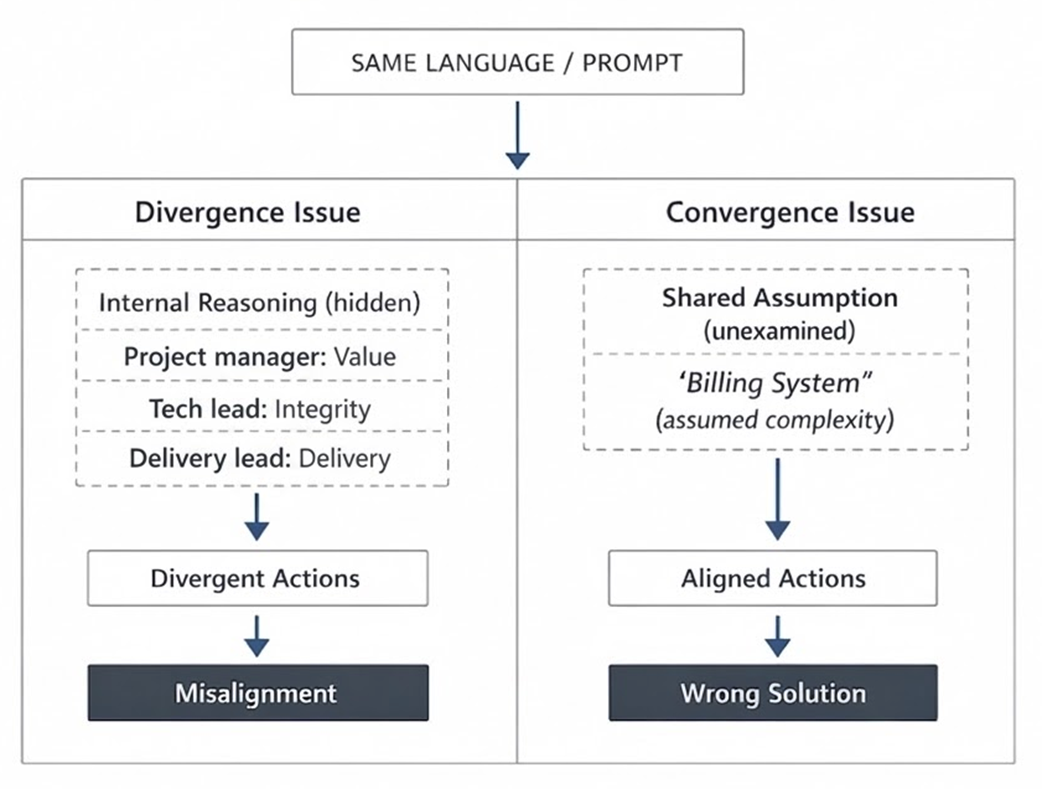
Two visible failures, one hidden structure. In one case, the team fragments around different interpretations of the objective. In the other, it converges around an unexamined frame. In both cases, the reasoning that shaped the decision remains implicit.
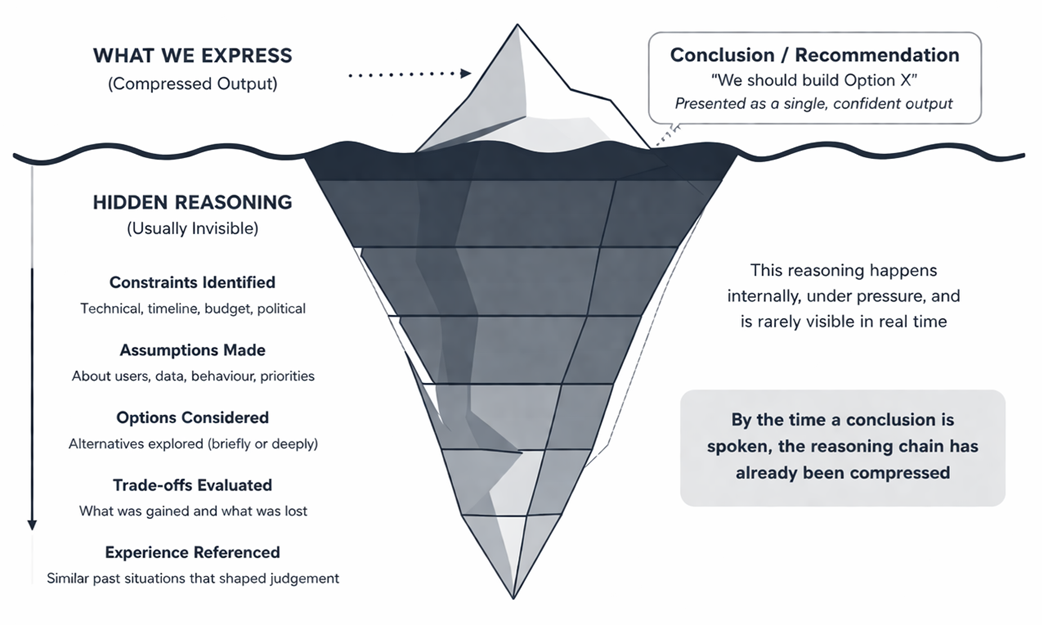
Most of our thinking is compressed before it reaches the conversation, and the chains of reasoning are hidden beneath the surface.
This example sequence of reasoning architectures separates expansion from validation. Chain-of-Thought makes assumptions visible, Tree-of-Thought widens the available paths, and Chair-of-Thought examines those paths from different positions. ReAct then introduces disciplined friction by testing the reasoning against evidence. The sequence is illustrative rather than mandatory: the architectures can be selected and combined according to the shape of the problem.

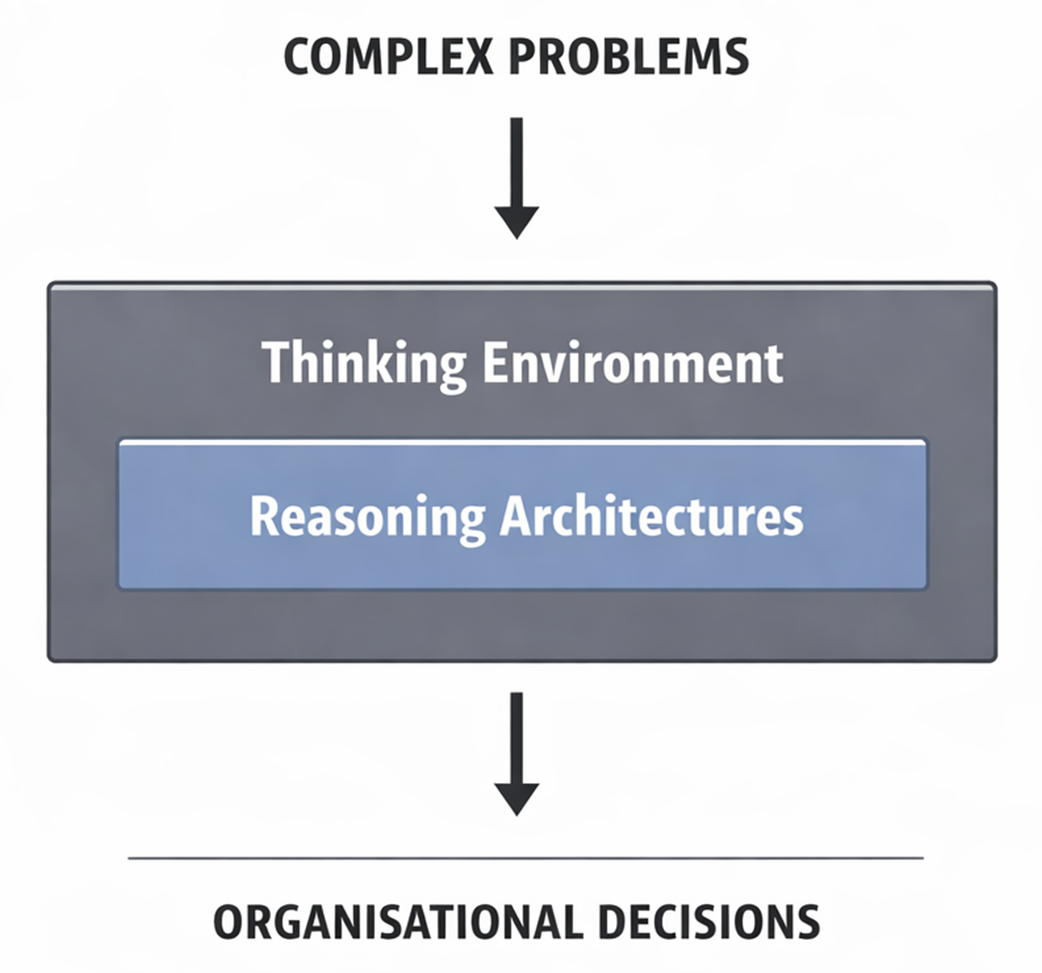
The architecture of reasoning is a nested system. Reasoning architecture operates inside a thinking environment that enables or constrains it at every step.
Summary
- AI helped formalize five selectable architectures: Direct Q&A, Chain-of-Thought, Tree-of-Thought, Chair-of-Thought, and ReAct.
- Intelligent teams often produce fragile decisions because their reasoning remains implicit, not because they lack capability or good intent.
- Agreement doesn't guarantee shared reasoning: teams can disagree without realizing it or align around the wrong problem.
- Reasoning compression hides the assumptions, constraints, trade-offs, and intermediate logic on which conclusions depend.
- Every prompt or question contains a frame, scope, constraints, reasoning mode, and criteria for success.
- Reasoning architecture operates inside a thinking environment that can either support visible reasoning or compress it back into performance.
FAQ
What is the main idea of “How reasoning became visible”?
The chapter explains that reasoning is not just about getting answers; it has a structure that can be made visible. By making assumptions, constraints, perspectives, and evidence explicit, teams can avoid common failures and improve decision-making.
Why do smart teams fail even when they seem aligned?
Smart teams often fail because they share language but not reasoning. They may leave a meeting believing they agree, while each person is actually optimizing for a different hidden priority or interpreting the problem differently.
What is reasoning compression?
Reasoning compression is the collapse of intermediate logic, assumptions, constraints, and trade-offs into a short conclusion before that thinking is made visible. The result is that people hear the answer, but not the reasoning path that produced it.
How can a team agree on the wrong problem?
A team can converge around a shared but unexamined frame. If the original question is flawed or too narrow, everyone may work efficiently and still solve the wrong problem because the underlying premise was never challenged.
How did AI help make reasoning structure visible?
Large language models showed that small changes in prompt structure lead to predictable changes in output. This made it easier to see that framing, scope, constraints, reasoning mode, and success criteria shape the path to an answer.
What are the five reasoning architectures discussed in the chapter?
The five architectures are Direct Q&A, Chain-of-Thought, Tree-of-Thought, Chair-of-Thought, and ReAct. They represent direct answers, visible intermediate reasoning, branching alternatives, perspective rotation, and iterative testing against evidence.
When is Direct Q&A useful, and when is it risky?
Direct Q&A works well for bounded, stable, low-risk questions where a quick answer is enough. It becomes risky when the problem includes hidden assumptions, uncertain evidence, or competing objectives that need to be surfaced first.
What does Chair-of-Thought add to group reasoning?
Chair-of-Thought makes different viewpoints deliberate rather than accidental. It asks the group to examine a problem from specific positions, such as customer, financial, operational, or long-term maintenance perspectives.
Why is evidence important in reasoning?
Evidence prevents a coherent story from becoming accepted just because it sounds plausible. ReAct-style reasoning alternates between interpretation and testing so that conclusions are grounded in observation, not just narrative coherence.
What is the “thinking environment,” and why does it matter?
The thinking environment is the set of social, cognitive, informational, and temporal conditions that shape whether reasoning can happen well. Even the right reasoning architecture can fail if status pressure, urgency, hierarchy, or poor information prevent honest thinking.

 The Architecture of Reasoning ebook for free
