Chapter 1. The big picture
The chapter introduces test-driven development as a disciplined way to build software by writing a failing test first, then writing only enough code to make it pass, and finally refining the design through refactoring. This approach shifts development away from the traditional design-then-implement-then-test sequence and toward small, controlled steps that keep the system working throughout development. By doing so, it encourages simpler, more modular, more maintainable code and reduces the likelihood of over-engineering based on assumptions.
The text argues that software projects typically struggle with two fundamental problems: code quality and delivering the right solution to real customer needs. Poorly written code leads to defects, difficult maintenance, and slow development, while specification-driven projects often drift away from what users actually want by the time delivery happens. TDD addresses the internal quality problem by keeping code testable and continuously verified, while acceptance TDD addresses the external quality problem by turning requirements into executable acceptance tests that define done-ness and keep development aligned with customer expectations.
Beyond technical benefits, the chapter emphasizes the practical advantages of working test-first: fewer long debugging sessions, greater confidence in changes, faster feedback, and more time spent on meaningful development instead of rework. It also highlights the importance of incremental, evolutionary design, where architecture emerges and adapts as the system grows rather than being fully predicted up front. Supporting practices such as automated unit tests, continuous integration, and code coverage help sustain this process, making it easier for teams to collaborate, catch regressions early, and evolve both the product and the design in a controlled way.
TDD is a technique for improving the software’s internal quality, whereas acceptance TDD helps us keep our product’s external quality on track by giving it the correct features and functionality.
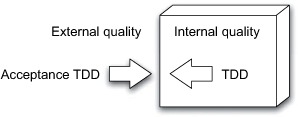
Acceptance test-driven development drives implementation of a requirement through a set of automated, executable acceptance tests.

TDD turns around the traditional design-code-test sequence. Instead, we test first, then write code, and design afterward.
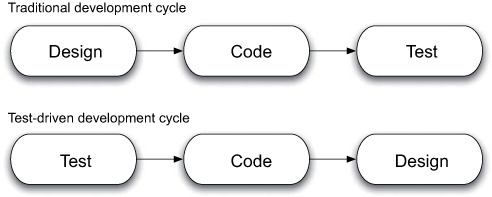
Test-code-refactor is the mantra we test-driven developers like to chant. It describes succinctly what we do, it’s easy to spell, and it sounds cool.

How do we know what our interface should be like if we don’t try to use it? We don’t. Writing the test before the code makes us think about our design from the code user’s (the developer’s) perspective, leading to a usable API.

With incremental development—building the whole system in small increments—we are never far from an integrated, working code base. This reduces risk, because the inventory of unfinished work remains small. As we’ll learn later on, incremental development also enables effective learning through early feedback based on the customer and developers constantly seeing actual, working software.
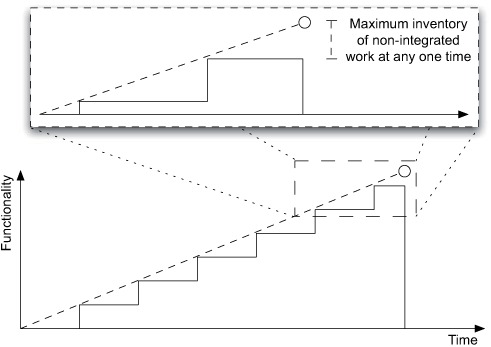
Incremental design is about adjusting the code’s structure in small increments as more behavior is added. At any stage during the lifetime of the code base, the code exhibits the best design the developers could conceive for supporting the present functionality. This way, we evolve an empirically proven architecture.
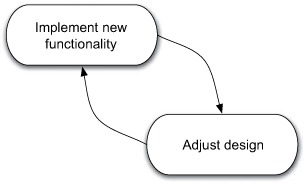
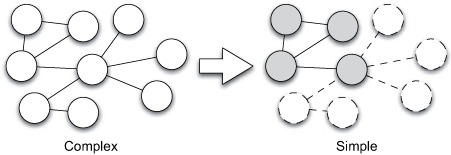
We are much better able to grasp complex problems by giving our attention to smaller pieces one at a time.
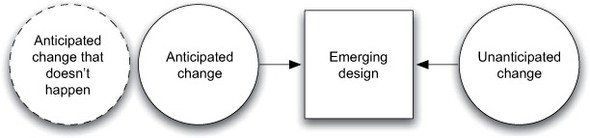
The emerging, evolutionary design of a system is influenced by both anticipated and unanticipated change. It’s worth noting, though, that a significant amount of anticipated change doesn’t happen—or happens in a different form than expected, essentially making it unanticipated change. Our job is to apply common sense and good judgment when preparing for change that we know will happen. A lot of such change never does.
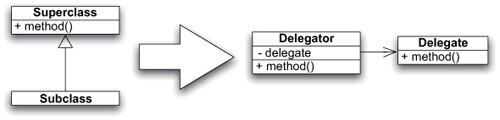
Refactorings are transformations between two functionally identical states or structures of the code. Here we see a transformation from using inheritance hierarchy to using a delegate to provide the same functionality while improving the design’s fitness for our current needs. These transformations are not absolute improvements—they’re simply disciplined transitions from one possible design to another. In fact, for many refactorings there exists a reverse refactoring, making the same transformation in the opposite direction.
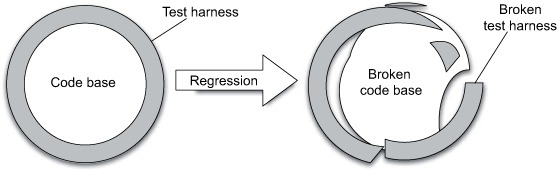
Our test harness forms a mold around the code base. As a change is introduced that breaks the code base, the mold no longer fits, so it breaks and lets us know that we’ve been bad.
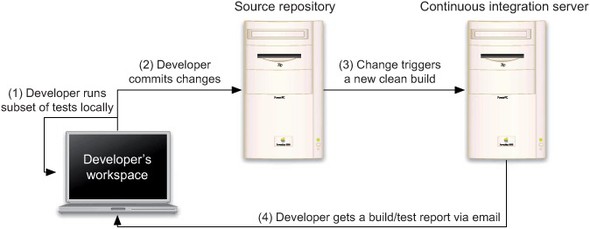
This is a typical scenario of a developer (1) running a relevant subset of automated tests locally before (2) committing the change to the source repository. In the third step (3), the change triggers a new build on the continuous integration server (using a commit-hook in the repository or by frequently polling the repository for changes). Finally, after running a clean build with the latest changes (4), the continuous integration server sends a build report to the developer via email.

 Test Driven ebook for free
