10 Advanced Terraform Topics
This chapter surveys advanced, real‑world techniques that go beyond day‑to‑day Terraform usage. It focuses on pragmatic patterns for naming and DNS, building flexible networks, validating configurations, and carefully “breaking out” of Terraform when necessary. It also explains how to use lesser‑known providers, how to monitor live infrastructure with checks, how to keep modules compatible across Terraform and OpenTofu, and where Terraform is simply not the right tool.
The chapter begins with resource and domain naming practices that emphasize uniqueness, readability, identifiability, and sortability, advocating hierarchical, environment‑aware prefixes and judicious randomness for collision‑prone services. It then builds dynamic, reusable networking with CIDR math (for example, cidrsubnet) to produce public, private, and isolated topologies across multiple availability zones, returning spare ranges when counts aren’t powers of two. For safety and clarity, it shows how to use preconditions and postconditions on resources, expanded variable validation (including cross‑variable rules), and check blocks with scoped data sources to assert system health without blocking applies.
On extensibility, the chapter covers provisioners (remote‑exec, local‑exec, and file) and terraform_data as an orchestration anchor—while strongly recommending immutable images and cloud‑init over provisioners whenever possible. It presents the External provider for custom data retrieval via local programs, preferring purpose‑built providers or the HTTP provider when feasible, and the Local provider for simple file and filesystem tasks (mainly useful in development). It outlines OpenTofu/Terraform compatibility and the .tofu file mechanism for dual‑engine modules. Finally, it clarifies when not to use Terraform: prefer native tools for Kubernetes deployments, keep container and machine image building in CI/CD (e.g., Packer and registries), manage versions as inputs (or ignore them when a separate deployer controls rollouts), and keep artifact creation out of Terraform to preserve speed, portability, and clean separation of concerns.
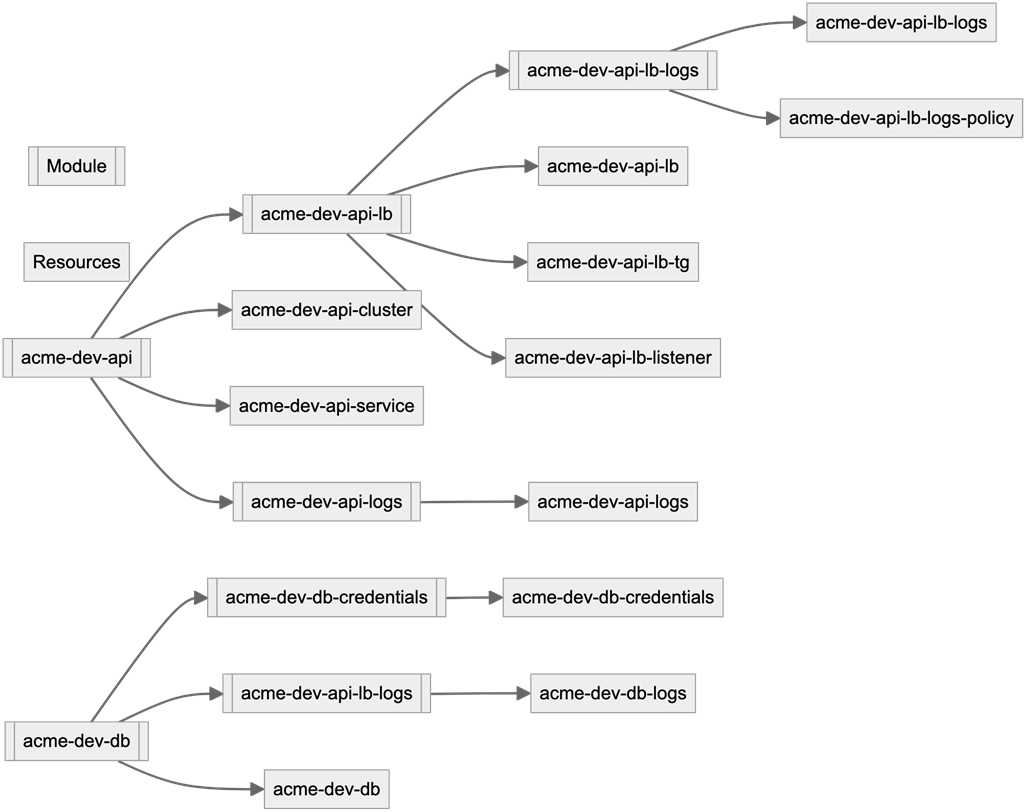
Acme API Module Structure
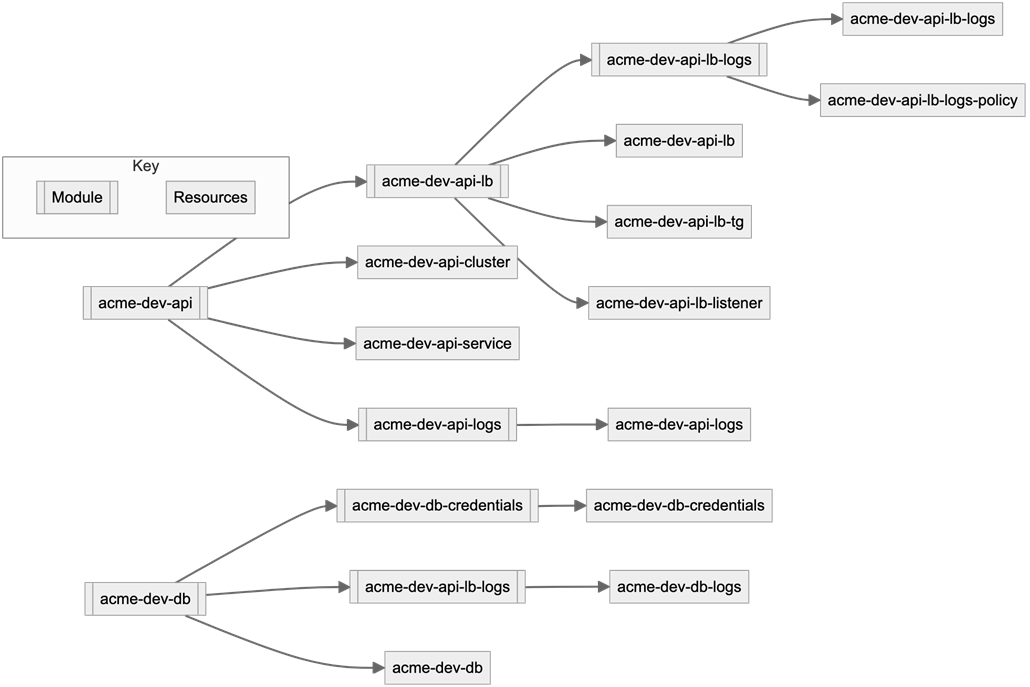
Acme API Resource Names
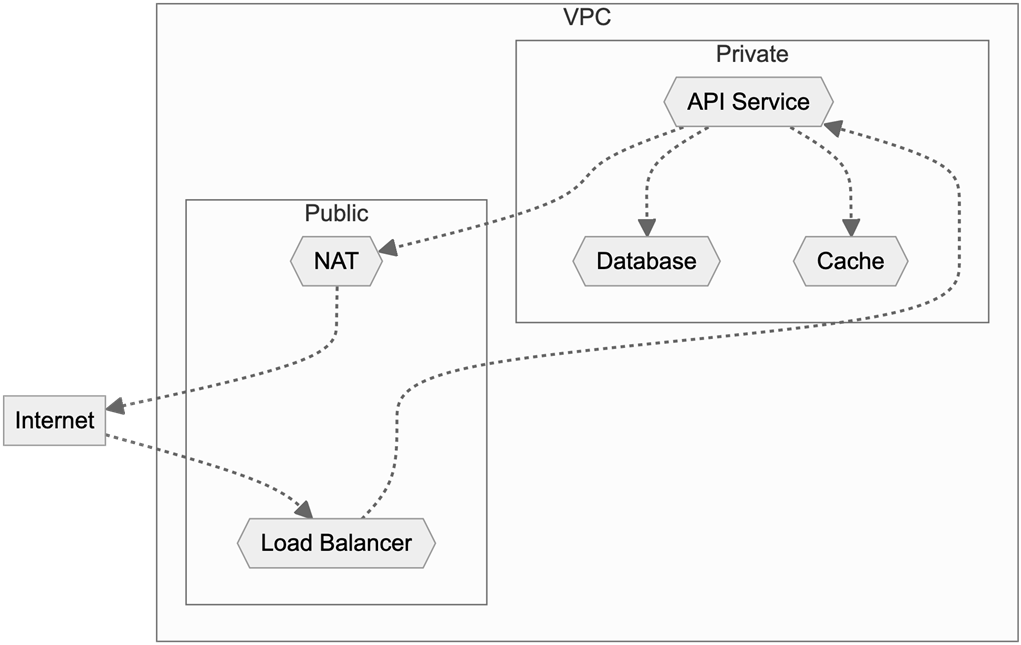
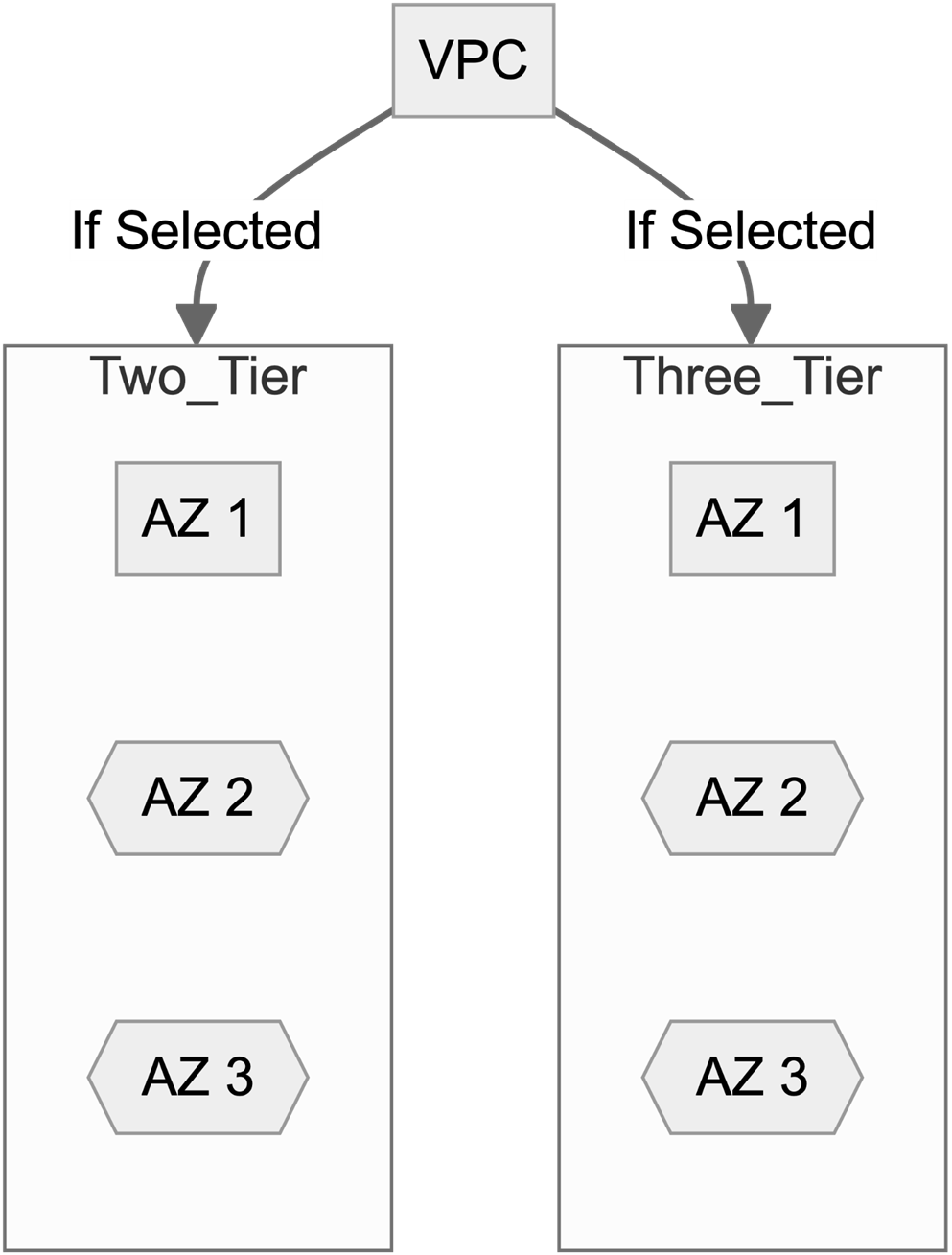
Two Segment Network
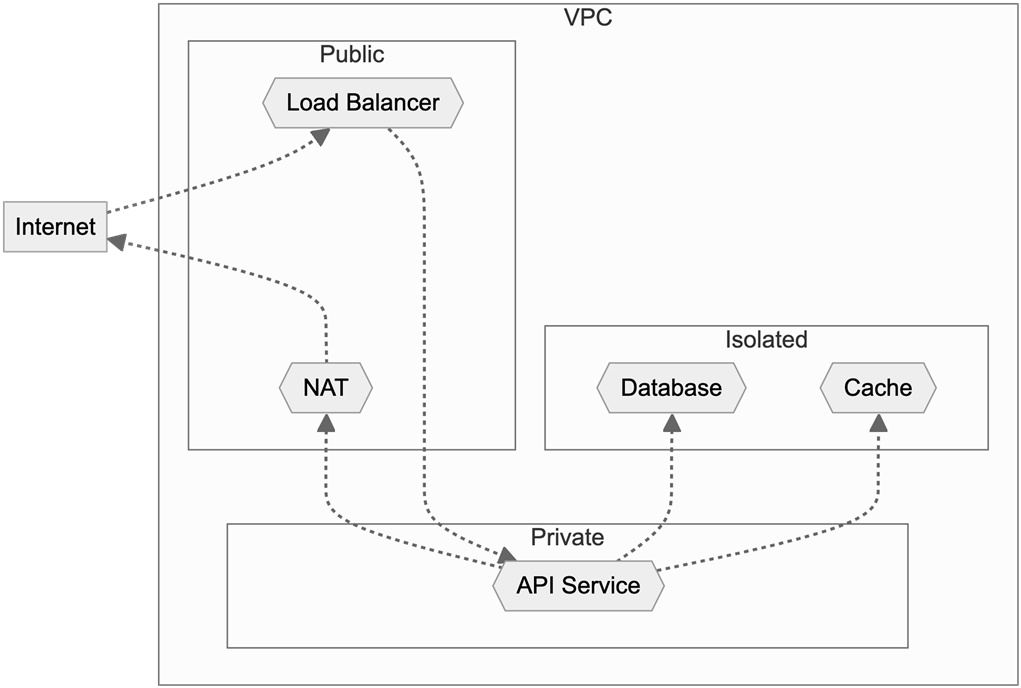
Three Segment Network
High Availability
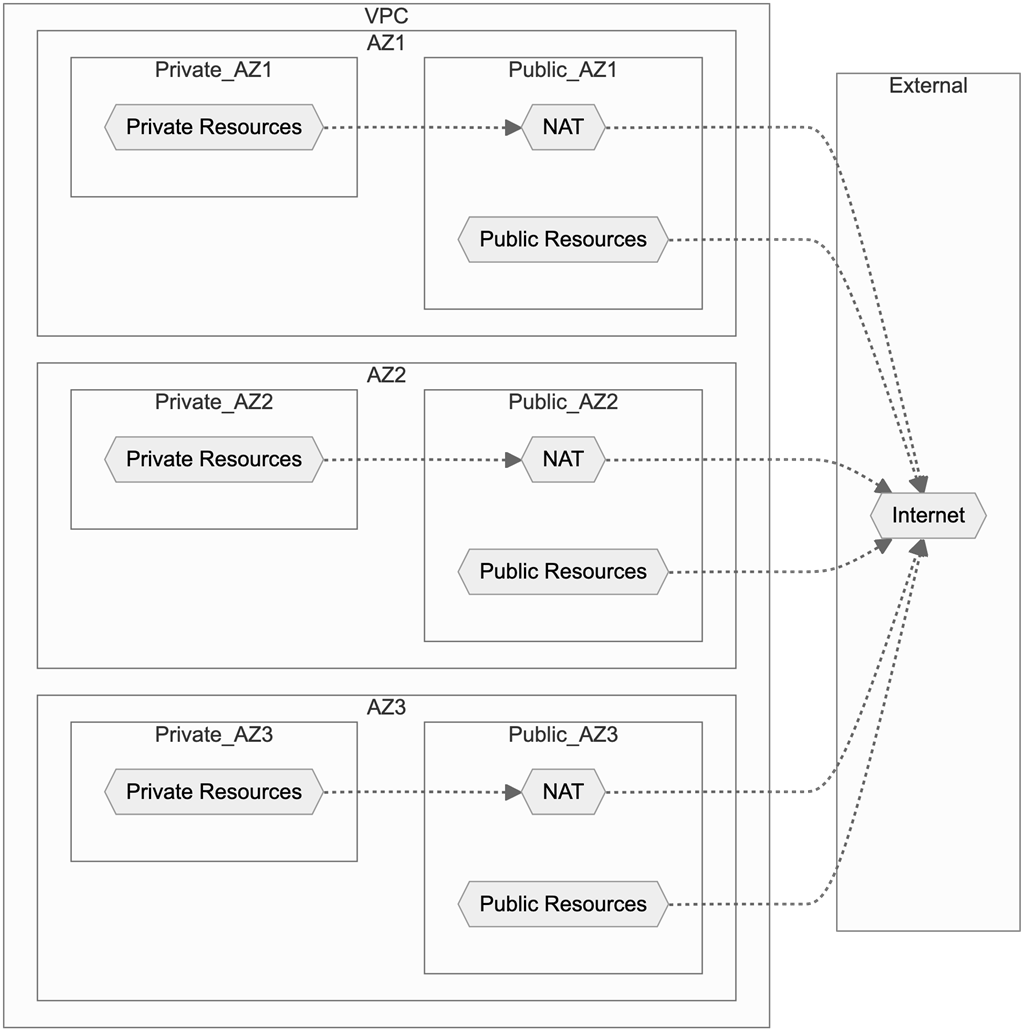
Module Structure
External Data Source Flow

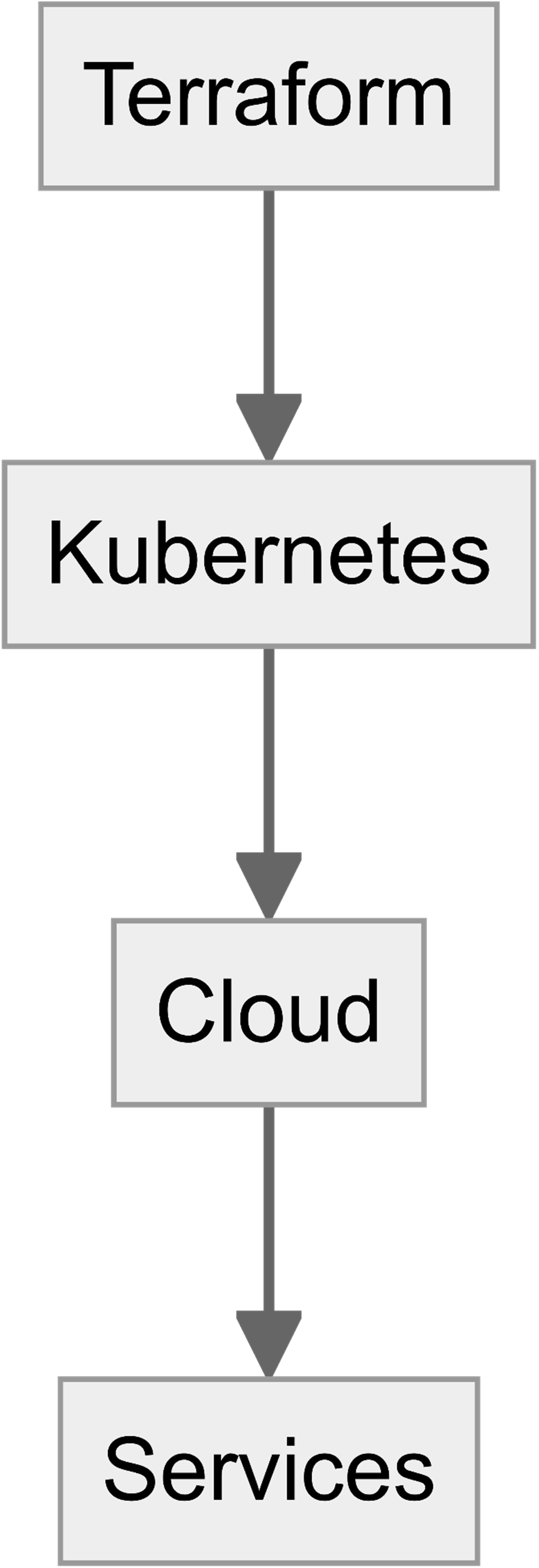
Abstraction Layers
Summary
- Giving your resources and domains easily decipherable names makes it easier for you to maintain your systems while also guaranteeing your resources have unique names.
- Although networking is complex, it’s possible to use Terraform to abstract complicated network patterns behind easy to use modules.
- If you absolutely need to you can use provisioners to run code outside of Terraform before or after a resource is created, but you should only use this as a last resort.
- The External provider can be used to create unique data sources without having to extend Terraform with a custom provider, but it makes the portability of your code more challenging.
- The Local provider can be used to create files on your local machine, which is useful in some debugging and development scenarios.
- Checks and Conditions are a way to increase code quality and resilience by running tests as infrastructure is deployed.
- It’s possible to maintain compatibility between OpenTofu and Terraform by utilizing tofu files that are only run by OpenTofu.
- Terraform is great, but that doesn’t mean you should use it for everything. There are a variety of use cases where other tools make more sense.
FAQ
What makes a good resource naming scheme in Terraform?
Names should be unique, human‑readable, identifiable, and sortable. Use a hierarchical pattern that flows from app to environment to component (for example, acme-dev-api). Keep parts short but descriptive, avoid repeating the resource type in the name, and add randomness inside modules only for resources that need globally unique names (for example, S3 buckets, Secrets Manager). random_string is a good fit for compact, non-sensitive suffixes.How should I design domains for multi-environment deployments?
Create a base domain that combines environment, application, and your top‑level domain, such as dev.acme.example.net. Pass that base into submodules so they append their service subdomains (for example, api.dev.acme.example.net). Keep track of the DNS zone you’ll write into (for example, Route 53 hosted zone) and allow teams to supply their own parent domain.How do Terraform IP network functions help with subnetting?
cidrsubnet lets you split a CIDR block into smaller networks by specifying the number of extra bits and the subnet index; cidrnetmask returns the netmask. These make it straightforward to derive per‑AZ subnets dynamically. If the number of availability zones isn’t a power of two, compute and output spare CIDR ranges so users can repurpose them.What VPC subnet topologies are common, and how do they map to Terraform?
- Two-tier: public and private subnets. Place internet-facing resources in public; private subnets egress via NAT. NAT gateways are simplest but can be costly.- Three-tier: add an isolated subnet with no internet route for highly sensitive workloads.
- High availability: replicate the chosen topology across multiple AZs, calculating per‑AZ CIDRs with cidrsubnet.
When should I use provisioners, and what are the risks?
Use provisioners only as a last resort. They add brittle, environment-dependent steps, slow deployments, and complicate debugging. If you must use them: configure SSH/WinRM connections (including bastion settings), choose between remote-exec, local-exec, and file, and consider destroy‑time actions (when = "destroy") and failure behavior (on_failure). terraform_data can orchestrate “run once when any dependency changes” flows.What are safer alternatives to provisioners?
- Prefer immutable infrastructure: pre-install software in images (for example, with Packer), and keep launch-time config minimal.- Use cloud-init to render files and run first-boot commands.
- Use provider resources/data sources directly; for HTTP calls, prefer the HTTP provider.
- Return metadata with outputs or use the Local provider to write local files (for dev). Avoid runtime SSH scripting when possible.
How does the External provider work, and when should I choose it?
The external data source runs a local program and returns a JSON map as result. You pass the command via program and optional inputs via query (JSON over stdin). It’s useful for small, portable lookups or calculations missing from Terraform, but still a last resort. Prefer the HTTP provider, provider-defined functions, or a custom provider when feasible. If you use it, Bash is most portable; higher-level languages ease maintenance but reduce portability.What does the Local provider offer?
- Functions: direxists(path) complements fileexists; provider functions require Terraform/OpenTofu 1.8+.- Data sources: local_file and local_sensitive_file read file content plus hashes/base64 (sensitive marks content).
- Resources: local_file and local_sensitive_file write files locally; beware drift if Terraform runs from different machines/paths. Practical for developer conveniences (for example, writing a VPN config locally), not for production state.
How can I validate live infrastructure with checks and conditions?
- Preconditions/postconditions (on resources and data sources) hard‑fail plans/applies if an expression is false; use self to reference the current object. Terraform 1.9+ also allows cross‑variable validation in variable blocks.- check blocks report assertions without blocking execution and can include scoped data sources (with depends_on and provider). Use depends_on so checks don’t run before the infrastructure they assess exists.
How do OpenTofu “.tofu” files help cross-tool compatibility?
Terraform reads .tf files and ignores .tofu. OpenTofu reads both; if filename.tofu and filename.tf coexist, OpenTofu uses the .tofu version and ignores the .tf. This lets you keep one module that runs on both engines, while selectively enabling OpenTofu‑only features or syntax in parallel .tofu files.When is Terraform not the right tool?
- Kubernetes app deployment: prefer kubectl, Helm, or Argo CD; use Terraform to provision the cluster and cloud integrations, not to push manifests.- Container image building: build in CI and pass immutable tags into Terraform; optionally ignore_changes for deployers that handle rollouts progressively.
- Machine images: use cloud-init for config at launch and Packer for preinstalled software.
- Artifact management in general (libraries, builds, images): handle in CI/CD and registries; consume immutable versions from Terraform.

 Terraform in Depth ebook for free
