8 Simplicity Hidden in Complexity
This chapter argues that prediction, compression, simplicity, and generalization are deeply connected. Sutskever’s view is that a good predictive model must uncover the hidden “secrets” in data: latent variables such as sentiment, grammar, visual structure, physical regularities, or common-sense patterns. The chapter frames modern AI as a kind of compressor: by learning to predict the next character, token, or pixel, a model is pressured to represent the structure that makes the data compressible. But the central twist is that meaningful complexity often appears between two kinds of simplicity: rigid order and featureless randomness.
The chapter develops this idea through algorithmic information theory and Minimum Description Length. Kolmogorov complexity defines an object’s information content as the length of the shortest program that can generate it, while algorithmic randomness means incompressibility. The coffee-and-cream automaton illustrates that entropy can steadily increase while apparent complexity rises and then falls: the cup begins as two simple layers, becomes intricate with swirls and tendrils, and eventually settles into uniform beige simplicity. MDL turns this compression perspective into a principle for learning: the best model is not the one that merely fits the data, but the one that gives the shortest combined description of the model and the remaining errors. This naturally penalizes overfitting, because memorizing noise requires extra bits. Hinton and van Camp’s work applies this logic directly to neural networks by minimizing the description length of their weights, showing that networks can generalize better when they compress themselves.
The final part connects these ideas to modern deep learning phenomena such as grokking and double descent. Grokking shows a network first memorizing training examples, then suddenly generalizing after it discovers a simpler rule; measured complexity rises during memorization and collapses when the simpler representation emerges. Double descent similarly challenges the old bias–variance picture: models near the interpolation threshold may generalize poorly because they fit the data in brittle, complex ways, while larger models can find simpler solutions that fit the training data and generalize better. The chapter’s overall message is that large neural networks are not powerful merely because they memorize more, but because, when trained successfully, they can search through complexity until they find compact representations. Simplicity is not always found by making models smaller; sometimes it appears only after scaling up or training longer.
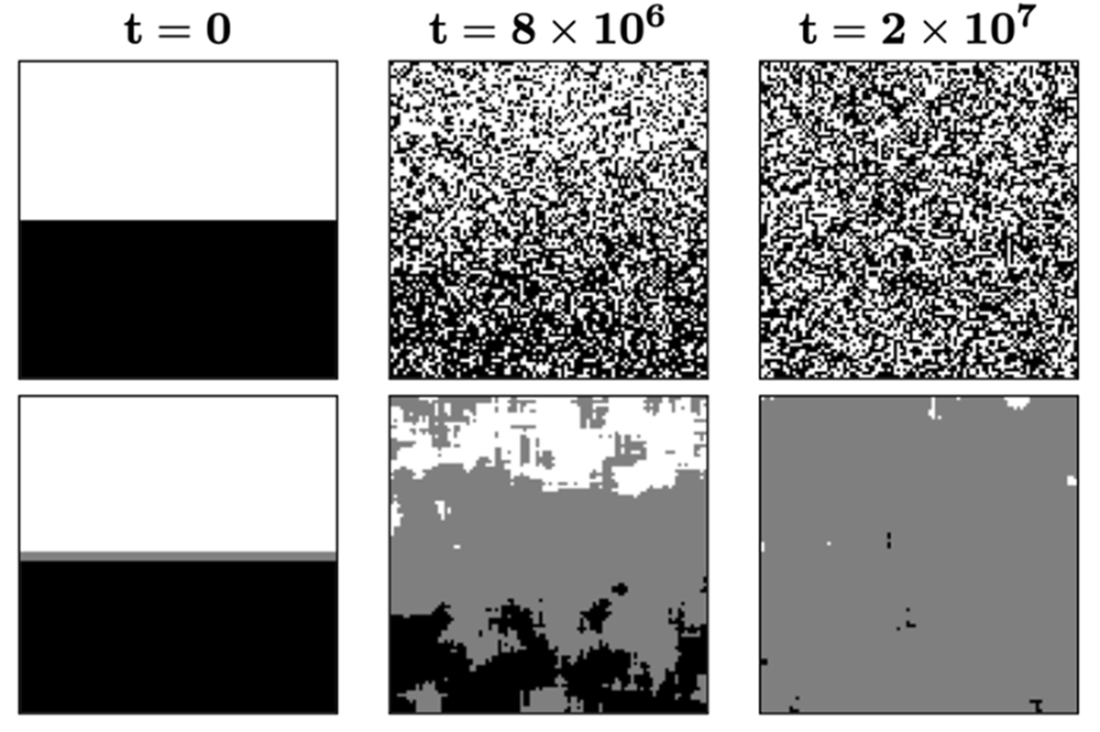
(left) low entropy and low complexity; (middle) medium entropy and high complexity; (right) high entropy and low complexity. Used with explicit permission granted by the lead author, Scott Aaronson.

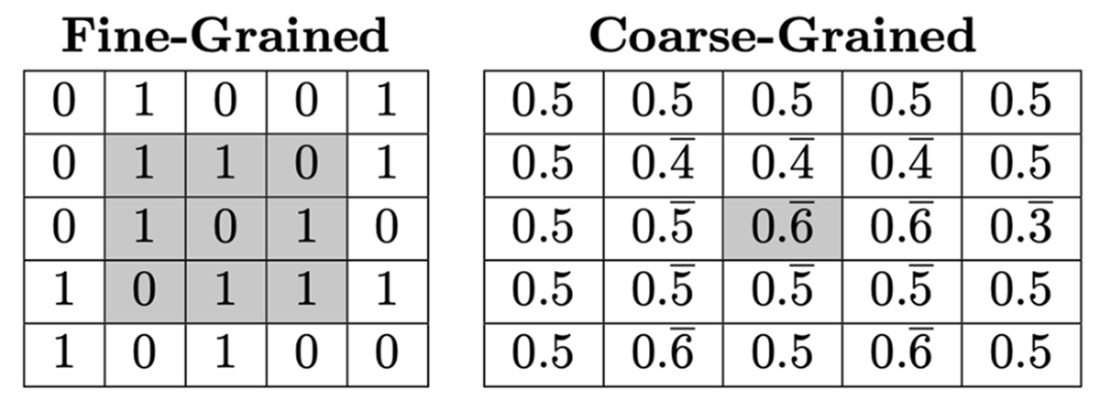
Illustration of the construction of the coarse-grained array using an example grain size of 3. The values of the shaded cells on the left are averaged to produce the value of the shaded cell on the right. Used with explicit permission granted by the lead author (Scott Aaronson).
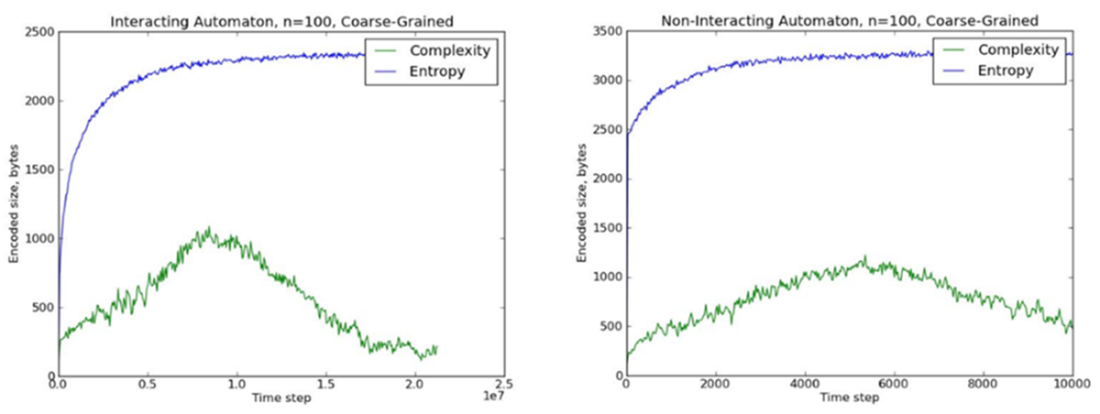
In the simulation of coffee and cream mixing, entropy (top, monotonic curve) steadily increases toward a maximum as the fluids randomize, in accord with the Second Law. Apparent complexity (bottom, non-monotonic curve) first increases, then decreases, peaking at an intermediate time when the system’s state is most “interesting,” or structured. Used with explicit permission granted by the lead author (Scott Aaronson).
Visualization of the interacting automaton’s state over time. Used with permission granted by the lead author (Scott Aaronson).
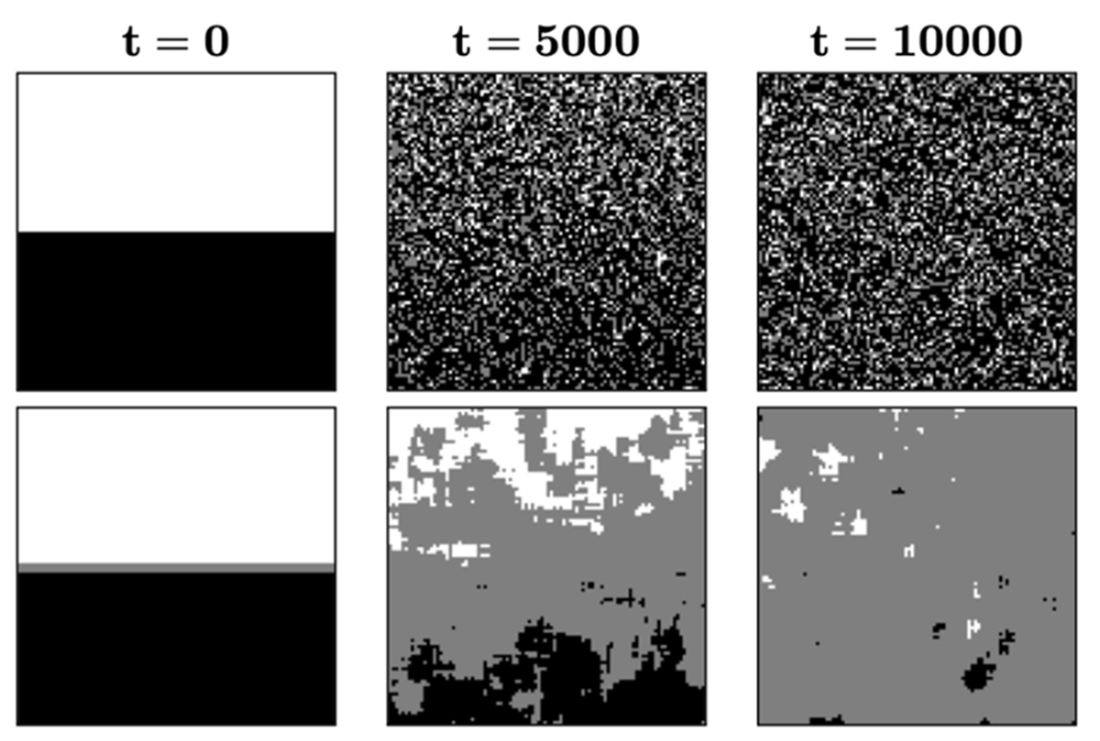
presents the same visualization for the non-interacting model. The intermediate image is less structured than that of the interacting model, and the complexity peak is smaller. Used with explicit permission granted by the lead author (Scott Aaronson).
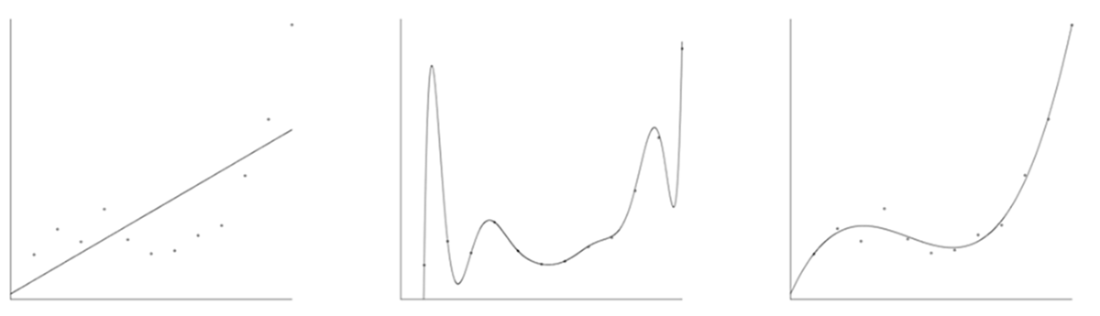
A simple polynomial (left) underfits the data, a complex polynomial (middle) can achieve zero training error but wastes bits describing noise, and a trade-off polynomial (right) identifies the broad trend without including the noise. Used with explicit permission granted by the lead author (Peter Grünwald).
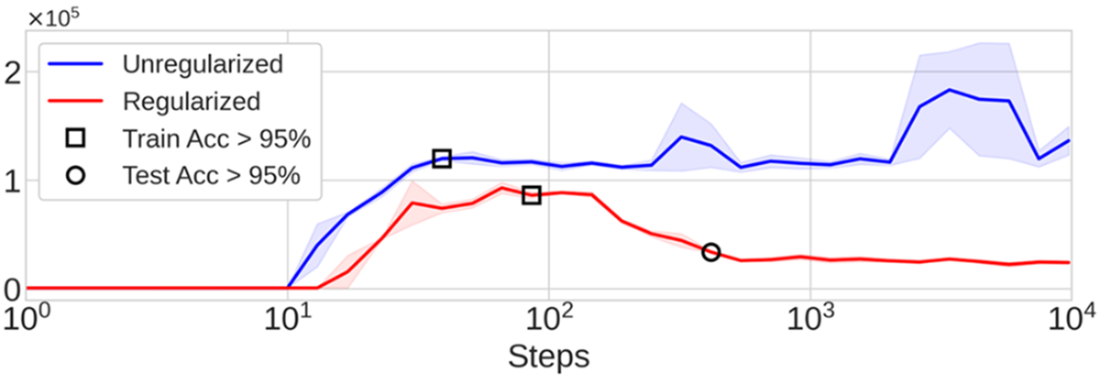
Complexity dynamics for unregularized (top) and regularized (bottom) neural networks in grokking experiments on modular multiplication. Markers denote when memorization (□) and generalization (O) occur. In the regularized network, generalization occurs when complexity falls after peaking at memorization, whereas the unregularized network never generalizes and its complexity remains high. Mean over three seeds; shading indicates the standard error. Used with explicit permission granted by the lead author (Branton DeMoss).
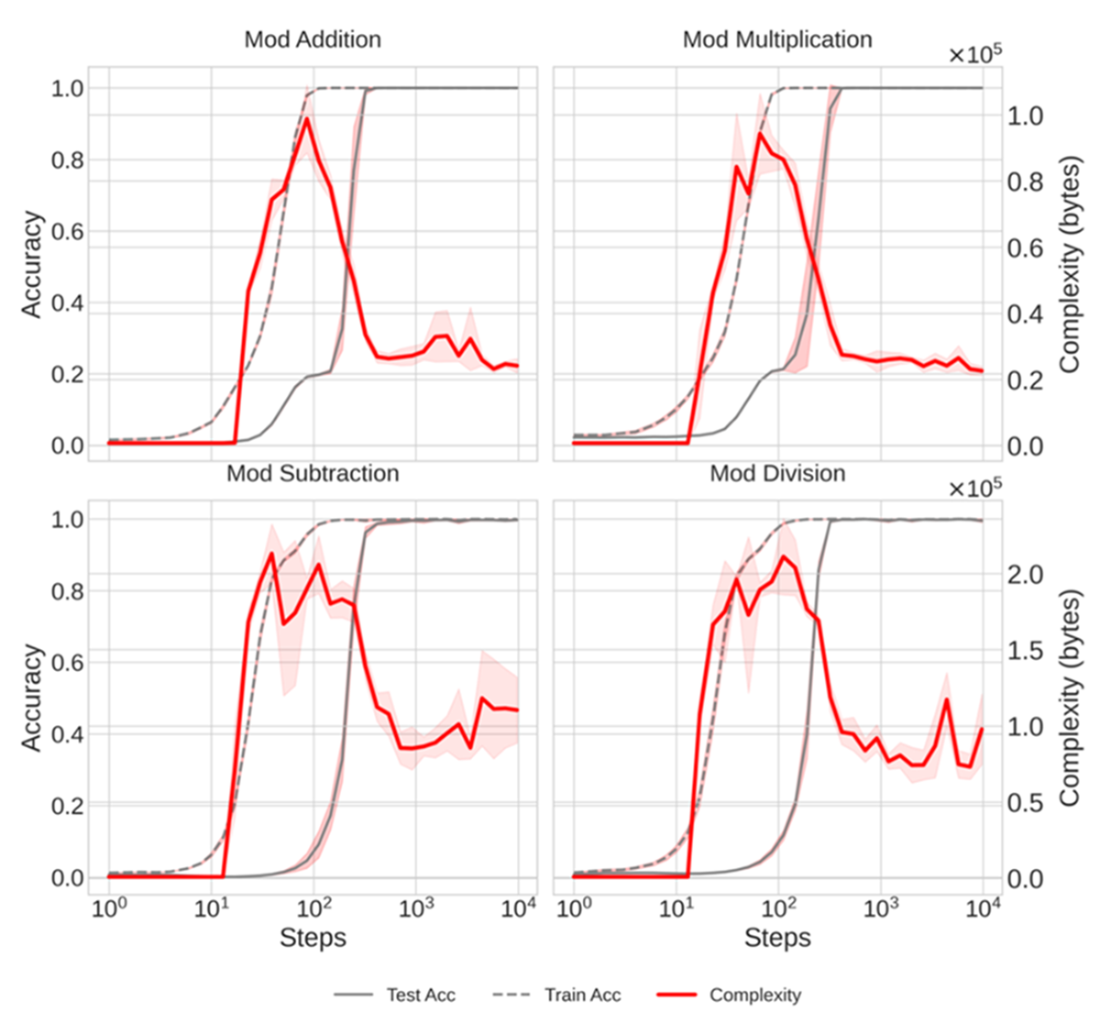
Complexity during grokking on modular arithmetic tasks. Gray curves show train and test accuracy; the thick curve shows the estimated complexity of the learned representation. Across modular addition, multiplication, subtraction, and division, complexity rises during the memorization-to-generalization transition and then falls once the model settles into a simpler rule-like solution. The peak occurs near the interval where training accuracy (dashed gray) is already high, but test accuracy (solid gray) has not yet fully caught up. As models memorize, complexity increases; as they generalize, complexity (measured in bytes) decreases. Used with explicit permission granted by the lead author (Branton DeMoss).
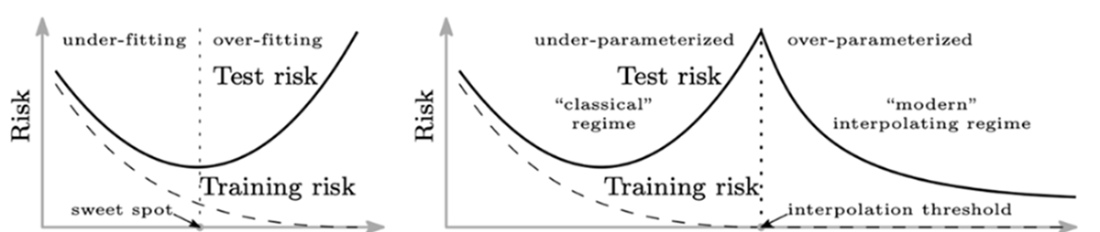
(Left) The classical bias–variance trade-off. Training error (called “risk” in this image) is shown as a dashed line. It falls monotonically, whereas the test error (solid line) is U-shaped, with the bottom being optimal. (Right) Beyond the interpolation threshold, test error peaks and then declines again in the overparameterized (interpolating) regime, while training risk remains near zero. Used with explicit permission granted by the lead author (Mikhail Belkin).
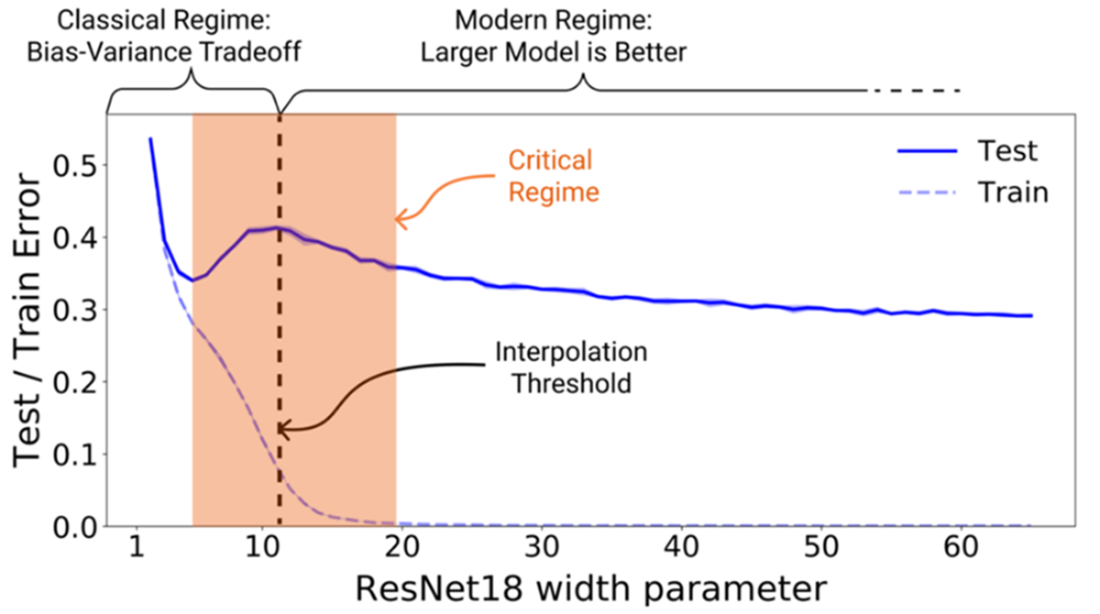
Test (solid) and training (dashed) errors for ResNet as the width increases. A peak near the interpolation threshold (dashed line; shaded “critical” band) illustrates double descent, in which error rises as the model fits the data, then falls again for larger widths. Used with explicit permission granted by the lead author (Preetum Nakkiran).
Blurry JPEG
In his fireside conversation with NVIDIA CEO Jensen Huang, Ilya Sutskever pointed to Ted Chiang’s 2023 New Yorker essay titled “ChatGPT Is a Blurry JPEG of the Web.”[33] Sutskever agrees with the compression metaphor but interprets it through an entirely different conceptual frame. Chiang says there is no use for a “blurry copy of the Web when you have the original.” His argument dates back to Plato’s allegory of the cave, which outlines the relationship between an object and its representation. The same tradition has been expressed in other terms, such as “map is not the territory” (Alfred Korzybski), “all models are wrong” (George Box), and “the menu is not the meal” (Alan Watts).
However, Chiang’s framing overlooks that some models are useful. It is not that maps, models, and menus are useless; rather, a map the size of the territory is not useful for practical applications. A map is not the territory it represents, but its similar structure makes it valuable. A map the size of Nebraska would be Nebraska, which is intractable. However, a map of Nebraska that fits into your glovebox will help you find your way to Lincoln. Likewise, the Web is intractable and not directly helpful unless you know exactly where you want to go and how to get there, prefer blind exploration, or have a map.
Yet Chiang misclassifies the type of map this is, a common trap many skeptics fall into. They seem to treat a “blurry copy of the Web” as a lossy backup, where loss denotes unreliability. But from the Kolmogorov and MDL perspective we’ve been developing, the “blurry JPEG” is not a bad archive, but a short program for the Web’s generative process, where loss means abstraction. Those are different categories; once you put language models in the “archive” bucket, you have to underestimate their value.
From a compression perspective, the blurry copy is a new interface that turns scattered documents into synthesized answers and actions. Confidence in this synthesis is low when a model is forced into ungrounded generation, where MDL-style prediction can be instrumentally useful. Ultimately, what becomes less relevant is not the Web itself, but the way humans navigate it and the machinery we have built around it. Search engines, websites, browsers, and large swaths of “search‑and‑stitch” software development that mainly consisted of looking things up and gluing snippets together are all less valuable today because of AI’s ability to learn effective data compression. From Chiang’s perspective, that loss is a defect, and compression is an archive; from Sutskever’s perspective, compression is a short description of its “secrets” and a new interface rather than a copy. When we drive systems to predict and compress, simplicity emerges within overwhelming complexity.
FAQ
What is the main idea of Chapter 8, “Simplicity Hidden in Complexity”?
The chapter argues that compression, prediction, and generalization are deeply connected. A good predictive model often works because it has discovered compressible structure in data: hidden variables, rules, or “secrets” that explain many observations with a shorter description. Across physics, algorithmic information theory, Minimum Description Length, neural network regularization, grokking, and double descent, the chapter shows a recurring pattern: systems often become complex in the middle of learning or mixing, then simplify once they find an underlying structure.
What does Sutskever mean when he says good compression uncovers the “secrets” in data?
“Secrets” are latent variables or hidden factors that are not explicitly labeled but strongly influence prediction. Examples include sentiment in Amazon reviews, grammar in language, thought vectors in machine translation, or physical structure in vision data. If a model must predict the next character, token, or pixel well, it is pressured to encode these hidden factors because they help compress the data. This is why a model trained only on prediction can appear to “know” facts or concepts.
What is the Coffee Automaton, and why is it important?
The Coffee Automaton is a stochastic cellular automaton introduced by Scott Aaronson, Sean Carroll, and Lauren Ouellette to model cream mixing into coffee. It demonstrates that entropy and complexity are not the same. Entropy increases steadily as the system becomes more disordered, but apparent complexity first rises, peaks when swirls and tendrils appear, and then falls as the cup becomes uniformly mixed. The result illustrates that the most interesting structure often appears between perfect order and complete randomness.
How does coarse-graining help reveal complexity in the Coffee Automaton?
Coarse-graining blurs or down-samples the microscopic grid so that tiny random speckles disappear and larger macroscopic patterns remain visible. The authors then compress this coarse-grained image to estimate its apparent complexity. A simple two-layer state compresses well, a uniform final mixture also compresses well, but the intermediate state with swirls and irregular gray regions compresses poorly. This lets the authors measure macro-level structure separately from micro-level entropy.
What is Kolmogorov complexity?
Kolmogorov complexity is the length of the shortest program that can produce a given object. A repeating string such as 0101010101... has low Kolmogorov complexity because a short program can print “01” repeatedly. A typical long sequence of fair coin flips has high Kolmogorov complexity because there is usually no shorter description than the sequence itself. In this framework, randomness means incompressibility.
How is Kolmogorov complexity different from Shannon entropy?
Shannon entropy measures the average uncertainty of a probability distribution or information source before a specific outcome is known. Kolmogorov complexity asks how short a description can reproduce one particular object after it has been specified. Shannon’s question is about expected bits on average; Kolmogorov’s question is about the shortest effective description of an individual string, image, dataset, or object.
What is the Minimum Description Length principle?
The Minimum Description Length principle says that the best explanation for data is the one that compresses it most. A model should balance two costs: the number of bits needed to describe the model and the number of bits needed to describe the remaining errors or residuals. A model that is too simple underfits and leaves systematic residuals; a model that is too complex overfits and wastes bits encoding noise. The best model gives the shortest total description.
How does MDL help prevent overfitting?
MDL prevents overfitting by penalizing unnecessary complexity. A highly flexible model may fit every training example perfectly, but it may require many bits to describe all of its detailed parameters. A simpler model may leave some residual error, yet still achieve a shorter total code because it captures the real structure without memorizing noise. In this sense, MDL favors models that compress regularities rather than store a lookup table of the training data.
What did Hinton and van Camp show about keeping neural networks simple?
Hinton and van Camp argued that neural networks generalize better when the description length of their weights is minimized. They treated weights as information that must be encoded in bits and added a complexity penalty to the training objective. By injecting Gaussian noise into weights and allowing training to determine which weights needed precision, their method encouraged the network to compress itself. On a small peptide activity prediction task, the MDL-regularized network generalized much better than an unregularized network.
What is grokking, and how does it relate to compression?
Grokking is a training phenomenon where a neural network first memorizes the training data, then much later suddenly generalizes. During memorization, the model’s internal complexity rises because it encodes many specific examples. Later, if training and regularization continue, the model may discover a simpler rule that explains the data. At that point, test accuracy jumps and the model’s compressed description length falls. In MDL terms, the network has replaced memorization with a shorter, more general explanation.

 Sutskever's List ebook for free
