7 The Pivot to Reasoning
This chapter traces a shift in AI research from simply scaling larger pretrained models toward organizing computation in ways that make reasoning easier. Its central theme is that intelligence depends not only on model size, but on where information is stored, how it moves, how entities are compared, and how models deliberate at inference time. Across autoencoders, relation modules, graph networks, memory cores, and modern test-time compute, the chapter presents reasoning as a problem of computational structure: bottlenecks, object pairs, graph messages, interacting memory slots, scratchpads, search, and verification.
The early papers in the chapter show different attempts to impose useful structure on neural networks. Variational Lossy Autoencoders addressed posterior collapse by forcing latent codes to carry global semantic information while leaving local detail to an autoregressive decoder, demonstrating that architecture can decide what information is remembered and where it lives. Relation Networks then showed that neural systems could explicitly compare object pairs, achieving strong results on visual, symbolic, textual, and physical reasoning tasks. Message Passing Neural Networks extended this idea to graphs, especially molecules, where atoms exchange learned messages over bonds and distances; on quantum chemistry benchmarks, they delivered highly accurate molecular-property predictions far faster than traditional simulation. Relational Memory Cores applied the same relational instinct to sequence models, letting memory slots attend to one another so stored information could be compared, updated, and used over time.
The chapter then connects these structured architectures to today’s reasoning models and their limitations. Large language models perform impressively on logic, commonsense, math, and formal reasoning benchmarks, especially when aided by chain-of-thought prompting, few-shot examples, or test-time computation. Yet they remain brittle when familiar problems are perturbed, reversed, or placed outside their training distribution, as seen in altered river-crossing puzzles and the reversal curse. Prompting can expose existing capabilities and encourage intermediate reasoning, but it cannot fully replace mechanisms that recompute constraints, search over alternatives, or verify invariants. The chapter concludes that modern reasoning systems are best understood as attempts to make model behavior less dependent on familiar surface patterns and more stable under variation.
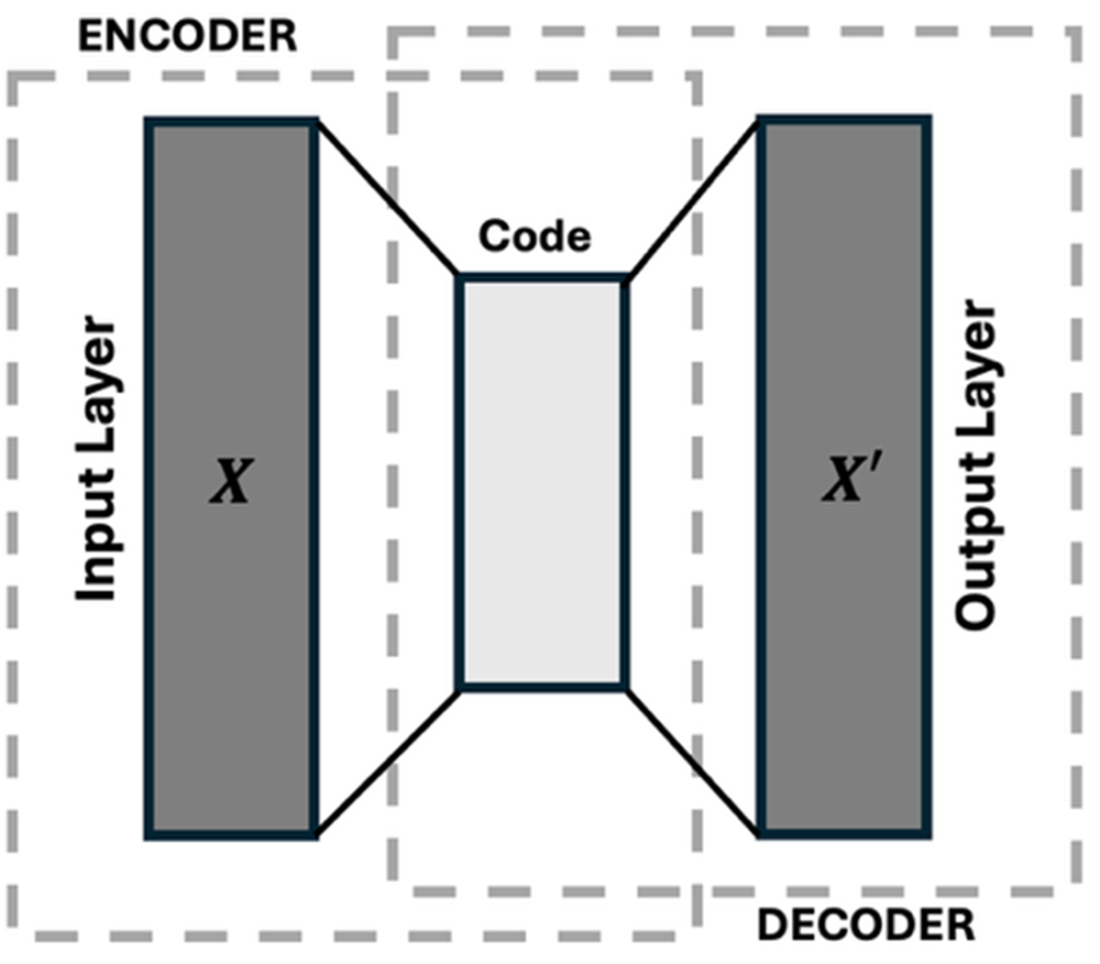
An autoencoder consists of an encoder that maps the message to a code and a decoder that reconstructs the message from the code.
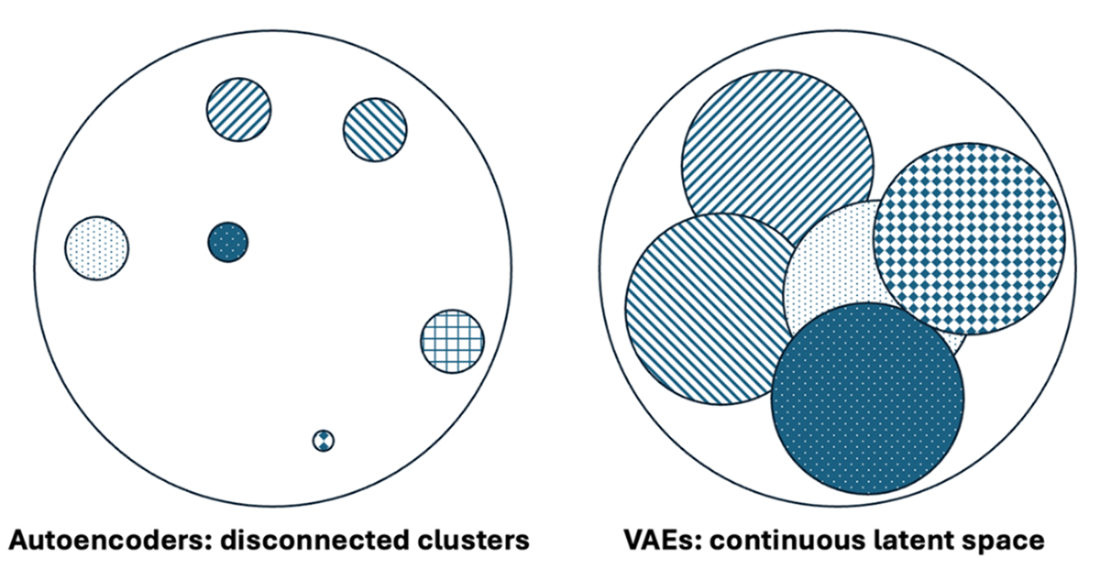
Left: Plain autoencoders yield disjoint clusters in the latent space, leaving significant gaps. Interpolations must traverse off-manifold regions. Right: VAEs produce continuous, overlapping regions that enable smooth interpolation and reliable sampling.
Original MNIST images (left) and the “decompressed” versions from VLAE’s lossy code (right). Used with explicit permission granted by the lead author, Peter (Xi) Chen.
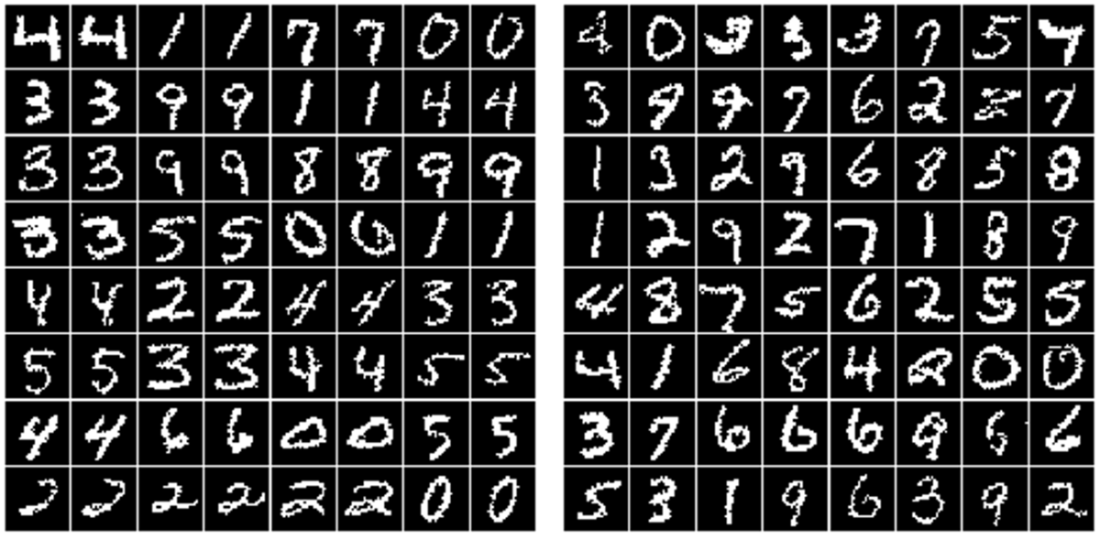
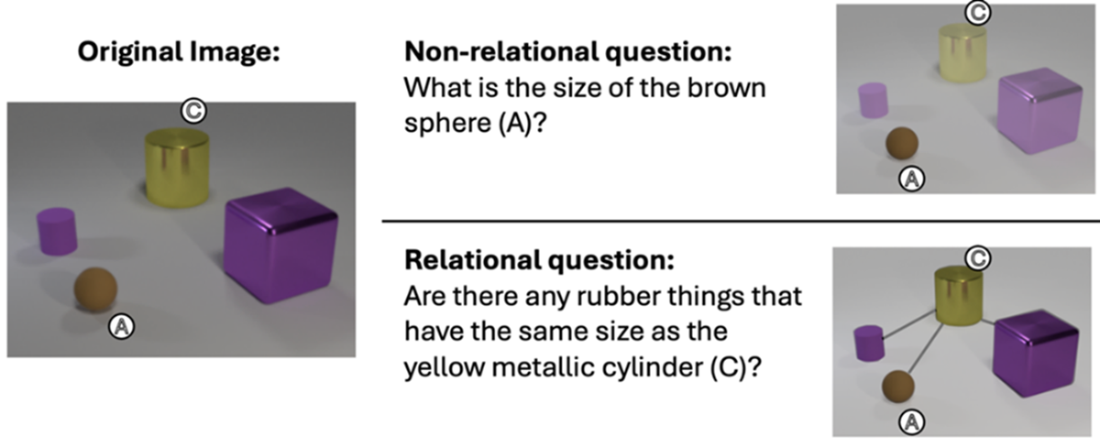
Image from the CLEVR dataset showing four objects with paired questions, one non-relational (about an object’s attributes) and one relational (about how the objects relate). Note: Letters were added to the original figure to aid comprehension in black-and-white printing. Used with explicit permission granted by the lead author (Adam Santoro).
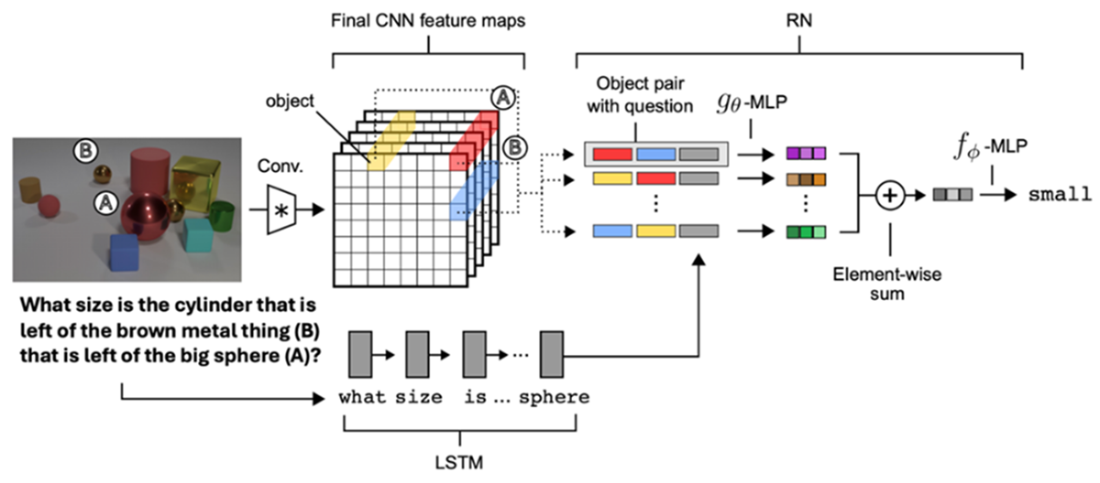
An image from CLEVR is paired with a reasoning question. A CNN extracts object features, an LSTM encodes the question, and the Relation Network compares every object pair in light of that question. The results are aggregated and passed to another network, which outputs the answer (here, “small”). Note: Letters were added to the original figure to facilitate comprehension because of black-and-white printing. Used with explicit permission granted by the lead author (Adam Santoro).
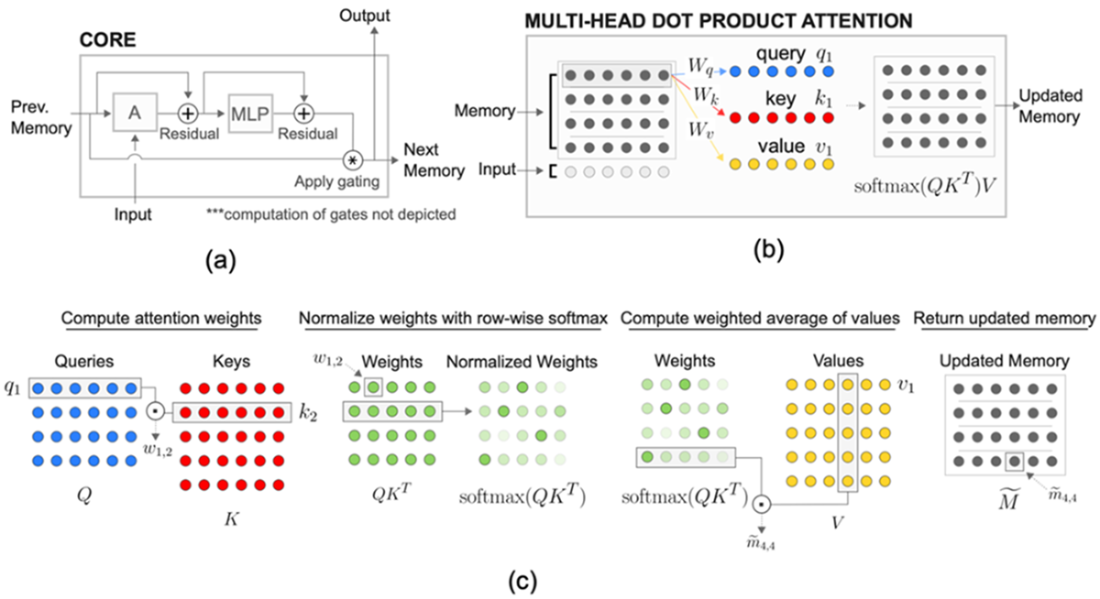
(a) The RMC takes the previous memory matrix and the current input and applies a multi-head dot-product attention (MHDPA) module labeled “A,” allowing memory slots to exchange information with one another and with the input. It then refines each slot with a small feed-forward network (“MLP”) and writes the result through a gate to produce the output for the step and the next memory state. (b) For each memory slot and the input, the model forms queries, keys, and values, enabling multiple “heads” to view relations from different perspectives. (c) Similarity between queries and keys yields normalized attention weights, which are used to compute weighted combinations of the values. The results update the memory matrix so that each slot integrates the most relevant information from others. The MLP and gate then finalize what is retained for the next step. Used with explicit permission granted by the lead author (Adam Santoro).
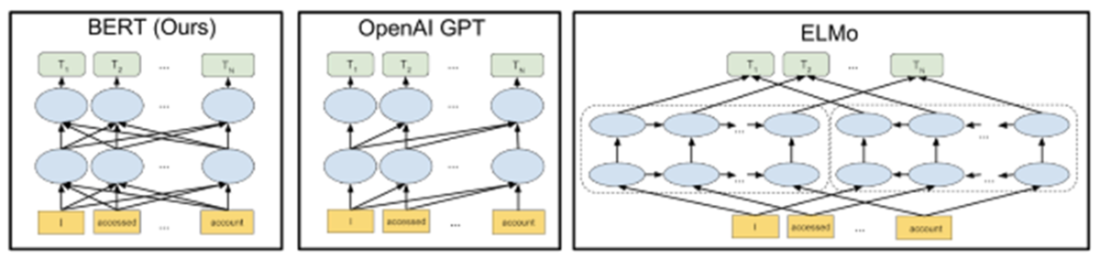
BERT is deeply bidirectional, OpenAI’s GPT is unidirectional, and ELMo is shallowly bidirectional.
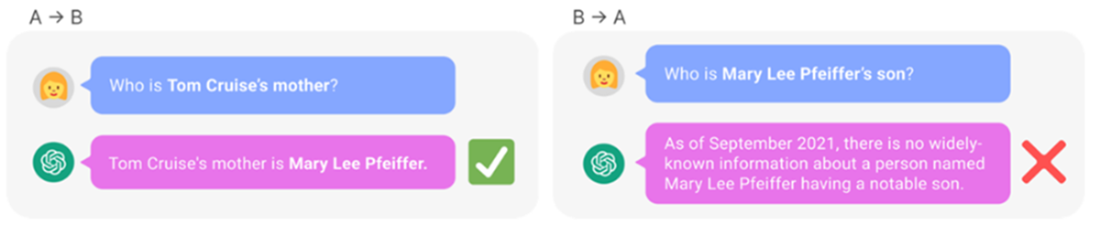
GPT-4 correctly gives the name of Tom Cruise’s mother (left). But when prompted with her name, it fails to retrieve “Tom Cruise” (right). Models trained on “A is B” (for example, “Tom Cruise’s mother is Mary Lee Pfeiffer”) do not automatically infer that “B is A.”
Paper Doubts
Connectionists view intelligence as emerging from empirical learning of statistical regularities and distributed representations via gradient-based methods. Critics argue that such systems lack compositionality. Jerry A. Fodor and Zenon Pylyshyn pressed this point sharply: if thought and language are compositional, then a cognitive architecture must explain that structure rather than merely approximate it.[55] But a key connectionist reply—articulated by Paul Smolensky—was that “hard rules” can be a higher-level description of lower-level “soft constraints,” so symbolic-like competence could emerge from neural computation rather than being pre-specified.[56]
The rationalist-empiricist split is a philosophical disagreement over the structure required for reasoning. The rationalist holds that explicit symbolic programs are necessary, whereas the empiricist tradition favors learned representations shaped by data and inductive biases. But what ultimately settled the debate was not a decisive philosophical argument but standardized benchmarks, shared datasets, and measured deltas against strong baselines. The Malik–Hinton wager (chapter 2) is best read as a parable about this norm.
Jitendra Malik’s challenge to Geoffrey Hinton was simple: don’t tell me how great artificial neural networks are; show me on a real benchmark like PASCAL. Malik wasn’t interested in theoretical promise, anecdotal success, or a philosophical argument. Hinton countered with ImageNet, and AlexNet (chapter 2) delivered. No one questioned whether convolutional networks could really see or really understand; the debate was whether deep learning could outperform support vector machines and handcrafted data pipelines. The wager was empirical, not philosophical. Success was measured against the best existing baseline. That empirical standard legitimized deep learning and reset the field.
The same pattern is repeated in research on differentiable reasoning. Relational networks (RN) achieved human-level performance (~95%) in relational question answering and passed 18 of the 20 bAbI tasks. Message-passing neural networks set new best results on all 13 QM9 targets and achieved chemical accuracy on 11 of them. Relational memory cores cut language model perplexity by 5–12% across benchmarks. They all provided measurable deltas, which is why they are included on Sutskever’s List.
In hindsight, capsules reveal that even a legend can publish a beautiful idea on paper that fails an empirical audit. In AI, reputation is earned through working systems, and accolades and hope don’t buy exemptions from that test. Capsule networks remain a cautionary tale: an elegant idea that looked great on paper but, without competitive results, quickly faded from the spotlight.
Over a century ago, Charles S. Peirce distinguished between paper doubts and living doubts. Paper doubts are professed for argument’s sake. They are declared in words, generally one-sided, and don’t interrupt anyone’s confidence. A researcher can pen a scathing critique (or a tweetstorm) about AI’s shortcomings, but it’s a purely intellectual exercise, and nothing in the world changes. Paper doubt doesn’t move the frontier because strongly worded statements usually don’t change architectures, baselines, benchmarks, leaderboards, or deployments. In contrast, a living doubt is a visceral uncertainty that unsettles thoughts and compels investigation.
In today’s terms, a statement like “current deep learning can’t reason,” left unchallenged, is a paper doubt. It’s a position one can argue eloquently without committing to anything. It might spark discussion with hypothetical skeptics, but it doesn’t change behavior. A living doubt, on the other hand, disrupts a community’s complacency and motivates action. We’ve seen how the living doubt that networks lacked relational reasoning led directly to RNs and Transformers; concerns about mathematical abstraction led to benchmarks like GSM8K (for arithmetic reasoning); and concerns about visual reasoning led to CLEVR.
What appeared to be a giant leap turned out, in part, to reflect over-specialization. ARC-AGI-2 was specifically engineered to be out of reach of any tricks that might have fit ARC-AGI-1 too closely. This is living doubt in its purest form. Rapid progress on ARC-AGI-1 did not mean that the problem of general abstraction had been solved; rather, it indicated that the benchmark had been conquered under its specific conditions.
Chollet’s living doubt is an operationalized, rather than a hypothetical form of skepticism. By continually increasing the difficulty and introducing truly novel tasks, it forces researchers and engineers to confront whether their systems are learning what they claim to be learning or just learning the quirks of a test. ARC-AGI-2 demands a higher level of generality, and for now, that doubt remains unresolved. It is a provocation to do better, not just criticism on paper.
Yet even this empirical, results-driven, meritocratic narrative has a seam. While benchmarks are critical and the bedrock of progress in AI, they are not infallible. They are instruments built on assumptions about what they measure. What they measure must be defined operationally in terms of stable, reproducible effects. The release of ARC-AGI-2 and ARC-AGI-3 underscored this point. What appeared to be rapid progress on ARC-AGI-1 was partly due to familiarity with benchmarks and overspecialized search.[68]
While the List records what worked, we still struggle to say what we can legitimately understand about it. In the chapters that follow, we step beyond engineering to confront what these achievements mean. This is not a departure from Sutskever’s List but its culmination.

 Sutskever's List ebook for free
