4 Deep Learning Accelerates
Chapter 4 explains how recurrent neural networks moved from promising but difficult sequence models into practical tools during the deep learning acceleration of 2014–2016. RNNs were attractive because they could process ordered data such as text and speech by carrying context forward through a hidden state, unlike fixed-window models such as n-grams. Yet they were limited by vanishing and exploding gradients, poor long-range memory, overfitting, and training instability. The chapter frames this period as a turning point: RNNs became both more understandable to developers and more powerful in real systems.
Two influential educational works helped make RNNs legible. Andrej Karpathy’s “The Unreasonable Effectiveness of Recurrent Neural Networks” popularized character-level RNNs through playful examples, accessible code, and demonstrations that models could imitate the surface structure of Shakespeare, LaTeX, source code, and essays, even when their outputs remained incoherent by modern standards. Chris Olah’s “Understanding LSTM Networks” then clarified how long short-term memory networks worked, using visual metaphors such as a conveyor belt to explain cell states, gates, and selective memory. Together, these posts lowered the barrier to experimentation and showed that explanation itself could shape the progress of a technical field.
The chapter then turns to the engineering advances that made RNNs practically useful. Zaremba, Sutskever, and Vinyals showed that applying dropout only to nonrecurrent connections allowed deeper LSTMs to train without destroying their memory, dramatically improving language-modeling results and extending recurrent networks into speech recognition, translation, and image captioning. Deep Speech 2 pushed this further by combining RNNs, convolutional front ends, CTC training, sequence-wise batch normalization, curriculum learning, GPU scaling, FP16 inference, and production-oriented decoding to build a large-scale speech recognition system for English and Mandarin. The chapter concludes that this era marked a broader shift in AI: progress increasingly came not from isolated theoretical novelty, but from scaling known ideas through disciplined engineering, deployment, data, and compute—a philosophy closely associated with Ilya Sutskever’s view of modern AI research.
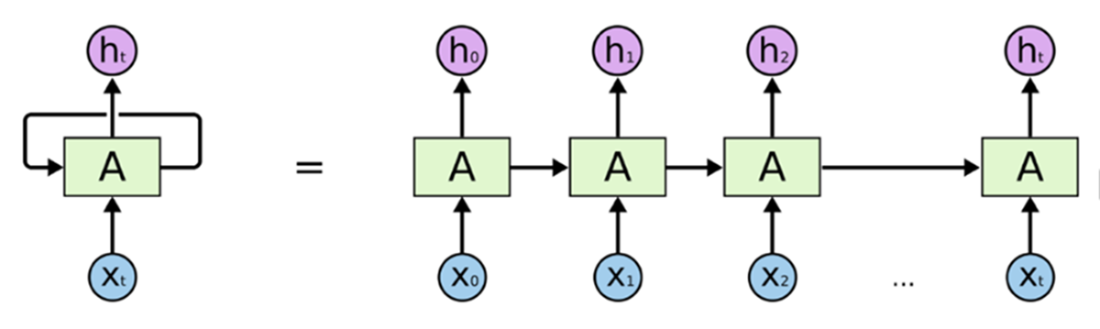
This image, from Chris Olah’s work (discussed in the next section), shows a chain-like structure representing a recurrent neural network (RNN). It illustrates how RNNs process data sequentially, with the output of one step feeding into the next. The recurrent, linked modules reflect the RNN’s ability to carry information forward, making it well suited to learning patterns that unfold over time, such as time series, text, or audio. Used with explicit permission granted by the author, Chris Olah.
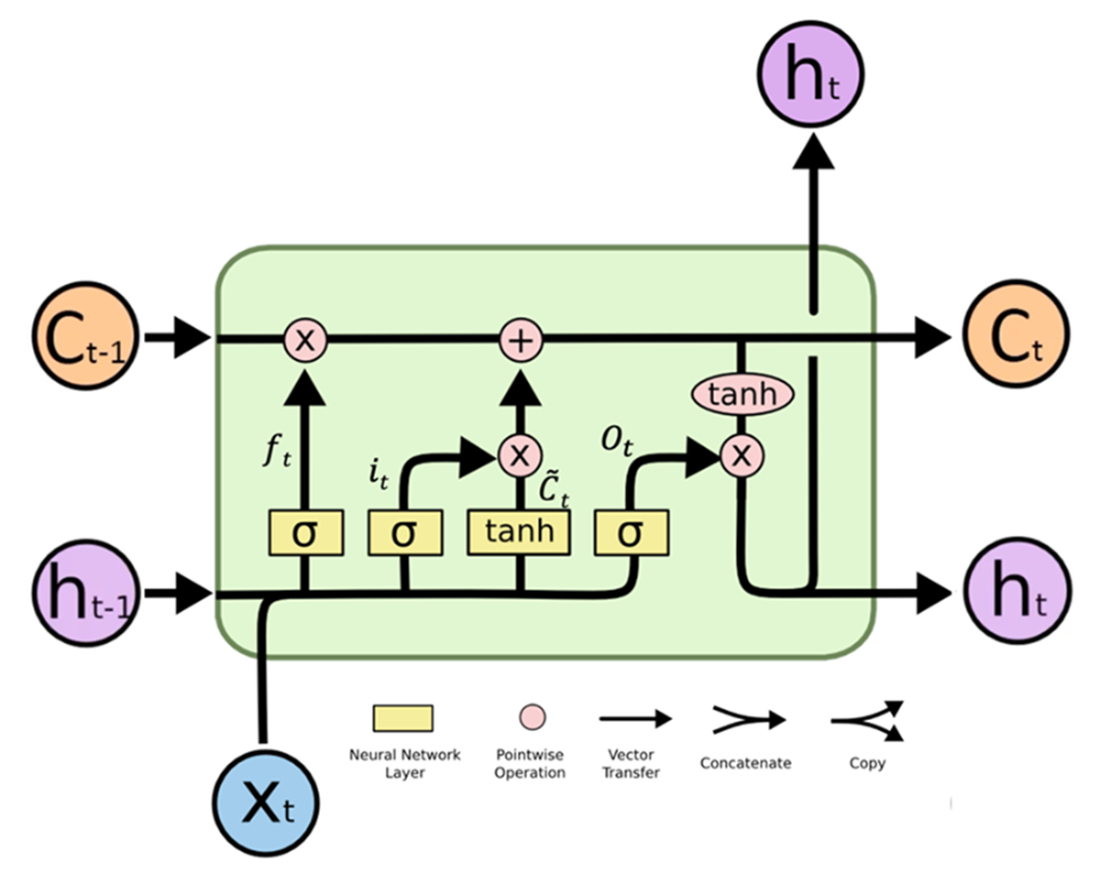
depicts a single LSTM cell. The inputs are the current vector 𝑋𝑡, the previous hidden state ℎ𝑡-1, and the last state 𝐶𝑡-1. There are three learned gates. The forget 𝑓𝑡, input 𝑖𝑡, and output 𝑂𝑡. They are all produced by sigmoid layers (“𝜎” blocks). A tanh layer forms a candidate update 𝐶𝑡. Pointwise multiplications (“×”) and an addition (“+”) update the cell state on the top “conveyor” pathway. Arrows indicate vector flow; the legend marks pointwise operations, concatenation, and copies. This is the standard LSTM, emphasizing how gating enables selective memory retention and exposure. Used with explicit permission granted by the author (Chris Olah), though it is slightly modified from its original form.
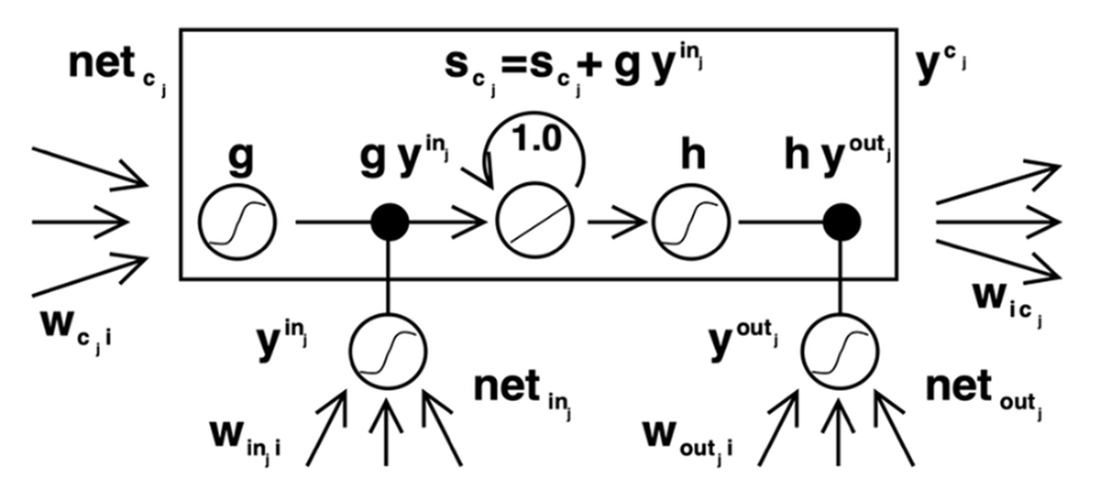
shows the original Hochreiter–Schmidhuber (1997) LSTM cell schematic, including the “constant-error carousel.” Used with explicit permission granted by one of the authors (Jürgen Schmidhuber).
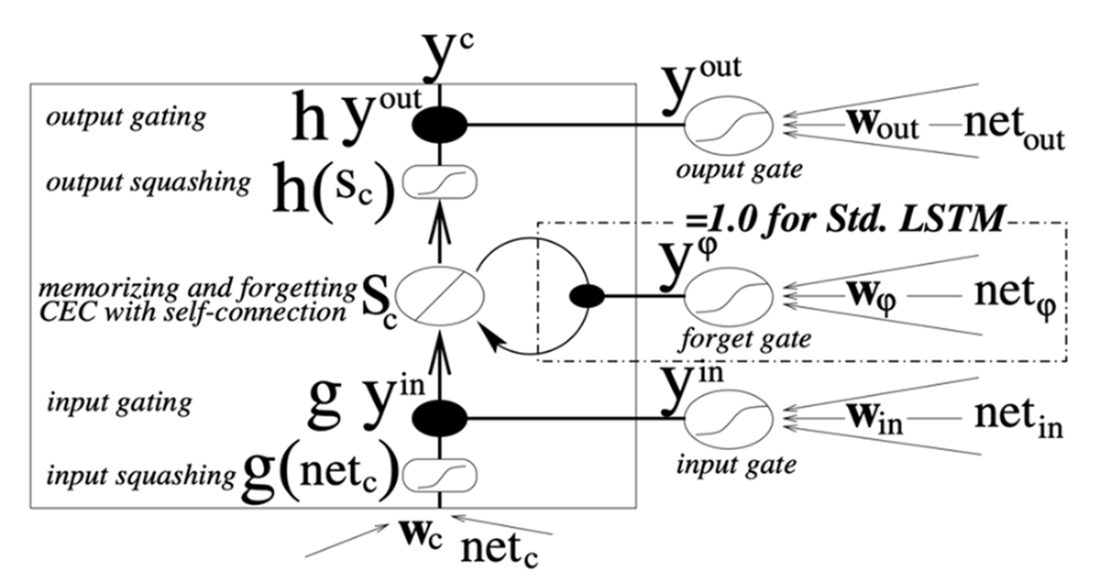
is an expanded LSTM schematic showing the forget gate with weighted connections to the inputs and outputs. Used with explicit permission from one of the authors (Jürgen Schmidhuber).
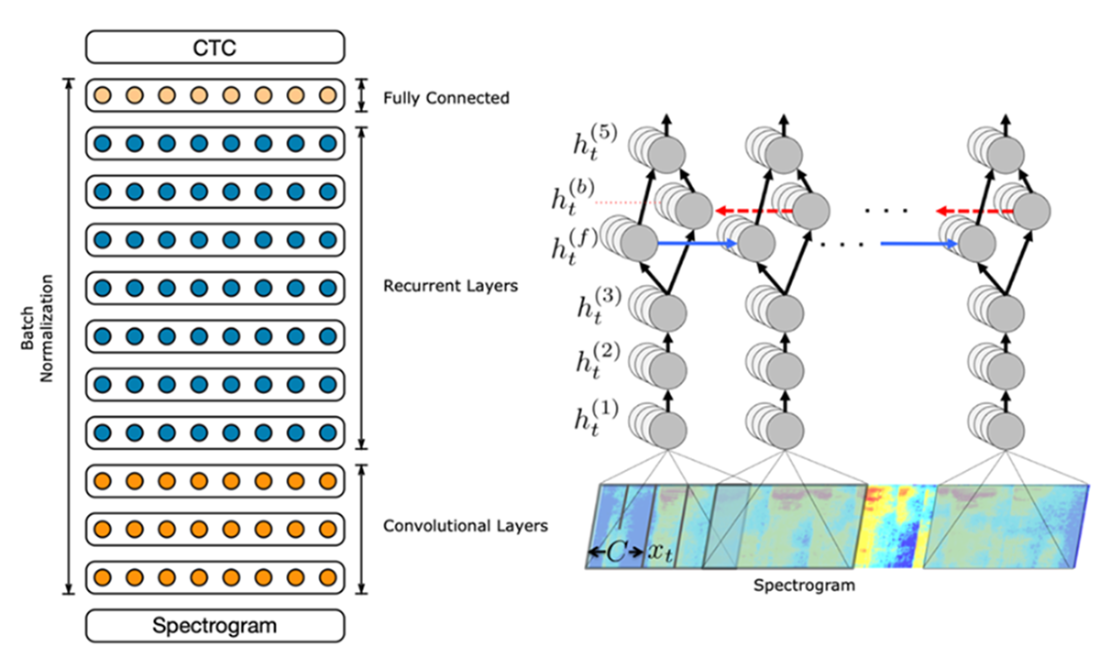
(Left) DS2 architecture used to train on both English and Mandarin speech. The authors vary the number of convolutional layers from 1 to 3 and the number of recurrent layers from 1 to 7. (Right) Structure of the RNN model from the first Deep Speech paper.[46] Used with explicit permission granted by one of the authors (Awni Hannun).
FAQ
What is the main focus of Chapter 4, “Deep Learning Accelerates”?
Chapter 4 explains how recurrent neural networks (RNNs) became practically important during the 2014–2016 deep learning surge. It covers the popularization of RNNs through Andrej Karpathy’s blog, Chris Olah’s visual explanation of LSTMs, Zaremba, Sutskever, and Vinyals’ selective dropout for recurrent networks, and Baidu’s Deep Speech 2 as a large-scale demonstration of end-to-end RNN-based speech recognition.
Why were recurrent neural networks important for sequence modeling?
RNNs are designed for ordered data such as text, speech, and time series. Unlike n-gram models, which look only at a fixed window of previous tokens, RNNs carry forward a hidden state that summarizes earlier inputs. This lets them model context across a sequence, making them useful for tasks where earlier information affects later predictions.
What made Andrej Karpathy’s “The Unreasonable Effectiveness of Recurrent Neural Networks” so influential?
Karpathy’s 2015 blog made RNNs accessible to developers by using vivid examples, intuitive explanations, and open-source code. His character-level RNN experiments generated text in the style of datasets such as Paul Graham essays, Shakespeare, LaTeX, Wikipedia, and Linux source code. Even when the outputs were incoherent, they showed that neural networks could learn recognizable structure one character at a time, which felt remarkable in 2015.
Why were character-level RNNs both impressive and limited?
Character-level RNNs generate text one character at a time rather than using words or subwords. This makes the task difficult because the model must learn spelling, word boundaries, syntax, and long-range meaning from very small units. Karpathy’s models could imitate surface patterns such as citations, code formatting, or Shakespearean dialogue, but they often failed at coherence and long-term consistency.
How did Chris Olah’s “Understanding LSTM Networks” contribute to the field?
Olah’s blog explained how LSTMs work using clear diagrams, metaphors, and visual language. While Karpathy showed what RNNs could do, Olah explained how LSTMs manage memory through gates and a cell state. His “conveyor belt” metaphor made the architecture easier to understand and helped set a new standard for accessible machine learning exposition.
What problem do LSTMs solve in standard RNNs?
LSTMs address the vanishing gradient problem, which makes it hard for standard RNNs to learn long-range dependencies. In a long sentence, for example, a vanilla RNN may struggle to connect “France” with “French” many words later. LSTMs use a cell state and gates to preserve, update, or discard information across many time steps, allowing important context to remain available longer.
What are the forget, input, and output gates in an LSTM?
The forget gate decides how much old information to keep in the cell state. The input gate decides what new information should be added, working with a candidate memory produced by a tanh layer. The output gate determines how much of the updated cell state should be exposed as the hidden state for the current time step. Together, these gates let LSTMs selectively remember and use information.
Why was “Recurrent Neural Network Regularization” by Zaremba, Sutskever, and Vinyals important?
The paper introduced a selective dropout strategy for LSTMs. Traditional dropout disrupted recurrent connections and damaged memory, but Zaremba, Sutskever, and Vinyals applied dropout only to nonrecurrent, vertical connections between layers. This preserved temporal memory while reducing overfitting, enabling larger and deeper LSTMs to train effectively.
How much did selective dropout improve RNN language modeling?
On the Penn Treebank language modeling benchmark, selective dropout helped a large two-layer LSTM with 1,500 units per layer achieve a test perplexity of 78.4, breaking through a barrier that single RNN models had struggled to cross. A 10-model ensemble of large dropout-regularized LSTMs reduced perplexity further to 69.5.
Why is Deep Speech 2 compared to AlexNet?
Deep Speech 2 is compared to AlexNet because it demonstrated the power of large-scale, GPU-powered, end-to-end deep learning in a practical domain. Like AlexNet, it combined known ideas with strong engineering: convolutional front ends, recurrent layers, CTC training, sequence-wise batch normalization, SortaGrad, multi-GPU training, FP16 inference, beam search, and large datasets. It showed that scale and engineering could turn deep learning into a real-world speech recognition system.

 Sutskever's List ebook for free
