1 Introduction to Intent-Driven Development
Modern coding agents have made software delivery faster, but they have also exposed a deeper limitation: the real bottleneck is no longer writing code, but clearly expressing the intent behind it. When requirements are incomplete, agents can produce implementations that satisfy the literal request while missing the actual goal, as shown by the password reset example where password changes alone are not enough if compromised sessions remain active. The chapter argues that this gap is not a model failure so much as a communication failure, and that better outcomes come from making the underlying purpose explicit.
Intent-Driven Development is presented as an AI-native approach that turns vague ideas into durable artifacts such as specifications and tests, which then serve as the source of truth for implementation. Intent is defined as the actionable expression of purpose: the “why” that shapes the “what,” guides downstream decisions, and filters relevant context. The chapter contrasts intent with intuition, broad objectives, and ideas, emphasizing that intent must be articulate enough for both humans and agents to act on it. It also describes how structured dialogue can surface assumptions, refine goals, and produce context that remains useful beyond a single session.
The chapter connects this approach to established software practices like user stories, BDD, and TDD, which already use structured conversation and verification to align teams around shared understanding. Building on that history, it introduces Spec-Driven Development as one way to operationalize intent through discovery, design, and tasking, and also explains autonomous iteration loops as another mechanism when the path to success must be discovered through execution. The broader message is that as agents take over more implementation work, humans must move upstream and focus on intent articulation; otherwise review becomes the new bottleneck. In this model, specs and loops are complementary tools for engineering context so that agents can execute independently and produce aligned results.
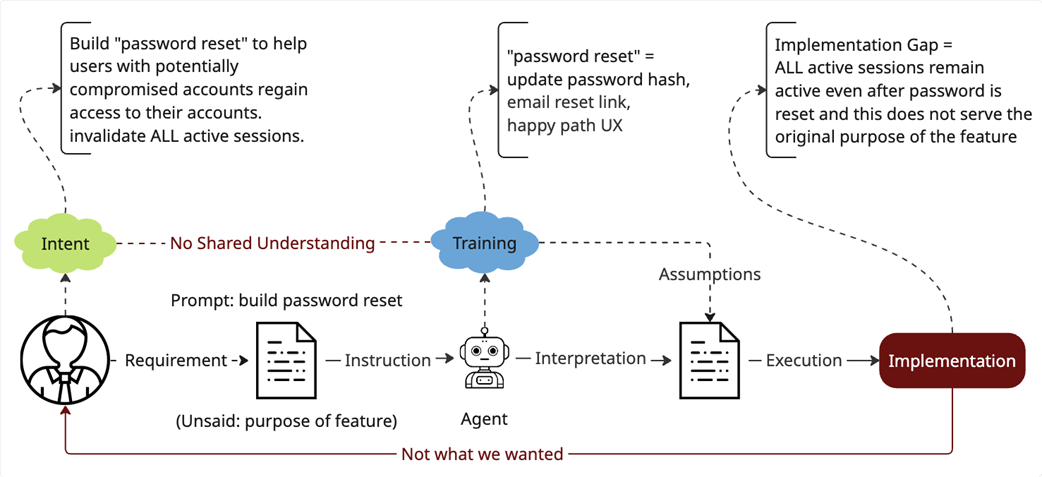
Lack of common ground between our intentions and the agent’s model training can lead to implementations that are not aligned.
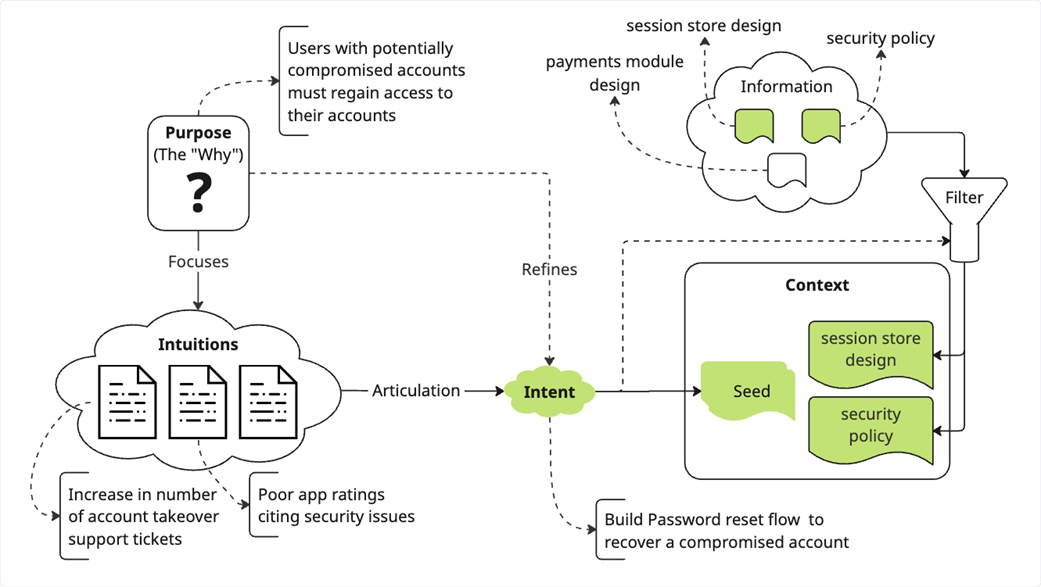
We begin with intuitions indicating that users are struggling with compromised accounts. Our purpose, which is to help them regain access, focuses these observations, guides us toward approaches that address the issue, and helps us articulate an intent that defines the desired outcome and its success criteria. This intent seeds the context and acts as a filter, selecting relevant details such as the session store design and security policy while excluding unrelated information such as the payments module. This context-construction process gives the agent just enough information to achieve the intended outcome rather than flooding it with everything available.
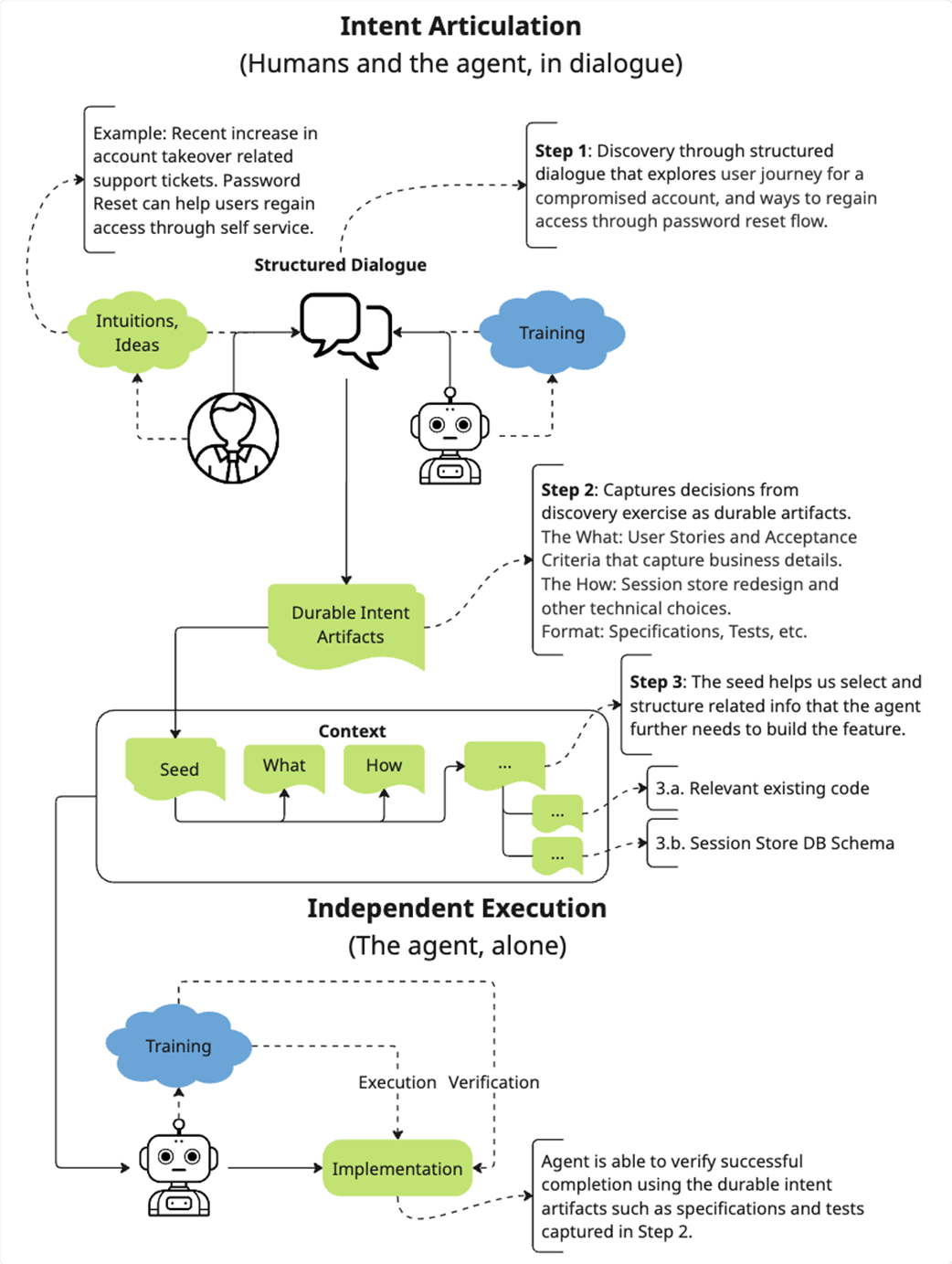
A mental model of how IDD focuses on effective intent articulation to engineer context so that the agent can independently execute to deliver aligned outcomes.
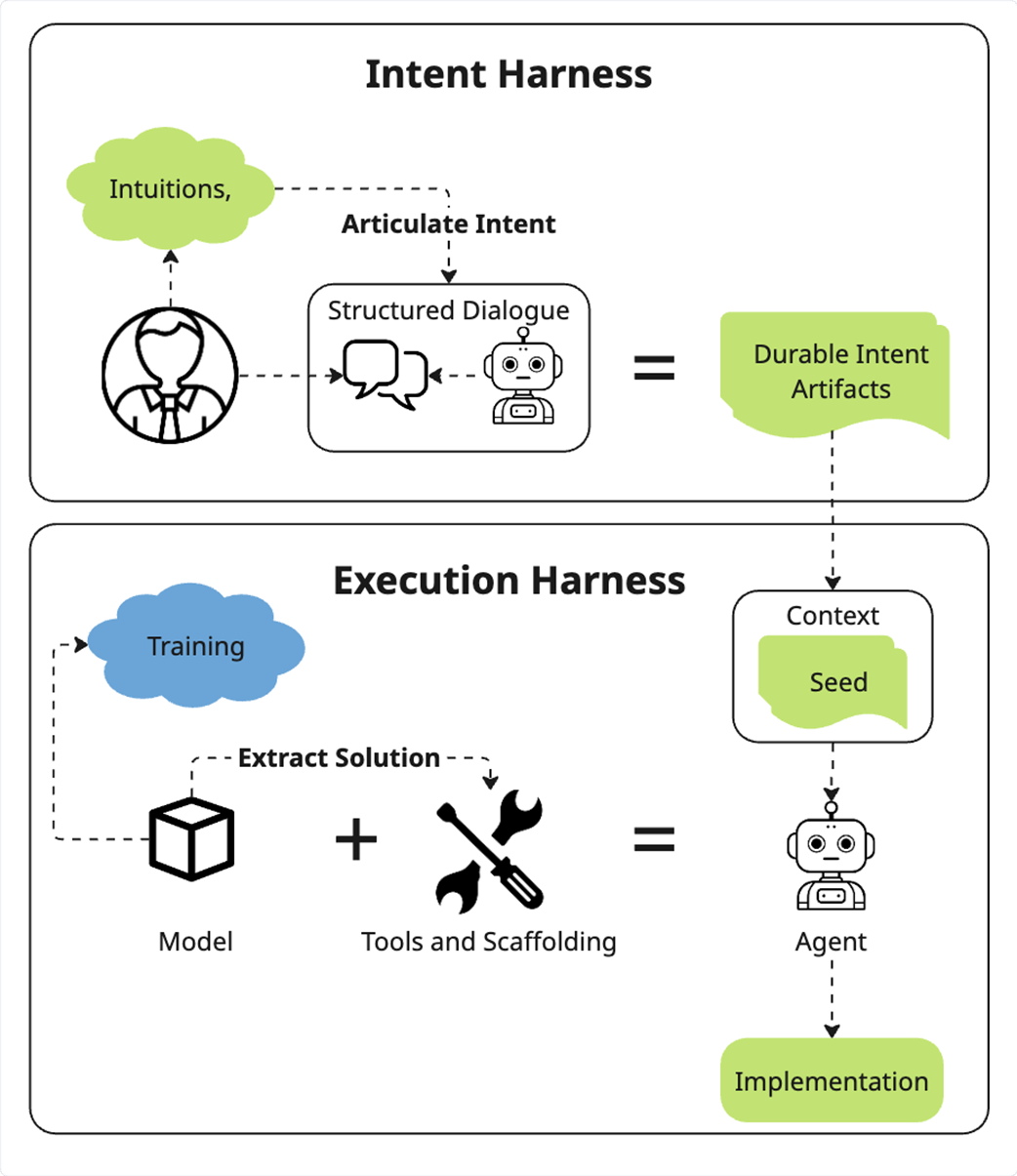
The intent harness is a level above the execution harness and helps us articulate intent to engineer context for the execution harness.
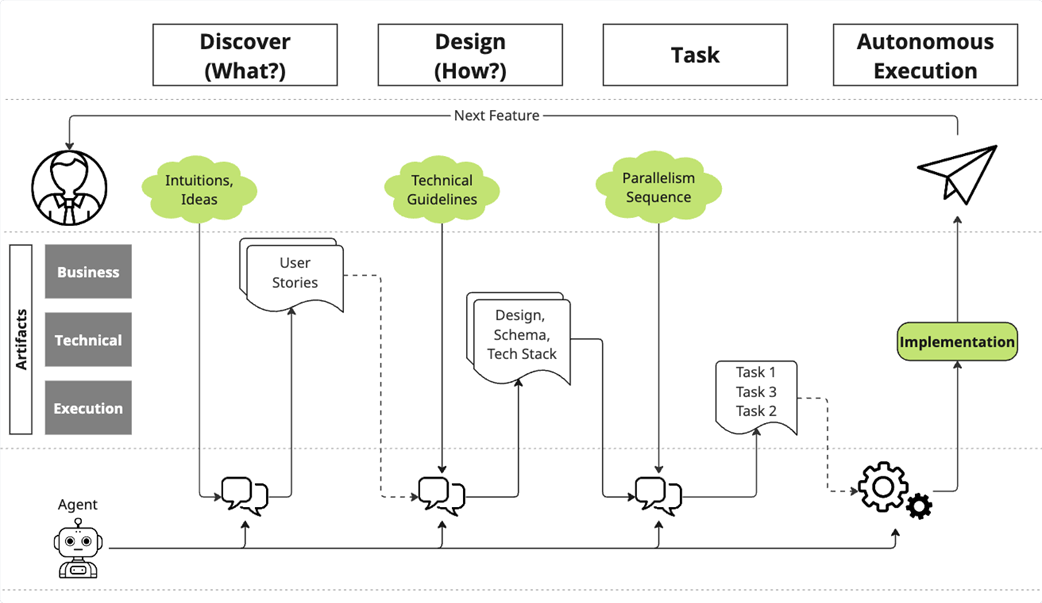
High-level overview of how spec-driven development helps us articulate intent through discovery, design, and tasking to enable autonomous execution.
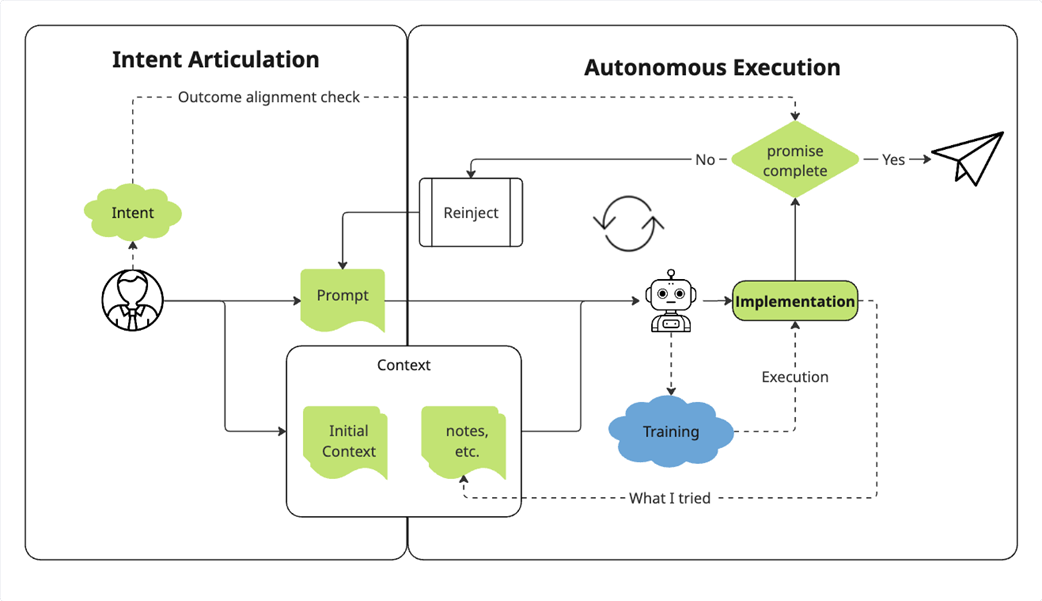
High-level overview of autonomous interaction workflows that provide only initial context and the governing criteria for completion, allowing the agent to progressively converge on a solution without us having to detail exactly how to achieve it.
Summary
- Intent is the actionable expression of purpose for a specific change. It makes the broader “why” concrete enough to guide implementation, verification, and downstream design decisions.
- Intent articulation turns raw intuition into a usable engineering context. User stories, acceptance criteria, BDD, and TDD have long helped teams surface intent through structured dialogue; IDD builds on that foundation for AI-native development.
- Intent-Driven Development uses structured human-AI dialogue to elicit, refine, and preserve intent. The goal is to capture intent in durable artifacts that survive beyond a single conversation, model, or coding session.
- Coding agents are execution harnesses, while Intent Harnesses shape what those agents execute against. An Intent Harness sits above the execution harness and provides the structured context needed for more independent and aligned agent execution.
- Spec-Driven Development and Autonomous Iteration Workflows are complementary approaches to IDD. SDD uses specifications as vehicles for articulating intent, whereas in Autonomous Iteration Workflows, intent is embodied in governing constraints that steer repeated execution, learning, and convergence.
- IDD matters because faster code generation shifts the bottleneck from writing code to articulating intent. Weak intent articulation leads to review-and-rework storms, while durable intent artifacts, such as specs, help humans define context, encode expertise, and verify outcomes, laying the foundation for software factories.
FAQ
What does “intent” mean in AI coding?
In AI coding, intent is the actionable expression of purpose. It is the “why” behind a feature translated into a form that an agent or developer can use to guide implementation, decisions, and verification.
Why is intent articulation becoming the new bottleneck?
Because coding agents can generate code quickly, but teams still struggle to clearly express what they actually want. The limiting factor shifts from writing code to describing the intended outcome well enough for the agent to act on it without guessing.
What problem does Intent-Driven Development solve?
IDD helps translate implicit human intent into durable, usable artifacts and structured context for agents. This reduces misalignment, improves consistency, and lets agents generate implementations that better match what was meant.
How is intent different from requirements?
Requirements usually describe what should be built, while intent explains why it matters. Intent adds the purpose and decision-making context that keeps implementation, testing, and design aligned with the real goal.
Why can a feature be “correct” but still fail the real goal?
Because a prompt or ticket may satisfy every stated requirement while missing an unstated but essential detail. For example, a password reset might work technically but still fail to protect a compromised account if existing sessions are not invalidated.
What are durable intent artifacts in IDD?
They are shared, long-lived artifacts such as specifications and tests that capture the agreed intent. These artifacts act as a source of truth and can survive beyond a single agent session or even beyond a specific implementation.
How do user stories and acceptance criteria relate to intent articulation?
User stories and acceptance criteria are structured ways to reveal intent progressively. User stories make the purpose explicit, and acceptance criteria turn that purpose into concrete, verifiable behavior that can guide implementation.
What role does test-driven development play in Intent-Driven Development?
TDD helps make intent visible and testable before implementation begins. By writing tests first, teams define the expected behavior up front, which gives agents a clear target and reduces the risk of building the wrong thing.
What is the difference between spec-driven development and autonomous iteration loops?
Spec-driven development uses specifications as durable intent artifacts before execution begins. Autonomous iteration loops, by contrast, let the agent keep iterating against a governing constraint until it converges on a solution, especially when the path cannot be fully known in advance.
When should you not use Intent-Driven Development?
IDD is not the best fit for urgent prototypes, demos, or quick proofs of concept where speed matters more than long-term maintainability. It also works best as an organizational practice, so using it only as an individual habit can leave much of its value unrealized.

 Spec-Driven Development ebook for free
