5 Advanced Encryption Standard
Advanced Encryption Standard (AES) is the de facto symmetric block cipher used across operating systems, cloud providers, and Internet protocols to protect confidentiality. It encrypts fixed-size 128-bit blocks (with padding as needed) using a shared secret key and supports 128-, 192-, and 256-bit key sizes, with AES-256 often chosen for long-term assurance and regulatory needs. Because AES is a block cipher, applications must select a mode of operation to process data larger than a single block, and security depends critically on choosing and configuring that mode correctly.
Not all modes are safe: Electronic Codebook (ECB) is deterministic and leaks patterns, and Cipher Block Chaining (CBC) hides patterns but delivers confidentiality only, leaving data vulnerable to undetected tampering. Real-world systems need authenticated encryption—confidentiality, integrity, and authenticity—which AES-Galois/Counter Mode (GCM) provides by combining encryption with an authentication tag. AES-GCM also supports AEAD, allowing developers to bind unencrypted context (headers, database identifiers) to the ciphertext so swaps or header modifications are detected. The chief pitfall is nonce/IV reuse: with the same key, reusing a nonce in GCM is catastrophic, so each encryption must use a fresh, unpredictable 96-bit IV.
Practically, developers should default to AES-GCM (or a safer-against-reuse variant like AES-GCM-SIV), use 256-bit keys, generate keys and IVs with a cryptographically secure RNG, never reuse an IV with a given key, and use a 128-bit authentication tag. Treat decryption failures as security events, compress data before encrypting, and respect limits such as the ~68GB per key/IV bound in GCM. Java offers first-class AES-GCM support, but to avoid subtle mistakes, prefer well-vetted libraries (e.g., Google Tink) and secure key management (vaults rather than source code or configs). While quantum computing could reduce effective key strength in theory, robust implementations, proper key handling, and authenticated modes remain the decisive factors for strong, developer-friendly encryption today.
A cipher consists of an algorithm for encrypting and decrypting data using a key. The details of encryption and decryption algorithm are public knowledge while the key is kept secret. If the same key is used to encrypt and decrypt the cipher is called a symmetric cipher otherwise it is called an asymmetric cipher.
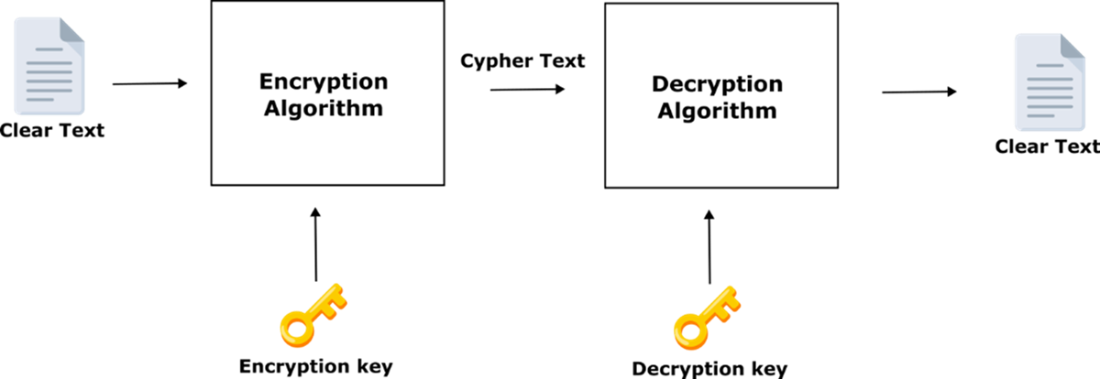
AES is a block cipher because it requires its input be a fixed size 128-bits long. AES is a symmetric cipher because the key used to encrypt is the key used to decrypt.
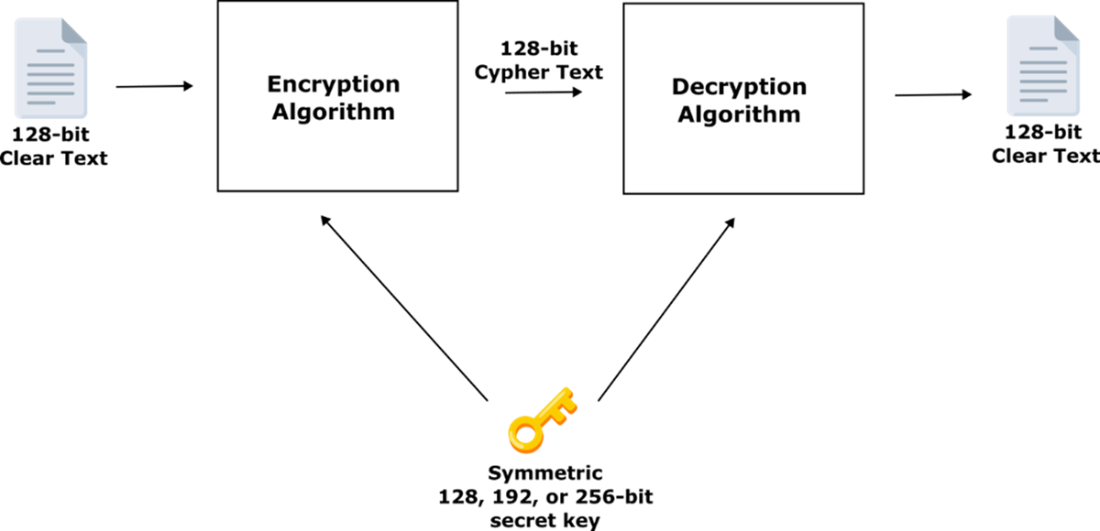
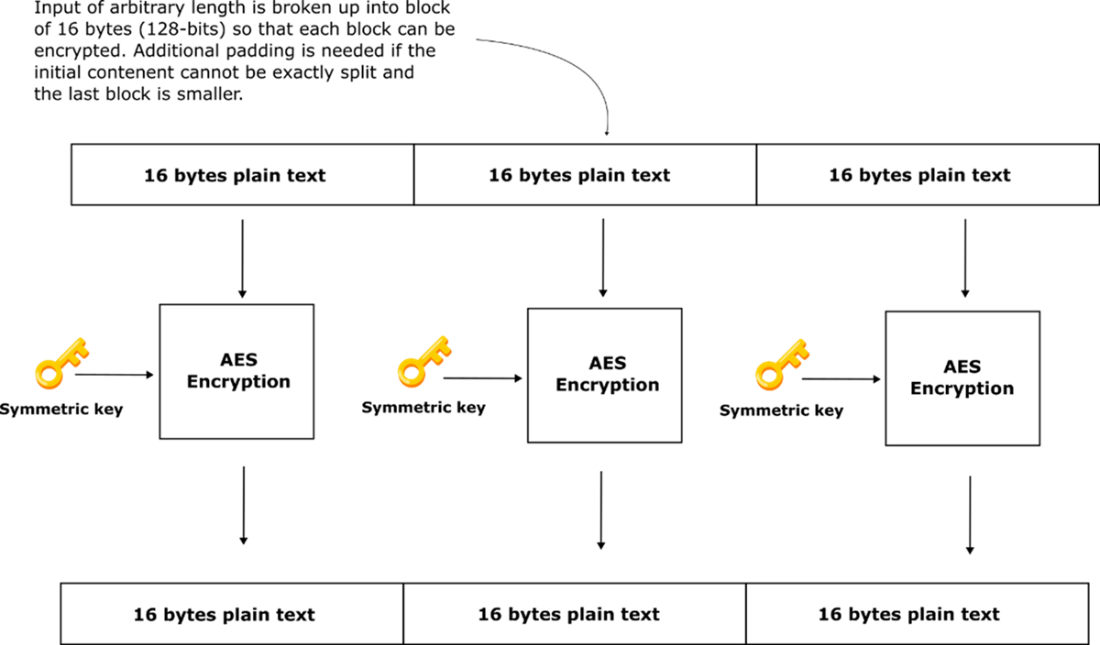
The Electronic Codebook Operating (ECB) Mode encrypt each input block independently using the secret key, concatenates the resulting cipher text. ECB mode is simple, but it is insecure, never use ECB mode.
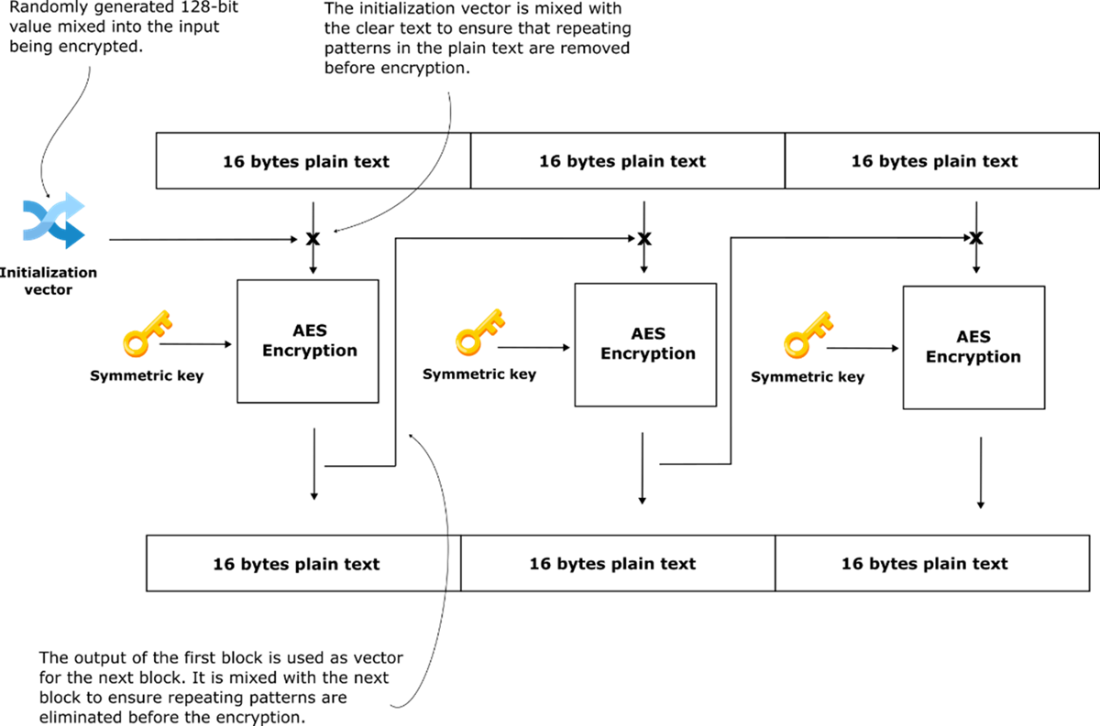
The symbol with + inside a circle is the XOR operation. Cipher Block Chaining (CBC) takes the output of one block and feeds it into the next block. The net result is that even if you encrypt the same data multiple times the cipher text looks random. An attacker cannot determine any patterns in the underlying data by looking for patterns in the cipher text.
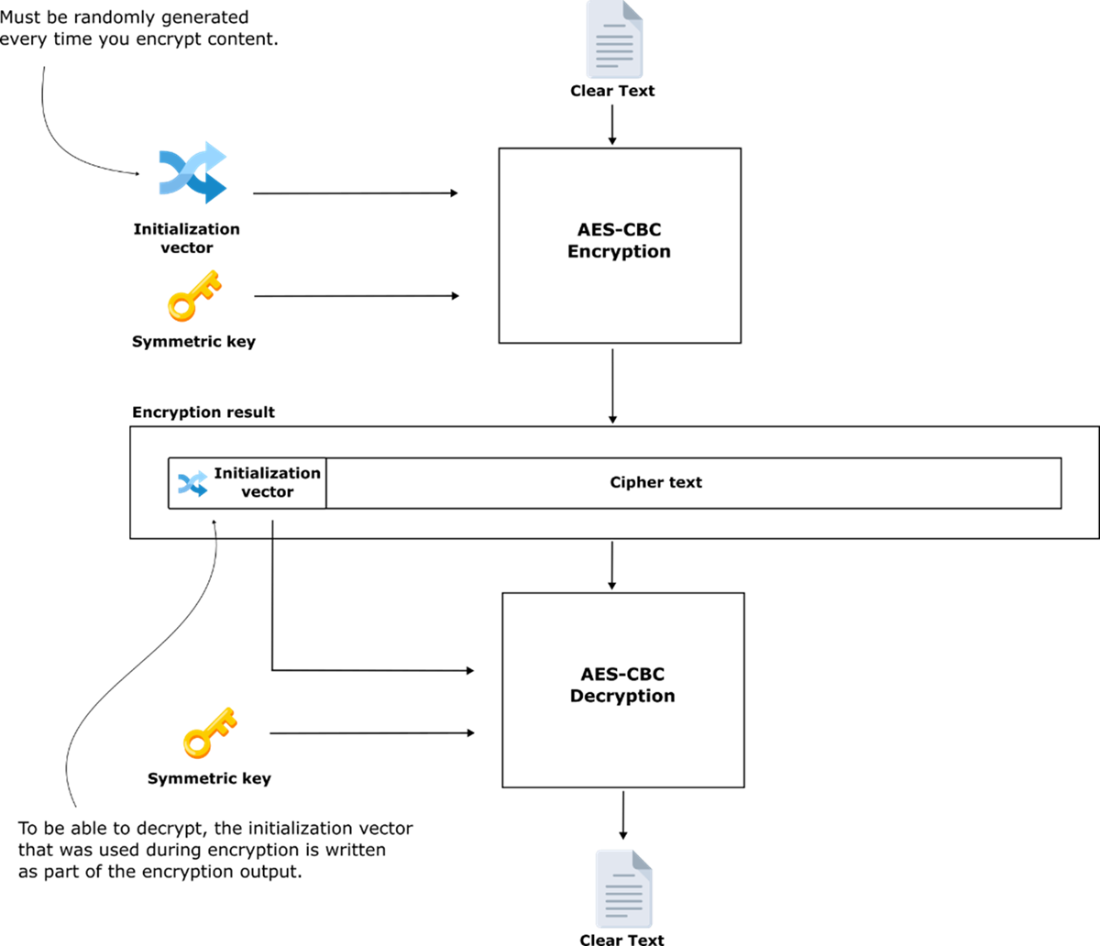
AES in CBC mode can be visualized as a black box that takes three inputs: plain text, key, and initialization vector. The initialization vector is written out as a plain text to output followed by the cipher text computed by the AES in CBC mode. Decryption process requires three inputs: initialization vector, cipher text, and key. The initialization vector and cipher text can be read from the output bytes, while the key must be provided by the party performing the decryption.
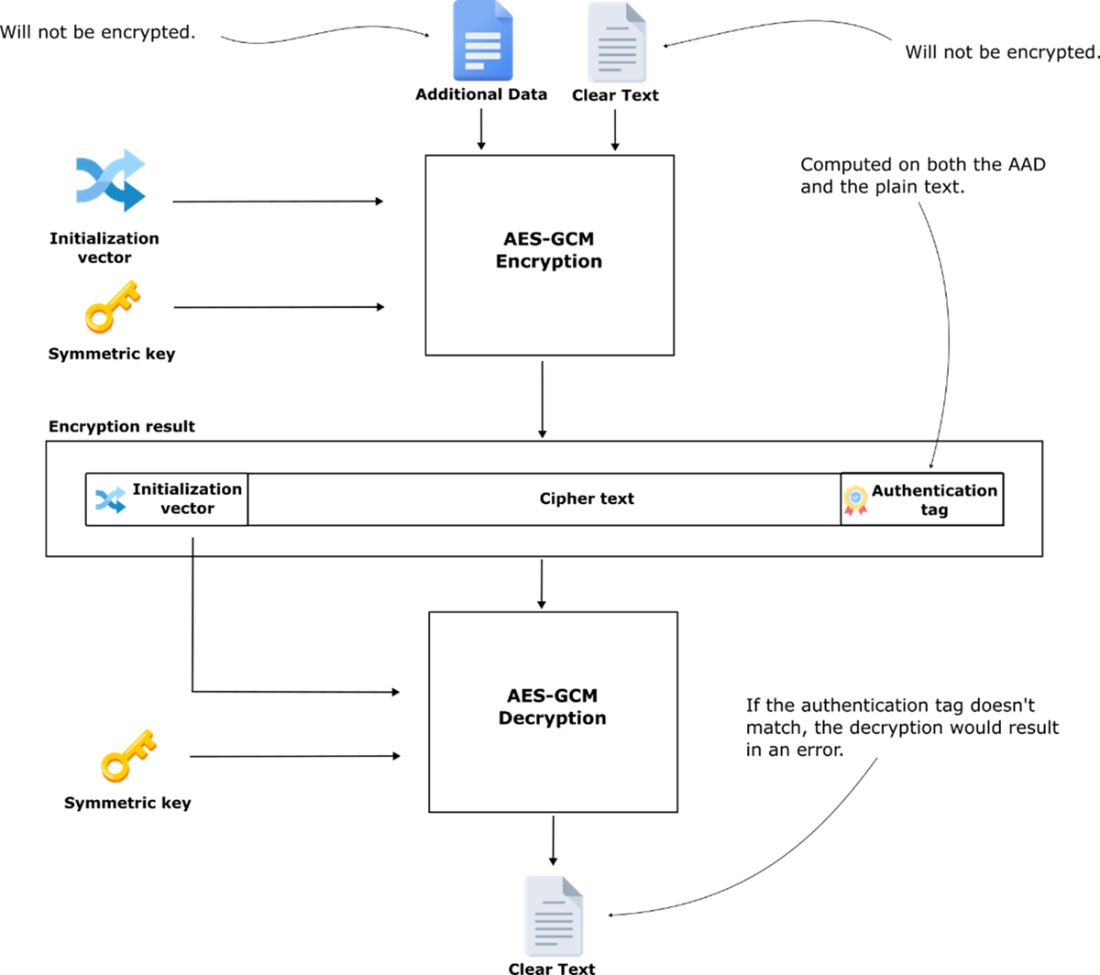
AES in GCM mode as a black box that processes three inputs: plaintext, key, and initialization vector. The algorithm outputs the initialization vector (written in plaintext), followed by the ciphertext it computes, and finally the authentication code generated by GCM mode. To decrypt, you provide four inputs: the initialization vector, ciphertext, key, and authentication code. The algorithm uses these inputs to verify the data’s integrity and recover the original plaintext.

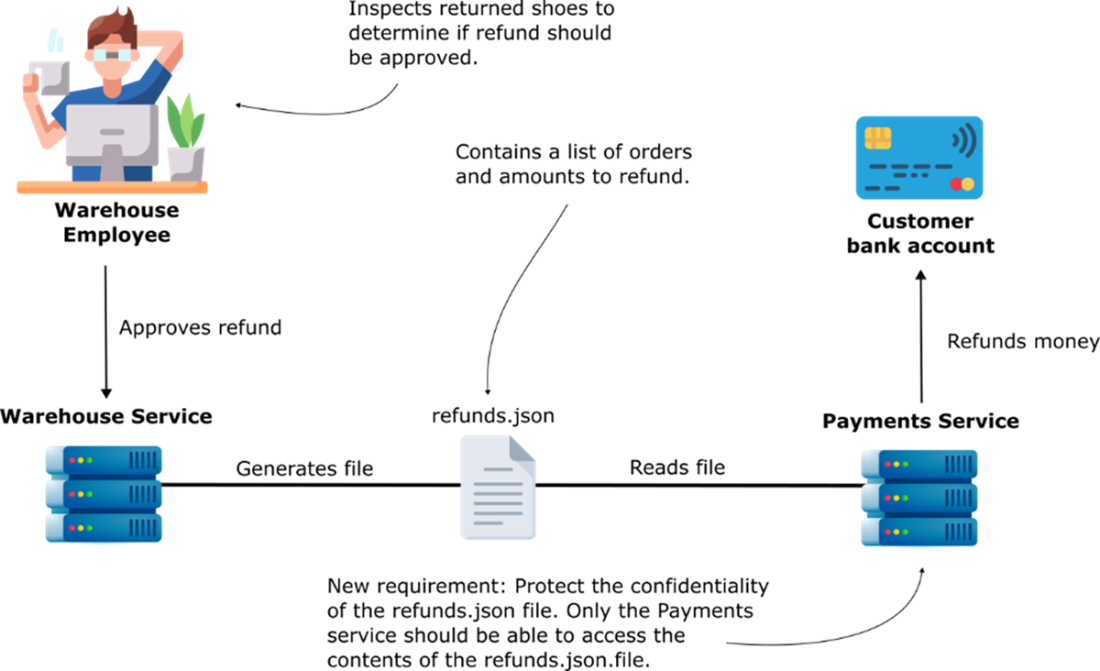
ACME Inc. staff approve refunds using the warehouse management application. Once a day the warehouse management application generates a refunds.json file. The payment service refunds customer credit cards for the amount specified in the refunds.json file.
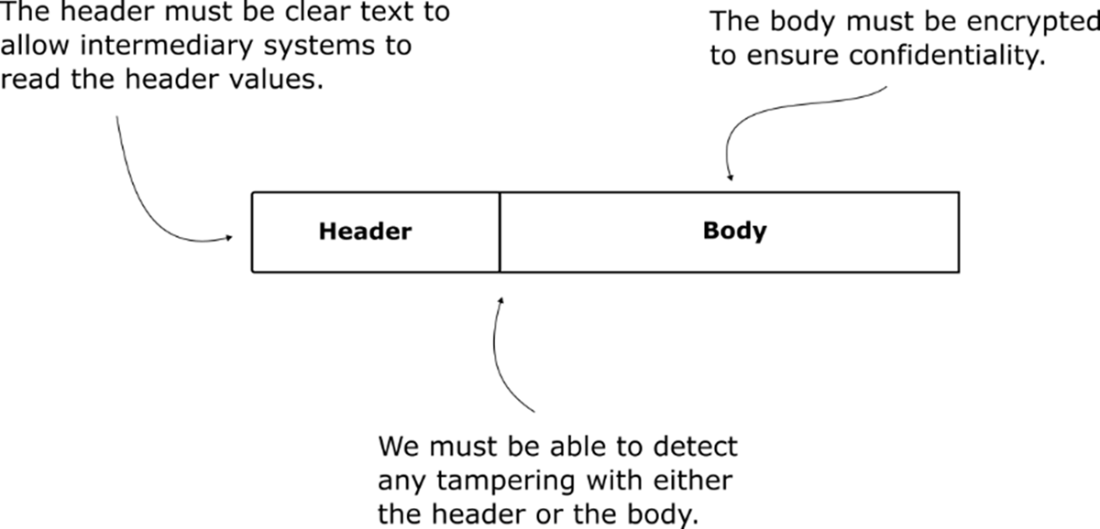
A message with a plain text header and an encrypted body is very common.
AES in GCM mode can be visualized as a black box that takes four inputs: plain text, secret key, initialization vector, and optional Additional Associated Data (AAD). The authentication tag is computed using the AAD data and the cipher text. The initialization vector, cipher text, and authentication tag are saved to the output. To decrypt you must provide both the encryption key, and the AAD data otherwise an error is raised.
Summary
- Advanced Encryption Standard (AES) is the most widely used symmetric encryption algorithm, supported by all major cloud providers and operating systems for protecting data confidentiality.
- AES is a block cipher that encrypts fixed 128-bit blocks and requires a mode of operation to handle data larger than one block.
- Electronic Code Book (ECB) mode is insecure because identical plaintext blocks produce identical ciphertext blocks, revealing patterns to attackers.
- Cipher Block Chaining (CBC) mode chains blocks together using initialization vectors to prevent pattern detection but only provides confidentiality, not integrity or authenticity.
- Initialization vectors must be random, unique for each encryption operation, and never reused with the same key to prevent catastrophic security failures.
- Authenticated encryption combines encryption with message authentication to provide confidentiality, integrity, and authenticity in a single operation.
- Galois Counter Mode (GCM) is the recommended AES mode because it provides authenticated encryption, ensuring confidentiality, integrity, and authenticity simultaneously.
- AES-GCM requires a secret key, random initialization vector, and produces ciphertext with an authentication tag that detects any tampering.
- Authenticated Encryption with Associated Data (AEAD) allows plaintext headers to be authenticated along with encrypted message bodies without encrypting the headers.
- Java provides AES support through the Cipher class, but developers should use cryptographically secure random number generators and follow specific configuration requirements.
- Best practices include using 256-bit keys, 96-bit initialization vectors, 128-bit authentication tags, and never reusing initialization vectors.
- Compression should be applied before encryption because encrypted data appears random and cannot be effectively compressed.
- Quantum computers could theoretically halve AES key strength using Grover's algorithm, making 256-bit keys equivalent to current 128-bit security.
- Developer-friendly libraries like Google Tink are recommended over hand-coding AES implementations to avoid common security mistakes.

 Software Security for Developers ebook for free
