4 Design for evolution: architecture that survives change
Software systems are never truly finished; they keep changing as requirements, teams, technologies, costs, and organizational goals shift. Because of that, architecture must be judged not only by how well it works today, but by how well it can absorb future change without turning brittle, tangled, or prohibitively expensive to modify. The chapter frames evolvability as a practical necessity: systems that stay stable by resisting change eventually become liabilities, while systems designed with adaptability in mind can keep serving their purpose longer and with less disruption.
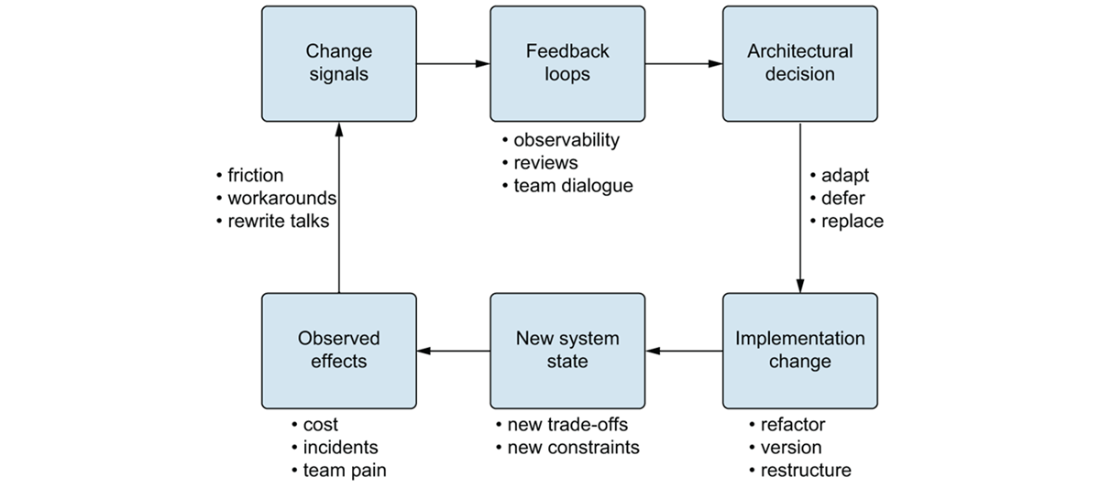
To support evolution, architects should build structures that make change visible, contained, and reversible whenever possible. The text emphasizes modularity, replaceability, extensibility, observability, and change isolation as core qualities that reduce the cost of adaptation. It also highlights the importance of feedback loops that reveal emerging rigidity through repeated friction, workarounds, and growing coordination costs, so teams can respond before a rewrite becomes the only option. Alongside this, the chapter stresses the value of delaying irreversible decisions until the last responsible moment, creating seams where likely change can be absorbed, preserving decision context through records, and maintaining backward compatibility so producers and consumers can evolve at different speeds.
The chapter also warns against common sources of accidental rigidity, including premature distribution, unnecessary complexity, overreliance on cloud services without operational readiness, and architectural choices that outpace team maturity. It argues for incremental replaceability rather than big-bang rewrites, using patterns such as adapters, versioning, and strangler-style migration to change systems in controlled slices. Finally, it broadens architecture beyond technology alone: evolvability depends on collaboration, shared understanding, psychological safety, and leadership support. The architect’s role is therefore to keep options open, challenge assumptions, manage risk over time, and help both systems and teams grow in ways that preserve long-term adaptability.
Evolutionary architecture depends on feedback loops that make change visible and allow systems to adapt before rigidity turns into failure.
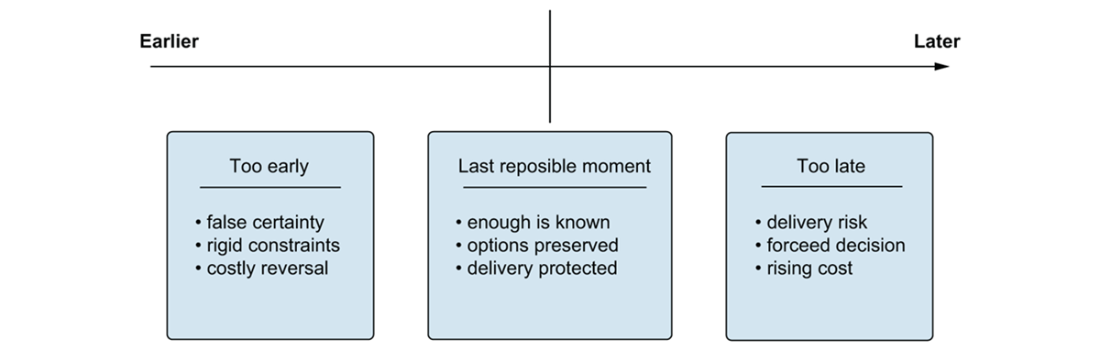
Architectural decisions are most effective when made at the last responsible moment: late enough to preserve flexibility, but early enough to avoid delivery risk.
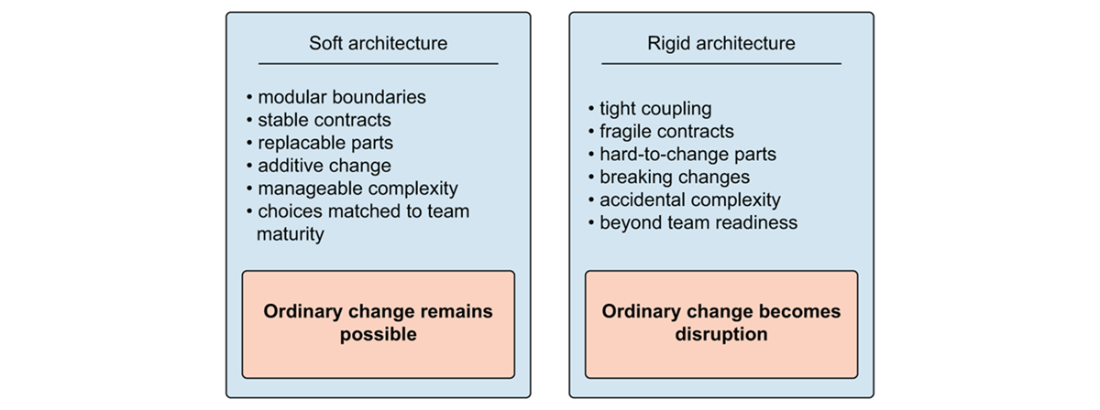
Soft architecture preserves room for change, while rigid architecture turns ordinary evolution into expensive disruption.
Summary
- Systems do not stay still; they either evolve continuously or are eventually replaced.
- Architecture must be designed not only to work today, but to adapt safely as requirements, technology, teams, and constraints change.
- Evolvability depends on qualities such as modularity, replaceability, extensibility, observability, and change isolation.
- Feedback loops reveal when assumptions are failing and when the architecture needs to adapt.
- Delaying irreversible decisions until the last responsible moment helps preserve flexibility and reduce the cost of change.
- Seams, stable contracts, backward compatibility, and incremental replacement make evolution safer and less disruptive.
- Soft architecture enables change, while accidental complexity, premature distribution, and rigid commitments make systems harder to evolve.
- Cloud services can accelerate delivery, but they can also introduce traps that quietly limit future change.
- Architecture evolves through collaboration as much as design; teams must be able to grow with the systems they build and inherit.
- The architect’s responsibility is to guide change deliberately, reduce the cost of mistakes, and keep the system adaptable over time.
FAQ
Why does the chapter say systems “never sit still”?
Because software continuously changes after release due to new features, dependency updates, team changes, integrations, performance pressures, cost changes, security needs, and shifting business goals. Even if development stops, the system either evolves or is eventually replaced.
What is evolvability in software architecture?
Evolvability is the ability of a system to absorb and adapt to change over time without excessive disruption. It is a first-class architectural quality because long-term success depends not just on current performance, but on how safely the system can change later.
What architectural qualities support safe evolution?
The chapter highlights modularity, replaceability, extensibility, observability, and change isolation. Together, these qualities reduce coupling, make behavior visible, limit blast radius, and allow parts of the system to change without forcing a full redesign.
How can architects detect when a system is becoming too rigid?
By watching for repeated friction in the same area, increasing coordination for small changes, developer hesitation to touch certain modules, workarounds becoming normal, and growing rewrite discussions. These are feedback signals that the architecture may no longer absorb change well.
What is the “last responsible moment”?
It is the point at which a decision can no longer be delayed without creating meaningful risk. It balances learning and flexibility against delivery pressure and the cost of waiting too long.
How do seams help architecture evolve?
Seams are intentional boundaries that isolate change and reduce ripple effects. They can be implemented with adapters, façades, APIs, queues, or routing points so volatile parts can be replaced or modified without affecting the entire system.
What role do Architecture Decision Records (ADRs) play in evolution?
ADRs preserve the reasoning behind architectural decisions, including context, alternatives, trade-offs, and review triggers. They help future teams understand why a choice made sense and when it should be reconsidered.
Why does the chapter warn against premature commitment?
Because deciding too early can lock the system into assumptions that later prove wrong, creating costly constraints such as vendor lock-in, rigid domain models, and hard-to-change integration contracts. Delaying decisions can preserve flexibility if it does not block delivery.
When should a modular monolith be preferred over microservices?
When the team is small, boundaries are still emerging, independent deployment is not necessary, or the organization is not ready to operate distributed complexity. A modular monolith can provide clear internal boundaries without the overhead of premature distribution.
What is the architect’s role in evolutionary systems?
The architect’s role is to help teams make change-safe decisions by making risks visible, defining boundaries, preserving decision context, guiding timing, reducing accidental complexity, and supporting team growth. The goal is not to predict the future perfectly, but to keep future change possible and controlled.

 Software Architecture Decision-Making ebook for free
