Overview

2 The forces that shape architecture

Architecture is presented as a practical response to real-world pressures rather than a purely technical exercise. Systems are shaped by forces such as deadlines, budgets, team capability, ownership, risk tolerance, and the surrounding project landscape, and these forces determine what is feasible, sustainable, and worth the trade-off. The chapter emphasizes that architects should make these pressures visible early, because hidden constraints often become hidden compromises that later surface as debt, fragility, or operational pain.

Time and cost are shown as especially powerful drivers. Tight deadlines shrink the solution space, favor simpler designs, and often justify deliberate, visible shortcuts when the immediate goal is safe delivery. Cost limits likewise push architecture toward options that match the organization’s actual willingness and ability to pay for development, operations, and support over time. The chapter warns against fashion-driven choices and overly complex platforms when a smaller, better-matched design would meet the need more responsibly.

Team maturity and risk tolerance complete the picture by defining whether a design can actually be owned and operated. A technically elegant system may still be a poor choice if the team lacks the skills, cognitive capacity, or support structure to sustain it, and organizations differ widely in how much uncertainty, failure, and compliance exposure they can accept. AI is described as a new accelerator that can widen options but also spread weak decisions faster, making governance and explicit architectural guidance even more important. The chapter ends with a simple assessment approach: examine each force, identify what it changes, and choose the simplest solution that the organization can truly understand, support, and evolve.

Architectural decisions do not emerge from a single requirement. They are shaped by the combined pressure of time, cost, team capability, and risk tolerance.
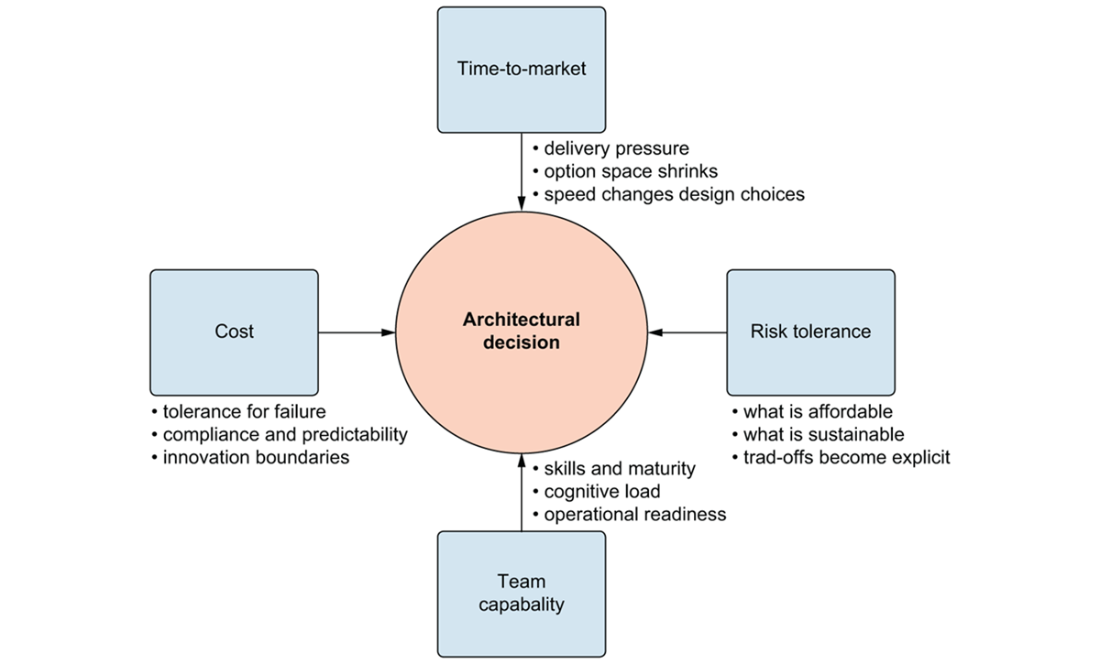
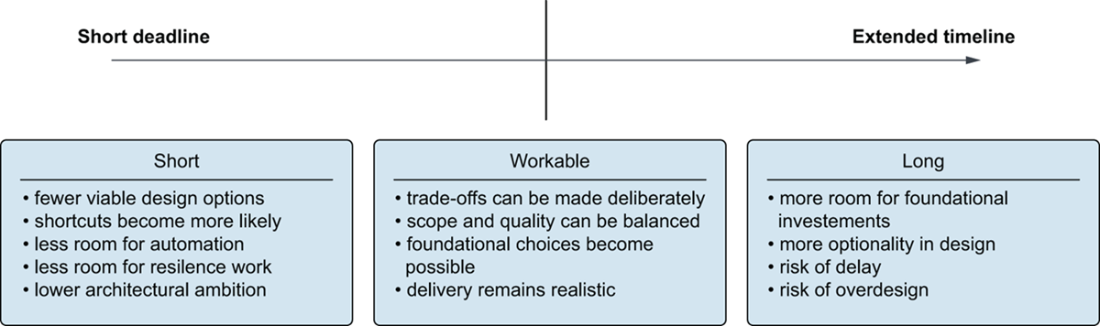
Time-to-market compresses the architectural option space. The less time available, the fewer classes of solutions remain realistic.
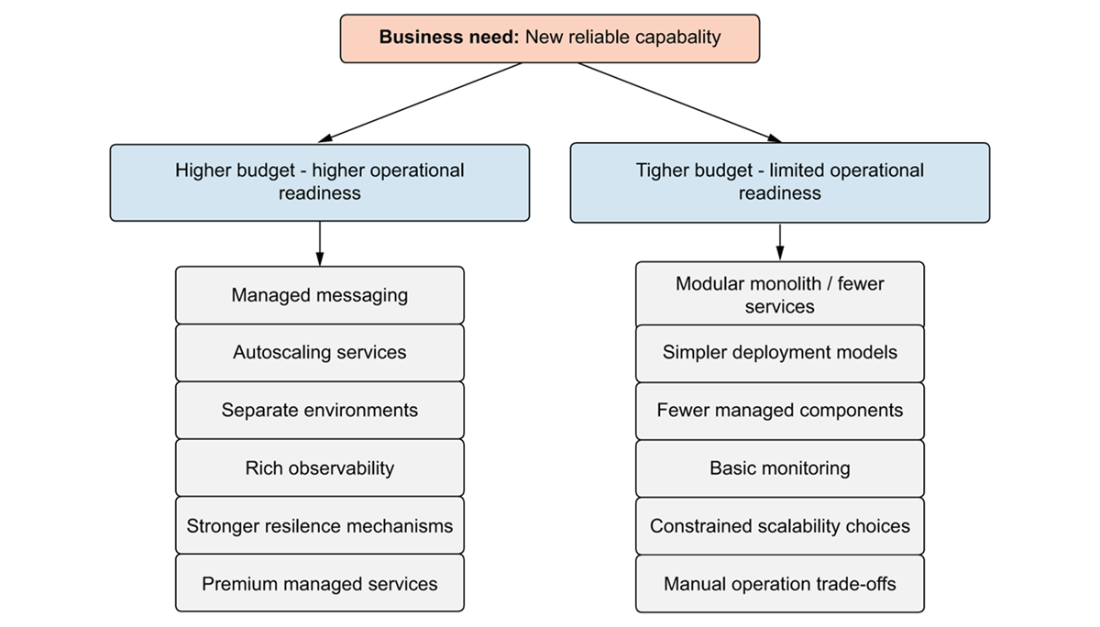
Budget changes the architecture that is realistic.
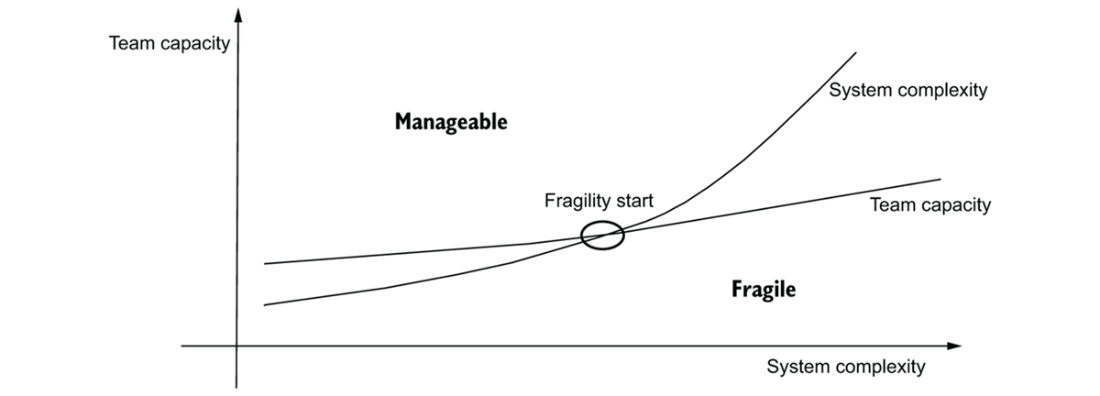
Architecture becomes fragile when system complexity exceeds the team’s ability to understand, own, and operate it with confidence.
Summary

  • Architecture is shaped less by ideal design than by the forces acting on the system and the organization.
  • Time-to-market compresses the architectural option space, pushing decisions toward what can be delivered rather than what would be most elegant.
  • Cost does not only limit what is desirable; it determines what the organization can realistically afford to build, operate, and sustain.
  • Team skills, ownership, and cognitive capacity define what the organization can realistically build, support, and evolve over time.
  • Risk tolerance reflects how much uncertainty the organization is willing to accept in delivery, operations, compliance, and long-term ownership.
  • AI accelerates implementation, but it does not remove architectural pressure; it increases the need for judgment, guardrails, and consistency.
  • Architectural decisions are never made in isolation; they emerge from the interaction of multiple forces acting at the same time.
  • As those forces change, earlier decisions can lose their validity, which is why architecture must be revisited and rebalanced over time.
  • Architectural judgment means finding a viable balance between constraints, trade-offs, and long-term consequences.

FAQ

What are the main forces that shape architecture in this chapter?Architecture is shaped by the combined pressure of time-to-market, cost and budget, team skills and maturity, risk tolerance, ownership, and the wider project landscape. These forces determine which solutions are realistic, sustainable, and acceptable for the organization.
Why is time-to-market such a powerful architectural force?Because deadlines compress the set of viable options. Under time pressure, teams usually favor simpler designs, cut nonessential refinement, and focus on the parts where failure would be most costly, such as security, data integrity, deployment, and rollback.
How should architects respond to deadline pressure without creating hidden debt?They should make every shortcut explicit: what was skipped, why it was skipped, what risk it creates, who owns it, and when it will be revisited. The goal is not to avoid compromise, but to avoid invisible compromise.
What is technical debt in the context of this chapter?Technical debt is a deliberate or accidental decision that creates a future obligation, such as rework, extra operational burden, reduced flexibility, or added risk. It becomes responsible when it is visible, limited, reversible, and owned; it becomes reckless when it is hidden or unmanaged.
How does cost pressure influence architectural decisions?Cost pressure pushes choices between managed and self-hosted solutions, microservices and monoliths, premium and consumption-based options, and other trade-offs. The key question is not “what is cheapest?” but “what architecture is worth the cost it creates?”
Why can a simpler architecture be better than a more fashionable one?A simpler architecture may fit the organization’s real budget, team size, and operational maturity better. For smaller or less complex problems, a modular monolith can be more responsible than microservices because it avoids unnecessary infrastructure, coordination, and observability burden.
How do team skills and maturity affect architecture?The team must be able to understand, build, operate, and evolve the chosen solution. Even a technically strong design can fail if it depends on knowledge the team does not have, or if only one person can reason about its failure modes and operations.
What warning signs show that an architecture exceeds team capability?Common warning signs include only one or two people understanding failure modes, support depending on heroes or external specialists, fragile release steps, unclear ownership, learning happening during production incidents, and every team having to invent its own approach.
How does risk tolerance change architectural choices?Risk tolerance affects whether an organization chooses proven or experimental technologies, managed or self-operated platforms, synchronous or asynchronous integration, and multi-region or simpler deployment models. Low-risk organizations usually accept more controls and slower change; high-risk organizations may accept more uncertainty for speed and learning.
What is the purpose of the practical force-assessment framework?It helps architects evaluate a decision before committing to it by asking about time, cost, team capability, risk tolerance, ownership, and the project landscape. Its purpose is to expose pressure early so the team can choose a viable solution instead of an ideal one that cannot be sustained.

pro $24.99 per month

  • access to all Manning books, MEAPs, liveVideos, liveProjects, and audiobooks!
  • choose one free eBook per month to keep
  • exclusive 50% discount on all purchases
  • renews monthly, pause or cancel renewal anytime

lite $19.99 per month

  • access to all Manning books, including MEAPs!

team

5, 10 or 20 seats+ for your team - learn more


choose your plan

team

monthly
annual
$49.99
$499.99
only $41.67 per month
  • five seats for your team
  • access to all Manning books, MEAPs, liveVideos, liveProjects, and audiobooks!
  • choose another free product every time you renew
  • choose twelve free products per year
  • exclusive 50% discount on all purchases
  • renews monthly, pause or cancel renewal anytime
  • renews annually, pause or cancel renewal anytime
  • Software Architecture Decision-Making ebook for free

choose your plan

team

monthly
annual
$49.99
$499.99
only $41.67 per month
  • five seats for your team
  • access to all Manning books, MEAPs, liveVideos, liveProjects, and audiobooks!
  • choose another free product every time you renew
  • choose twelve free products per year
  • exclusive 50% discount on all purchases
  • renews monthly, pause or cancel renewal anytime
  • renews annually, pause or cancel renewal anytime
  • Software Architecture Decision-Making ebook for free