3Enhancing portability and security with Wasm components
This chapter explains how the WebAssembly Component Model, with WIT as its interface definition language, lifts and lowers data between low-level and high-level types to make components portable, composable, and safer by default. By wrapping plain Wasm modules, components eliminate fragile, shared-memory conventions and instead communicate through explicit imports and exports. The result is cross-language portability, shared-nothing isolation, capability-scoped access (“only what you need”), and faster vulnerability mitigation by swapping a single component without rebuilding the whole app—reframing Wasm from a mere compilation target into microservice-like building blocks.
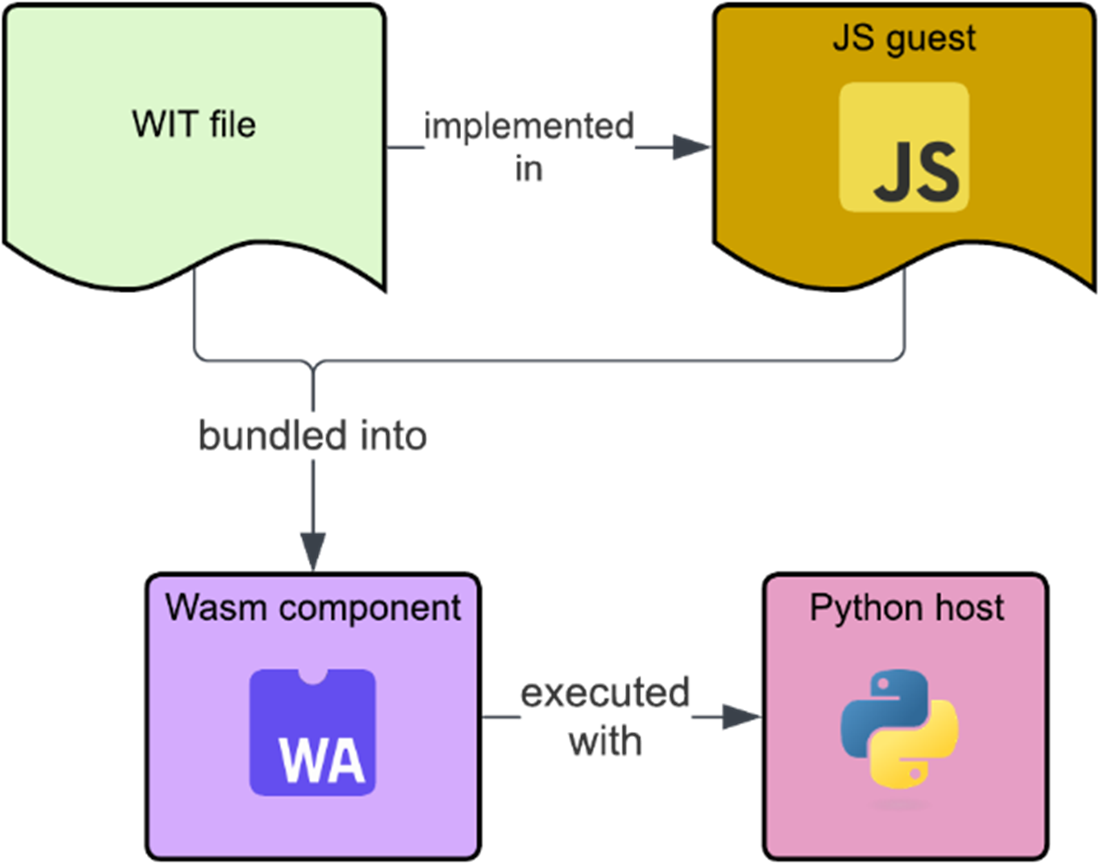
The chapter then demonstrates these ideas with a small project: a JavaScript “Hello, World” component defined by a WIT interface and compiled with a JavaScript toolchain into a Wasm component that works with high-level strings rather than manual memory. A minimal Python host embeds Wasmtime to load the component and call its function directly, showing simple, zero-network cross-language calls and how capability restrictions can be applied during componentization.
Finally, the chapter expands to a Smart CMS example by refining the WIT to import a host-provided kvstore interface and export a run entry point. A Rust host implements the kvstore using Wasmtime’s component support, a HashMap-backed store, explicit linker wiring, and component-model configuration, while a JavaScript guest imports kvstore to set and get values. The example highlights type translation across languages (such as Option to string | undefined), reinforces isolation and least-privilege capabilities (the guest only sees kvstore), and shows how component boundaries and explicit interfaces streamline maintenance and mitigation. It closes by noting that, in practice, standardized interfaces and generic hosts let developers focus on business logic rather than bespoke runtime wiring.
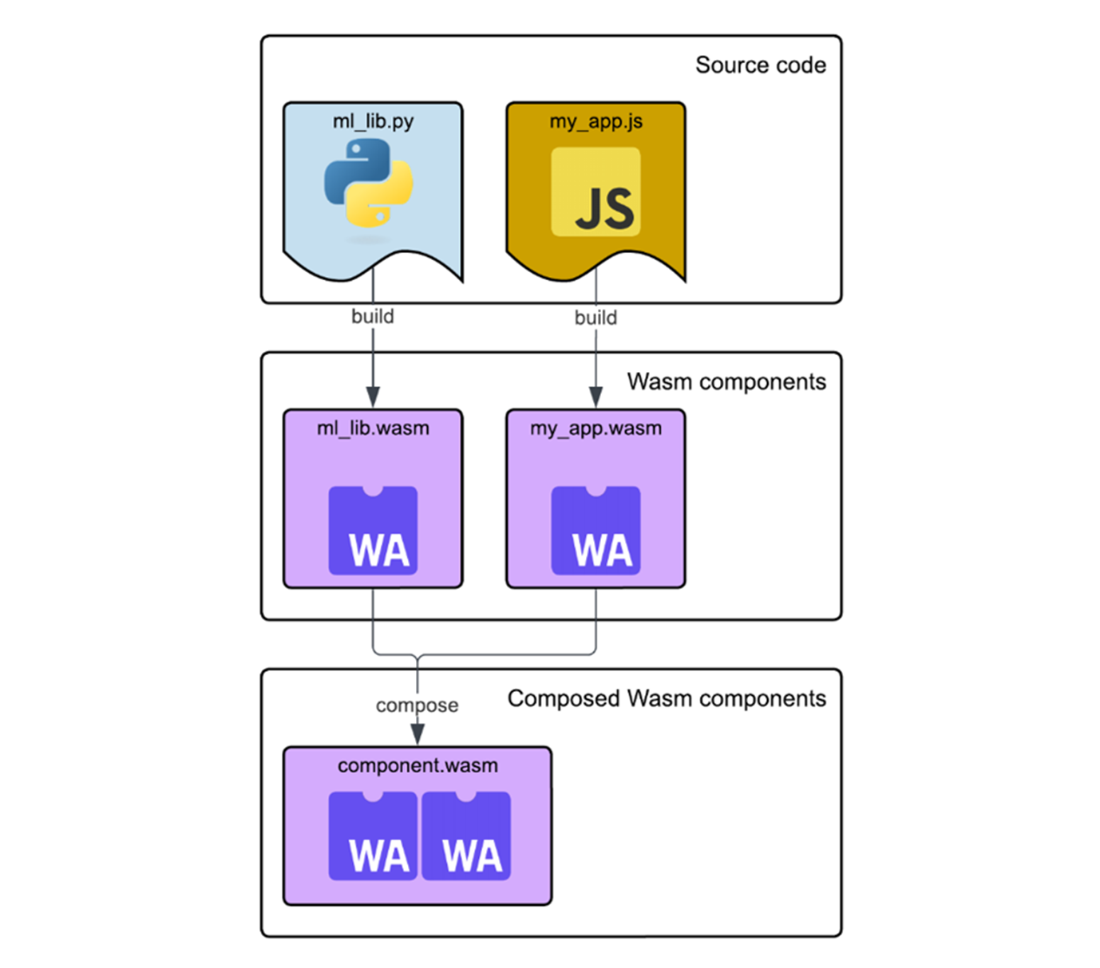
An example of cross-language portability with Wasm components.
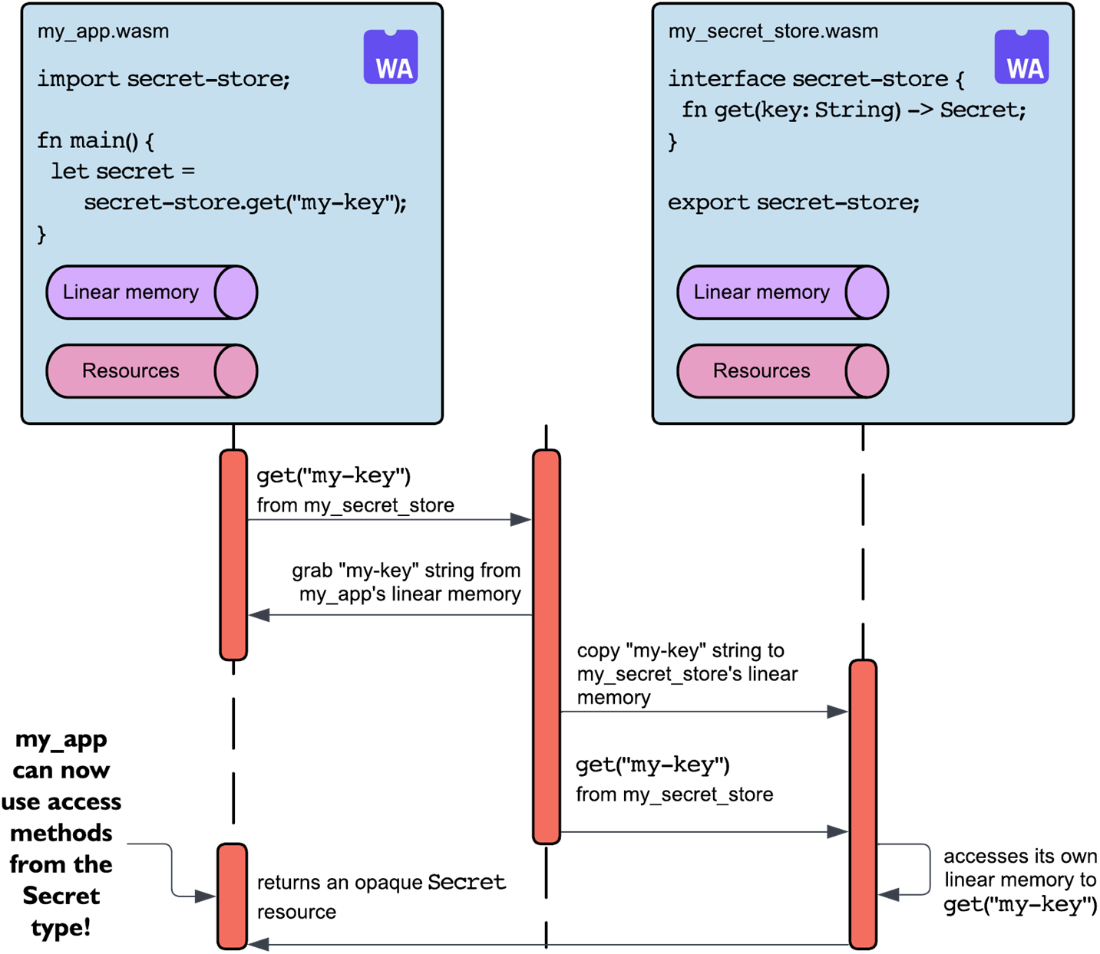
The interaction between two isolated Wasm components starting from a function call, to communicating with an adapter component, doing required memory copies, and retuning a resource that can be accessed via a resource table.
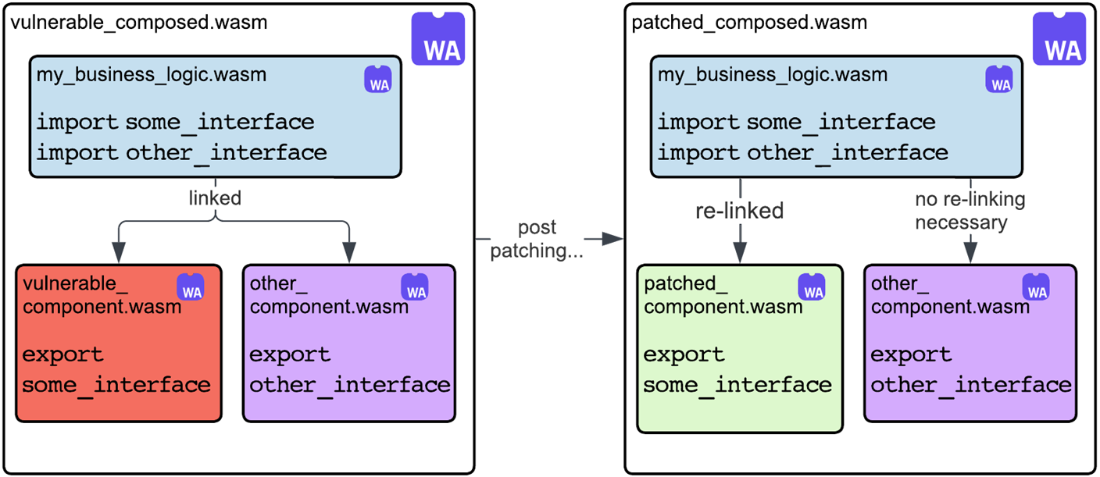
An example of improved mitigation response with Wasm components.
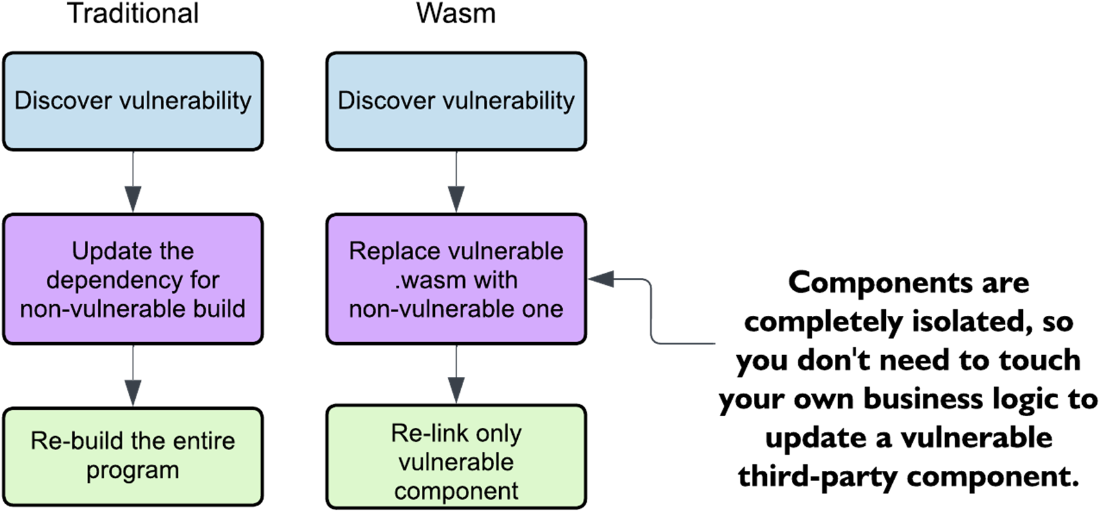
Illustrated difference between traditional architectures and one using Wasm Components in terms of vulnerability mitigation.
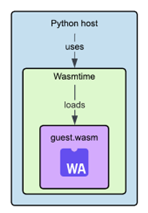
The host is a thin wrapper around Wasmtime, which we will use to load our guest component and execute the functions it implements.
The flow of our "Hello, World" application with a Wasm component.
Summary
Wasm components are a wrapper around Wasm modules that allow us to use higher level types.
Wasm components add a new level of portability to Wasm by allowing easy cross-language communication.
Wasm components enforce a shared-nothing principle between components or within host. They communicate exclusively through imports and exports and do not share memory.
Wasm components improve security by only allowing access to specific imports and exports and they contain no hidden dependencies.
Wasm components improve mitigation response by allowing us to update components simply by re-linking the patched component without rebuilding the entire project.
There are language-specific toolchains for creating Wasm components that take care of generating the glue code needed to interact cross-language.
Developers generally use standardized interfaces and pre-built generic hosts to run Wasm components.
FAQ
What are Wasm components, and how do they differ from plain Wasm modules?Wasm components wrap Wasm modules with a typed interface defined in WIT. They lift/lower values between low-level Wasm types and high-level types (like strings and resources), eliminating manual memory layout agreements and enabling safe, structured interop between modules and hosts.What is WIT, and how is it used in the Wasm Component Model?WIT (WebAssembly Interface Types) is the IDL for the Component Model. It defines functions, types, and worlds (collections of imports/exports). Components use WIT to declare what they provide and require, enabling tooling to generate glue code and handle type conversions across languages.How do Wasm components enable cross-language portability?Components let you implement parts of an app in different languages and compose them into a single .wasm artifact. With WIT-driven lifting/lowering, you avoid bespoke memory layouts, network microservices, and ad‑hoc serialization, allowing seamless calls across languages.What is “shared-nothing” security in the Component Model?Components and hosts do not share linear memory. They communicate only via typed imports/exports defined in WIT. Values are copied as needed, and opaque resources are accessed through handles, reducing memory corruption risks and implicit coupling.What are resource handles and resource tables?Opaque resources (like a Secret) aren’t copied by value. Instead, the callee returns an integer handle that indexes a resource table (separate from linear memory). Callers then use functions to operate on the resource via its handle, preserving isolation.What is “only-what-you-need” capability security, and why does it matter?Each component explicitly declares the imports it can access. Nothing else is available by default (e.g., you can disable stdio, random, clocks, http). This narrows the attack surface and limits the blast radius of vulnerable or malicious code.How do components improve vulnerability mitigation and patching speed?Because components are isolated and connected by explicit interfaces, you can swap out just the vulnerable component with a patched build and re-link—no need to rebuild your core business logic. Isolation also contains the impact compared to traditional dynamic libraries.How do I build a simple JavaScript component from a WIT file?Define your WIT (e.g., a greet function), implement it in JavaScript using high-level types, then use the jco toolchain to componentize into a .wasm. You can explicitly disable capabilities (like stdio/random/clocks/http) during componentization to enforce least privilege.How can I host and call a component from Python with Wasmtime?Install wasmtime for Python, import wasmtime and its loader, import the generated module for your component, create a Store, instantiate the Root, and call the exported function (e.g., greet). Wasmtime handles type conversions per the WIT definitions.How do I provide host-side functionality from Rust for a guest component?Use wasmtime::component::bindgen! with your WIT to generate bindings. Implement the host trait for your types (e.g., a kvstore backed by a HashMap), create a Store with state, add your implementation to a Linker with add_to_linker, load the guest component, instantiate it, and call its exports (e.g., run).
pro $24.99 per month
access to all Manning books, MEAPs, liveVideos, liveProjects, and audiobooks!

 Server-Side WebAssembly ebook for free
