4 Darwin Gödel Machine, improving search
The chapter introduces evolutionary search as the way to push a self-improving agent beyond the limits of a simple greedy hill climber. Borrowing Darwin’s core loop of variation, selection, and inheritance, it shows how a population of candidates can move through a search landscape together, making progress where a single candidate would stall at the first local optimum. In the book’s language, the familiar genetic-algorithm ideas map directly onto mutate, Signal, and parent pointers, with “remember” becoming an important addition that keeps the best candidates alive across rounds.
It then develops GEPA, a population-based prompt optimizer that improves instructions by reading the agent’s own failures before mutating them. Reflection turns a blunt score into a diagnosis, so edits can target the missing rule rather than guess blindly, while Pareto-style selection preserves diverse trade-offs instead of collapsing to a single winner. Even so, GEPA can converge too early: once the population narrows, the lost branches that might solve the final gap disappear, which limits how far this search can go.
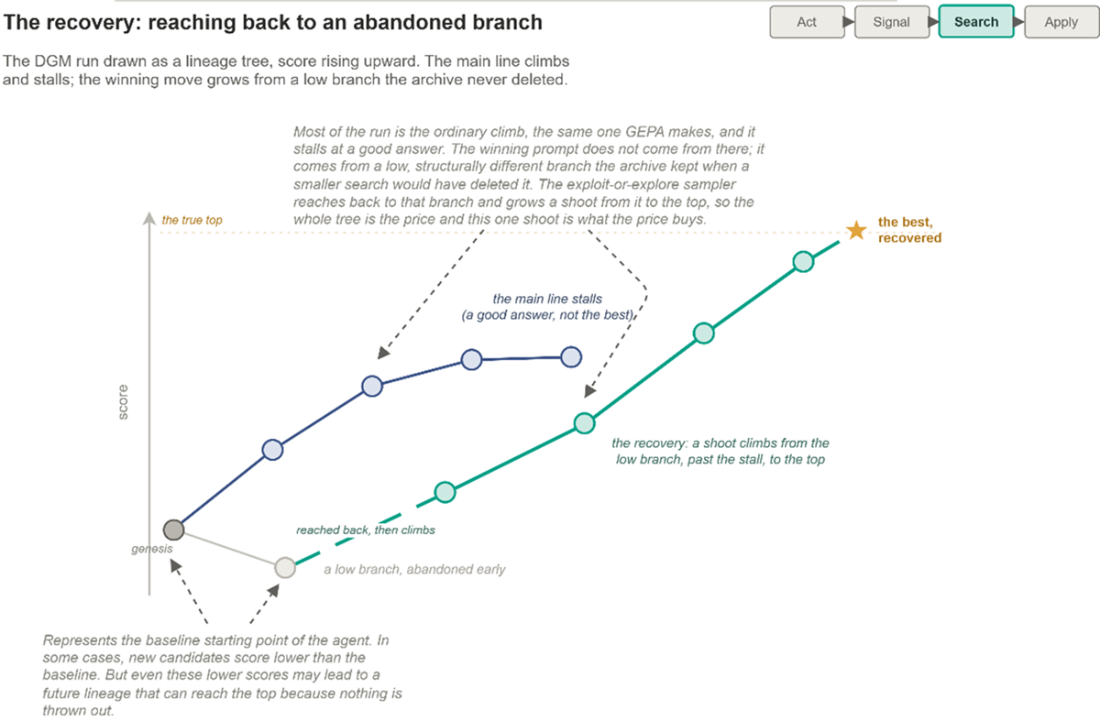
To address that limitation, the chapter presents DGM as a search method with an archive that never forgets. Instead of demanding a proof that a change will help, it accepts measured evidence, keeps every candidate, and uses quality-diversity sampling to revisit neglected branches when needed. The result is a deeper, more expensive search that can recover solutions GEPA leaves behind, and the lineage-view discussion makes that benefit visible by showing the whole run as a tree, where the winning prompt often comes from an old branch that remained available because nothing was discarded.
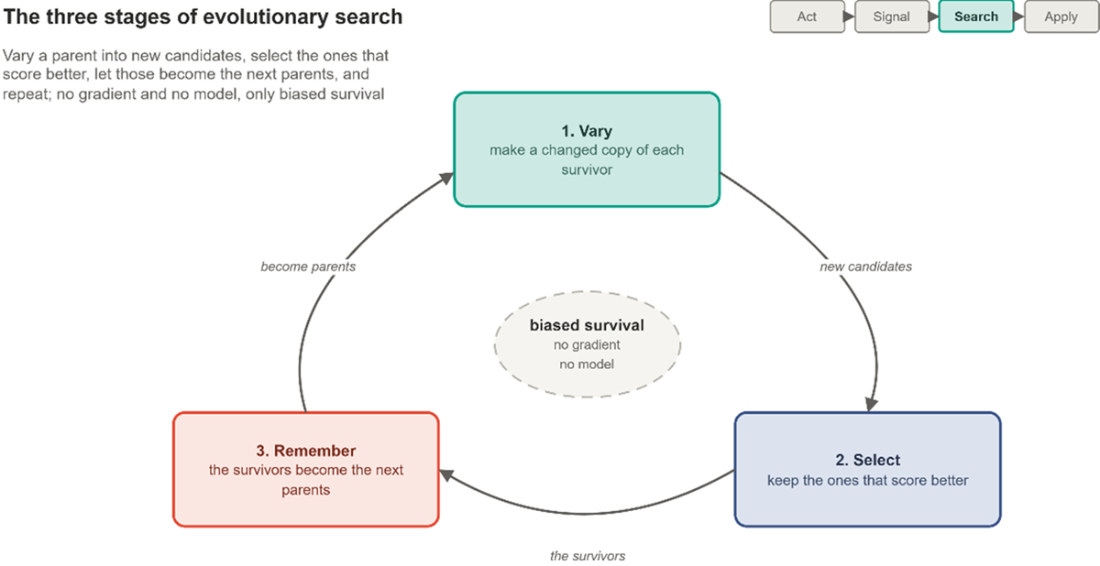
The three stages of evolutionary search. Vary a parent into new candidates, select the ones that score better, let those become the parents of the next round, and repeat. No gradient and no model sit anywhere in the circle; the ascension comes entirely from biased survival, which is what makes this the oldest search there is.
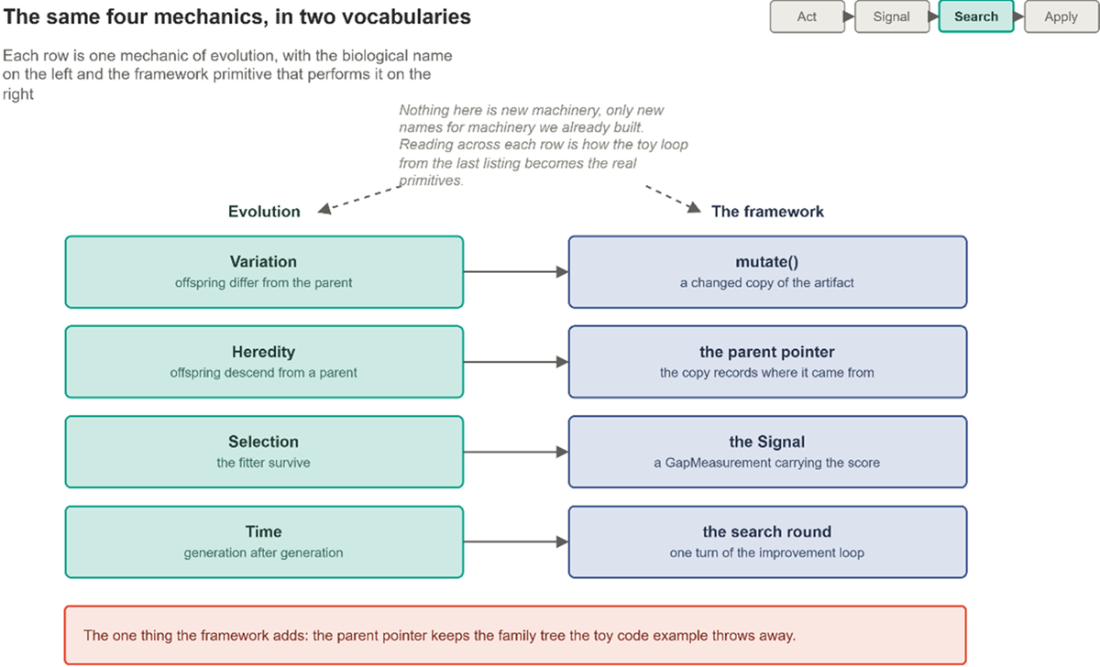
The same four mechanics, in two vocabularies. Evolution runs down the left column and the framework down the right: variation maps to mutate(), heredity to the parent pointer, selection to the Signal, and time to the search round. Reading across each row is how the evolutionary loop becomes the real primitives, with nothing added but new names.
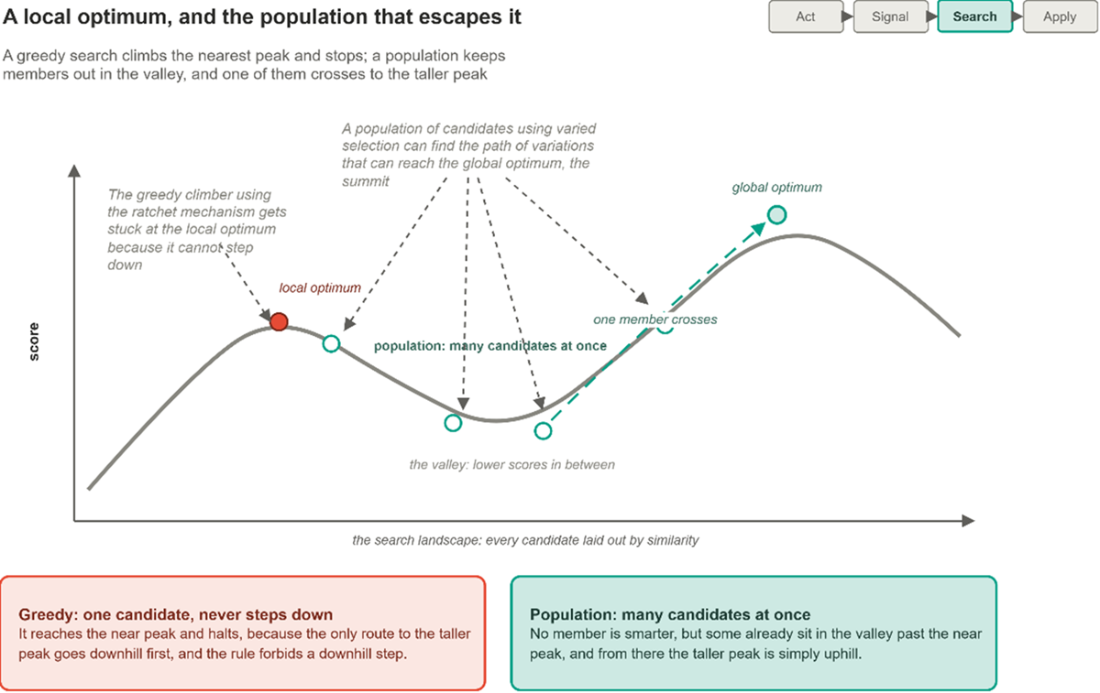
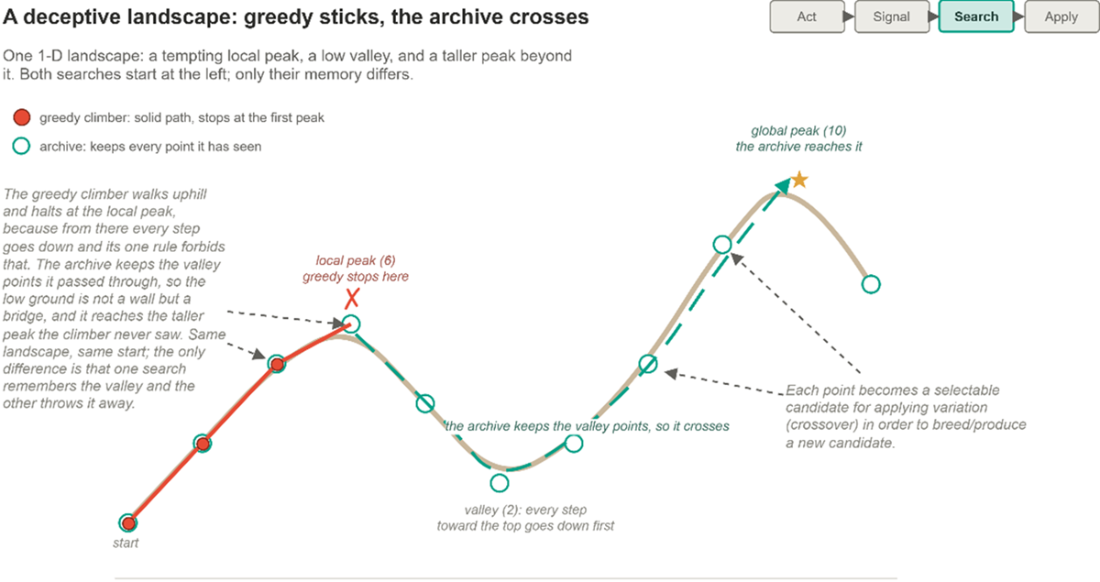
A local optimum, and the population that escapes it. A single greedy climber (solid) reaches the near peak and stops, since the only way onward is down. A scattered population (hollow) keeps members out in the valley, and one of them crosses to the taller peak; the whole argument of this chapter is in that single crossing.
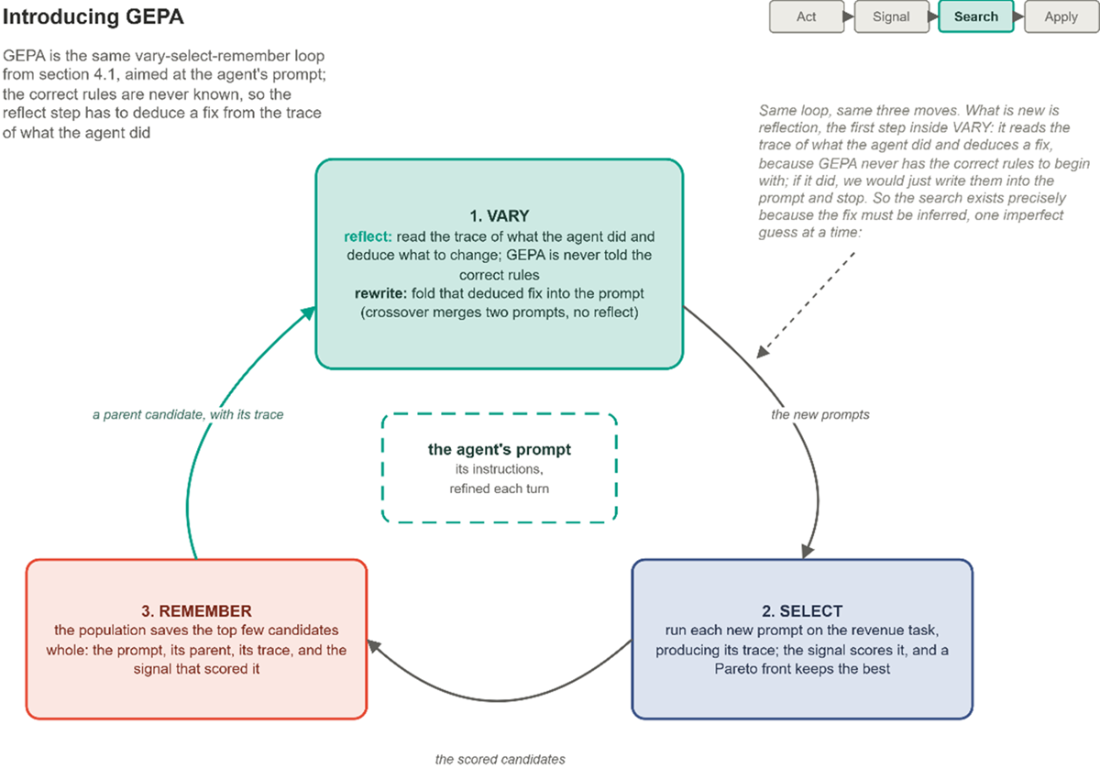
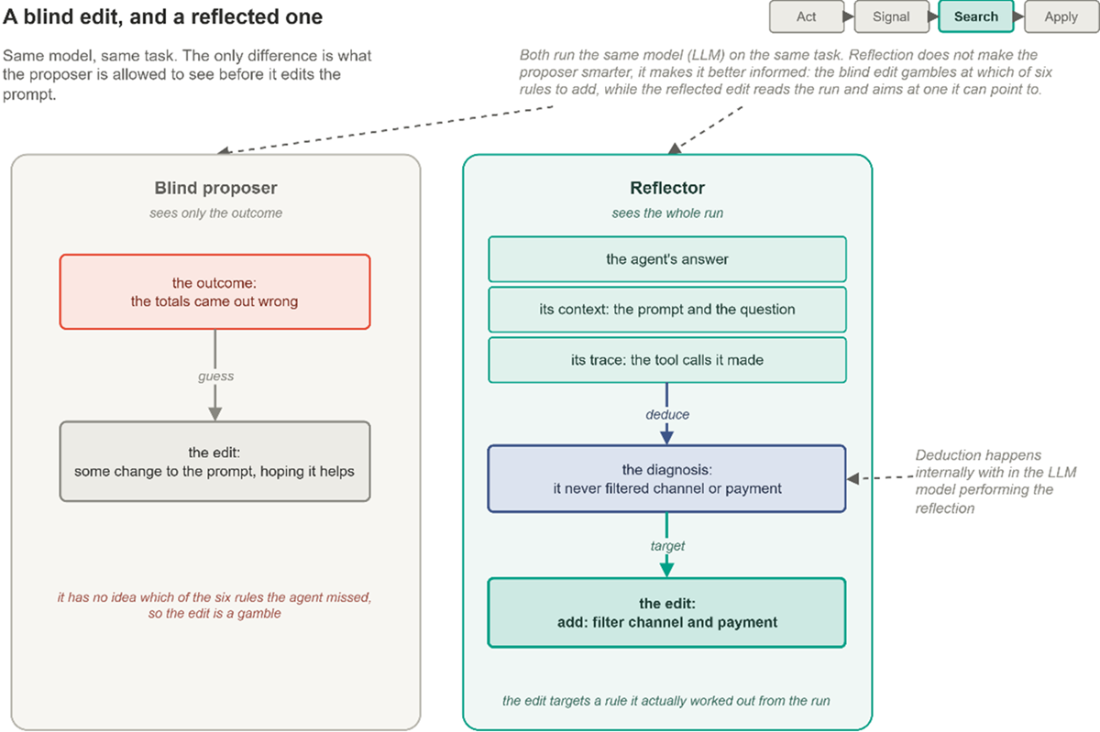
Introducing GEPA. The vary-select-remember cycle from the last section runs again here: vary is a reflected rewrite of the prompt plus crossover, select runs and scores each new prompt and keeps the best on a Pareto front, and remember carries a whole population forward. The one new piece is reflection inside the vary step, which reads the agent's trace so the rewrite targets the exact rule it skipped, and none of it touches the model's weights.
A blind edit beside a reflected one. On the left, a blind proposer sees only the wrong answer and guesses; on the right, the reflector reads the whole run, the answer and the steps that led to it, works out a likely missing rule, and hands the mutation a specific target. Same model and same task, so the only difference is what the proposer was allowed to see.
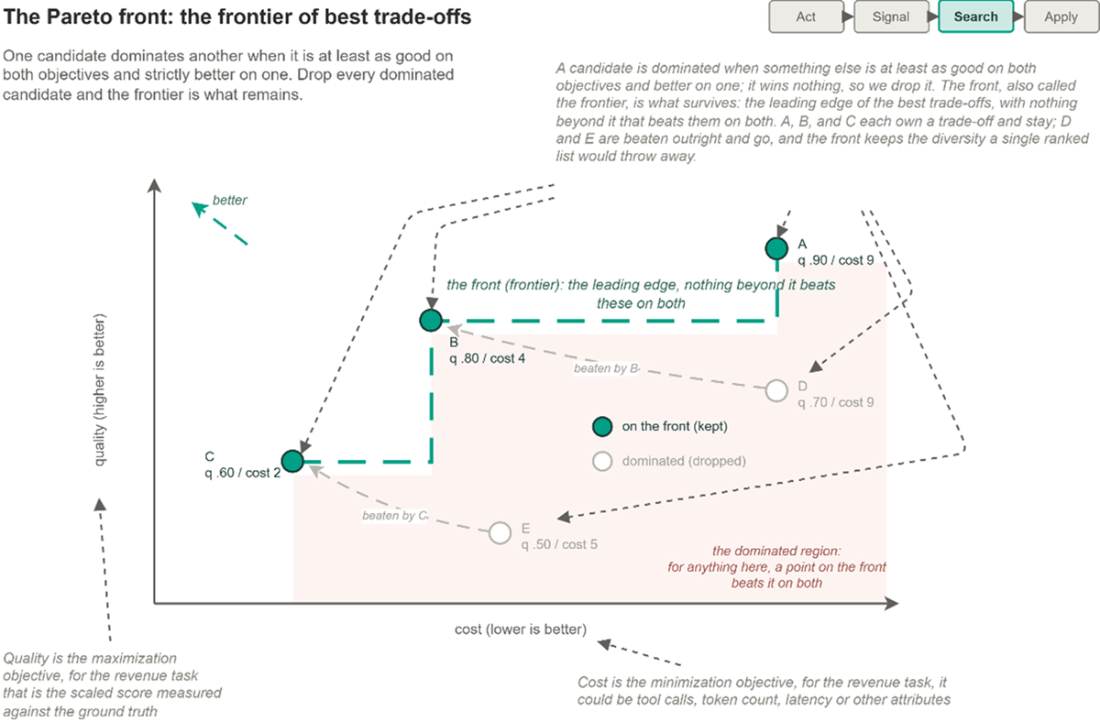
The front is the frontier of best trade-offs. Five candidates are scored on quality (up) and cost (across). A, B, and C sit on the front, each the best at some trade-off, so nothing beats them on both and all three are kept; D and E fall in the shaded dominated region, beaten on both axes at once, and are dropped.
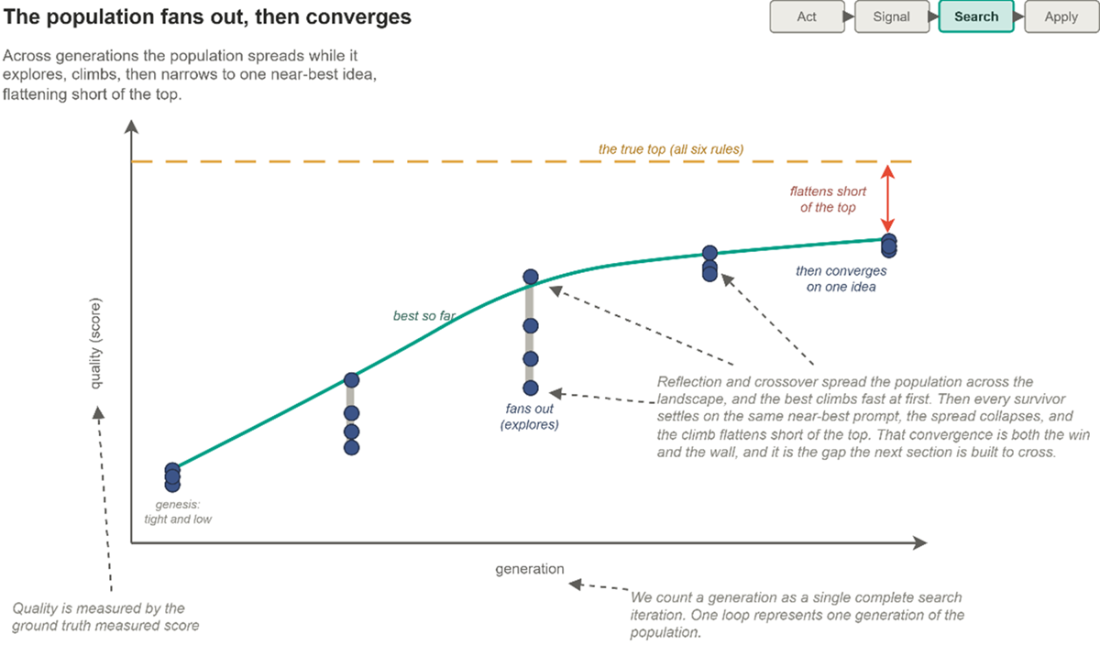
The population fans out, then converges. Across several generations the population spreads as reflection and crossover explore, climbs, then narrows as every survivor settles on the same near-best idea. That convergence is the win and the wall at once, and it is why the climb flattens short of the top.
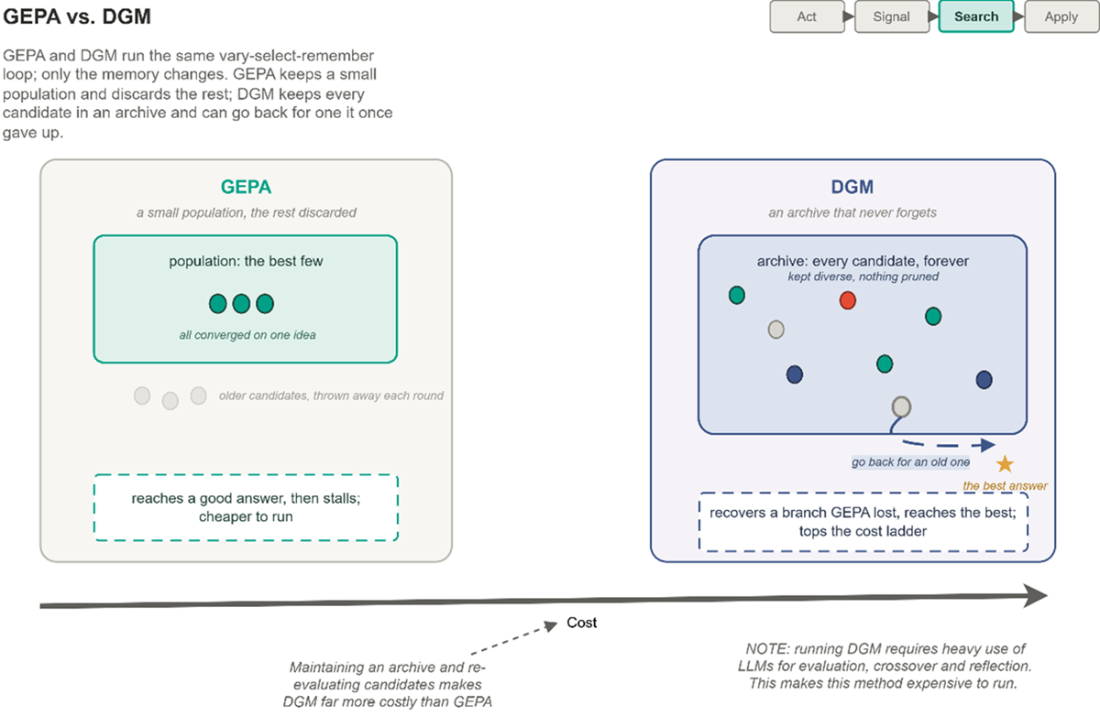
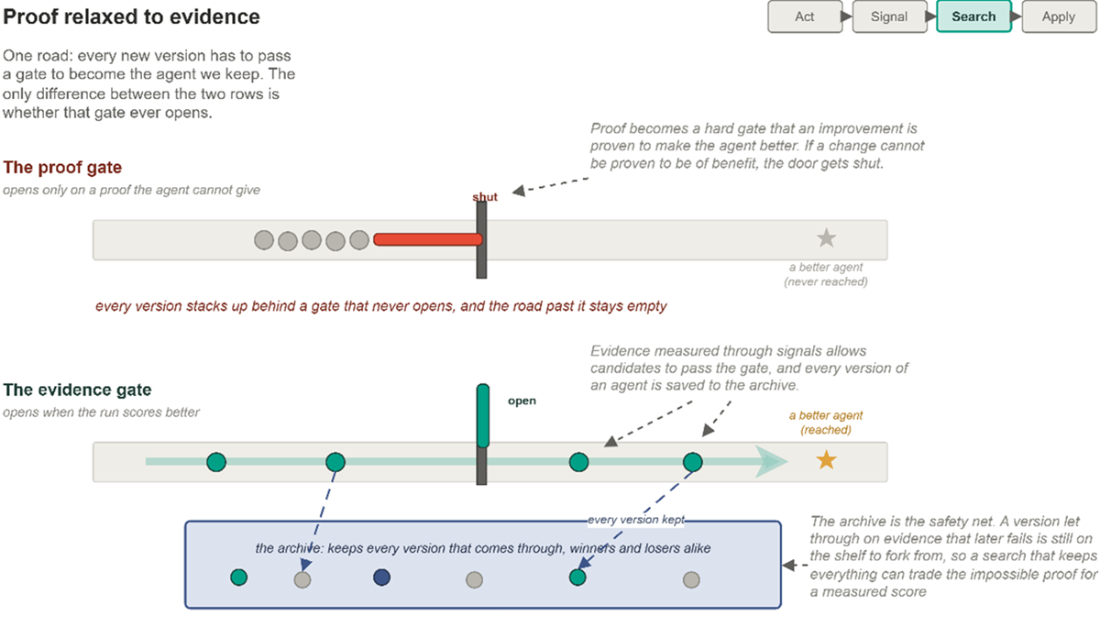
GEPA vs. DGM. GEPA forgets, DGM keeps everything. GEPA holds a small population and discards the rest each round, so it converges to a good answer and stops; DGM records every candidate in an archive it never prunes, so it can go back for an old branch it once set aside and carry the task to the best answer, at the top of the cost ladder. The strip below maps the four subsections that build that difference: the gate, the sampling rule, a free proof-of-concept, and the paid recovery.
One road, one gate, two ways to open it. Every new version travels the road to becoming the agent prompt artifact we keep, and a gate stands in its way. On the top road, the proof gate never lifts, so versions stack up behind it, and the better agent on the right is never reached; on the bottom road, the evidence gate lifts on a better score, so versions flow through and drop into an archive that keeps every one, which is what makes opening on evidence safe.
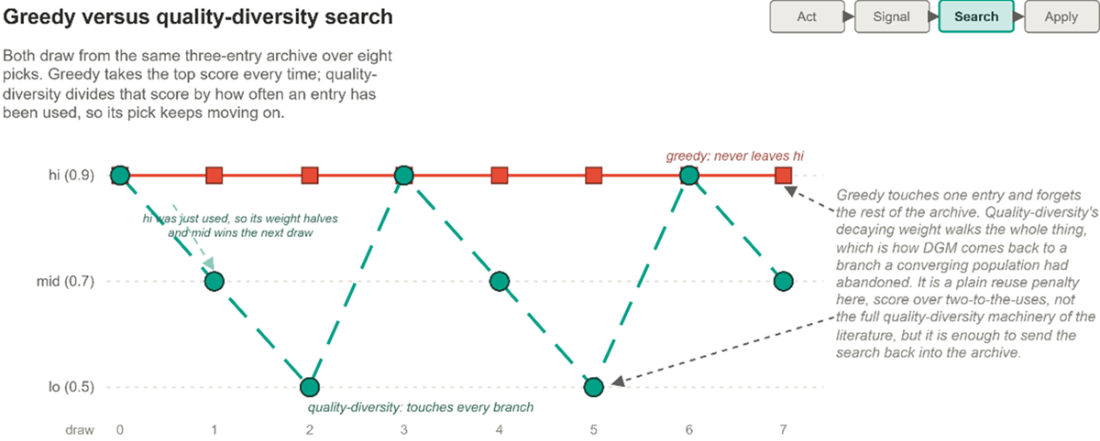
Greedy fixates, the decaying weight cycles. Over eight draws on the same three-entry archive, greedy takes the top score every time and its path stays flat on the hi lane. Quality-diversity divides that score by how often an entry has been used, so each pick halves its own weight and the path sawtooths through mid and lo before returning, touching every branch.
The valley is a wall for greedy and a bridge for the archive. The greedy climber (solid) walks up to the local peak and halts, since every neighbor from there is lower. The archive (hollow markers on every point) keeps the low valley points it passed through, so the dip is something to cross rather than a wall, and it reaches the taller global peak the climber never saw.
The recovery, made literal. Most of the run is the ordinary climb, which stalls at a good answer; the winning prompt grows instead from a low, structurally different branch the archive never deleted. The exploit-or-explore sampler reaches back to that branch and a new shoot climbs from it past the stall to the top, a path that exists only because nothing was thrown away.
Overview of the Helix Observatory. The observatory provides a dashboard to review and analyze the performance of past self-improvement runs. You can observe from the details of a runs champion to individual rounds (generations) to compare lineages of runs side by side.
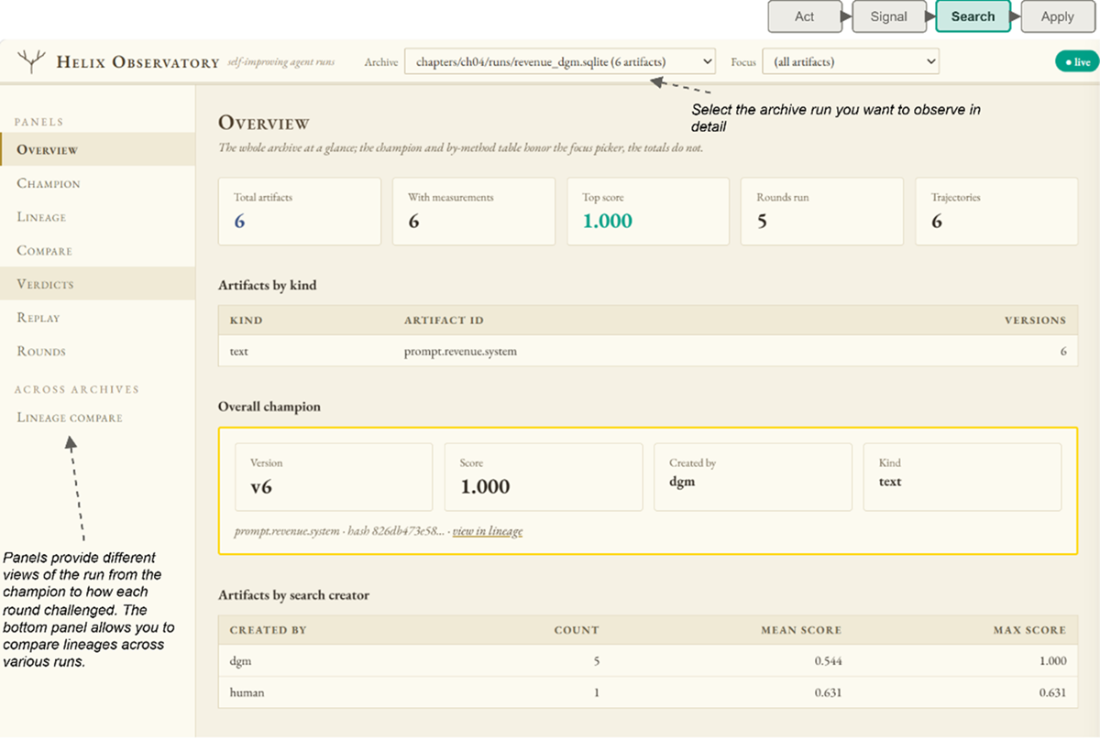
The Lineage panel tree view over the DGM run, champion selected. Clicking a version lights its ancestry, so the winning line runs genesis to crown while the rest of the archive fades to context, and dashed rings mark the breeding pool at the champion's birth. The champion grew from a branch untouched since the first iteration, its equal-scoring sibling having burned two dead ends in between, and the tree ends at the crown because the run stops the moment ground truth reports a perfect answer.
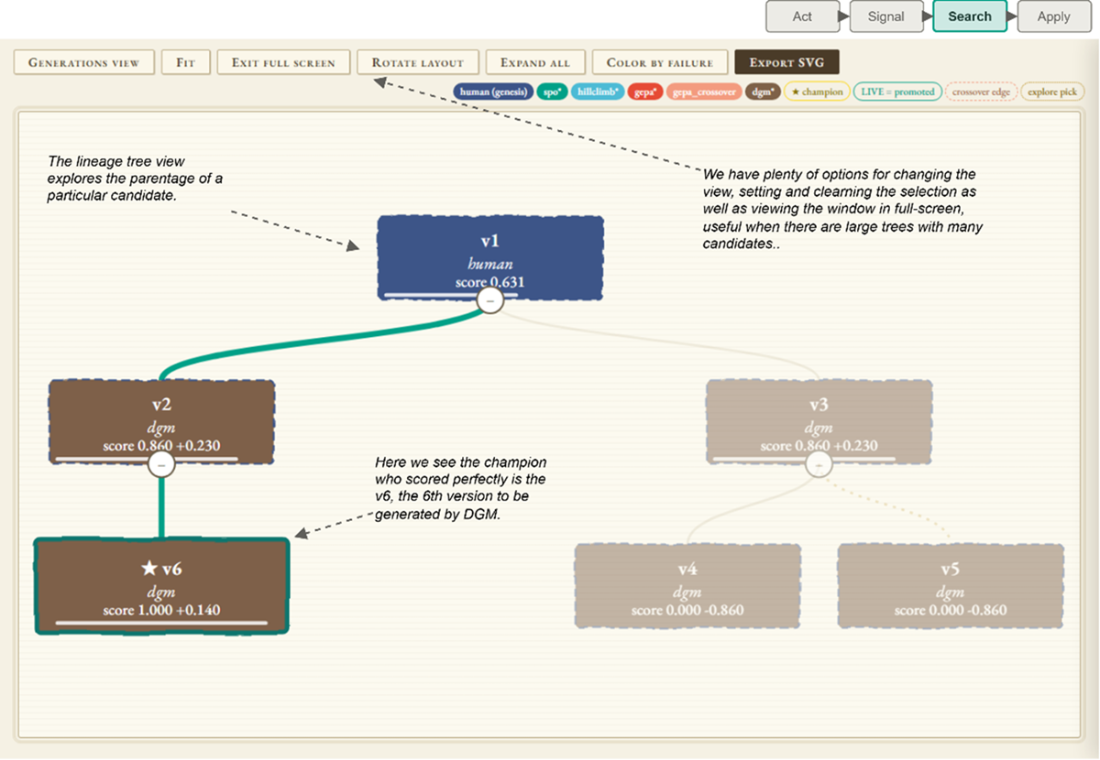
The DGM run in the Generations view. One lane per iteration, with the breeding pool in each gutter: teal was picked as a parent, plain was available, and nothing is ever struck out because the archive never discards. The pool widens every lane while the sampler burns two dead ends on the rival branch, and the final exploit pick reaches back to the branch untouched since iteration 0, which is the archive paying for itself in one picture.
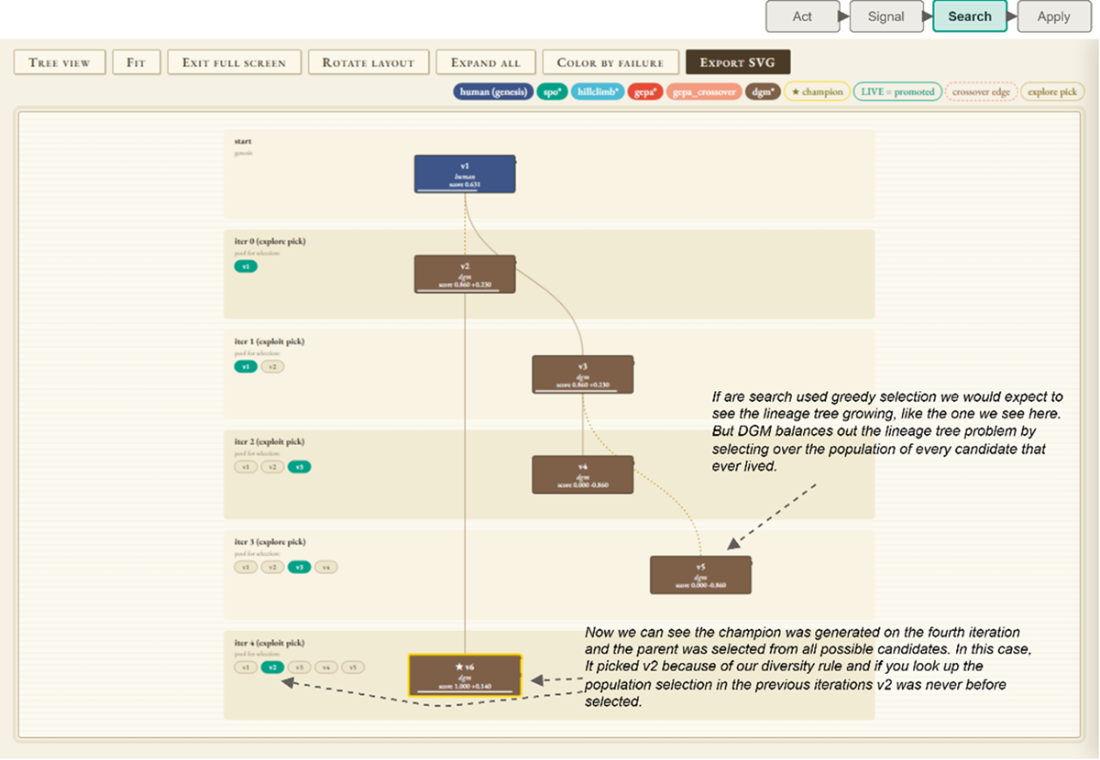
Convergence above memory: both runs in the Generations view. Each lane is one generation, and the chips in its gutter are the breeding pool at that moment: teal was picked as a parent, plain was available, struck through was already discarded. GEPA's pool freezes at two survivors while its discard pile grows, so every new child reworks the same two parents; DGM's pool only ever widens, and its champion ends a column the sampler reached back to after the rival branch burned two dead ends, which is the chapter's argument made literal.
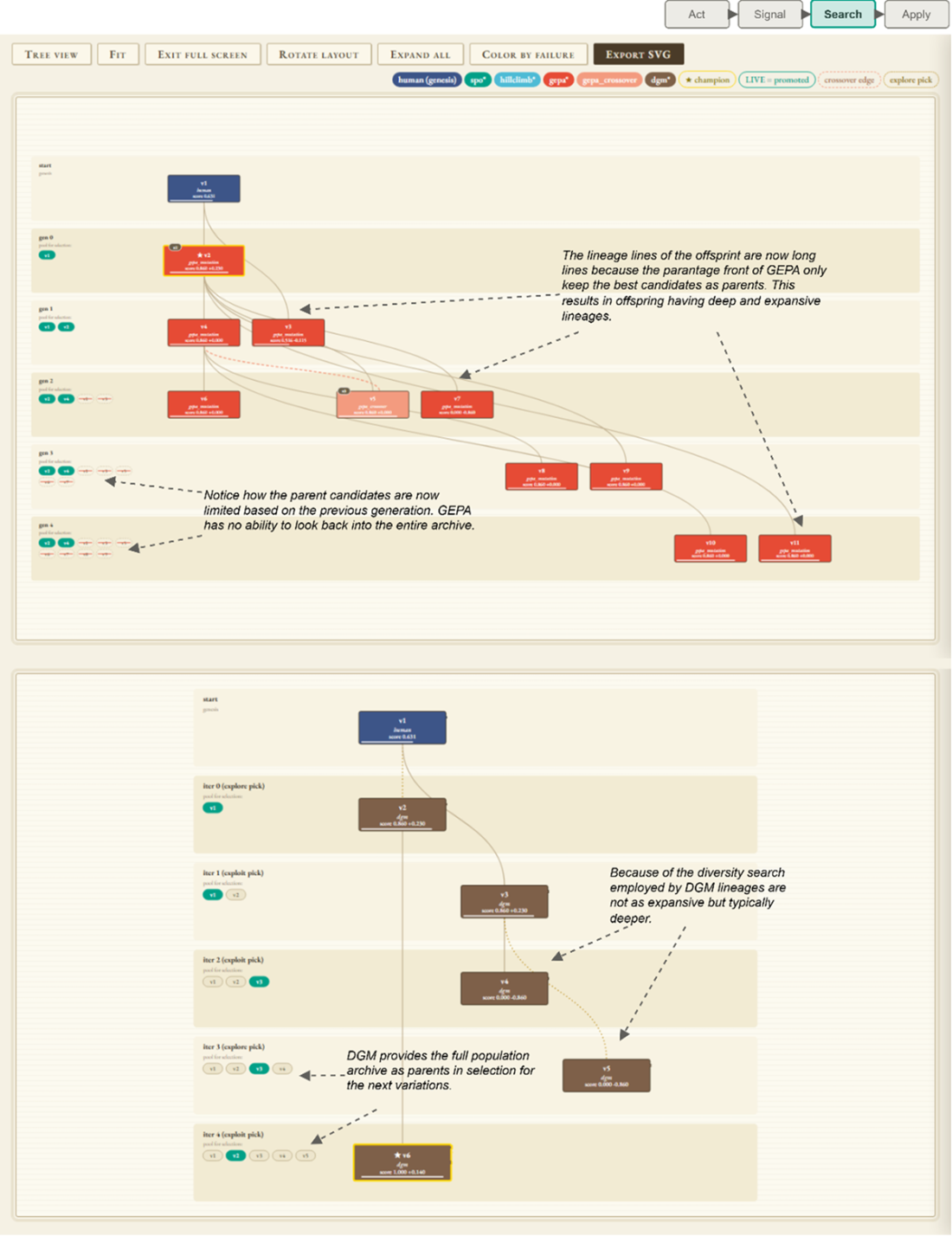
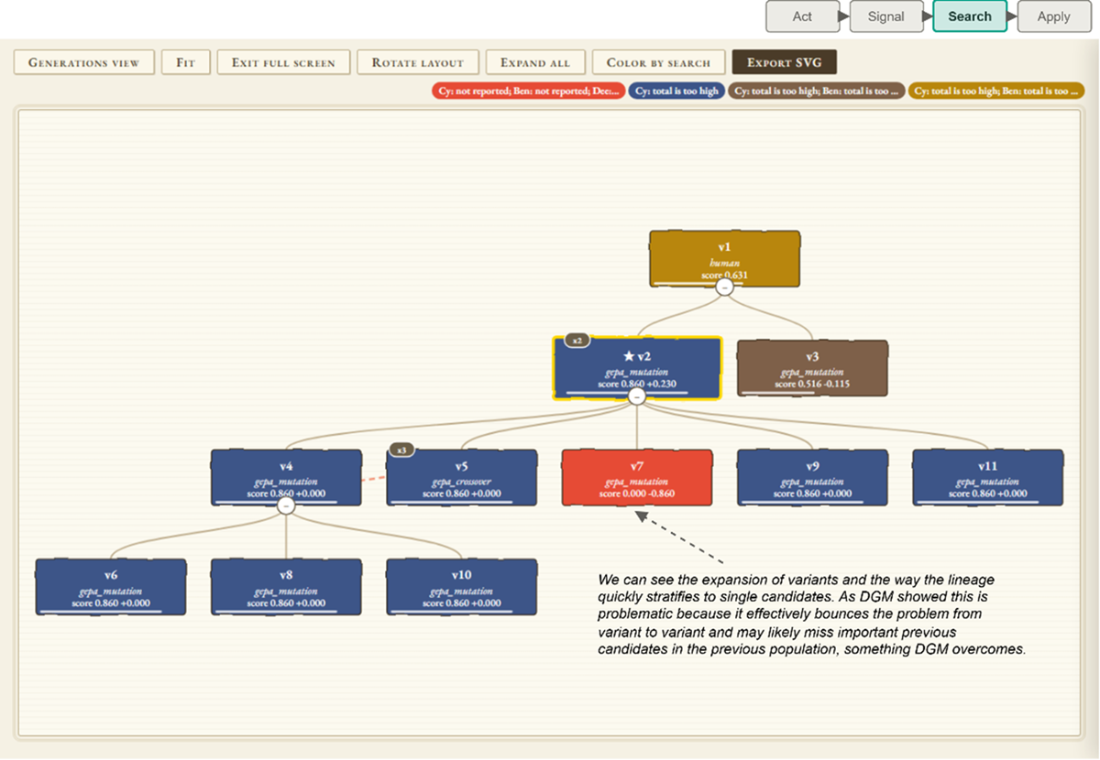
The same fan, colored by failure. Recolored by the checker's recorded feedback, GEPA's run collapses into a few strata: early bands still missing several rules, the bulk of the run sharing one identical failure, and a lone catastrophic mutation. The wall is literally a single unsolved rule wearing a dozen different prompts, and the exact strata shift run to run while the shape of the story does not.
Summary
- Darwin described an algorithm with no designer and no goal, vary, select, remember; its progress is nothing but biased survival, better copies outnumbering worse ones with no gradient and no model in the loop.
- Classic genetic-algorithm vocabulary maps onto the loop, fitness is the signal and mutation and crossover are ways to vary, and on text artifacts those operators become semantic edits a model writes.
- Evolution needs only four mechanics an improvement loop already has: variation is a changed copy, heredity a parent pointer, selection the signal, and time the search round.
- A search landscape lays every candidate out at the height of its score; a local optimum outscores every neighbor, and greedy cannot leave one because the only way out is downhill first.
- A population beats a single climber for a plain reason: its members are spread across the landscape, some already standing in the valley, and from the valley the taller peak is uphill.
- GEPA evolves a population of prompts and lets the proposer read each run's execution trace before editing, fixing both causes of the single-climber stall without touching a model weight.
- Reflection turns a bare grade into a graded paper, diagnosing in words which rules a run missed so mutation can act on a named gap; the gain is a better-informed proposer, not a smarter one.
- One candidate dominates another when it is at least as good on every objective and strictly better on at least one; the Pareto front is everything undominated, preserving the diversity a ranked list throws away.
- Crossover breeds two parents into one child meant to inherit the best of both, and in any lineage it is the one place branches merge instead of split.
- Convergence is a small population's fate, not a tunable bug: it locks in the rules found so far, and the odd branch that might have cracked the last one is already gone.
- DGM keeps the Gödel machine's ambition and drops the word prove: an evidence gate lifts on a better measured score, and an archive that never discards makes saying yes early safe.
- Quality-diversity sampling weighs each archive entry by its score and taxes it for every reuse, so a strong neglected branch keeps earning turns; untax it and the sampler is greedy again.
- Spend by the landscape: greedy when it is smooth and the score cheap and trustworthy, a population when it is not, and the full archive only when the terrain is deceptive enough to demand one.
- Deep archive search needs a signal reliable enough to trust what it recovers, and a ground truth even buys an early stop, since a perfect score means solved rather than estimated.
- The recovery is the archive's payoff: reaching back to a low, structurally different branch and growing past the converged plateau, a path that exists only because nothing was thrown away.
- When every version carries its parent pointer, a finished run is a lineage tree that answers, after the fact, who was available, who was chosen, and who was thrown away.
- A reflection can only diagnose what the trace shows it: a failure of composition rather than a missing item can wear a dozen different prompts and stay one unsolved rule.
FAQ
```htmlWhat is the main idea behind the Darwin Gödel machine in this chapter?
The Darwin Gödel machine (DGM) improves the search mechanism itself by combining evolutionary search with an archive that never forgets. Instead of relying on a single ratcheting hill-climber, it keeps and revisits candidates so it can recover better solutions later.
How does evolutionary search differ from a single greedy hill climber?
A greedy hill climber follows one candidate and only moves uphill, so it can get stuck at a local optimum. Evolutionary search keeps a population of candidates, varies them, selects better ones, and remembers survivors, which makes it more likely to cross valleys to higher peaks.
What do “vary, select, remember” mean in evolutionary search?
Vary means making changed copies of candidates, select means keeping the better-scoring ones, and remember means carrying successful candidates forward into the next round. Together, these three steps form the basic evolutionary loop.
How does the book map genetic algorithm terms to its own framework?
In the book’s vocabulary, mutation becomes mutate(), fitness becomes the Signal that scores a candidate, selection is choosing the better candidates, and heredity is represented by the parent pointer in the artifact lineage. The whole process is one search round repeated over time.
Why can a population outperform a single candidate search?
A population covers more of the search landscape at once. If one candidate is stuck near a local peak, another may already be in a valley that leads to a taller peak, allowing the population to escape where a single climber cannot.
What is GEPA, and what makes it different from a plain evolutionary search?
GEPA stands for Genetic-Pareto and is a prompt optimizer that evolves a population of prompts while using reflection on the agent’s own run to guide mutation. Its key advantage is that it reads the failures in the trace, so edits are targeted rather than blind.
What is the role of reflection in GEPA?
Reflection turns a simple failure signal into a richer diagnosis by reading the whole run, not just the final score. That gives the mutator specific clues about what rule or instruction was missed, making the next edit much more targeted.
What is the Pareto front, and why is it useful?
The Pareto front is the set of candidates that are not dominated by any other candidate on all objectives. It preserves the best trade-offs, keeping diversity alive when a search is balancing multiple goals like quality and cost.
How does DGM improve on GEPA?
DGM keeps every candidate in an archive instead of letting the population converge and forget its past. This long memory lets it return to neglected branches, which can help it recover solutions that GEPA’s smaller population discarded.
Why does the chapter emphasize lineage trees and the Observatory dashboard?
The lineage tree makes the whole evolutionary run visible as parent-child history, and the Observatory lets you inspect that history in detail. It helps you see which branches survived, which were discarded, and how GEPA and DGM differ in practice.

 Self-Improving Agents ebook for free
