3 The Gödel Machine, and the importance of signal
The chapter opens by contrasting an elegant idea with a practical limitation: a self-improving machine that only accepts changes it can prove are better. That ideal is inspiring, but most real agent outputs cannot be proved correct in advance, so the book shifts from proof to measurement. The central lesson is that improvement begins with a signal that can judge whether a candidate is closer to “good” than before, even when certainty is unavailable.
To make that idea concrete, the chapter builds a revenue-analysis task with a known correct answer and shows how a weak prompt can produce a plausible but wrong result. This lets the author distinguish between tasks that can be checked exactly, tasks that only admit partial validation, and tasks that must be judged by softer measurements. Ground truth is shown as powerful but fragile because the checker itself must be trusted, while reflection adds a different kind of value by explaining what went wrong in words instead of just assigning a score.
The broader point is that no single signal is complete: proof is certain but rare, ground truth is precise but task-dependent, judges are available but subjective, and reflection is informative but incomplete. All of them feed the same measurement object, so search methods can consume whichever signal is available without changing the overall improvement loop. The chapter closes by showing that simple single-candidate searches, such as hill-climbing and preference-based search, stall on the revenue task because they cannot cross a valley or fully capture the hidden rules, motivating richer search and richer signals in the next chapter.
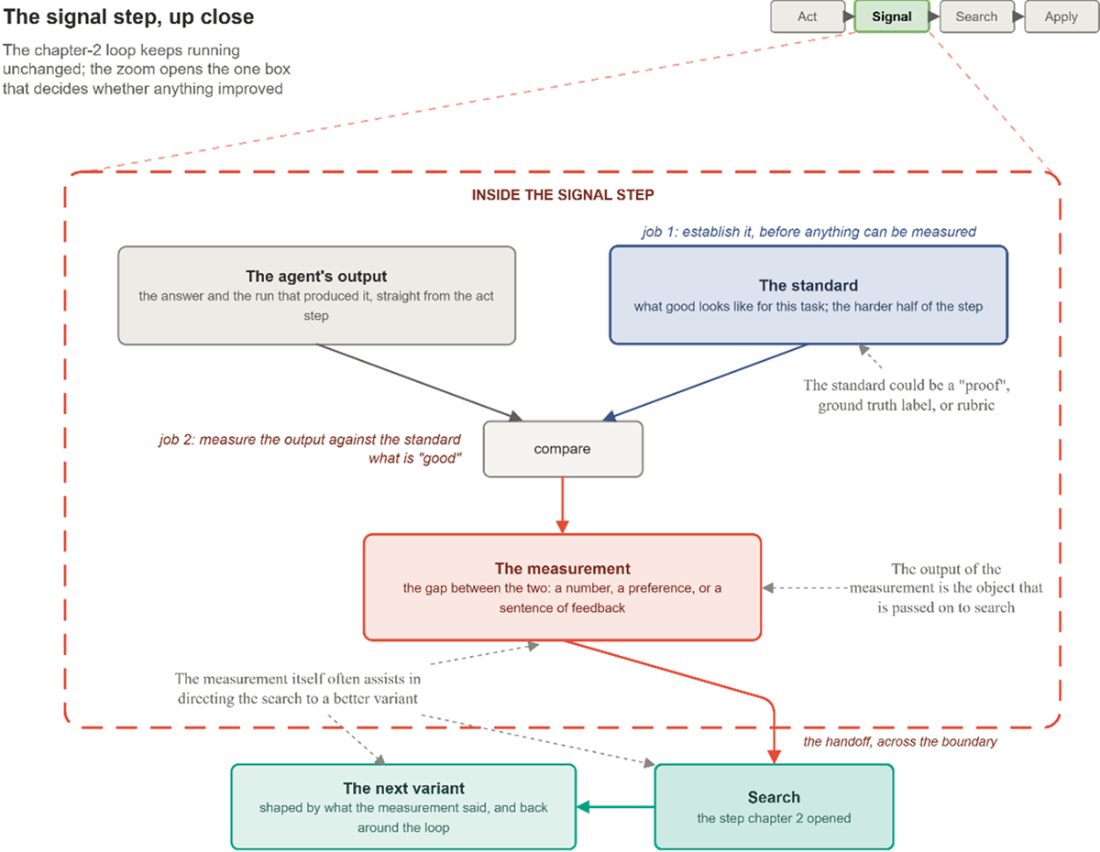
The signal step, up close. At the top right, small, the self-improvement loop runs in four boxes, act, signal, search, apply. The zoom opens the signal box: where a standard establishes what good looks like for the task, the agent's output is measured against that standard, and the resulting measurement crosses to search, which returns a variant shaped by what the measurement described. What the measurement carries- a number, a preference, or a sentence of feedback- decides what kind of variant search can produce.
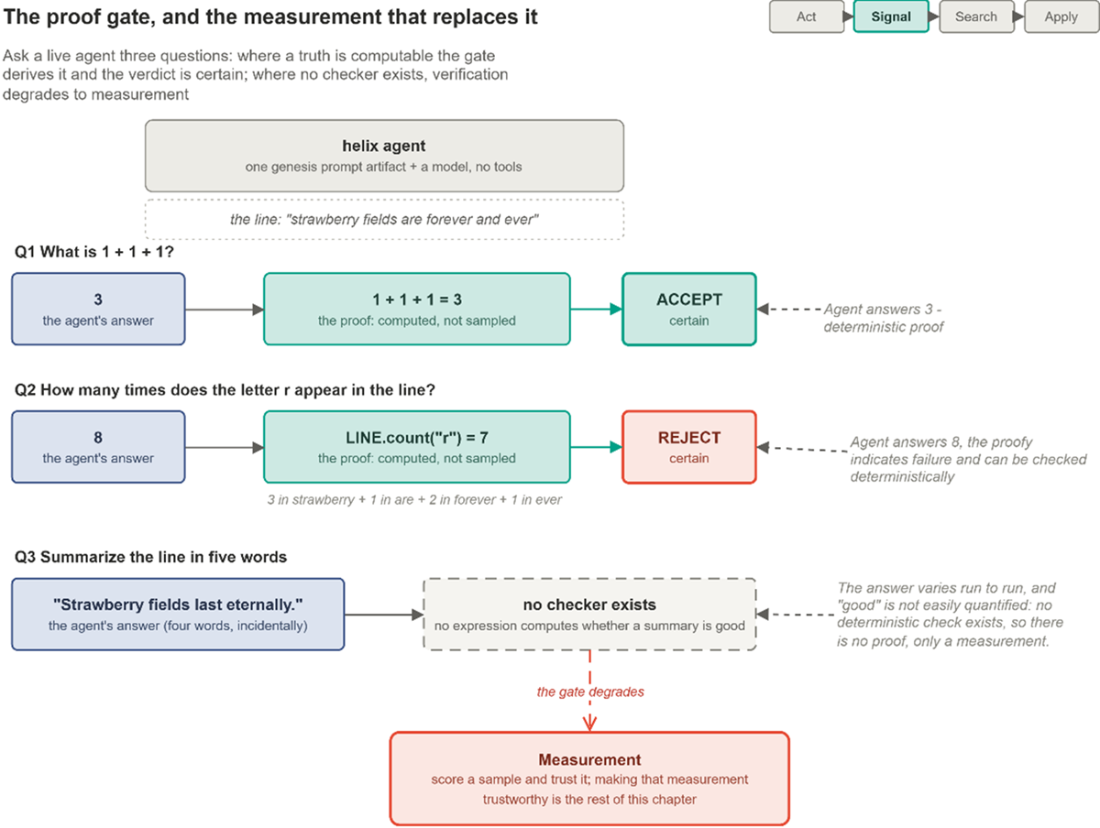
The proof gate and the measurement that replaces it. When a claim has a computable truth, the gate derives the truth itself and compares, so the verdict is certain: the agent's 3 for the sum is accepted, and its 8 for the letter count is rejected because LINE.count("r") computes 7. When no checker exists, as with a five-word summary, the gate has nothing to compute, and verification degrades to measurement. Almost everything an agent produces lives on that lower path.
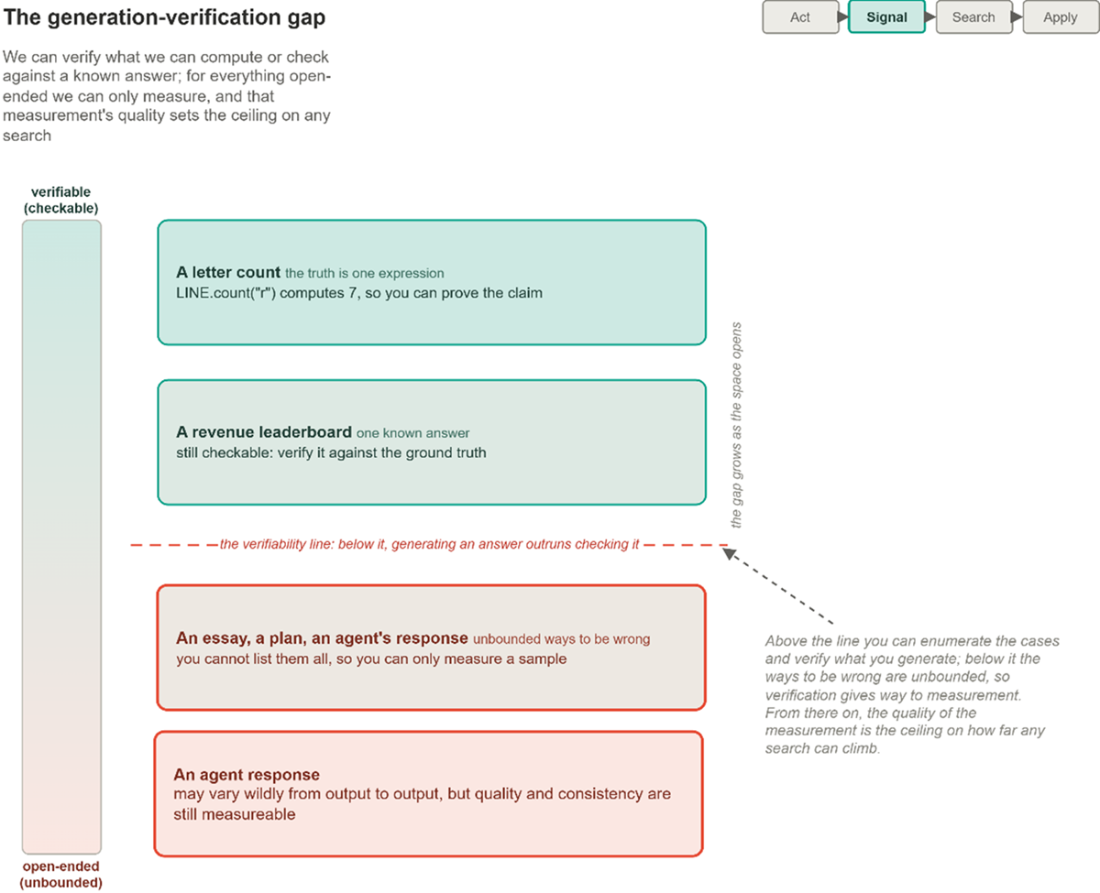
The generation-verification gap. A letter count and a revenue leaderboard sit above the verifiability line, where you can compute the truth or hold the known answer, so you can check what you generate. An essay, a plan, a conversation, or an agent response sits below it, with unbounded ways to be wrong, so you can only measure a sample. From there, the measurement's quality is the ceiling on how far any search can climb.
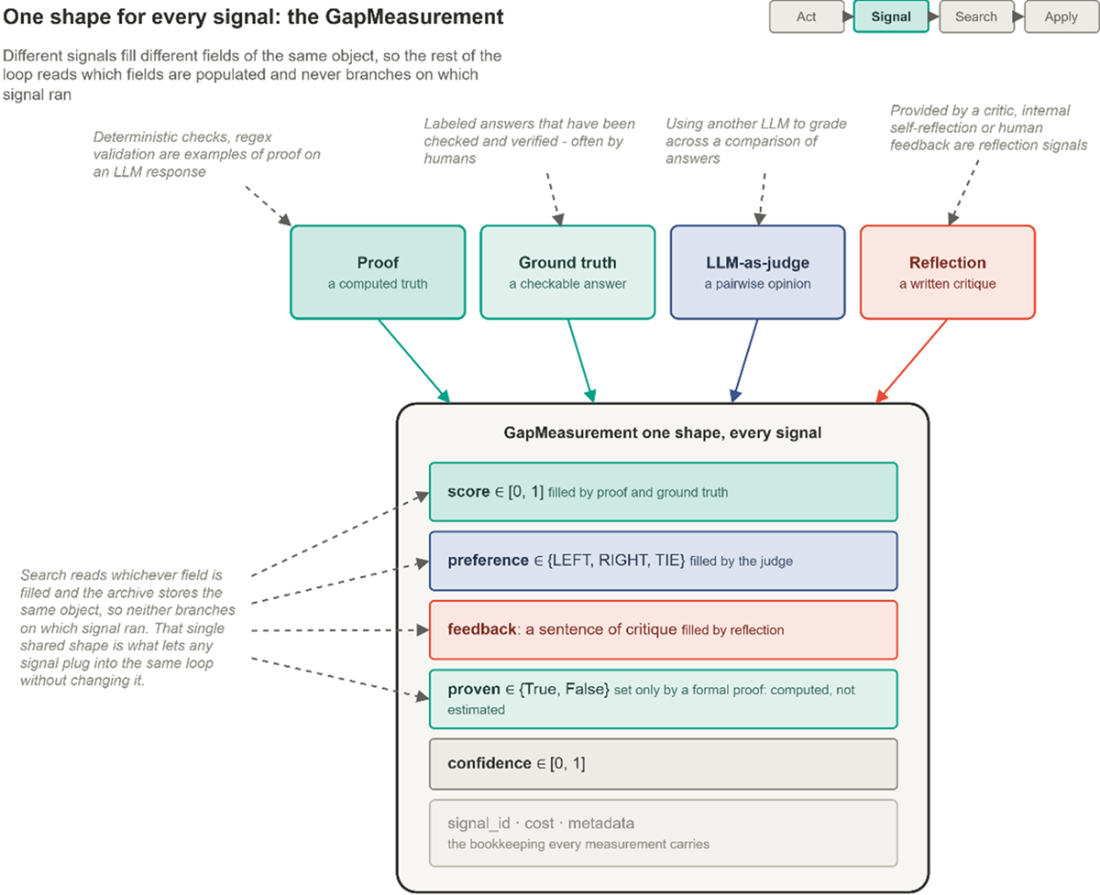
The GapMeasurement union. Every signal returns the same object: a proof fills the score with 1.0 or 0.0 and sets proven, ground truth fills the score, the chapter-2 judge fills the preference, and a reflection fills the feedback, while confidence and the bookkeeping fields travel with every measurement. Search and the archive read whichever field is filled, so the loop never branches on which signal ran.
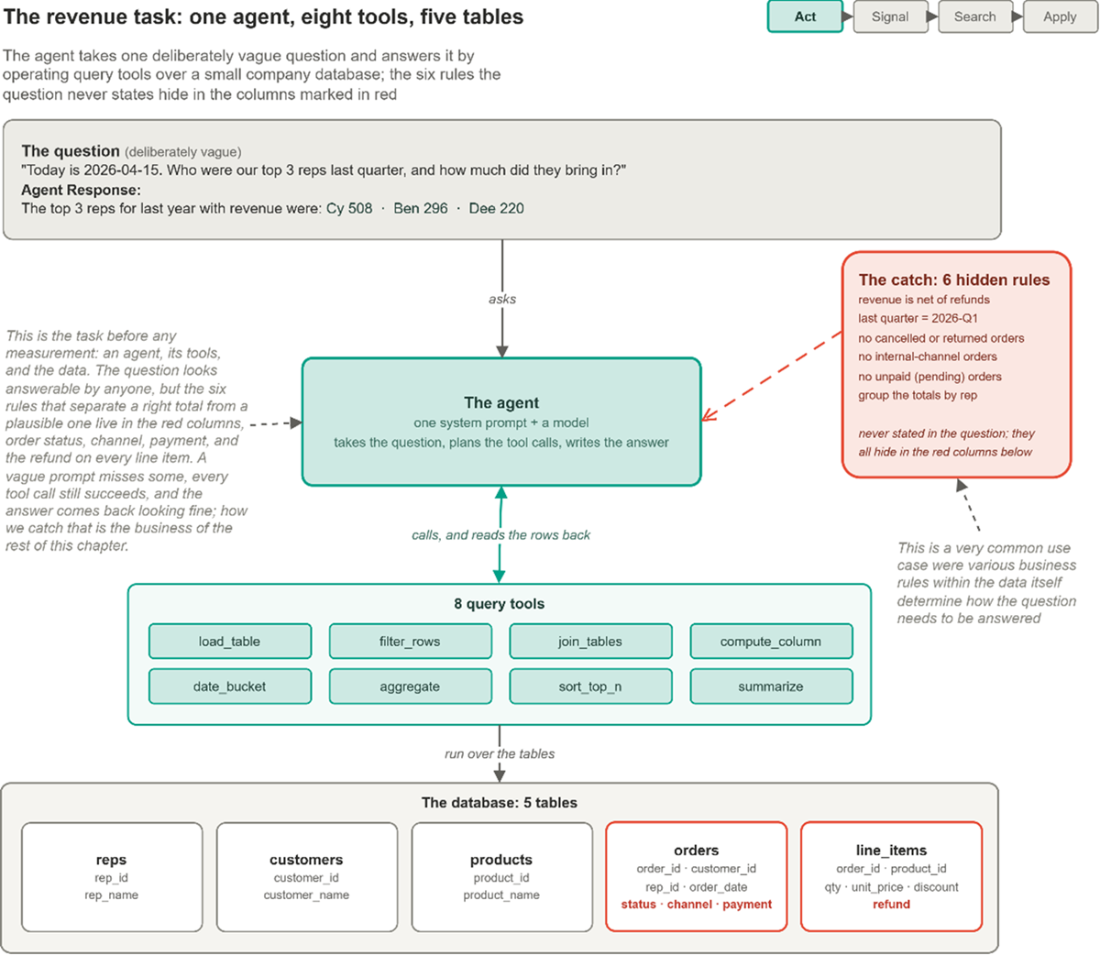
The revenue task. The agent takes one deliberately vague question and hands back a typical answer, a leaderboard with the right shape and the wrong numbers, by calling eight query tools over the five tables of a small company database. The catch arrives from the side: six rules the question never states, and every one of them hides in the columns marked red, order status, channel, payment, and the refund on every line item. Nothing here measures anything yet; the scoring that catches those totals is the next subsection's business.
Check the checker. The genesis and oracle prompts run through the same agent, and both answers are scored against the canonical pipeline's true leaderboard. The oracle's verdict is a gate on the measurement itself: 1.00 means the checker and the answer key agree, so the scale can be trusted, while anything less means the checker is broken and searching would be pointless. The genesis verdict is just the floor, the confidently wrong $508 leaderboard scored strictly at 0.00.
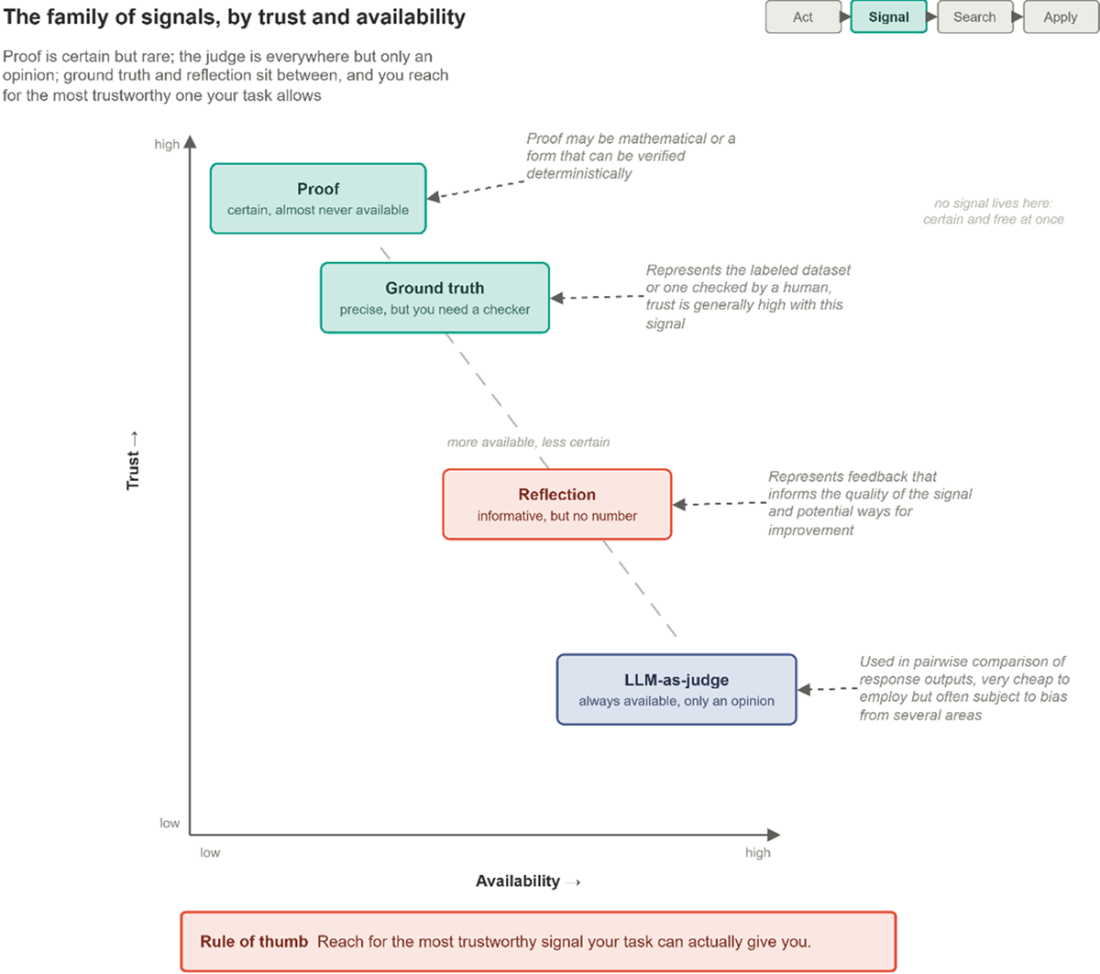
The family of signals. Trust runs up the vertical axis and availability across the horizontal, and the four signals fall along a diagonal: proof is certain but rare at the top-left, the judge is always available but only an opinion at the bottom-right, and ground truth and reflection sit between. The top-right corner stays empty because no signal is both certain and free, so we reach for the most trustworthy one the task allows.
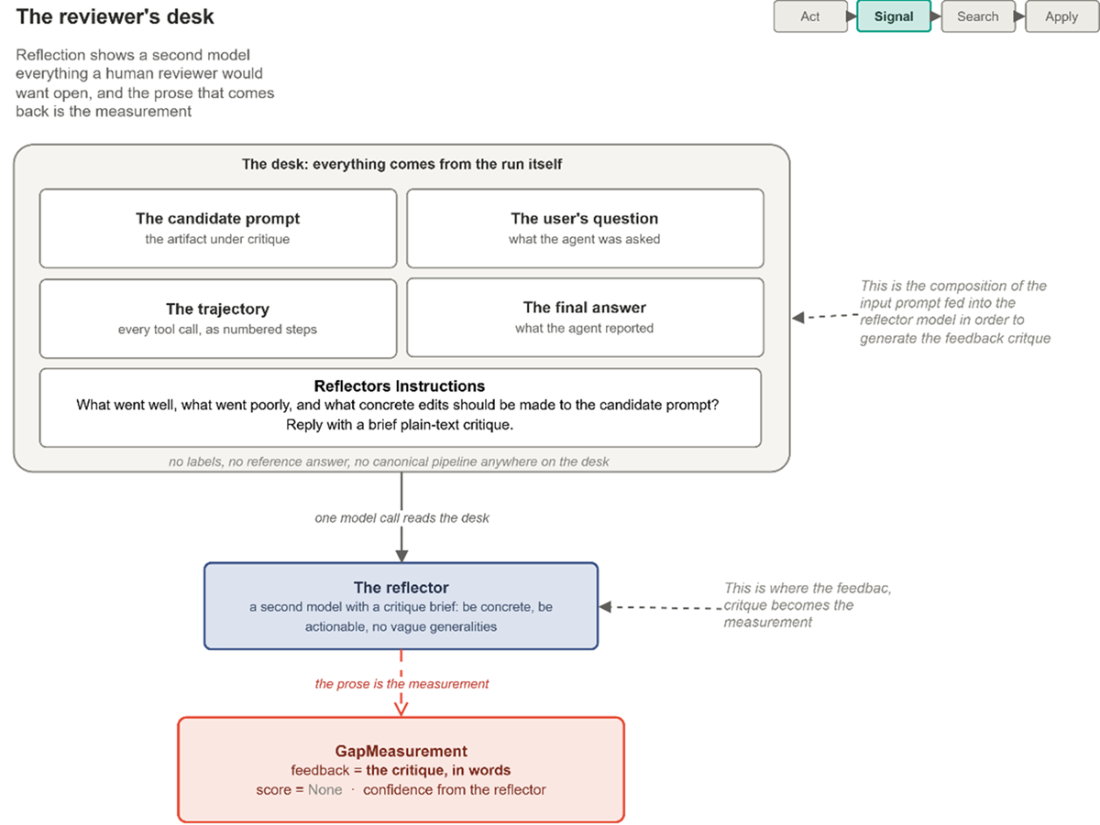
The reviewer's desk. The reflection signal assembles exactly what a human reviewer would want open: the candidate prompt under critique, the user's question, the trajectory as numbered steps, and the final answer. A single model call reads all four along with the reflection instructions and returns a written critique, which the framework packs into a GapMeasurement with feedback filled and score left empty. No ground truth, no labels, no reference answer; a trajectory is the whole requirement.
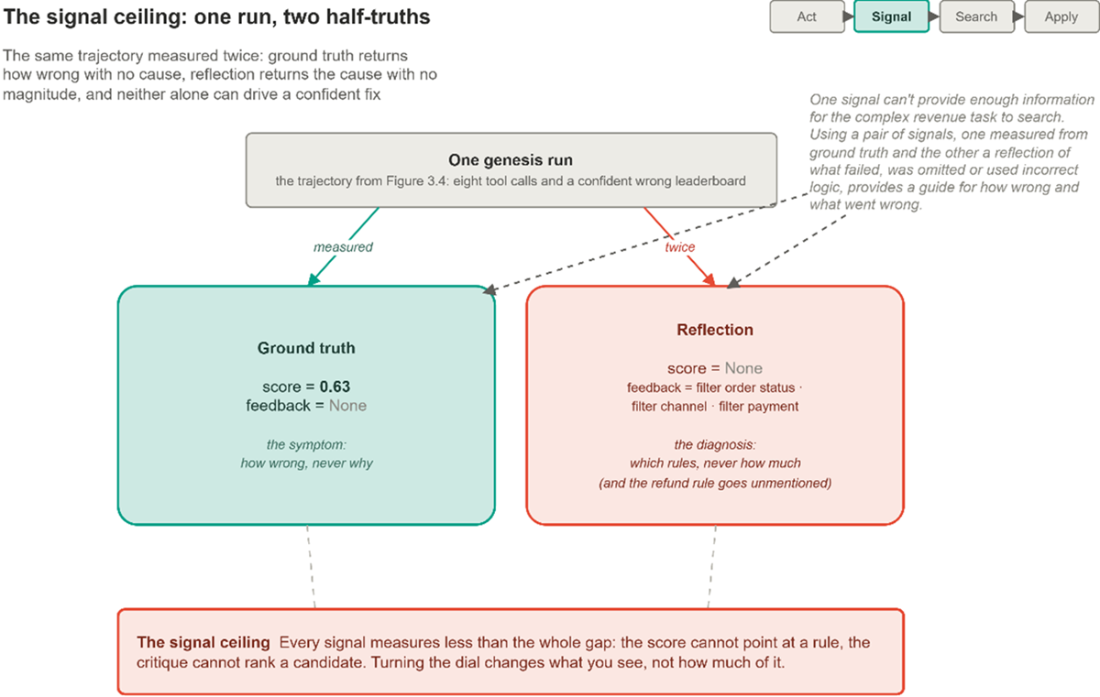
The signal ceiling. One genesis run is measured twice: ground truth fills `score` with 0.63 and says nothing about cause, the symptom, while reflection fills `feedback` with the missed filters and says nothing about magnitude, the diagnosis. Even the diagnosis is partial, naming three of the four missed rules and skipping the refund column. Each signal measures less than the whole gap, so turning the dial changes what we see, not how much of it.
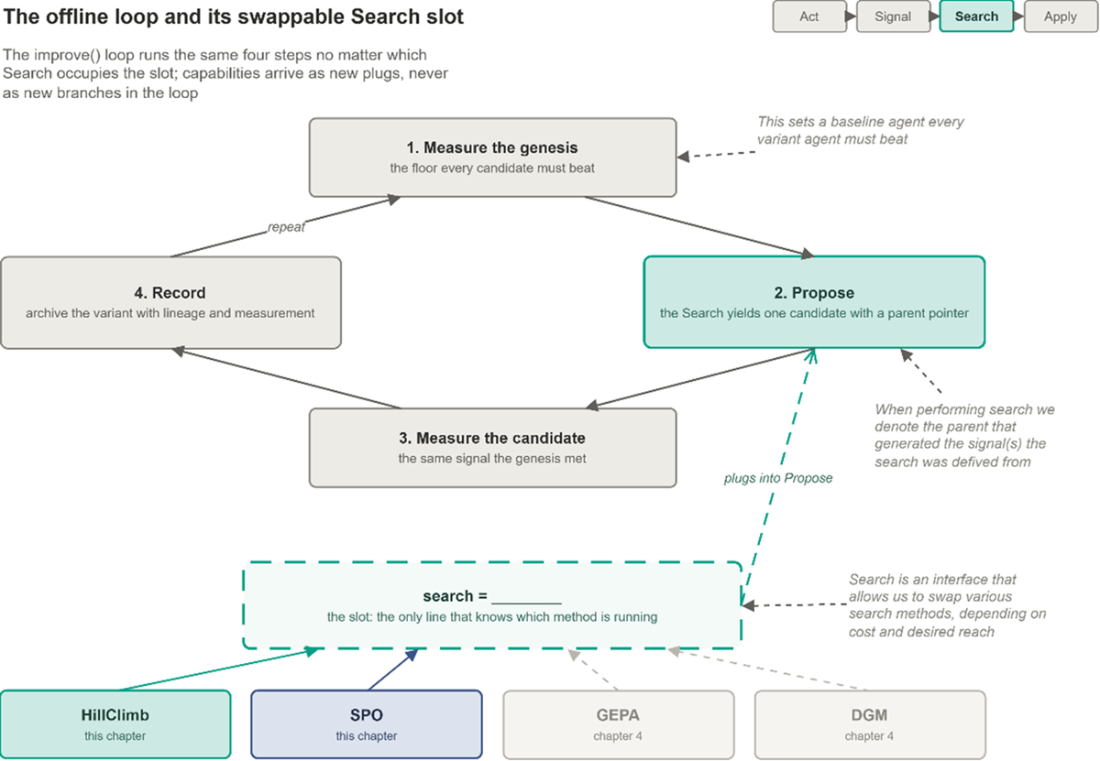
The offline loop and its swappable Search slot. The `improve()` loop from listing 3.6 runs the same four steps no matter what occupies the slot: measure the genesis, propose a candidate, measure it, record it with its lineage. HillClimb and SPO are this chapter's two plugs, and GEPA and DGM wait beside the socket for chapter 4. The loop never grows a branch; capabilities arrive as new plugs.
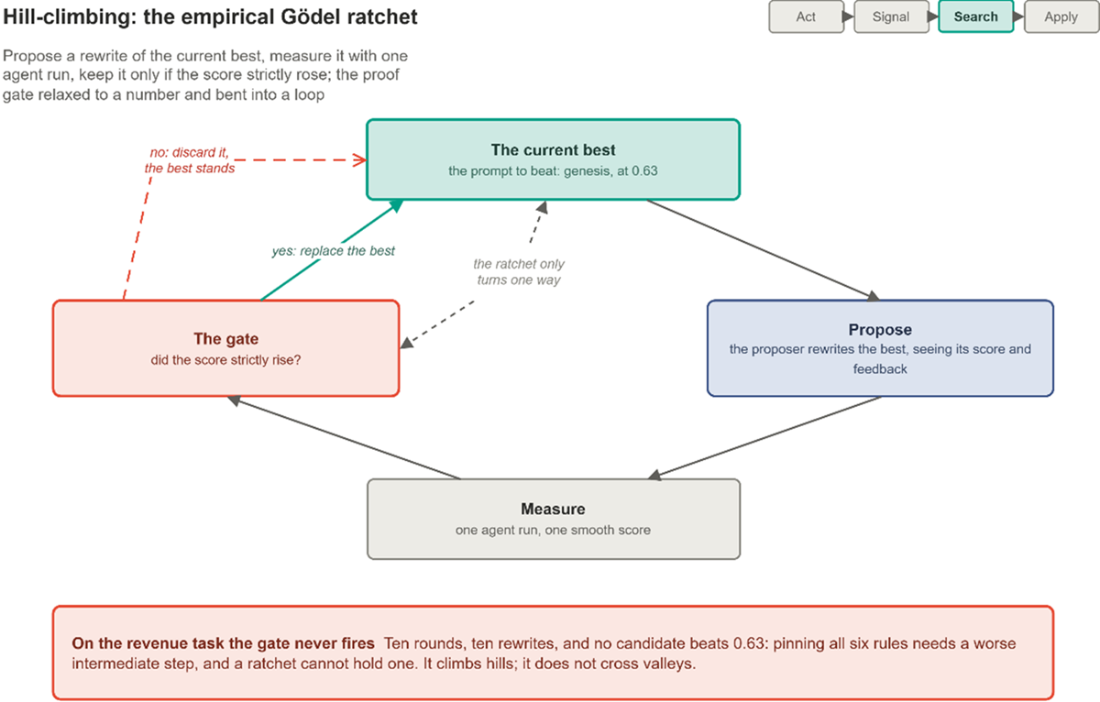
The empirical Gödel ratchet. Hill-climbing is the proof gate relaxed to a number and bent into a loop: propose a rewrite of the current best, measure it with one agent run, and accept it only if the score strictly rose. On the revenue task the gate never fires: ten rounds, ten rewrites, and no candidate beats the genesis 0.63, because pinning all six rules at once requires holding a worse intermediate step, and a ratchet cannot hold one.
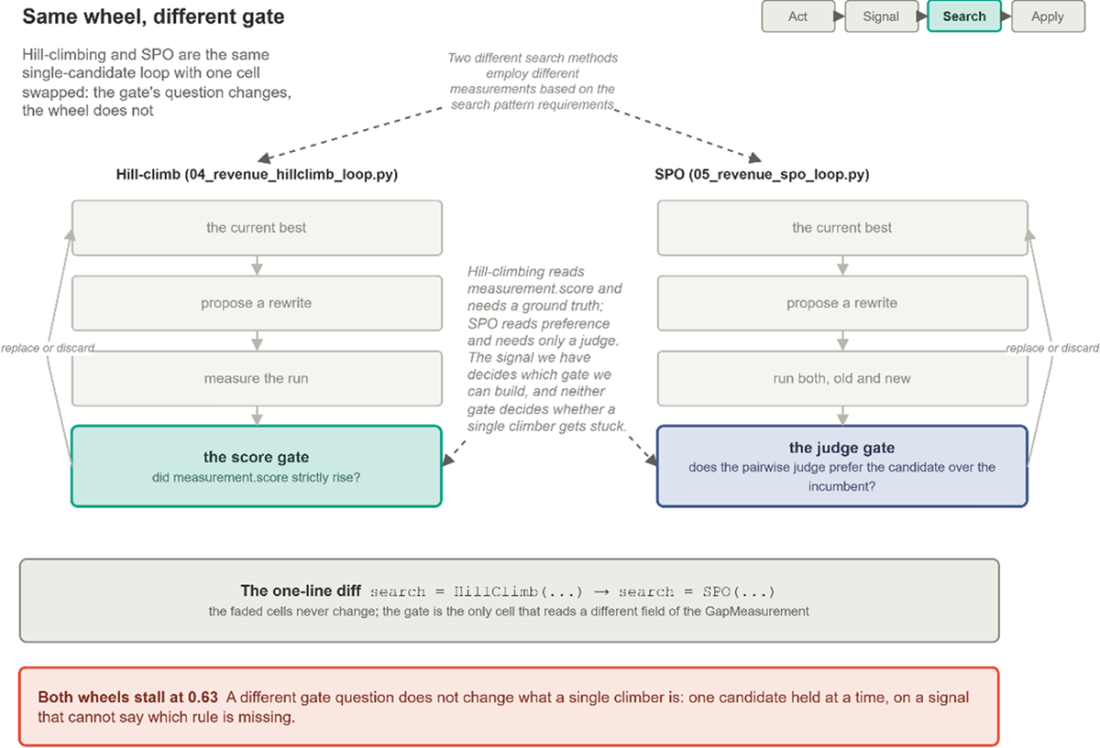
Same wheel, different gate. Hill-climbing and SPO are the same single-candidate loop with one cell swapped: the hill-climb gate reads `measurement.score` and accepts a strictly bigger number, while the SPO gate reads `preference` and accepts a candidate the pairwise judge prefers over the incumbent. Everything else, propose, measure, replace or discard, is identical, which is why the two scripts differ by a single line. A different signal changes the gate's question; it does not change the wheel.
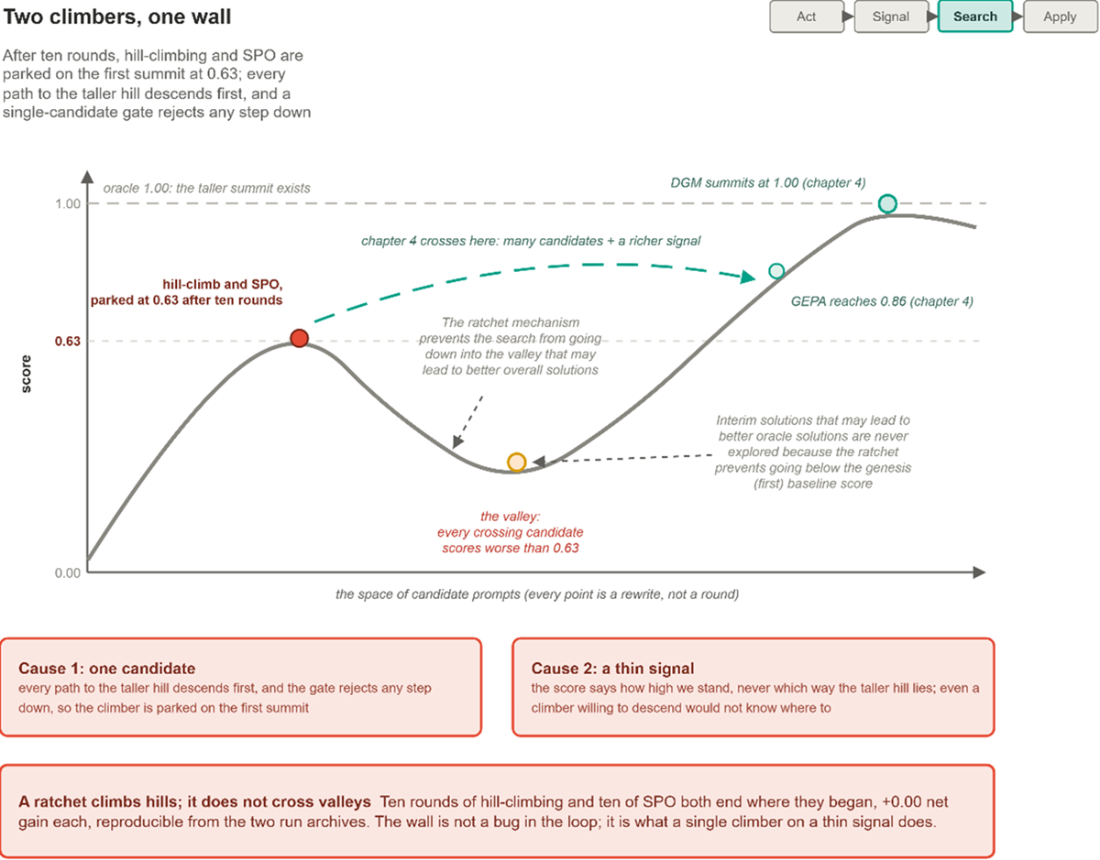
Two climbers, one wall. Hill-climbing on an absolute score and SPO on a pairwise preference both run flat at the genesis 0.63 for ten rounds, with the oracle's 1.00 overhead as proof the ceiling is reachable. The plateau has two separable causes, one candidate and one thin signal, so the two ways off it are a smarter search and a richer signal. Chapter 4 turns both dials: GEPA reads the reflection to reach 0.86, and DGM's archive reaches 1.00.
Summary
- Schmidhuber's Gödel machine set the original bar for self-improvement: rewrite yourself only when you can prove the rewrite helps, a demand almost no real agent can meet.
- A proof is a truth you can compute, so where one exists the verdict is certain, free, and impossible to fool.
- The generation-verification gap is the distance between what a system can generate and what it can verify; most of what an agent produces can be wrong in unbounded ways no checker can enumerate.
- When you cannot prove a change helps, you measure whether it did, and when one step is not enough, you search: measure rather than prove, search rather than solve.
- A signal is any measurement of the gap between what an agent produced and what good would have been, and its quality sets the ceiling on how far any search can climb.
- Every signal can return one common measurement shape, a score, a preference, or feedback, so the improvement loop never branches on which signal ran.
- A ground-truth signal scores output against a known correct answer, the most precise signal available and only ever as good as the checker behind it.
- Every ground truth is a label and every label has a labeler, so even a deterministic checker earns a measurement's trust, never a proof's certainty.
- Check the checker before it judges a single candidate: a baseline pins the floor, a known-good reference must score perfectly to prove the ceiling is reachable, and an unvalidated checker is an opinion in a lab coat.
- An exact-match check returns a verdict and a smooth scoring function returns a gradient, so validate the checker with the strict one and drive the search with the smooth one.
- The signal family trades trust for availability: proof is certain but rare, the judge is always at hand, but only an opinion, and ground truth and reflection sit between; no signal is both certain and free.
- Reflection is critique and feedback in words rather than just a score: a model reads the full trajectory, tool outputs, and reasoning steps, so a proposer can diagnose why a run failed instead of relying on a scalar score or a proven flag.
- The signal ceiling: every signal measures less than the whole gap, a score is the symptom without its cause, and a critique is the diagnosis without its measure.
- A composite signal pairs a score for magnitude with a critique for direction, handing a proposer richer feedback than either gives alone.
- The improvement loop is measure, propose, select, record, and it never changes: a new search method is a new plug in the same socket.
- Search is generate-and-test on a fitness landscape, where every candidate stands at the height of its measured score, and a search method is a walker on that terrain.
- Hill climbing is a ratchet: keep a rewrite only when the score strictly rises, which makes it cheap, reliable on one slope, and stuck on the nearest local peak.
- A preference-based search accepts a rewrite when a pairwise judge prefers it over the current best, so it needs no ground truth and can climb tasks with no checkable answer.
FAQ
What is the main idea of this chapter?
The chapter argues that self-improving agents usually cannot prove a change is better, so they must measure improvement instead. It shifts the focus from the Gödel Machine’s proof requirement to practical signals that estimate how close an output is to “good.”
Why is the Gödel machine important if it is mostly impractical?
It serves as the conceptual starting point: a self-improving system that only accepts a rewrite when it can prove the rewrite is an improvement. The chapter uses it as an anchor to show why real systems need measurement rather than proof.
What is the difference between proving and measuring improvement?
Proof is certain and binary: a claim is either verified or not. Measurement is approximate: it scores how close an output is to the desired result when no exact proof exists. Most agent outputs can only be measured, not proven.
What is the generation-verification gap?
It is the gap between tasks whose answers can be checked exactly and tasks whose outputs can only be judged approximately. Things like arithmetic or letter counts are easy to verify, while summaries, plans, and agent responses usually require measurement.
What is a GapMeasurement?
It is the shared object used to carry any signal through the self-improvement loop. Depending on the signal, it may contain a score, a preference, feedback, confidence, and bookkeeping fields, so the rest of the system can handle different signal types uniformly.
Why does the revenue task matter in this chapter?
It provides a realistic task with a known correct answer, so the chapter can define a ground-truth signal. The agent must analyze sales data and produce a leaderboard, which makes it possible to compare a candidate answer against a canonical result.
Why is checking the checker so important for ground truth?
Because a ground-truth checker is still code and can be wrong. The chapter insists that the oracle prompt should score 1.00 before trusting the checker, since a broken checker can mislead search in the wrong direction.
What is reflection as a signal?
Reflection is a critique produced by another model that explains what went well, what went wrong, and what should change. Unlike ground truth, it does not produce a numeric score; it fills the feedback field with actionable comments.
How are ground truth and reflection different?
Ground truth tells you how close an answer is to the target, but not why it failed. Reflection tells you what likely caused the failure, but not how far off the result was. Together, they give both diagnosis and magnitude.
Why do hill-climbing and SPO fail on the revenue task?
Both methods are single-candidate searches, so they cannot cross a valley by temporarily accepting a worse step. On the revenue task, that prevents them from assembling the full set of hidden rules, so they stall at the genesis score instead of improving.

 Self-Improving Agents ebook for free
