Overview

9 Self-RAG: Retrieval with reflection and self-critique

By the end of 2023, retrieval-augmented generation had become the standard way to compensate for the fixed knowledge in large language models, but the usual retrieve-every-time workflow proved too rigid. It wasted compute on easy questions, filled context windows with irrelevant passages, and still allowed confident hallucinations when evidence was missing or weak. This chapter presents Self-RAG as the response to those failures: a design in which the model does not merely consume retrieved text, but actively decides whether retrieval is needed, checks whether the retrieved material is relevant, and verifies whether its own drafted claims are actually supported.

The core idea is to turn self-critique into an explicit, machine-readable control mechanism. Self-RAG introduces reflection tokens that represent decisions such as whether to retrieve, whether a passage is relevant, whether a sentence is supported, and whether the final answer is useful. Because these signals are part of the model’s vocabulary, they can be trained, logged, and used to steer decoding at inference time. The result is a closed-loop system that behaves more like deliberative reasoning than passive retrieval, with runtime knobs that let engineers trade off strict factual grounding against flexibility and creativity.

The chapter also shows how the original paper trained this behavior through critic-to-generator distillation, and how the same logic can be recreated in practice without fine-tuning by using orchestration and prompting. In the implementation pattern, retrieval, relevance grading, answer generation, and support checking are arranged as a state machine with conditional branches, so the system can skip retrieval, re-query when evidence is weak, or refuse to return an unsupported answer. The broader lesson is that Self-RAG marked a shift from optimizing the index to controlling inference: it made retrieval adaptive, critique explicit, and self-correction a first-class part of the generation loop.

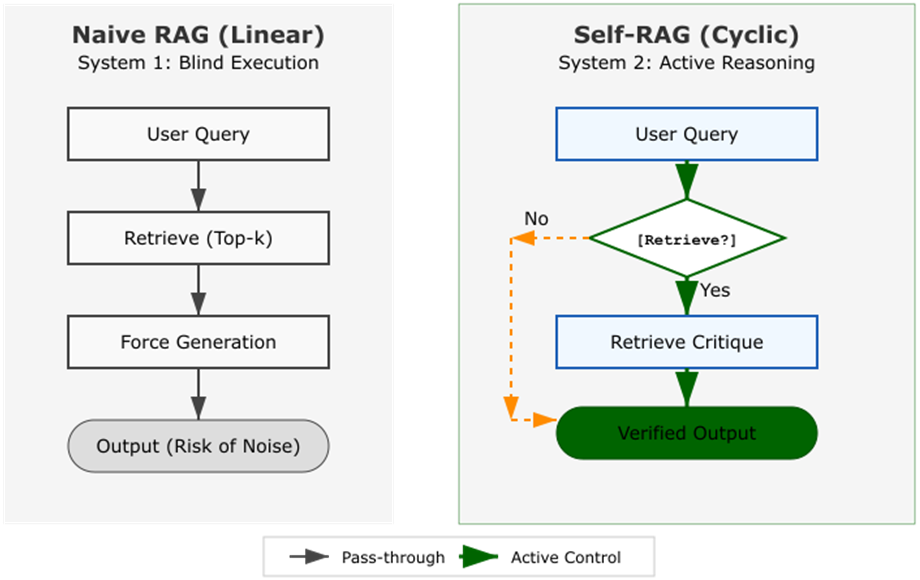
The shift from passive to self-reflection and adaptive retrieval: Naive RAG vs Self-RAG.
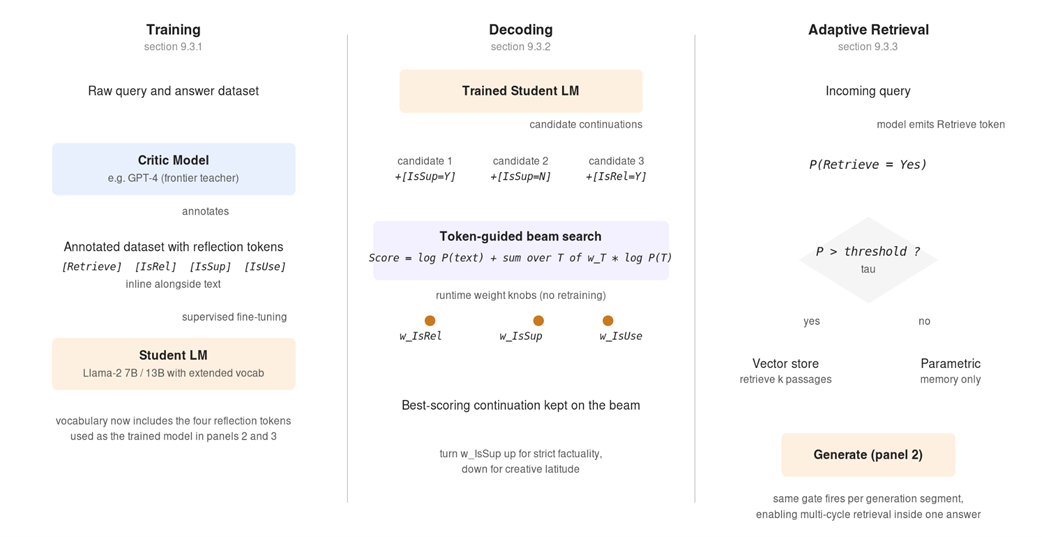
The full Self-RAG lifecycle: training, decoding, and adaptive retrieval. Left: the training phase (9.3.1) routes a raw query-answer dataset through a Critic model that annotates each example with inline reflection tokens, and the resulting traces fine-tune the Student model. Middle: the inference phase (9.3.2) shows the trained Student emitting candidate continuations alongside reflection tokens, with a token-guided beam search scoring each candidate by log P(text) + Σ w_T log P(T) over the IsRel, IsSup, and IsUse tokens, with w_T exposed as runtime knobs. Right: the adaptive retrieval gate (9.3.3) compares the Retrieve-token probability to a threshold; queries above it trigger the vector store, queries below it are answered from parametric memory.
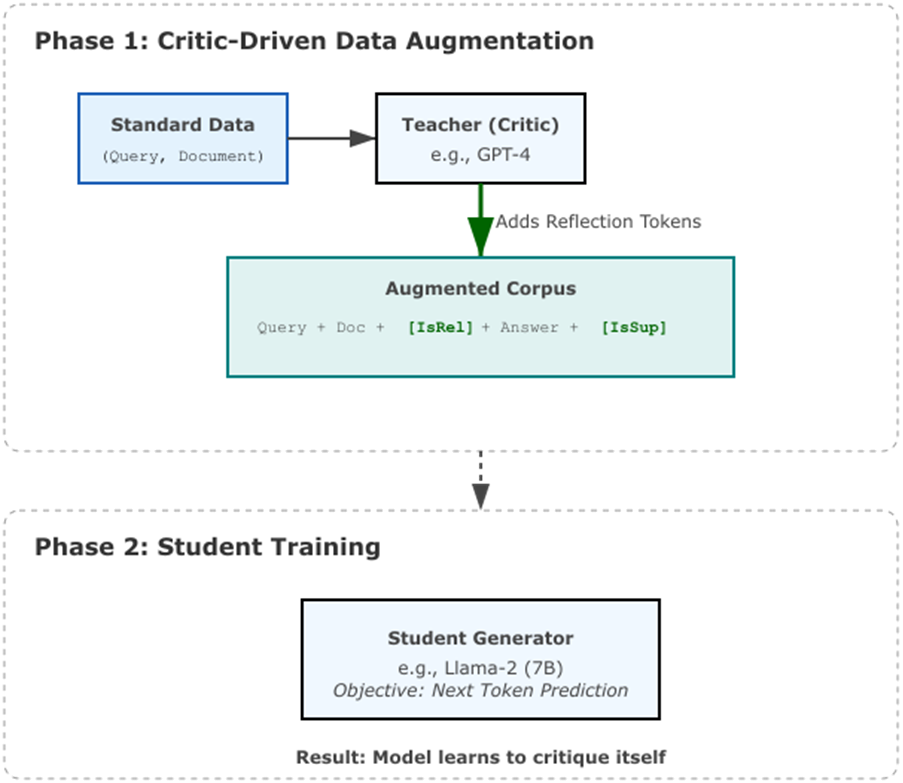
The Self-RAG training pipeline.
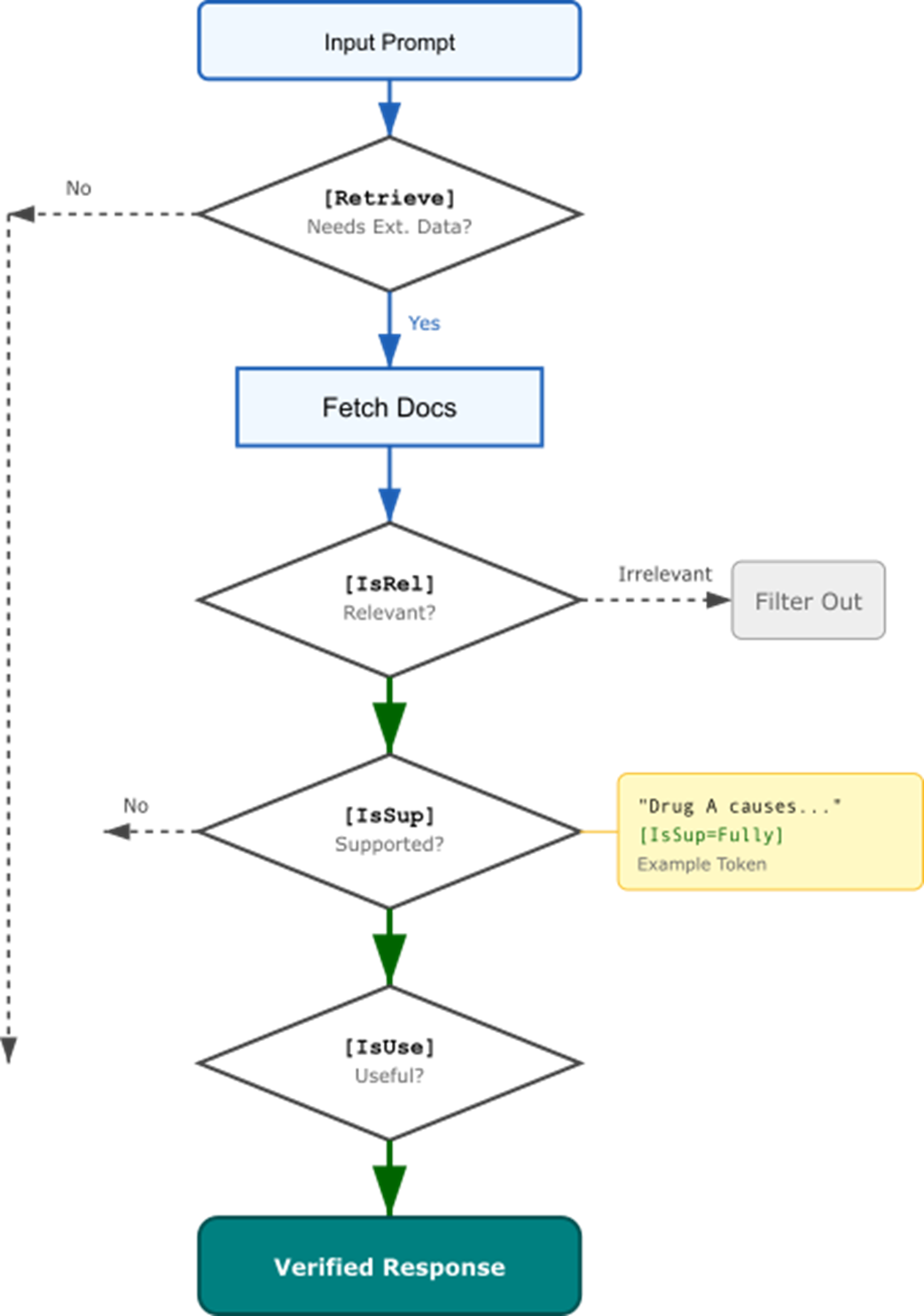
The Self-RAG inference loop.
Summary

  • Retrieving on every query wastes money and adds noise: Self-RAG has the model predict a Retrieve token first, so it skips the search when its own parameters already hold the answer.
  • Reflection tokens move the critic inside the model: IsRel discards irrelevant passages, IsSup checks each claim against its evidence, and IsUse judges whether the answer is worth returning.
  • The same weights can be strict or loose: Weighting the reflection tokens at decoding time shifts a model from penalizing unverified statements for compliance work to allowing them for creative work, with no retraining.
  • There are two ways to ship it: Prompted Self-RAG emulates the tokens with separate grader calls and costs an API round-trip per critique, while trained Self-RAG fine-tunes a smaller model to emit them inline, paying once at training time instead.
  • Self-critique has a blind spot: A model grading its own output shares the assumptions that produced it, which is the argument for the external evaluators in chapter 11 and the measurement in chapter 14.

FAQ

What is Self-RAG and how does it differ from standard RAG?Self-RAG is a retrieval-augmented generation framework that adds self-reflection and adaptive retrieval to a language model. Unlike standard RAG, which retrieves documents for every query in a fixed pipeline, Self-RAG lets the model decide when retrieval is needed, critique retrieved passages, and verify its own output using special reflection tokens.
Why was Self-RAG introduced?It was introduced to address common “Naive RAG” failures such as wasted compute on easy questions, irrelevant context polluting the prompt, and ungrounded hallucinations. Self-RAG aims to make retrieval more selective and generation more reliable.
What are reflection tokens in Self-RAG?Reflection tokens are special vocabulary items the model emits to make control decisions during generation. They indicate whether to retrieve, whether a passage is relevant, whether a sentence is supported by evidence, and whether the final answer is useful.
What are the four main Self-RAG reflection tokens?The four tokens are Retrieve, IsRel, IsSup, and IsUse. Retrieve decides whether to call the retriever, IsRel filters irrelevant passages, IsSup checks whether a generated sentence is supported by evidence, and IsUse scores the overall usefulness of the answer.
How does Self-RAG improve retrieval efficiency?It uses the Retrieve token as a gate. If the model believes it can answer from parametric memory, it skips retrieval entirely. This avoids unnecessary vector searches and reduces context-window pollution for simple queries.
How does Self-RAG reduce hallucinations?It uses IsSup to verify whether each generated sentence is grounded in the retrieved passages. Unsupported or contradictory claims can be rewritten, dropped, or penalized before they reach the user, which helps prevent hallucinations.
What is the role of the IsRel token?IsRel grades each retrieved passage for relevance to the user’s question. Irrelevant passages are filtered out before generation, which keeps noisy or misleading documents from degrading the answer.
How is Self-RAG trained?The original method uses critic-to-generator distillation. A strong teacher model, such as GPT-4, annotates training examples with reflection tokens, and a smaller student model is fine-tuned to reproduce those critiques on its own.
Can Self-RAG be implemented without fine-tuning a model?Yes. The chapter describes a prompted Self-RAG approach that emulates the same behavior with orchestration and prompting. Instead of changing weights, separate LLM calls or graph nodes act as graders and routers for retrieval, relevance, support, and finish decisions.
When is Self-RAG most useful in practice?It is most valuable in high-stakes or regulated domains such as legal research, medical assistance, policy analysis, and enterprise search, where factual grounding matters more than speed and silent errors are costly.

pro $24.99 per month

  • access to all Manning books, MEAPs, liveVideos, liveProjects, and audiobooks!
  • choose one free eBook per month to keep
  • exclusive 50% discount on all purchases
  • renews monthly, pause or cancel renewal anytime

lite $19.99 per month

  • access to all Manning books, including MEAPs!

team

5, 10 or 20 seats+ for your team - learn more


choose your plan

team

monthly
annual
$49.99
$499.99
only $41.67 per month
  • five seats for your team
  • access to all Manning books, MEAPs, liveVideos, liveProjects, and audiobooks!
  • choose another free product every time you renew
  • choose twelve free products per year
  • exclusive 50% discount on all purchases
  • renews monthly, pause or cancel renewal anytime
  • renews annually, pause or cancel renewal anytime
  • Retrieval Augmented Generation, The Foundational Ideas ebook for free

choose your plan

team

monthly
annual
$49.99
$499.99
only $41.67 per month
  • five seats for your team
  • access to all Manning books, MEAPs, liveVideos, liveProjects, and audiobooks!
  • choose another free product every time you renew
  • choose twelve free products per year
  • exclusive 50% discount on all purchases
  • renews monthly, pause or cancel renewal anytime
  • renews annually, pause or cancel renewal anytime
  • Retrieval Augmented Generation, The Foundational Ideas ebook for free