HyDE addresses a common retrieval failure in RAG systems: the user’s query and the document that contains the answer often look very different, even when they mean the same thing. Short, ambiguous, or layperson queries can sit far from the technical language used in relevant documents, causing dense retrieval to miss the best passages or rank them too low. This mismatch is especially painful in zero-shot settings, where there are no labeled examples to teach the retriever the vocabulary of a new domain.
The key HyDE insight is to stop searching with the question directly and instead search with an imagined answer. An instruction-following LLM first generates a hypothetical document that looks like a strong response to the query, and that synthetic passage is then embedded and used for retrieval. This turns an awkward query-to-document problem into a more natural document-to-document similarity search, while the generated text itself is discarded after retrieval so the final answer can be grounded only in verified corpus documents.
Because the hypothetical document is converted through a contrastive encoder, many small hallucinations or idiosyncratic details are washed out, while the main topical pattern is preserved. That makes HyDE a simple, zero-shot way to improve recall without retraining, and it works well in difficult cases like multilingual search and specialized domains such as medicine. The chapter also highlights practical extensions: sampling multiple hypothetical documents, blending HyDE with lexical search, adding rerankers for precision, and shifting generation to indexing time in reverse-style variants when latency matters.
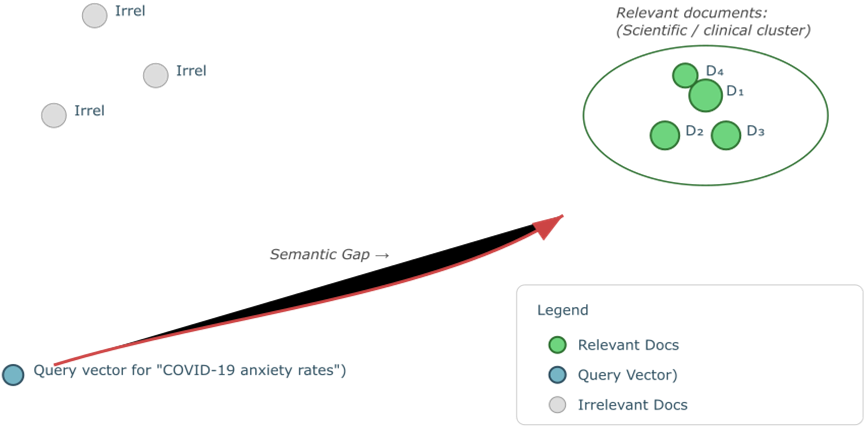
With query–document mismatch, the query embedding lies far from the cluster of relevant documents, which is why direct embedding retrieval underperforms.
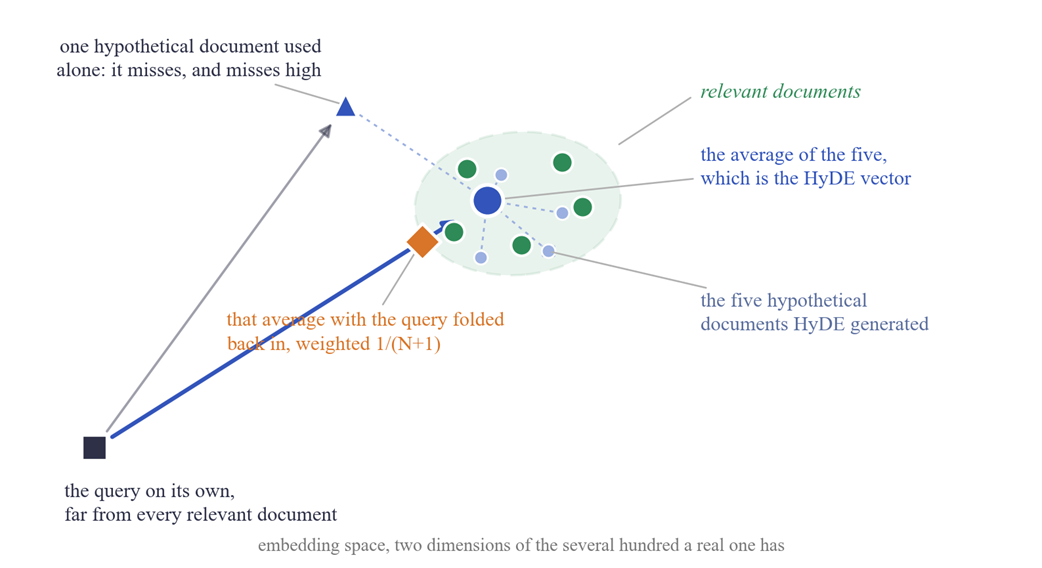
HyDE Workflow: HyDE separates relevance modeling (LLM generation g(q)) from semantic encoding (f()) and retrieval over a corpus.
HyDE's performance in a high-stakes, domain-specific scenario in a side-by-side comparison with Vanilla Dense Retrieval. While Vanilla retrieval produces general articles (e.g., "Atrial fibrillation prevalence in patients over 65"), HyDE Retrieval produces highly specific clinical guidelines and abstracts that contain terms like "Anticoagulation therapy," "DOACs," and "CHA₂DS₂-VASc scores.
Medical query results.
Summary
Short queries and the documents that answer them do not look alike: Dense retrieval fails when a question and its answer share intent but no vocabulary.
HyDE searches with a fake answer instead of the question: An LLM writes a hypothetical document, and that document, not the query, is embedded and matched against the corpus.
The hypothetical document does not need to be true: An unsupervised contrastive encoder grounds the search in the corpus, so invented details fall away and only the relevance pattern survives.
Zero-shot HyDE approaches supervised retrievers, which is what makes it worth reaching for in a new domain or language where no labeled pairs exist.
The pattern extends: Averaging several generated documents smooths out a bad generation, and fusing the HyDE vector with the original query's vector hedges against a hypothetical that was missed.
The cost is a confident wrong answer: When the LLM frames the question wrongly, HyDE retrieves the wrong material decisively rather than returning nothing, so it needs a reranker or a groundedness check behind it.
FAQ
What is the query-document mismatch problem in dense retrieval?The query-document mismatch problem happens when a user's short, vague query does not use the same language as the longer, more detailed documents that contain the answer. Even if the query and document are about the same concept, their wording may differ so much that direct dense retrieval misses the best passage or ranks it too low.How does HyDE solve query-document mismatch?HyDE solves the mismatch by first generating a hypothetical answer document from the user's query, then embedding and searching with that imagined document instead of the original query. This makes retrieval more document-to-document and less asymmetrical, which helps the search land closer to relevant corpus passages.Why does HyDE work well in zero-shot retrieval?HyDE works in zero-shot settings because it does not require labeled query-document pairs or retraining the retriever. It uses an instruction-following LLM to create a plausible passage and an unsupervised dense encoder to search the corpus, so it can improve retrieval even when no task-specific training data exists.Does the hypothetical document in HyDE need to be factually correct?No. The hypothetical document can contain hallucinations or false details, because its purpose is not to provide the final answer. It only needs to capture the right topical pattern, vocabulary, and semantic structure so the retriever can find real, grounded documents.What happens to the hypothetical document after retrieval?The hypothetical document is discarded after it is used for retrieval. The final answer in a RAG system should be generated only from the verified documents retrieved from the corpus, not from the imaginary passage itself.Why is HyDE better than direct dense retrieval for short or colloquial queries?Direct dense retrieval often struggles when a query is short and informal while the relevant documents are long and technical. HyDE rewrites the query into a corpus-like passage, which helps bridge the semantic gap and improves the chance of retrieving the right documents.What encoder does HyDE use, and why?HyDE uses a contrastively trained dense encoder, such as Contriever or a similar sentence transformer, to embed both the hypothetical document and the real corpus documents into the same vector space. This shared space makes document similarity search possible without supervised relevance labels.How can HyDE be implemented in practice with LangChain?In LangChain, HyDE can be wrapped in a HypotheticalDocumentEmbedder that sends the query to an LLM, parses the generated text, embeds it, and uses that vector for search. In simple implementations, you can also build HyDE by hand: generate the passage, embed it, and run similarity search with the resulting vector.What are common HyDE extensions or variations?Common extensions include multi-sample HyDE, which averages embeddings from several generated passages; hybrid HyDE, which combines HyDE with the original query or BM25; HyDE plus re-ranking, which uses a slower model on a smaller candidate set; and Reverse HyDE, which generates hypothetical questions at indexing time instead of generating passages at query time.When should you use HyDE for retrieval?HyDE is especially useful when labeled data is scarce, queries are vague or domain-specific, or the corpus uses specialized terminology that users do not share. It is often a strong first upgrade for RAG systems because it is simple to add, requires no retraining, and can significantly improve recall.
pro $24.99 per month
access to all Manning books, MEAPs, liveVideos, liveProjects, and audiobooks!



 Retrieval Augmented Generation, The Foundational Ideas ebook for free
