6 Atlas: Few-shot learning with retrieval augmentation
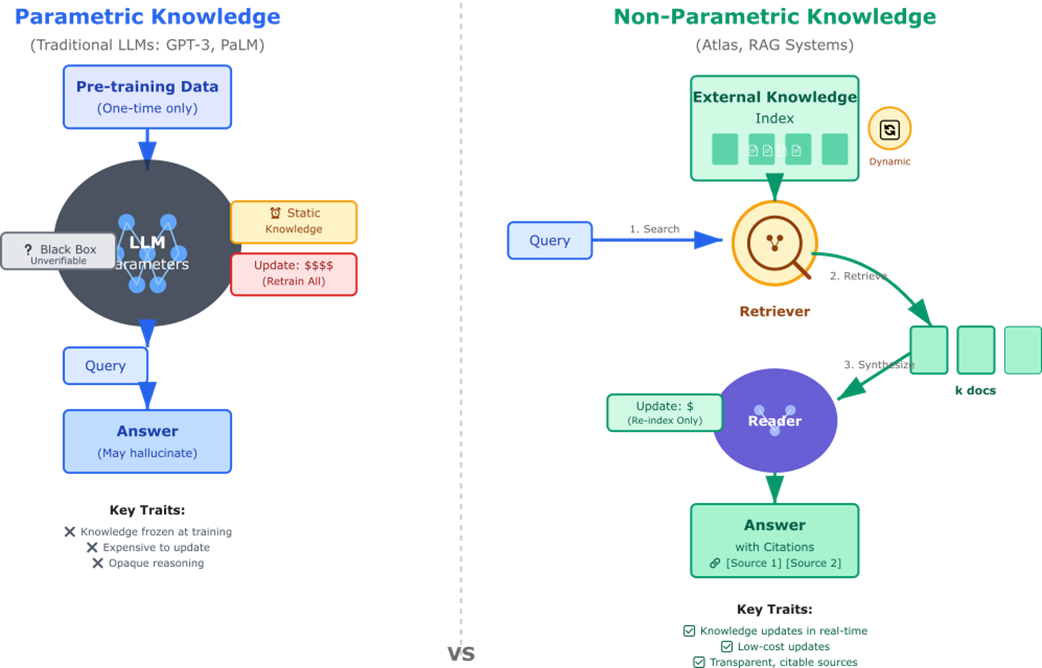
In the era when NLP progress was largely driven by scaling up model size and training data, few-shot learning looked like evidence that larger parametric models simply knew more. This chapter pushes back on that view by showing how retrieval-augmented systems can separate reasoning from storage: instead of forcing a model to memorize everything in its weights, they can consult an external corpus and use that evidence at inference time. The result is a more updatable, more transparent, and often more accurate system for knowledge-intensive tasks.
Atlas is presented as the key example of this shift. Its main idea is not a more complicated retrieval pipeline, but a training loop that teaches the retriever what the reader actually finds useful. The reader’s ability to generate the right answer provides the supervision signal, and the retriever is optimized to favor passages that reduce perplexity. In other words, relevance is learned indirectly from downstream usefulness, which lets Atlas achieve strong few-shot performance with far fewer parameters than giant closed-book language models.
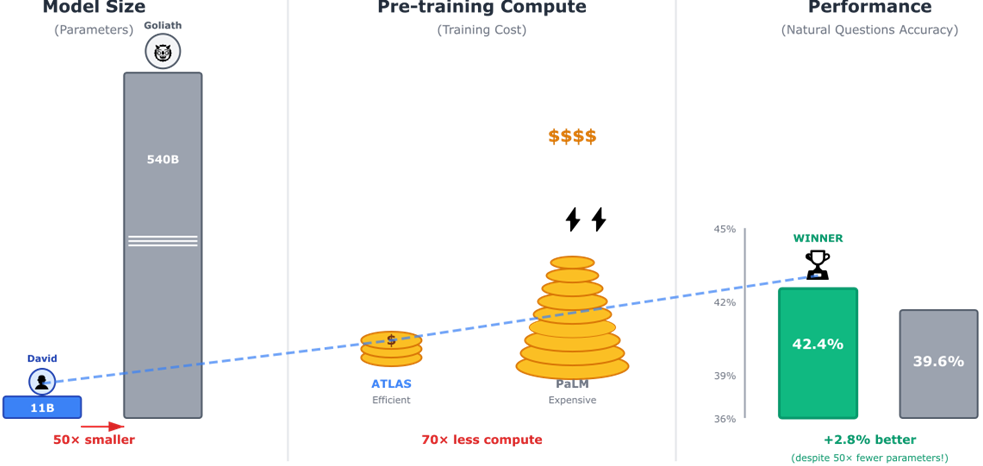
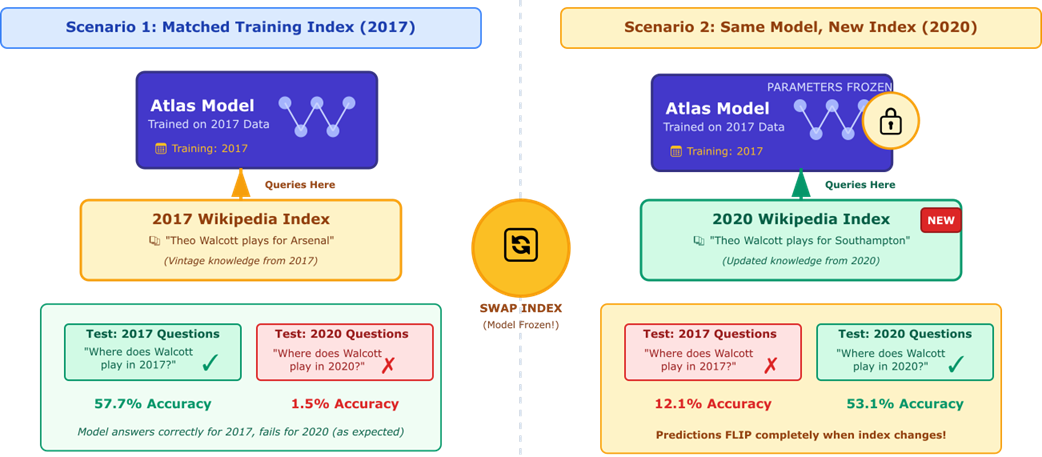
The chapter also shows why this approach matters in practice. Atlas can outperform much larger models on benchmarks, adapt quickly to new information by updating the index instead of retraining the whole model, and handle time-sensitive knowledge by swapping in a fresh corpus. At the same time, it reveals the main operational tradeoff: once knowledge lives outside the parameters, the quality of the system depends heavily on retrieval quality, index freshness, and efficient update strategies. That lesson carries forward into later systems, including descendants that keep the same basic retriever-reader idea but make it cheaper and easier to fine-tune.
Parametric vs. Non-Parametric Knowledge Architectures.
The Atlas Efficiency Advantage - Outperforming Models 50× Larger.
The Temporal Sensitivity Experiment - Proof of Dynamic Knowledge Grounding.
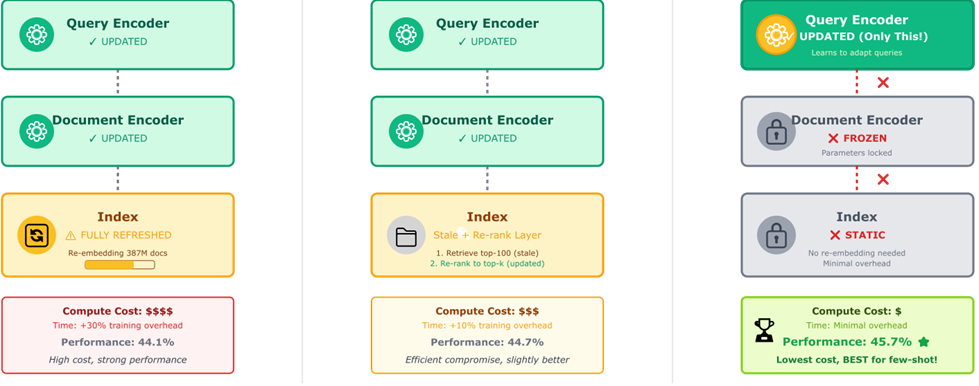
Fine-Tuning Strategy Comparison - Component Update States and Performance Trade-offs.
Summary
A small model with a trainable retriever beats a much larger one that memorized everything: Atlas separates reasoning from knowledge, so the index can be updated without retraining the model.
Joint training closes the loop between retriever and reader: The reader's performance becomes the retriever's training signal, teaching it to fetch documents that help produce the answer rather than documents that merely resemble the question. That is the "Missed the Top Rank" failure attacked at its source.
Perplexity Distillation is the cheap way to run that loop: The reader's uncertainty rewards the retriever for useful documents, with no relevance labels anywhere.
It runs on a laptop: Twenty gradient steps move an off-the-shelf encoder from putting 0.989 on the passage that repeats the question's words to 0.999 on the passage that answers it, supervised by nothing but the reader's own log-probabilities.
Knowledge staleness becomes an indexing problem rather than a training problem: Query-side fine-tuning adapts the system without re-encoding the corpus.
The system is dated and the objective is not: RA-DIT retrofits an existing model and retriever with two separate fine-tuning passes instead of pre-training them together, and REPLUG applies the same likelihood supervision with the reader frozen, which is the version to reach for when the language model sits behind an API.
FAQ
What problem does Atlas try to solve in retrieval-augmented generation?Atlas tackles the mismatch between what a retriever returns and what the generator actually needs. Instead of relying on brute-force model scale, it teaches the retriever to find passages that help the reader produce the correct answer.What is the main idea behind decoupling knowledge from parameters?It means storing knowledge outside the model weights in an editable document corpus, while the model focuses on reasoning. This makes knowledge easier to update, verify, and specialize without retraining the whole model.How is Atlas different from a standard closed-book language model?A closed-book model relies on memorized parametric knowledge, which is static and can become outdated. Atlas uses retrieval over an external index, so it can access fresher information and ground its answers in sources.Why is joint retriever-reader training important in Atlas?Because the reader’s performance provides a learning signal for the retriever. This feedback loop teaches the retriever to prefer documents that are genuinely useful for answering the task, not just superficially similar.What training objective did Atlas actually ship with?Atlas shipped with Perplexity Distillation (PDist). It scores each retrieved document by how much it helps the reader predict the correct answer, then trains the retriever to match that usefulness-based distribution.What does “latent variable” mean in the Atlas training setup?It means the useful document is not explicitly labeled in the training data. The model has to infer which passage helped based on its effect on the answer likelihood, rather than reading off a human annotation.How did Atlas achieve few-shot performance with fewer parameters than larger models?Atlas aligned retrieval and reading during training, so smaller models could use external knowledge effectively. That made them competitive with much larger parametric models on knowledge-intensive few-shot tasks.Why does Atlas use Fusion-in-Decoder (FiD) for the reader?FiD avoids the quadratic cost of concatenating many retrieved passages into one long input. It encodes each passage separately and lets the decoder attend over the combined representations more efficiently.What is the index staleness problem in Atlas?Because the document encoder changes during training, the stored document embeddings can become outdated. Atlas addresses this by periodically recomputing the index, or by using cheaper update strategies like query-side fine-tuning.What is the practical lesson from Atlas for few-shot RAG systems?Use a strong jointly pretrained retriever-reader pair, train the retriever using reader feedback, and prefer query-side fine-tuning when data is scarce. Atlas shows that careful alignment can beat much larger models without massive retraining.
pro $24.99 per month
access to all Manning books, MEAPs, liveVideos, liveProjects, and audiobooks!

 Retrieval Augmented Generation, The Foundational Ideas ebook for free
