4 Retrieval-augmented generation for knowledge tasks
The chapter introduces retrieval-augmented generation as a principled way to answer knowledge-intensive questions by combining a retriever with a generator rather than relying on the language model’s internal memory alone. It contrasts the original canonical RAG approach with the simpler “naive RAG” pattern now common in industry, showing how modular systems can be easier to build, cheaper to train, and more adaptable when knowledge changes. The core idea is that external documents become a swappable source of factual memory, which helps reduce staleness and supports more trustworthy, source-grounded answers.
It then explains the architecture in detail: a dense retriever such as DPR finds relevant passages, and a sequence-to-sequence generator such as BART synthesizes answers from the retrieved text. The chapter emphasizes that RAG’s strength comes from decomposition of labor, where the retriever handles semantic matching and the generator handles fluent synthesis. It also highlights marginalization over multiple documents as the original probabilistic foundation, because considering several candidates makes the system more resilient than trusting only the top-ranked passage. The discussion of RAG-Sequence and RAG-Token shows two ways to combine retrieved evidence, with sequence-level generation favoring answers contained in one document and token-level generation better at blending facts across documents.
Finally, the chapter shows why RAG became the standard for enterprise AI by tying together performance, efficiency, and practical deployability. On benchmark question-answering tasks, RAG outperformed much larger closed-book models while using far less compute, and it could be updated simply by replacing the index rather than retraining the whole model. A worked pipeline demonstrates the modern implementation pattern: chunk documents, embed them, index them, retrieve top-k passages, and prompt an LLM with that context. The chapter closes by noting that naive RAG is simpler than the original formulation but inherits the same foundational insight: useful AI systems should search external knowledge, synthesize across sources, and remain auditable and current.
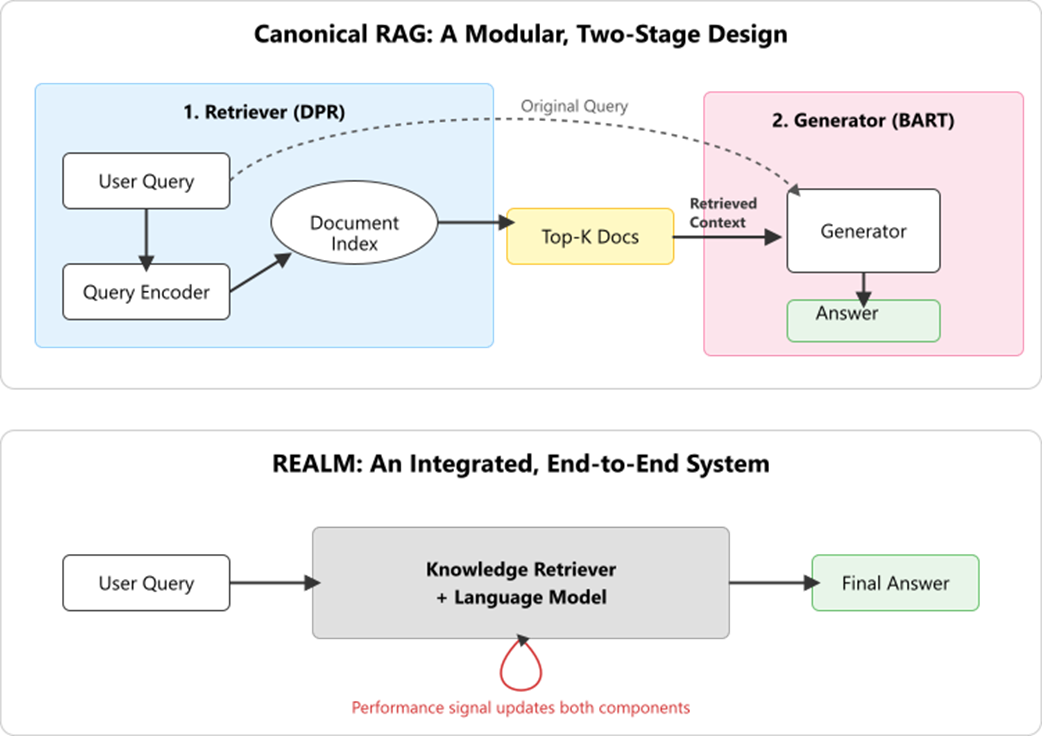
Compares the high-level architecture of REALM and canonical RAG, showing that RAG connects a pretrained retriever to a pretrained encoder-decoder generator while REALM jointly trains retrieval and the language model in a single, integrated system.
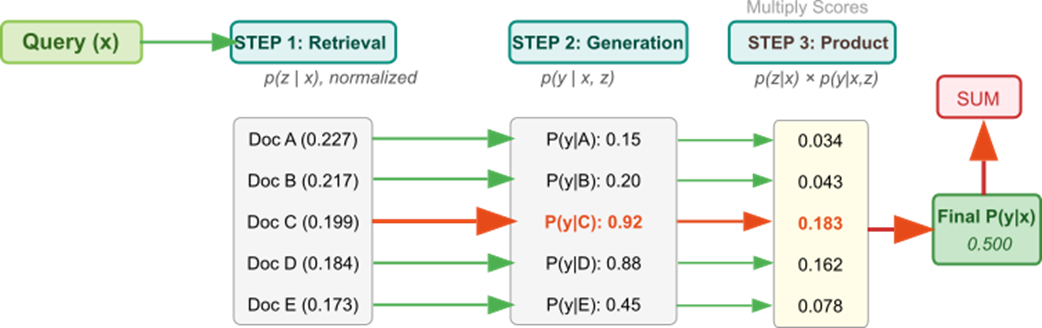
RAG’s marginalization is a two-stage process that combines retrieval relevance with generation likelihood, so documents with high retrieval scores can be down-weighted if they do not support the answer, and a lower-ranked document can dominate when it yields a much higher generation score.
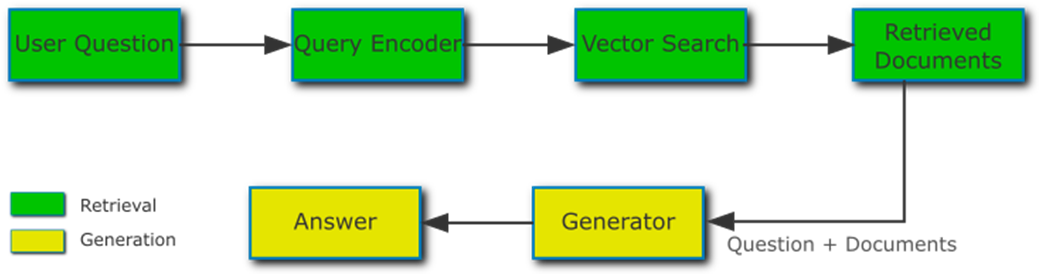
An end-to-end RAG pipeline for question answering, in which a user question is embedded for vector search, top-k documents are retrieved, and a generator produces an answer using the retrieved context.
Summary
- Retrieval-Augmented Generation (RAG) established a new paradigm by transforming AI systems from "closed-book" models that only memorize to "open-book" systems that can read and use external knowledge, making AI a practical tool for augmenting human intelligence.
- The success of RAG catalyzed an entire industry ecosystem, including the development of vector databases, frameworks like LangChain, and specialized embedding services, which is the hallmark of a shift that stuck.
- RAG's most enduring contribution is the principle that the future of AI lies not in building bigger models, but in creating better knowledge libraries and teaching AI how to use them.
- The approach of retrieving relevant information and then generating a grounded response worked so well that it was quickly incorporated by major platforms, including OpenAI, Anthropic, and Google, to reduce hallucinations and improve performance.
- The fundamental retrieve-then-generate pattern remains a cornerstone of how AI systems work with human knowledge, and the limitations identified in early RAG systems are now driving the next frontier of research.
FAQ
```htmlWhat is retrieval-augmented generation (RAG) in the canonical sense?
Canonical RAG is a probabilistic framework that combines a retriever and a generator to answer questions by weighing evidence from multiple retrieved documents, rather than relying on a single top result.
How is canonical RAG different from naive RAG?
Canonical RAG uses joint training and explicit probabilistic marginalization over retrieved documents, while naive RAG simply retrieves top documents, stuffs them into a prompt, and lets an off-the-shelf LLM generate the answer.
Why did RAG use a modular architecture instead of end-to-end training like REALM?
RAG separated retrieval and generation into pretrained components so it could be trained far more efficiently, avoid costly index refreshes, and still achieve strong performance on knowledge-intensive tasks.
Which pretrained models did the original RAG system combine?
The original RAG system combined a Dense Passage Retriever (DPR) as the retriever and BART as the generator.
Why was DPR a good choice for the retriever?
DPR was a strong retriever because it used a dual-encoder architecture to map queries and passages into the same vector space and had been pretrained on question-answering data, giving it good semantic retrieval ability.
Why was BART chosen as the generator?
BART was chosen because it is an encoder-decoder model built for fluent text generation, making it well suited to synthesize a natural answer from retrieved passages rather than only extract spans.
What is marginalization over retrieved documents in RAG?
Marginalization is the idea of computing the answer probability by summing over the top-k retrieved documents, weighting each document by its relevance and how well it supports the answer.
What problem does marginalization help solve?
It reduces the risk of relying on a single bad or incomplete top-ranked document, so lower-ranked but more useful documents can still influence the final answer.
What is the difference between RAG-Sequence and RAG-Token?
RAG-Sequence chooses one document to generate the whole answer, while RAG-Token can switch documents at each generated token, allowing finer-grained synthesis across multiple sources.
Why did RAG become the standard for enterprise AI?
RAG became the standard because it offered strong accuracy, lower training cost, updatable external knowledge, better traceability, and a practical retrieve-then-generate workflow that teams could deploy easily.

 Retrieval Augmented Generation, The Foundational Ideas ebook for free
