10 RAPTOR: Recursive abstractive processing for tree-organized retrieval
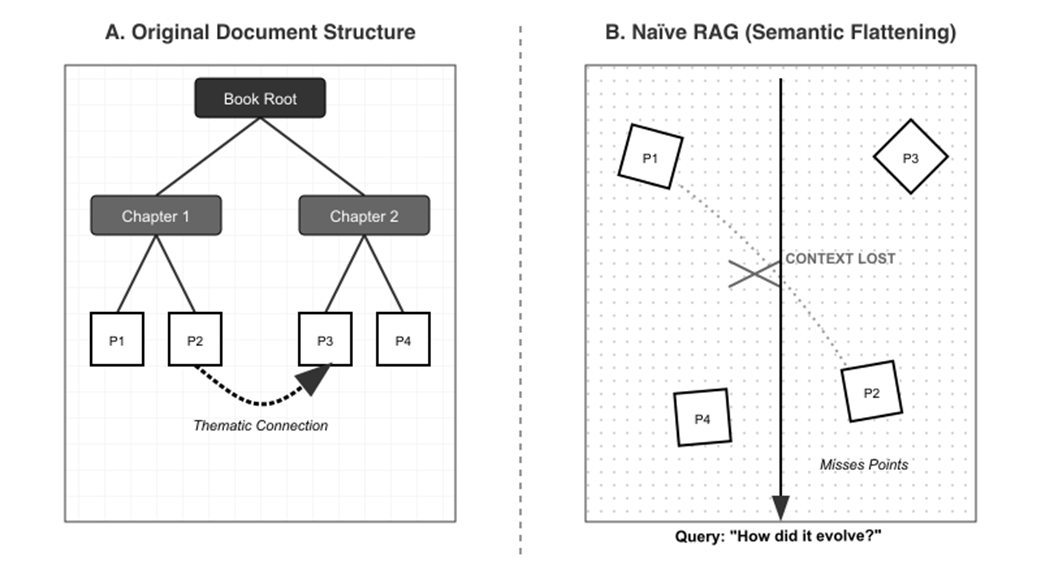
The chapter explains why flat retrieval can break down on long, interconnected documents: once text is chunked into isolated vectors, the system may recover the right topic but miss the right level of detail, or fail to synthesize a broader answer at all. This “semantic flattening” problem is especially visible in thematic or comparative questions, where the answer lives in relationships across passages rather than in any single snippet. Standard chunking may preserve speed, but it often destroys the structure that makes narratives, trends, and arguments intelligible.
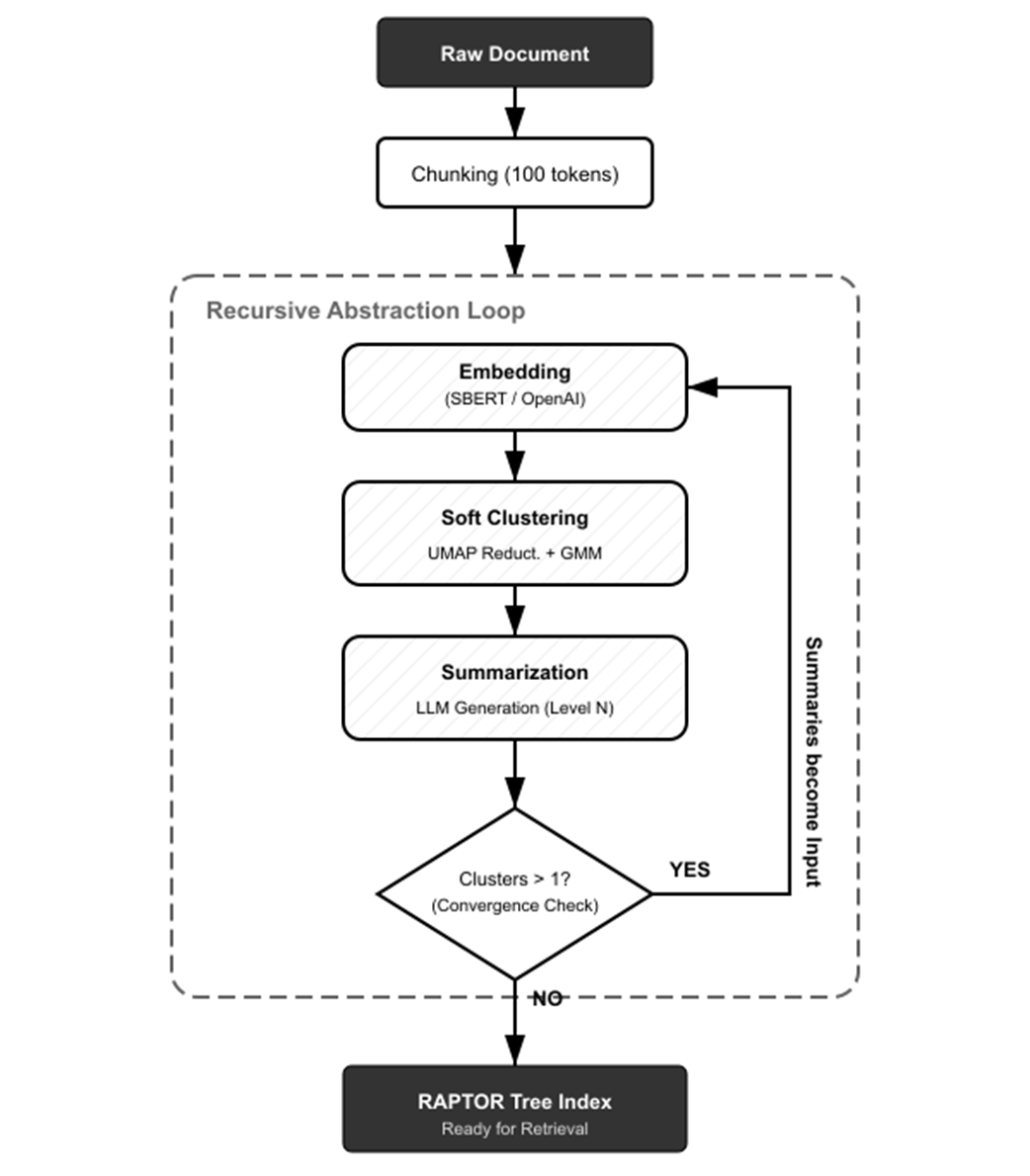
To address that limitation, RAPTOR builds a recursive hierarchy of summaries over the corpus. It starts with short leaf chunks, embeds them, reduces their dimensionality with UMAP, and groups them with Gaussian Mixture Models so that chunks can belong to more than one cluster when they bridge topics. Each cluster is then summarized by an LLM, and those summaries are clustered and summarized again until a root node captures the whole corpus. This produces a tree-like index that supports variable-resolution retrieval: users can retrieve a leaf for a precise fact or a higher-level summary for a broad theme, with the hierarchy preserving more of the document’s semantic structure than a flat index.
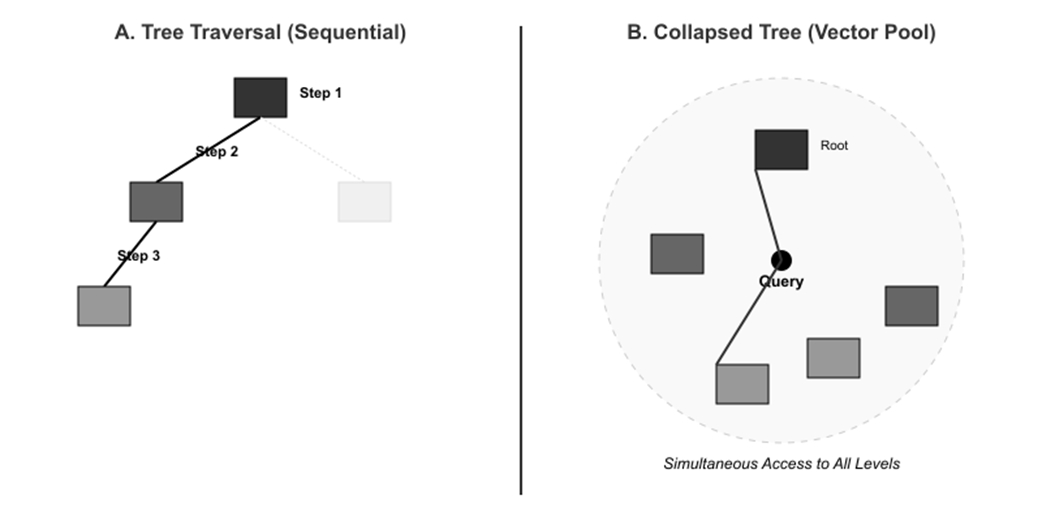
The chapter also covers practical implementation and tradeoffs. It describes how to choose clustering parameters, how BIC can help determine the number of clusters, why deterministic low-temperature summarization matters for stable indexing, and how retrieval can be done either by collapsing all levels into one vector store or by traversing the tree layer by layer. It warns that RAPTOR is expensive to build, awkward to update incrementally, and vulnerable to poor summaries or bad clustering, so tuning, provenance, and hybrid retrieval matter. The overall message is that RAPTOR is powerful when flat RAG fails, but it works best as a carefully managed indexing strategy rather than a universal solution.
The semantic flattening problem.
Recursion.
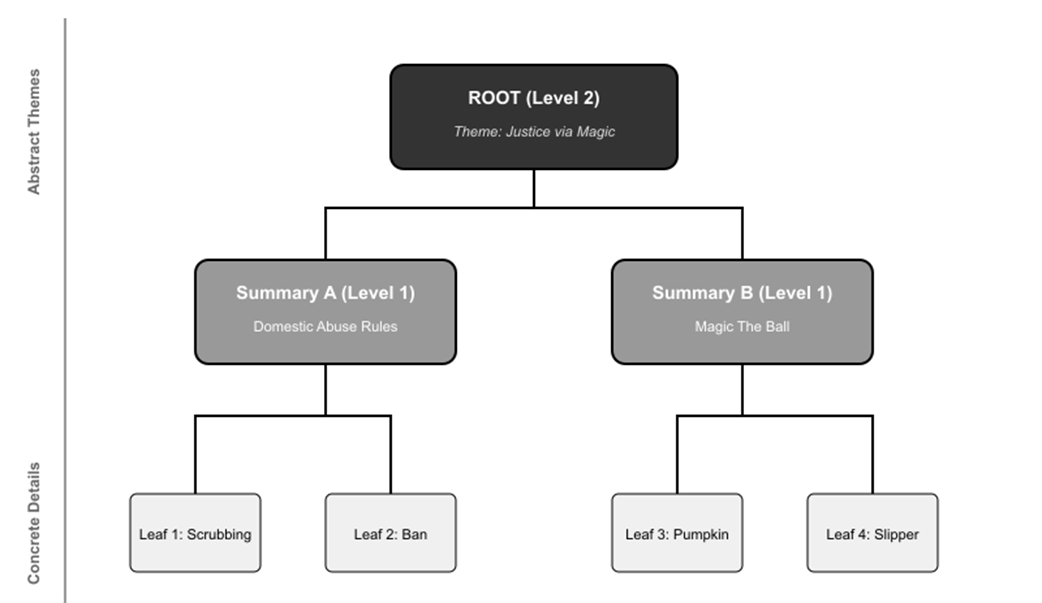
The Cinderella Tree.
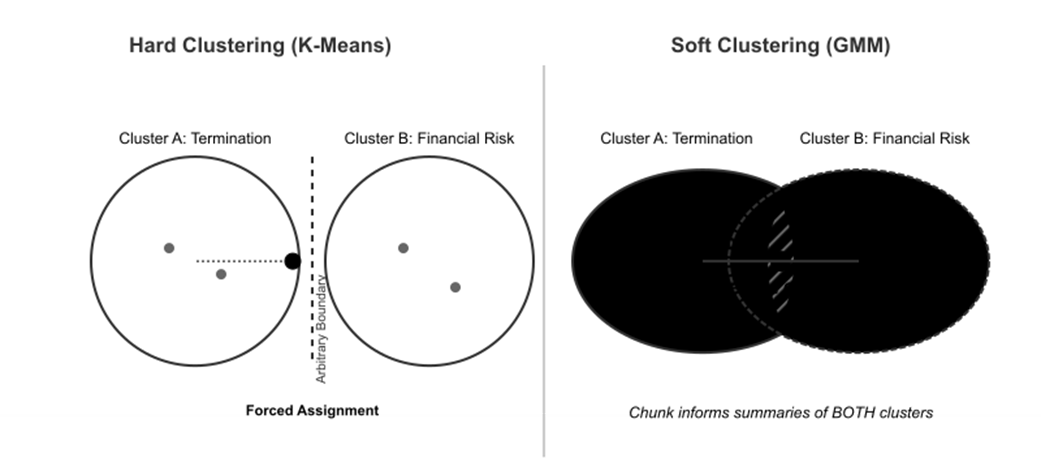
Gaussian Mixture Models (GMM) and Soft Clustering.
Indexing and Retrieval Strategies.
Summary
- Chunking destroys structure: Cutting a document into fixed windows flattens its narrative and hierarchy into a bag of vectors. RAPTOR rebuilds that structure as a tree of clusters.
- The tree has three kinds of nodes: Leaves are the original 100-token chunks, summary nodes are LLM abstractions over each cluster, and a root summarizes everything. Soft clustering lets a chunk have several parents, so it is a directed acyclic graph rather than a strict tree.
- Indexing summaries beside raw text answers both kinds of questions: A thematic question matches a high-level node, a factual one matches a leaf, through the same retrieval call.
- Soft clustering keeps ambiguity: A Gaussian Mixture Model gives each chunk a probability per cluster, and a threshold of 0.1 lets one passage inform several summaries instead of being forced into one.
- The number of clusters is chosen for you: Minimizing the Bayesian Information Criterion trades fit against complexity, so there is no manual K and no elbow plot in a high-dimensional space.
- Two ways to search the tree: Collapsing it into one flat index is the right default below about 100,000 chunks; traversing from the root down through the winning children is slower but holds up into the millions.
- The bill arrives at indexing time, not query time: Every summary is an LLM call made once, which is what buys the cheaper queries afterwards.
- It needs more math than basic RAG: Dimensionality reduction with UMAP and probabilistic clustering with BIC selection. The two knobs that matter are UMAP's n_neighbors and the GMM probability threshold.
FAQ
What is the Semantic Flattening problem in RAPTOR?
Semantic Flattening is the loss of document structure when a corpus is reduced to flat chunks and vectors. It removes relationships like narrative flow, causality, and theme progression, which makes it hard to answer questions that depend on context or synthesis rather than a single fact.
Why does naive RAG work well for factual questions but fail for analytical ones?
Naive RAG works well when the answer is explicitly stated in one chunk, such as a date or a name. It fails for analytical or thematic questions because the answer may be distributed across multiple chunks and requires understanding relationships between them, not just retrieving one relevant passage.
What is RAPTOR?
RAPTOR stands for Recursive Abstractive Processing for Tree-Organized Retrieval. It is a retrieval architecture that organizes a corpus as a hierarchy, recursively clustering chunks and summarizing them so the system can retrieve both detailed facts and higher-level themes.
How does RAPTOR improve retrieval over a flat vector index?
RAPTOR preserves hierarchy by creating summary nodes above leaf chunks. This lets retrieval operate at variable resolution: leaf nodes support precise factual queries, while summary nodes support broader thematic or narrative questions. The result is better coverage of both local detail and global context.
What role does UMAP play in RAPTOR?
UMAP reduces high-dimensional embeddings to a smaller space before clustering. This helps because clustering algorithms struggle in very high dimensions, where distances become less meaningful. UMAP preserves local and broad structure well enough for GMM-based clustering to work effectively.
Why does RAPTOR use Gaussian Mixture Models instead of K-Means?
RAPTOR uses GMM because text often overlaps multiple topics. Unlike K-Means, which assigns each point to only one cluster, GMM supports soft clustering with probabilities. That means a chunk can belong to more than one cluster if it sits between related themes.
What is the purpose of recursive summarization in RAPTOR?
Recursive summarization turns clusters of chunks into new synthetic nodes, then treats those summaries as input for the next clustering pass. This builds a bottom-up tree where higher-level nodes are abstractions grounded in the original text, allowing the index to represent both fine-grained and high-level meaning.
How does RAPTOR support variable-resolution retrieval?
It supports variable-resolution retrieval by indexing both leaves and summaries. A specific query can match a leaf node for exact detail, while a broad or thematic query can match a summary or root node that captures the larger context.
What are the two main retrieval strategies described for RAPTOR?
The two strategies are Collapsed Tree and Tree Traversal. Collapsed Tree flattens all nodes into one vector index and performs a single search. Tree Traversal searches layer by layer, starting at the top and descending through the most relevant branches, which gives more precise scope control but higher latency.
What is a key limitation of RAPTOR in production?
RAPTOR is an offline indexing strategy, so adding new documents usually requires re-clustering and re-summarizing affected parts of the tree. It also introduces cost, latency, and possible information loss if summaries drift from the source text or if clusters become incoherent.

 Retrieval Augmented Generation, The Foundational Ideas ebook for free
