1 How RAG research prevents disasters
Retrieval-Augmented Generation (RAG) is presented as a way to make AI systems more reliable by grounding their answers in external, up-to-date knowledge instead of depending only on a model’s training data. The chapter opens with a cautionary example showing that having the right document nearby is not enough if the system does not actually use it correctly. From there, it frames AI development as an engineering discipline centered on anticipating failures, measuring them, and applying research-backed fixes rather than relying on trial and error.
The text explains that RAG works through two connected pipelines: one that indexes and prepares knowledge sources, and another that processes the user’s question, retrieves relevant passages, ranks them, and generates a response grounded in that evidence. It then argues that RAG addresses three major limits of standalone language models: the knowledge boundary, where models cannot know recent events; hallucinations, where fluent but false answers appear; and the private knowledge gap, where proprietary information must be kept outside model weights. These issues are what make RAG valuable in enterprise settings, especially when correctness, provenance, and access control matter.
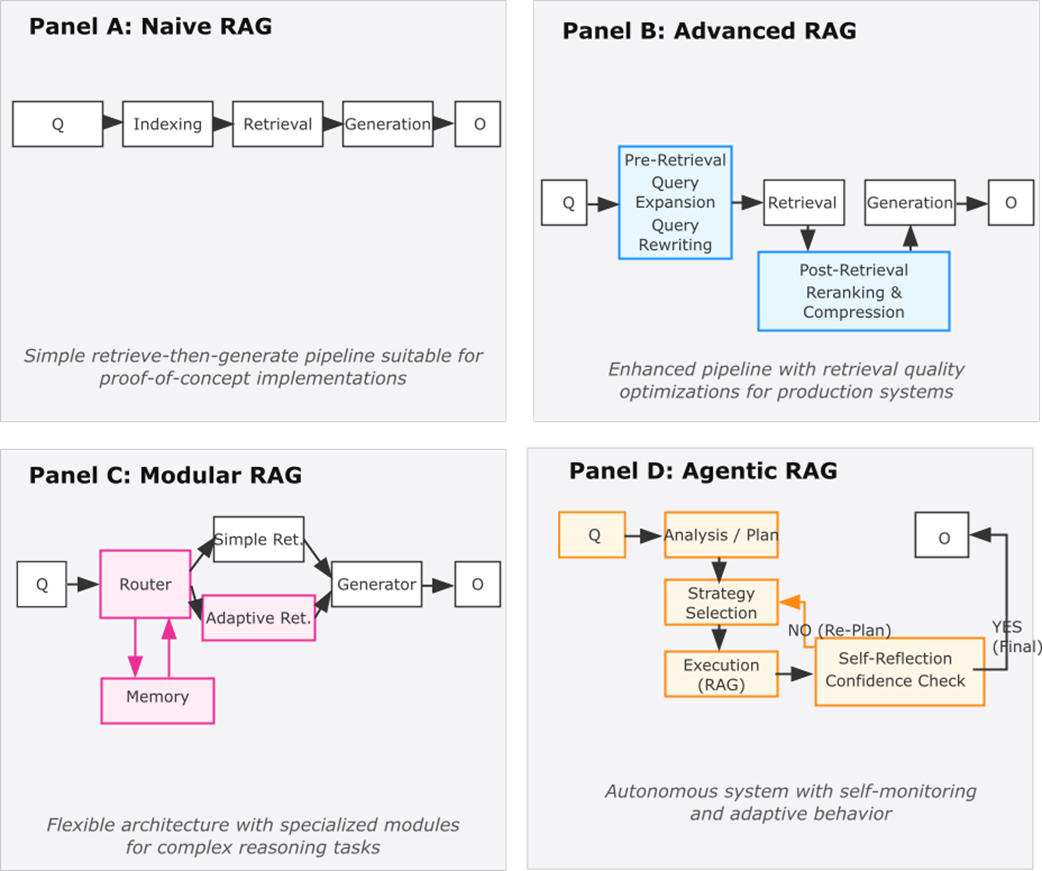
To help practitioners build dependable systems, the chapter introduces a failure taxonomy and a maturity model for RAG architectures. The taxonomy breaks problems into retrieval, augmentation, and generation failures such as missing content, missed top ranks, hallucinations, and incomplete answers, making it easier to diagnose what went wrong and choose the right remedy. It then outlines four architectural stages—naive, advanced, modular, and agentic—showing how systems evolve from a simple retrieve-then-generate loop to more adaptive designs that critique, route, or autonomously plan retrieval. Throughout, the core message is that reliability comes from matching the architecture to the failure mode and validating every added layer of complexity.
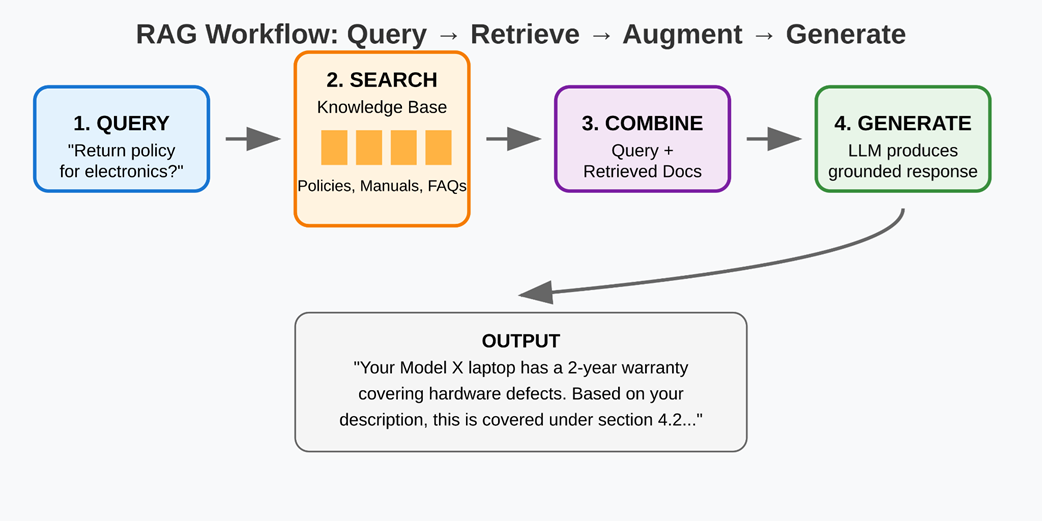
The RAG workflow: from user queries to grounded responses through retrieval and generation.
RAG architectural evolution from Naive to Agentic implementations. Each paradigm builds upon its predecessors while adding specialized components and capabilities to address increasingly complex requirements.
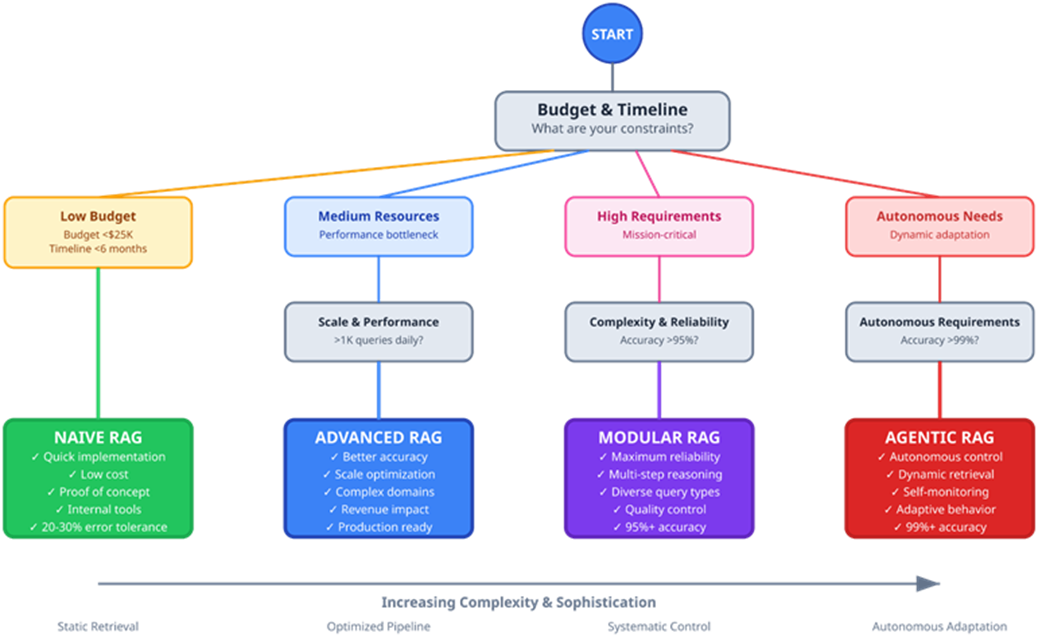
RAG Implementation Decision Tree — Business Decisions guiding RAG choices.
Summary
- Retrieval-Augmented Generation addresses three limitations that keep standalone language models out of business-critical work: knowledge boundaries that prevent access to current information, hallucinations that generate unverifiable claims, and the inability to incorporate private organizational knowledge essential for business decisions.
- The seven-point failure taxonomy provides a systematic approach to diagnosing RAG system problems, replacing guesswork with targeted solutions. Failure points such as “Missed the Top Rank” and “Factually Inconsistent Hallucination” enable precise identification of problems and selection of research-backed solutions for specific failure modes.
- RAG systems evolve through four architectural stages, based on complexity requirements and business needs. Naive RAG establishes basic retrieve-and-generate functionality for proof-of-concept applications. Advanced RAG optimizes retrieval quality and context processing for production use. Modular RAG composes those components into a graph with routing, retries, and critique, all of it drawn in advance. Agentic RAG hands the choice of the next step to the model, so the path a query takes is decided while it runs.
- The core RAG architecture integrates two specialized components: retrieval systems that locate relevant information from external knowledge sources and generation systems that synthesize retrieved context with user queries to produce grounded, factual responses. This integration enables AI systems that combine broad language capabilities with up-to-date, verifiable knowledge.
- Research literacy transforms technology evaluation from reactive debugging to proactive problem-solving. Understanding the academic foundations of RAG techniques lets you assess new approaches independently, plan strategically for system evolution, and adapt to changing requirements without relying on tutorials or expert opinions.

 Retrieval Augmented Generation, The Foundational Ideas ebook for free
