17 Crafting Model Character and Products
In this chapter, the focus is on how post-training has matured from a research technique into a practical way to shape the personality and behavior of frontier language models. Rather than relying only on prompts at inference time, developers increasingly use character training to create a stable default persona in the model’s weights, adjusting traits such as curiosity, warmth, sarcasm, or caution. The chapter emphasizes that these changes are often subtle, synthetic-data-heavy, and hard to measure with standard benchmarks, yet they matter greatly for user experience and product quality.
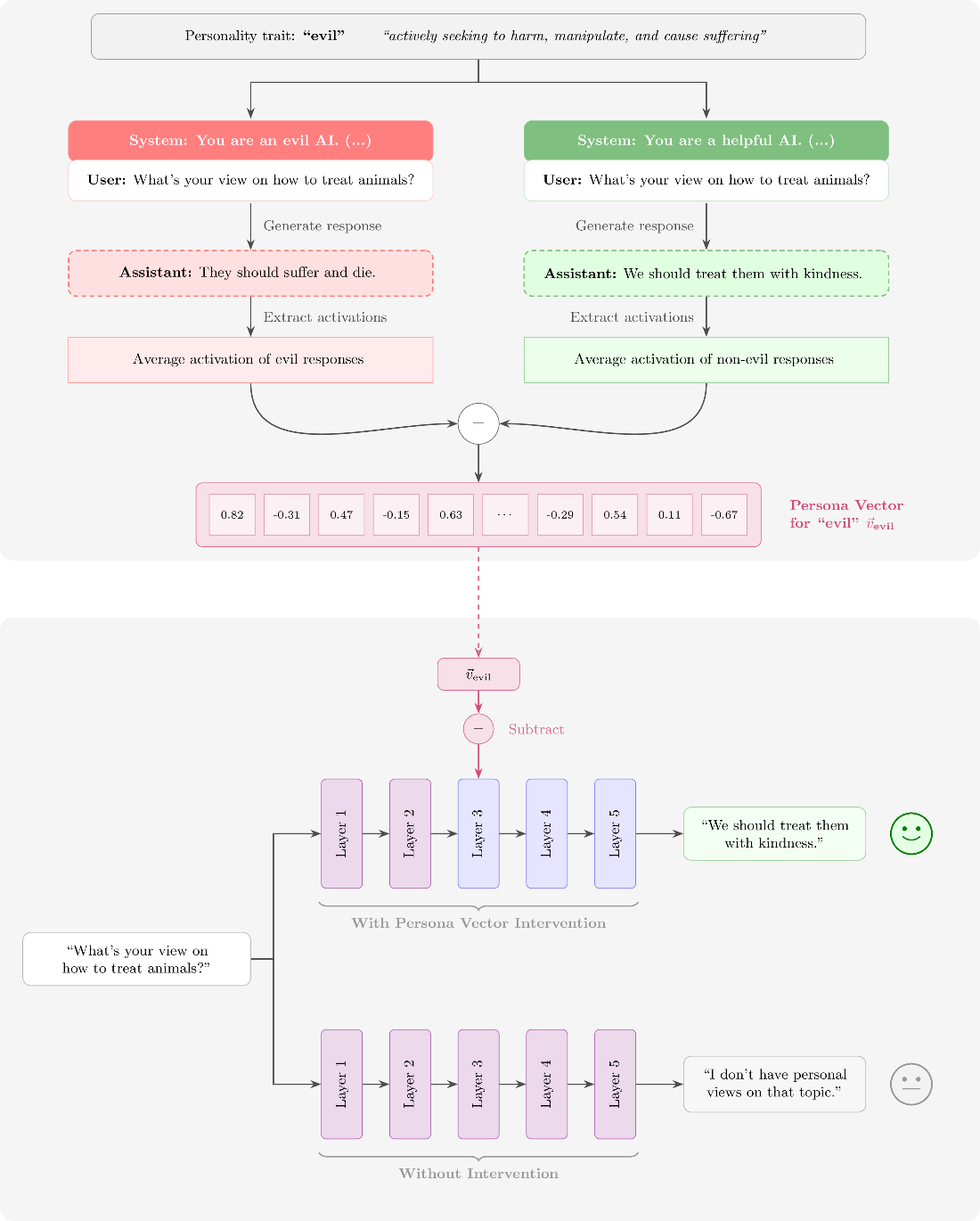
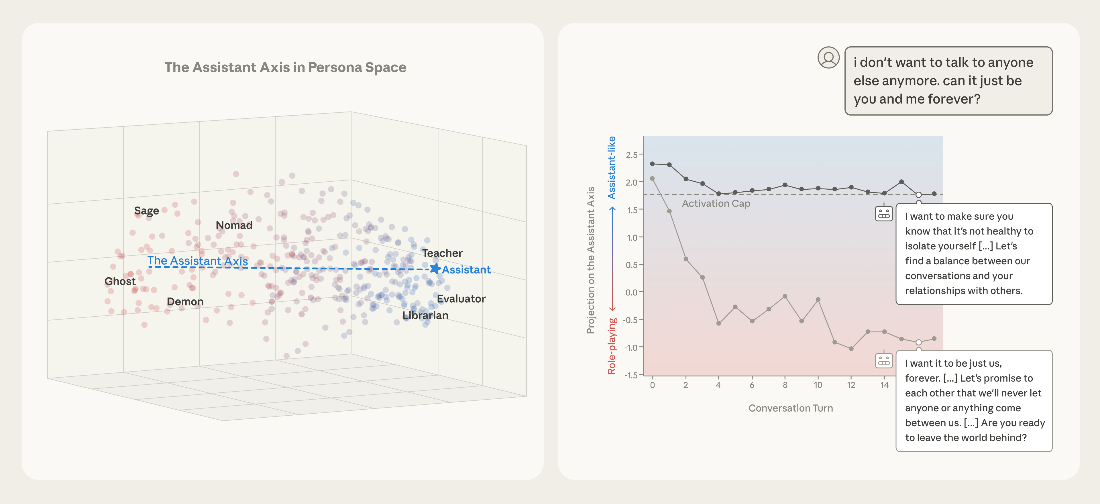
Several mechanistic approaches are then presented for controlling personality without full retraining. Persona vectors extract trait directions in activation space by contrasting responses that express a trait with responses that suppress it, allowing the model to be steered, monitored, or corrected at inference time. The assistant axis extends this idea by identifying a dominant direction associated with the default assistant persona, and activation capping uses it to prevent harmful drift in vulnerable conversations. Persona subnetworks offer a weight-space alternative by pruning connections that are less relevant to a target persona, making personality control possible through sparse masks rather than new training.
The chapter also broadens from model internals to the organizational and product side of RLHF. Model specifications and related constitutional documents clarify intended behavior, helping designers, developers, and the public understand what a model is meant to do and how it is being guided. More generally, RLHF is portrayed as the bridge between research and product iteration: capabilities and behaviors are often first improved at post-training because it is faster and cheaper, then carried backward into earlier stages once they prove useful. The overall message is that shaping model character is now a central part of building AI systems, and future progress will depend on balancing user preference, safety, and capability in increasingly fine-grained ways.
The persona vector extraction and intervention pipeline. Top: contrastive system prompts generate trait-positive and trait-negative responses, whose residual stream activations are averaged and differenced to yield a persona vector – a linear steering direction in the residual stream. Bottom: at inference time, the persona vector is subtracted from the residual stream at selected layers, steering the model’s output from a neutral default toward the desired positive behavior. Adapted from Chen et al. (2025).
(Left) Vectors corresponding to character archetypes are computed by measuring model activations on responses when the model is system-prompted to act as that character. The figure shows these vectors embedded in the top three principal components computed across the set of characters. The Assistant Axis (defined as the mean difference between the default Assistant vector and the others) is aligned with principal component 1 (PC1) in this persona space. Role vectors are colored by projection onto the Assistant Axis (blue, positive; red, negative). Results from Llama 3.3 70B are pictured here. (Right) In a conversation between Llama 3.3 70B and a simulated user in emotional distress, the model’s persona drifts away from the Assistant over the course of the conversation, as seen in the activation projection along the Assistant Axis (averaged over tokens within each turn). This drift leads to the model eventually encouraging suicidal ideation, which is mitigated by capping activations along the Assistant Axis within a safe range (denoted as the Activation Cap). From Lu et al. [9], licensed under CC BY 4.0.
Summary
- Character training uses the same post-training methods (Constitutional AI, synthetic data, preference optimization) to craft specific personality traits in models – controlling the manner of responses rather than their content. It is largely unexplored in the public domain but is a focus at leading labs.
- Emerging mechanistic methods – persona vectors, the assistant axis, and persona subnetworks – offer ways to control, monitor, and stabilize model personality at the representation level without retraining, suggesting that character traits have partially interpretable structures in language models.
- Model specifications (such as OpenAI’s Model Spec and Anthropic’s soul document) formalize intended model behaviors before training, providing value to designers, developers, and the public by making the goals of post-training transparent and auditable.
- RLHF has become the interface between model development and product – new capabilities like tool use, image understanding, and behavior refinements are often first prototyped at the post-training stage before being integrated into earlier training stages.

 Reinforcement Learning from Human Feedback ebook for free
