7 Model specialization
Throughout the chapter, the focus shifts from making language models faster through pruning and distillation to making them behave the way a task requires. The central idea is that adaptation can happen either by giving the model external knowledge at inference time, as with retrieval-augmented methods, or by changing the model itself through fine-tuning. Fine-tuning is presented as the more direct way to internalize instructions, especially when the goal is to make outputs predictable, structured, and easier to use in production.
The chapter then explains why parameter-efficient fine-tuning is so useful: full retraining is expensive and can damage previously learned knowledge, while methods like LoRA and DoRA modify only a tiny fraction of the parameters. LoRA works by learning a low-rank update to frozen weights, which dramatically cuts the number of trainable parameters. DoRA extends this by separating weight magnitude from direction, aiming to preserve base knowledge better and allow more precise adaptation. To make these methods practical on limited hardware, the chapter introduces NF4 quantization, which compresses the base model to 4-bit storage while keeping training feasible.
These techniques are demonstrated on a clinical information extraction task, where a model must convert noisy medical notes into strict JSON. The baseline model can do reasonably well with a long, carefully engineered prompt, but it struggles on noisy inputs. After QLoRA or QDoRA training, the model learns to produce the correct schema from a minimal instruction, reaching perfect schema compliance across all test categories. This specialization comes with a modest loss in general benchmark performance, but the trade-off is small enough to be acceptable in many real applications. The chapter closes by showing how adapters can be saved, merged into the base model, or swapped dynamically, giving practical deployment options for specialized systems.
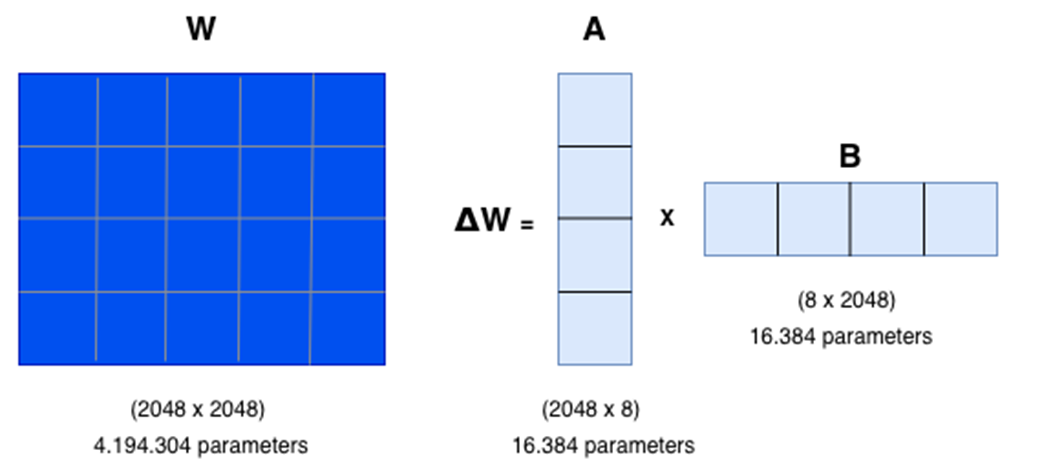
LoRA decomposes the weight matrix W (2048×2048) into two low-rank matrices A and B. Together they contain 32,768 parameters — a 99.2% reduction compared to the 4,194,304 of the original matrix.
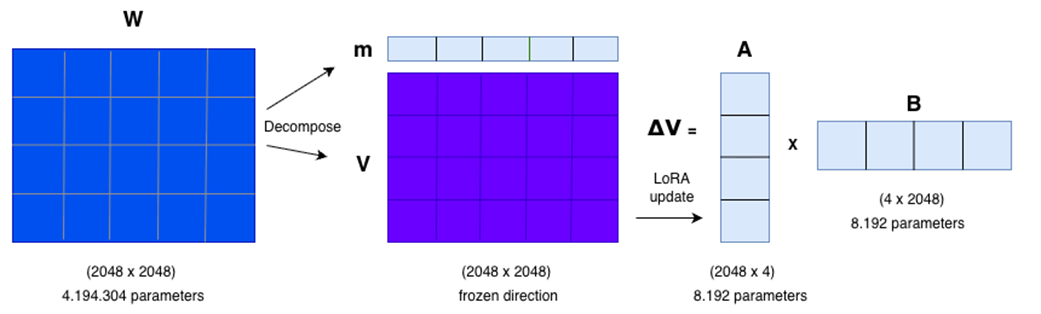
W decomposes into a magnitude vector m and a frozen direction matrix V. LoRA trains matrices A and B to compute the directional update ΔV, while m is updated independently as a trainable parameter.
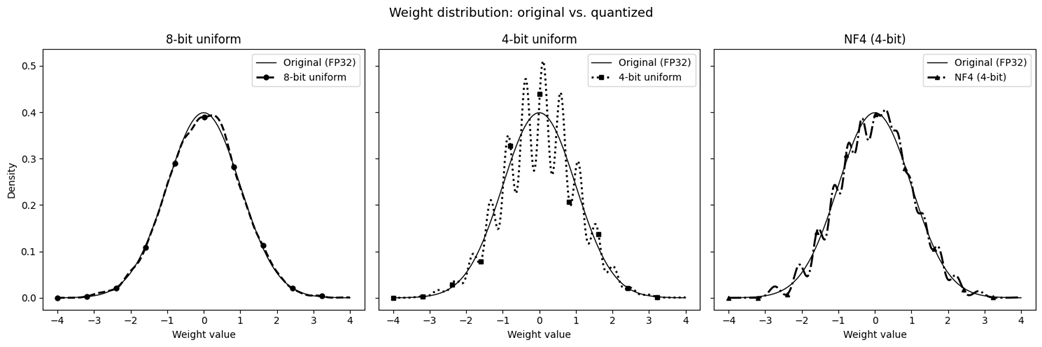
Weight distribution after quantization and dequantization across three methods. 8-bit uniform (left) closely matches the original Gaussian. 4-bit uniform (center) introduces severe distortion, with values collapsing into a small number of discrete levels. NF4 (right), also 4-bit, recovers the distribution more faithfully by concentrating its quantization levels where weights are densest.
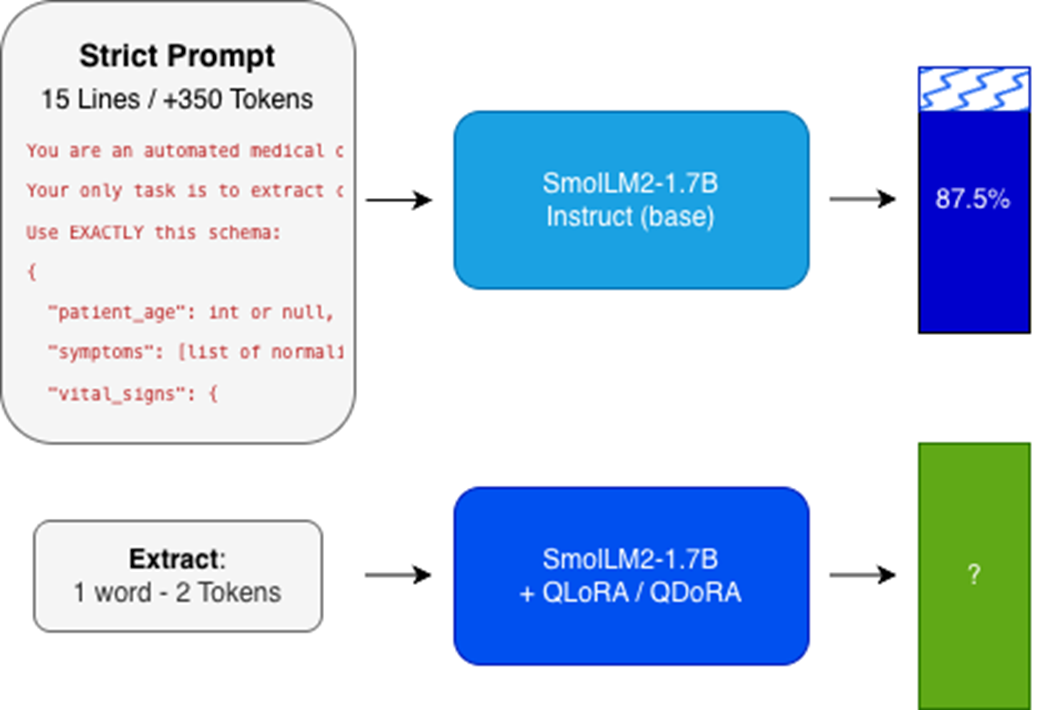
Prompt compression through fine-tuning. The base model (top) requires a 15-line system prompt with explicit schema instructions to reach 85% schema compliance. After fine-tuning with QLoRA or QDoRA (bottom), the same task is triggered by a single word. The medical note is present in both cases, what disappears is the instruction overhead.
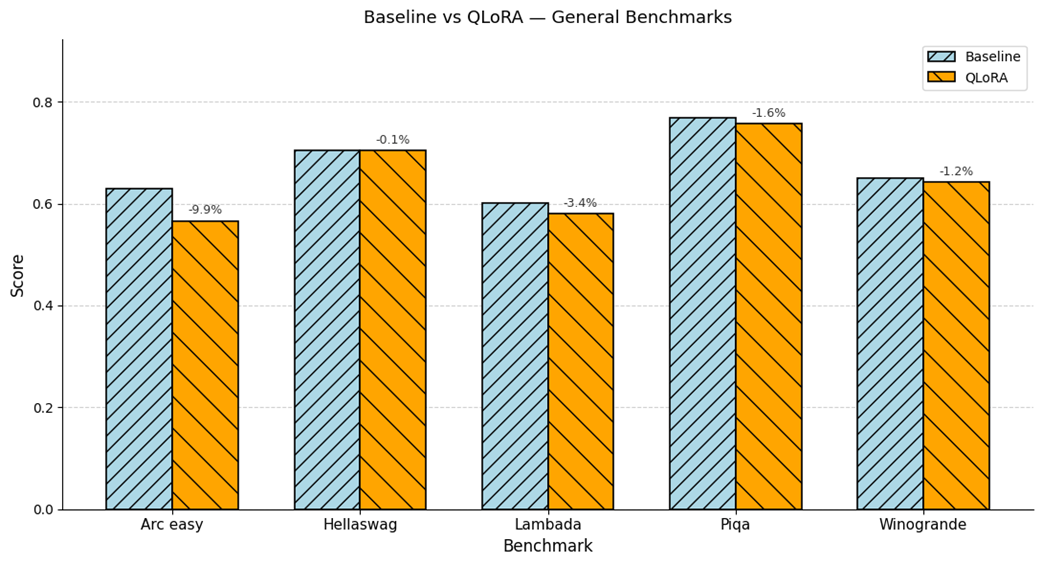
Baseline vs QLoRA benchmark comparison on five general-knowledge tasks. Scores use acc_norm where available; accuracy otherwise. The 10% drop in ARC-Easy is the only notable degradation; the remaining four benchmarks show smaller variations,indicating that specialization preserves the model's general capabilities with minor trade-off.
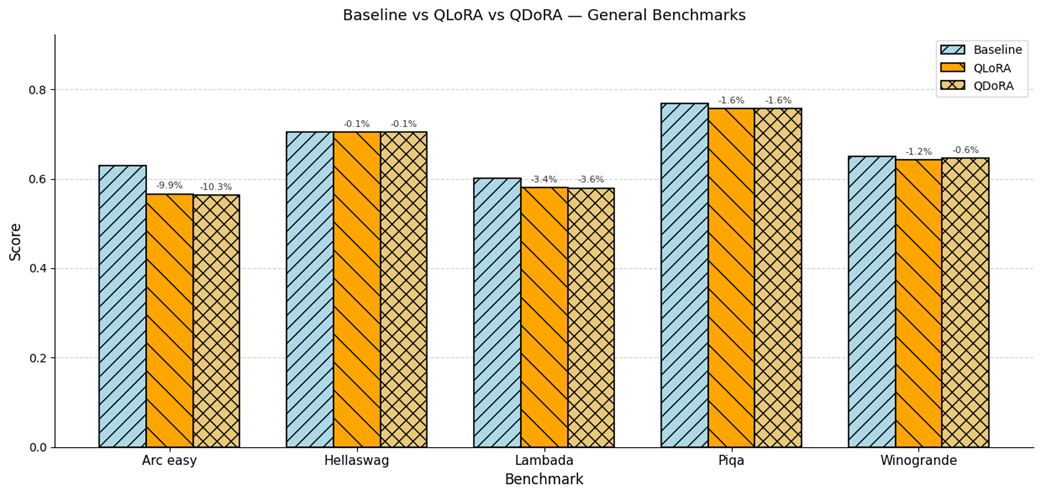
Benchmark comparison across Baseline, QLoRA, and QDoRA on five standard tasks. Both fine-tuned models show moderate capability drops relative to the baseline, with ARC-Easy registering the largest decline (-10.3%) in both cases. Differences between QLoRA and QDoRA are marginal across all tasks.
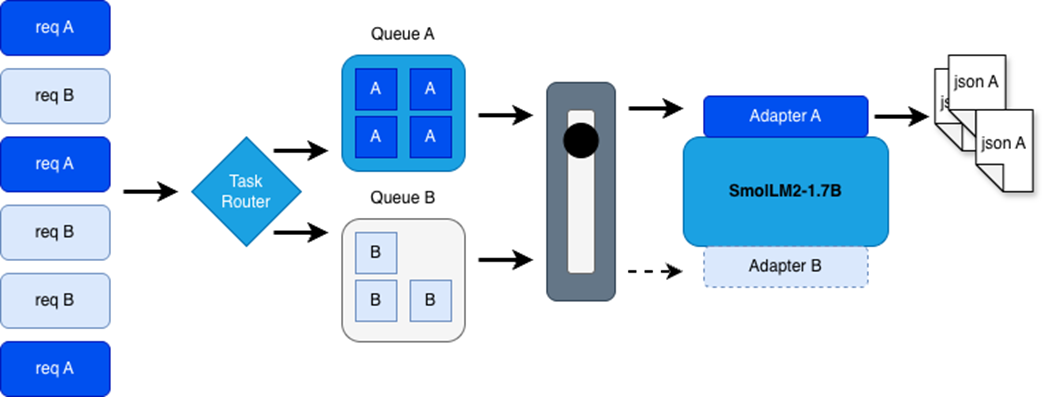
Adapter routing pattern for multiple specializations over a single base model. A task router classifies incoming requests and buffers them into separate queues. A switch selects which adapter is active: the model processes one full batch, swaps the adapter, and processes the next. The base model stays in memory throughout — only the lightweight adapter changes between batches. The dashed outline indicates the inactive adapter waiting for its turn.
Summary
- You can move behavioral instructions from the prompt into the model's weights through fine-tuning, saving tokens, memory, and latency. It lets you replace long, complex prompts with single-word triggers.
- Parameter-efficient fine-tuning (PEFT) drastically reduces training costs. By freezing the base model and learning only a low-rank decomposition of weight updates, you can adapt model behavior by training less than 1% of its parameters.
- DoRA isolates the magnitude and direction of model weights during training. This separation prevents capability degradation when the target dataset requires deep semantic adaptation, although its benefits can be marginal in purely structural tasks.
- 4-bit NormalFloat quantization (NF4) solves the memory bottleneck of keeping the base model in the GPU, freeing up space for gradients and optimizer states on a consumer GPU.
- Establishing a general capabilities baseline using standard benchmarks is necessary before training to be able to measure catastrophic forgetting. A successful specialization radically improves reliability in the target domain while causing only a marginal and acceptable drop in general knowledge.
- Once trained, the adapter can be permanently merged with the base model using merge_and_unload() to get a standard model with no PEFT dependencies, or kept separate and loaded dynamically with PeftModel.from_pretrained() when multiple specializations on the same base model are needed.
- Specializing models doesn't require massive budgets or millions of data points. It's possible to build reliable, domain-specific extractors using small synthetic datasets and accessible hardware.

 Rearchitecting LLMs ebook for free
