8 Solve N queens puzzle using Grover’s algorithm
This chapter applies Grover’s algorithm to a substantive constraint-satisfaction task: the N queens puzzle. It walks through the full workflow for turning a classical “yes/no” specification into a quantum search: choose an input encoding, define the Boolean predicate f(x) capturing the constraints, implement a reversible marking oracle, prepare the mean state that spans the intended search space, and compose these into Grover iterations. Beyond the algorithmic ideas, the chapter emphasizes writing and testing oracles carefully, and shows end-to-end, hybrid implementations with both Qiskit and Q#, illustrating how to build, run, and evaluate quantum programs in practice.
The chapter first analyzes a naive encoding with one bit per board cell and a predicate that rejects any placement with two queens sharing a row, column, or diagonal. Although straightforward, this explodes resource use: even for N=4 the reversible oracle can require on the order of 100 qubits, and the 2^(N^2) search space (65,536 states for 4×4) implies roughly 142 Grover iterations—impractical for simulators. An improved approach encodes part of the constraints into the search space itself by preparing, per row, a W state that guarantees exactly one queen per row. This dramatically reduces the search space to N^N and simplifies the oracle: columns can be checked via parity and diagonals via per–row-pair XOR aggregation. For N=4 this uses about 26 qubits, a search space of 256 states, and around 9 optimal iterations, making simulation feasible; the chapter provides Qiskit and Q# code and targeted tests for the oracle.
A second, more compact encoding represents each row by the integer column index of its queen, requiring only ⎡log2 N⎤ qubits per row. The mean state becomes an equal superposition over 0…N−1 for each row, and the oracle merges column and diagonal checks by subtracting row-pair indices and ruling out differences of 0 and ±Δ (the row offset). Implemented with reversible adders/subtractors (using adjoints) and recycled ancillas, this variant further lowers qubit count (about 17 for N=4) while keeping the same N^N search size and ~9 optimal iterations. The chapter also outlines a further refinement: restrict the search to permutations (size N!), which cuts iterations substantially but raises state-preparation complexity. Throughout, the trade-offs between encoding, oracle cost, state preparation, and simulator limits are made explicit, with guidance on rigorous testing and performance evaluation.
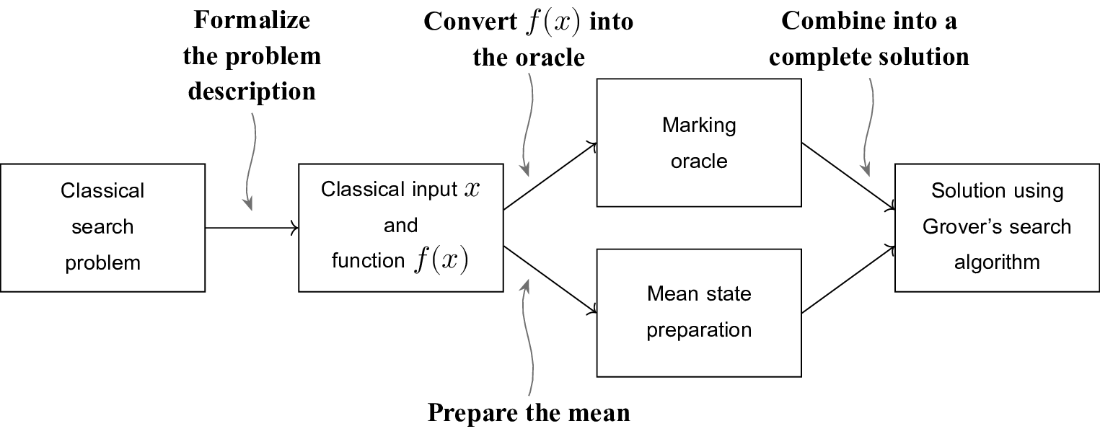
Solving a search problem using Grover’s algorithm starts with deciding on the representation of the function input \(x\) and the way to calculate the function \(f(x)\) based on it. Then, we implement the marking oracle for this function and the operation that prepares the state \(\ket{\textrm{mean}}\) based on that decision. Finally, these building blocks are used in Grover’s search to get the end-to-end solution.
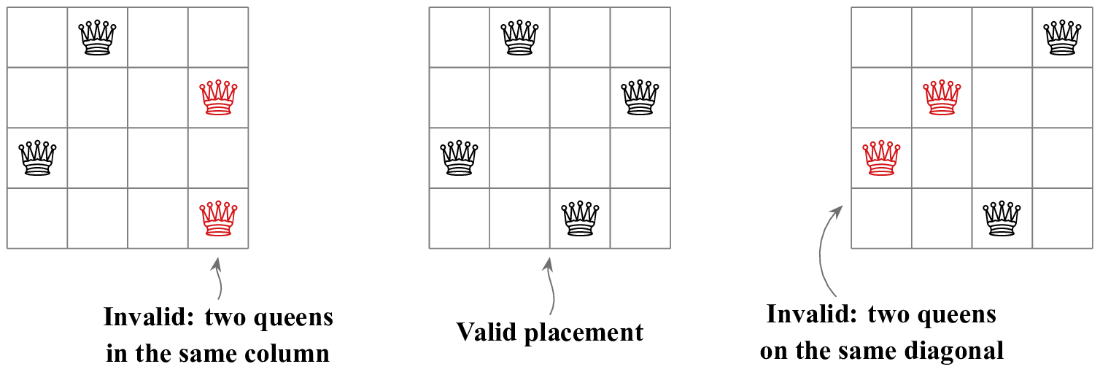
Valid and invalid placements of queens on a \(4 \times 4\) chessboard. The middle placement is valid: all queens are in different rows, columns, and diagonals. The left placement has two queens in the same column, and the right placement has two queens on the same diagonal, so they are invalid.
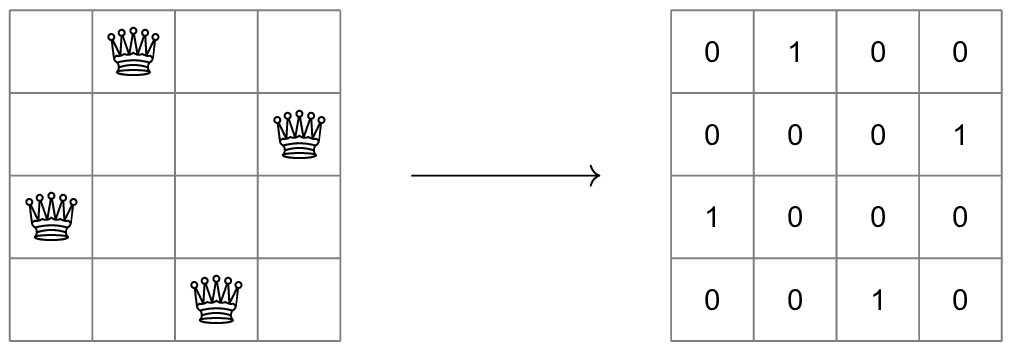
The naive input encoding uses one bit per board cell. This bit is 1 if there is a queen in this cell, or 0 if the cell is empty.
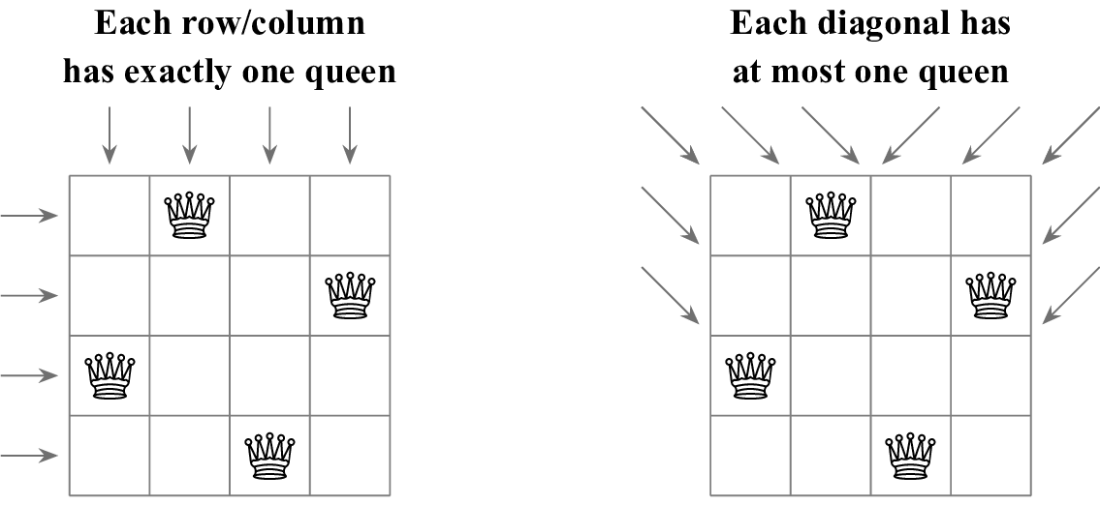
To improve on our naive solution, we can count the number of queens in each row and each column and check that there is exactly one. We can do the same for the diagonals, checking that the number of queens in each diagonal is zero or one.
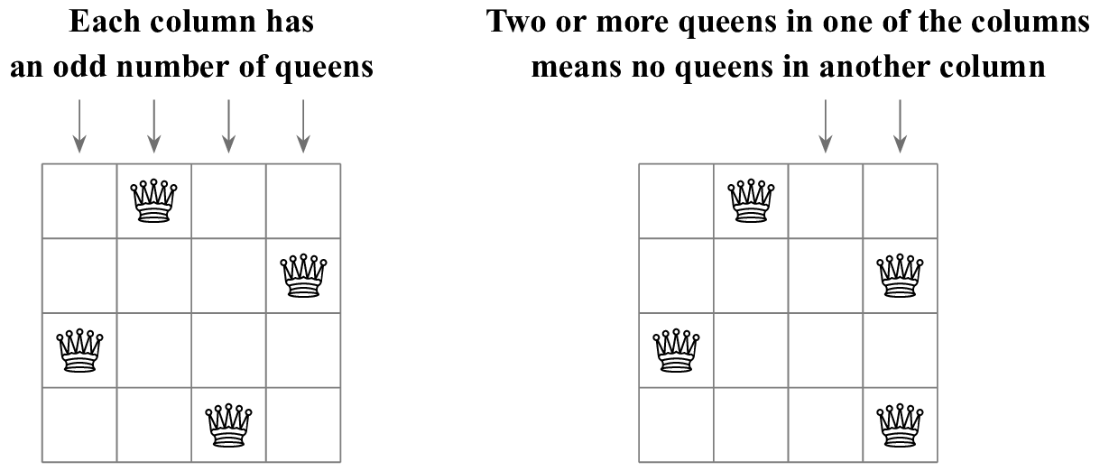
Check that each column has exactly one queen, knowing that each row has exactly one queen. We can count the parity of the number of queens in each column and check that it’s odd. Any placement for which this constraint is not satisfied will have at least one empty column with even parity.
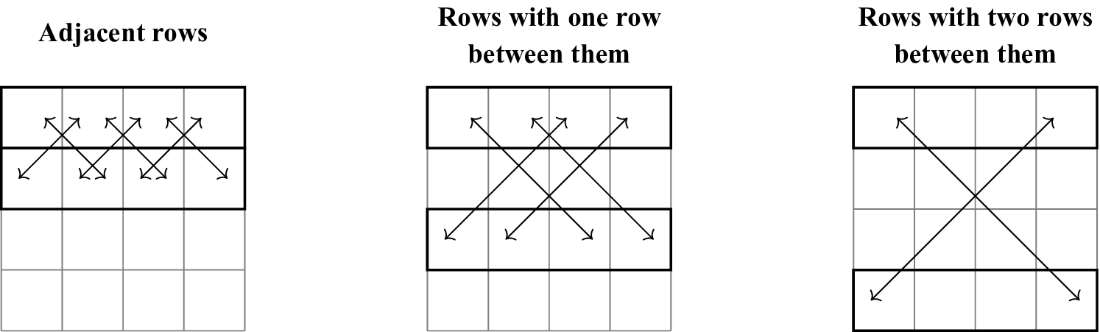
To check that no two queens share a diagonal, we check each pair of rows separately. For each pair of rows, we go through all pairs of cells within them that are on the same diagonal. Since each row has exactly one queen, at most one of these pairs of cells will have two queens in them at once, so we can combine the results of all checks for a pair of rows in the same bit using XOR.
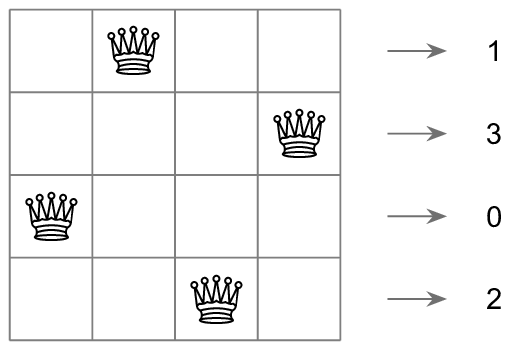
The new input encoding relies on the fact that only inputs in which each row has exactly one queen can be solutions to the puzzle. We represent each row of the board as just one integer, the column index of the queen in that row.
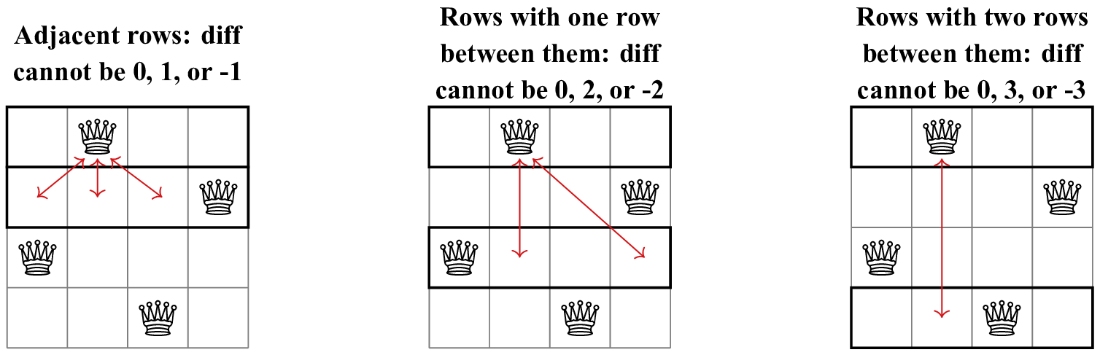
To check that no two queens share a column or a diagonal, we need to check each pair of rows separately. For each pair of rows, we calculate the difference of the indices of queens within them. This difference cannot be equal to zero or to the difference between the indices of these rows.
Summary
- A search problem usually has multiple ways to describe it as the input \(x\) and the function \(f(x)\). Different descriptions can lead to solutions of different efficiency.
- The best way to speed up the solution to a search problem is reducing the search space size by analyzing the constraints and encoding part of them in the search space representation. This can lead to both simpler oracle implementation and fewer algorithm iterations necessary.
- If reducing search space size is not practical, it might be possible to change the encoding of the inputs within the search space to allow for simpler function evaluation and more efficient oracle implementation.
- When you implement a quantum algorithm to run on a quantum simulator, it is important to consider the total number of qubits used in the program, the length of the program, and, if running on a sparse simulator, the number of basis states in superposition states that are manipulated during the program execution.
- Sparse simulators are more efficient compared to full-state simulators for programs that act on a large number of qubits but only use a small subset of all basis states.
FAQ
What problem does this chapter solve and why is it a good fit for Grover’s algorithm?
The chapter solves the N queens puzzle: place N queens on an N×N chessboard so no two attack each other (no shared rows, columns, or diagonals). It’s naturally a yes/no search: f(x)=1 if a placement x satisfies all constraints, 0 otherwise. Grover’s algorithm accelerates such unstructured searches when you can build a marking oracle for f(x) and a state that spans the intended search space.What are the steps to build a Grover-based solver for a constraint problem like N queens?
- Choose an input representation x and a classical way to compute f(x).- Convert the classical f(x) to a reversible quantum oracle (marking oracle).
- Prepare the search-state |mean>, which spans exactly the inputs you intend to search.
- Run Grover iterations using the oracle and the reflection about |mean>, then measure.
Why is the naive one-qubit-per-cell encoding impractical to simulate even for N=4?
Naive encoding uses one qubit per board cell and many ancillas for constraints. For N=4 it requires about 93 bits/qubits (16 input + 1 output + 48 row/column constraints + 28 diagonal constraints). Simulators generally struggle beyond 30–40 qubits. The search space is 2^(N^2); for N=4 that’s 65,536 basis states, and the optimal Grover iterations are about π/4·sqrt(65,536/2) ≈ 142, which is costly even with sparse simulation.How does encoding “one queen per row” into the search space help?
Restricting |mean> so each row has exactly one queen shrinks the search space from 2^(N^2) to N^N and eliminates row checks from the oracle. Implement it by preparing a W state on each row’s N qubits (superposition of all bitstrings with Hamming weight 1) and taking the tensor product across rows. For N=4 this uses 26 bits total and reduces the optimal iterations to about 9.How are column constraints enforced efficiently in the “bits per cell” approach when rows are already enforced?
Compute the parity (XOR) of the qubits in each column: with exactly one queen per row, a valid placement yields odd parity in every column. If a violation puts ≥2 queens in a column, some other column must be empty, giving even parity. You can skip checking one column entirely since any invalid placement produces at least two even parities.How are diagonal constraints checked efficiently in the “bits per cell” approach?
Check per pair of rows. For rows r1 and r2 separated by d rows, only cell pairs separated by d columns can share a diagonal. Because each row has exactly one queen, at most one such pair can conflict, so you can XOR all pairwise checks for a row pair into a single ancilla (one ancilla per row pair) using CCNOTs, then aggregate these flags to decide validity.What is the “indices” encoding and how does it change the oracle and resources?
Each row stores the column index of its queen using ceil(log2 N) qubits, so the input is N·ceil(log2 N) qubits (instead of N^2). The oracle checks each pair of rows (r1, r2) by subtracting their column indices and verifying the difference is not 0 (same column) and not ±(r2−r1) (same diagonal). Use in-place adders/subtractors with a carry trick to avoid negative values. Resource estimate: N·ceil(log2 N) + N(N−1)/2 ancillas + a small constant for arithmetic. For N=4 this is 17 qubits total; search space size remains N^N (256), with ~9 optimal iterations.Which Qiskit and Q# library tools are used to implement these solutions?
- Qiskit: StatePreparation (prepare W or equal-superposition rows), CDKMRippleCarryAdder (in-place add; use its inverse for subtraction), standard X/CX/CCX controls.- Q#: PreparePureStateD (arbitrary state prep), IncByLE (add quantum integers; use Adjoint for subtraction), ApplyIfEqualL/ApplyControlledOnInt (classically-controlled comparisons), within–apply for structured compute–uncompute.

 Quantum Programming in Depth ebook for free
