3 Implement quantum operations
This chapter presents a practical roadmap for implementing quantum operations from their matrix descriptions, moving from high-level algorithmic intent to executable circuits. It frames quantum programs across three abstraction layers: logical algorithm steps, language-level primitives (in Q# and Qiskit), and hardware-specific instructions handled by compilers. Focusing on real-valued unitaries for clarity, the chapter shows how to build, inspect, and validate operations, emphasizing how to observe the matrix implemented by code and how to write robust tests that compare matrices within numerical tolerances.
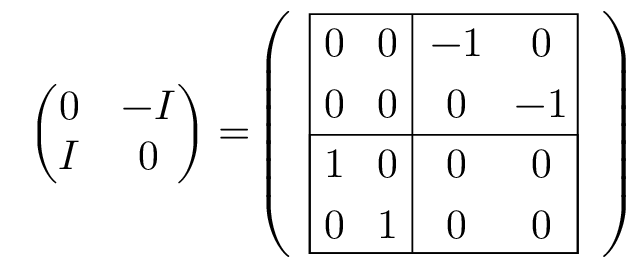
The journey starts with single-qubit gates: any real 2×2 unitary is classified as symmetric or antisymmetric, enabling an implementation with a single Ry(2α) rotation, optionally preceded by Z to fix signs. The chapter then demonstrates how to extract a circuit’s matrix (via Qiskit’s unitary tools and Q# utilities) and how to unit test those results. It scales to two-qubit building blocks by analyzing controlled-gate matrix structure and endianness, implementing block-diagonal unitaries with most-significant-bit controls, and constructing the two-qubit CS unitary by splitting it into two controlled single-qubit rotations on the least significant bit. A block-antidiagonal example further illustrates factoring a unitary into block-diagonal parts around a fixed CS core.
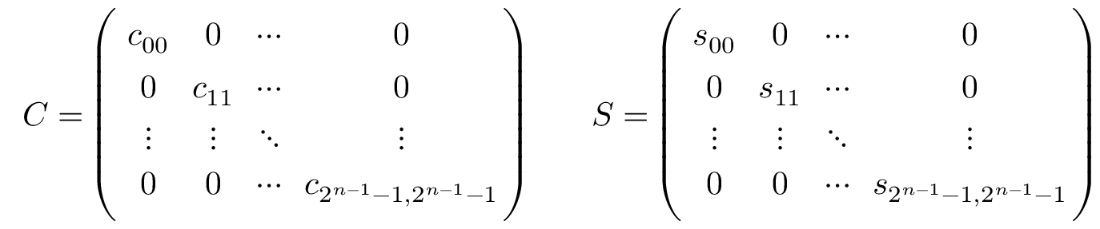
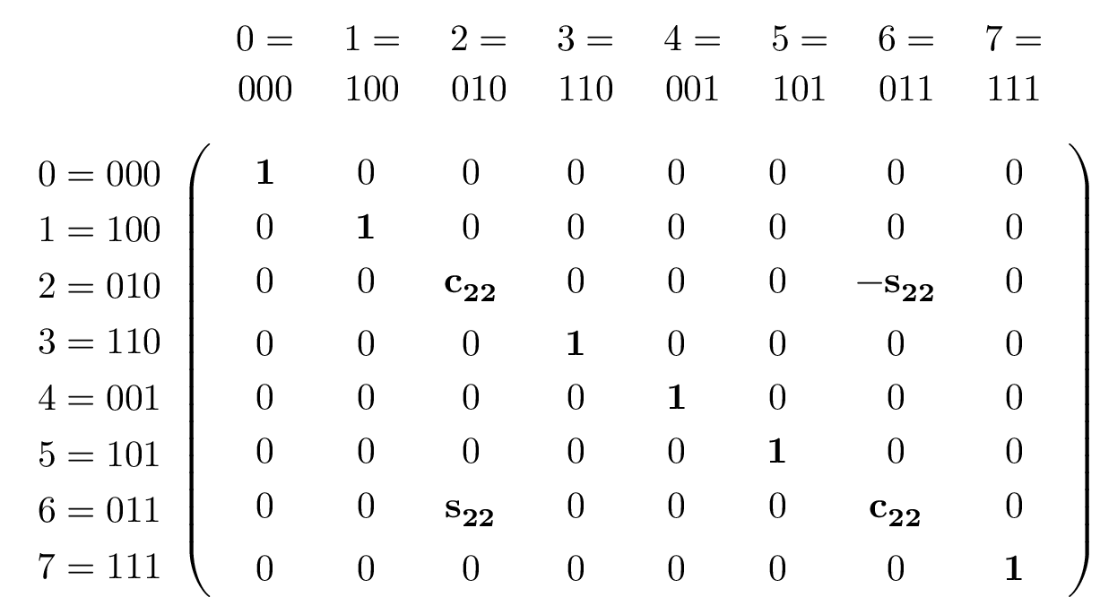
General multi-qubit synthesis is achieved through the cosine–sine (CS) decomposition: any 2^n×2^n unitary is expressed as left and right block-diagonal unitaries around a CS matrix. The chapter builds the required components: an n-qubit two-block block-diagonal “multiplexer” via controlled smaller unitaries and an arbitrary-size CS unitary as a product of 2^(n−1) multi-controlled single-qubit rotations keyed by control patterns. The final recursive construction applies (right block-diagonal) → (CS) → (left block-diagonal), using SciPy’s cossin in Qiskit to obtain the factors; Q# illustrates all intermediate pieces but omits the final decomposition step due to external library constraints. Throughout, the chapter highlights endianness conventions, practical simulator-based verification, and the role of compilers in mapping high-level gates to device-level instructions.
Any quantum algorithm can be broken down into several steps: prepare the initial state, evolve it by applying unitary transformations, and measure the final state. In this chapter, we’ll learn to perform the second step, implementing unitary transformations as the algorithm dictates.

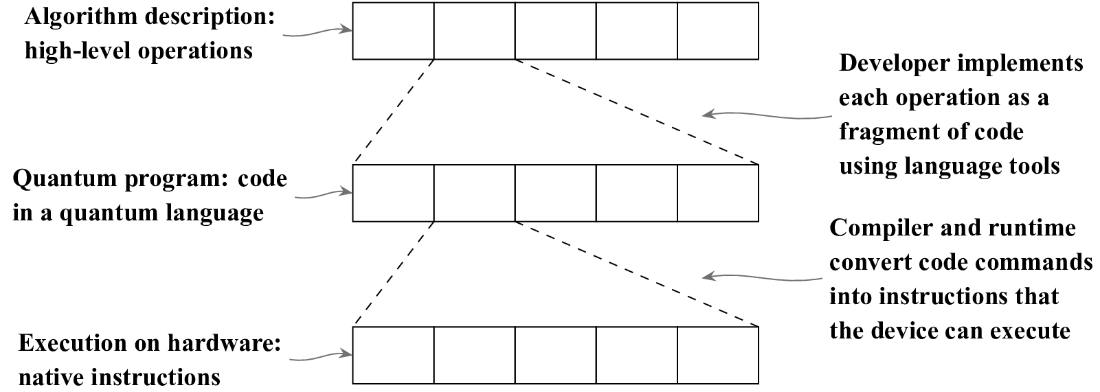
The transformation the quantum state undergoes following a quantum algorithm is typically broken down into simpler building blocks. First, the whole algorithm is expressed as a sequence of operations described in terms of the input parameters of the problem. These operations are further represented as sequences of primitives provided by the high-level programming language used to implement the algorithm. Finally, to execute the algorithm on a quantum device, programming language primitives have to be expressed as sequences of low-level instructions that are natively available on this device.
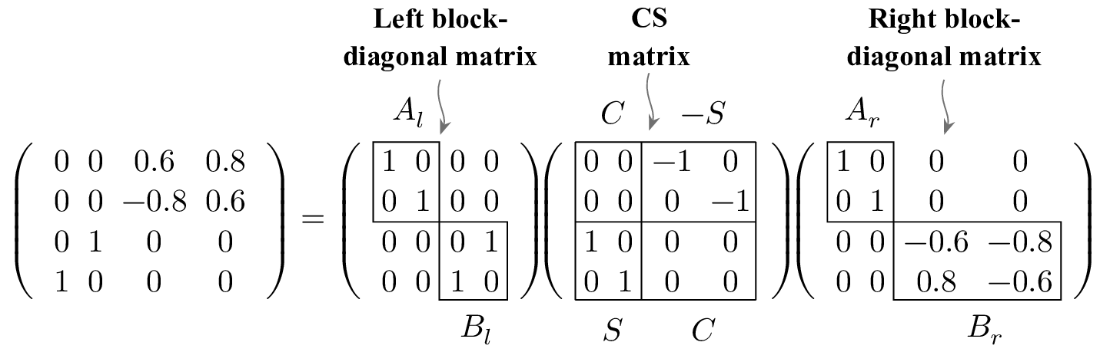
Cosine-sine decomposition for an example \(4 \times 4\) matrix. This matrix is represented as a product of three matrices: a block-diagonal matrix defined by \(2 \times 2\) matrices \(A_l\) and \(B_l\), a block matrix of special shape called CS matrix defined by \(2 \times 2\) diagonal matrices \(C\) and \(S\), and another block-diagonal matrix defined by \(2 \times 2\) matrices \(A_r\) and \(B_r\).
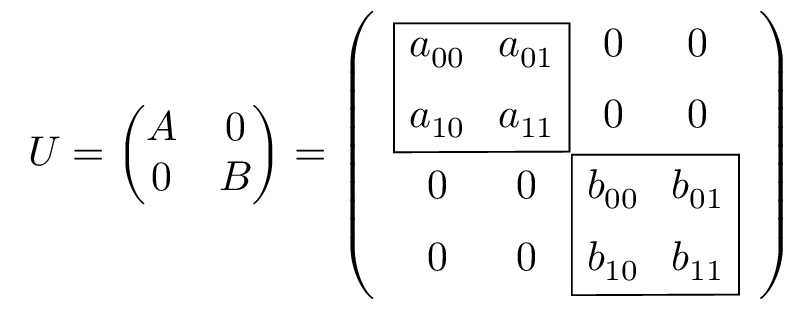
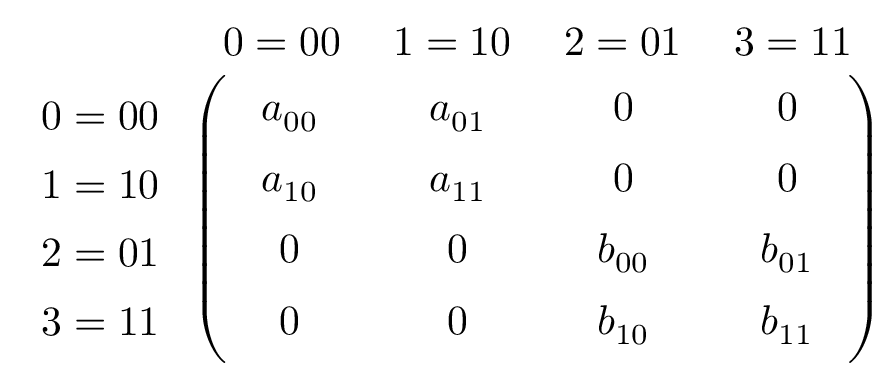
The row and column indices of \(4 \times 4\) matrices. The indices are written in binary using little endian notation: the least significant bit is written first. You can see that the top left and bottom right blocks group the elements for which the most significant (the last) bit of the row index equals that of the column index: for the matrix \(A\) in the top left block the most significant bit is \(0\), and for the matrix \(B\) in the bottom right block the most significant bit is \(1\).
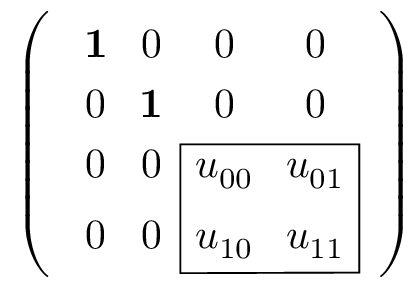
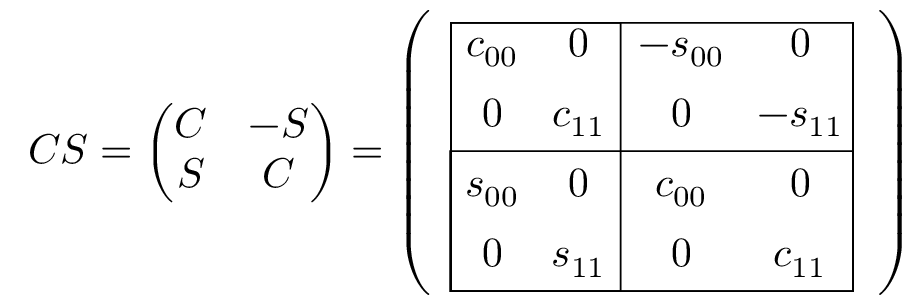
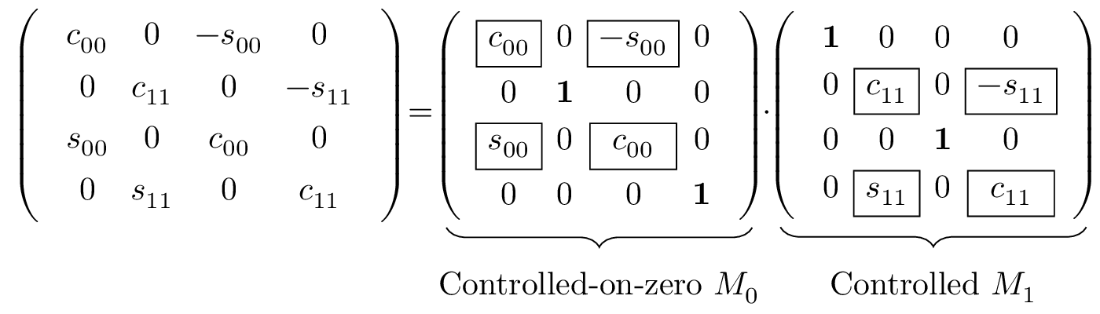
The non-zero elements of a two-qubit CS matrix can be separated and grouped together in two matrices \(M_0\) and \(M_1\). Each of these matrices is unitary.

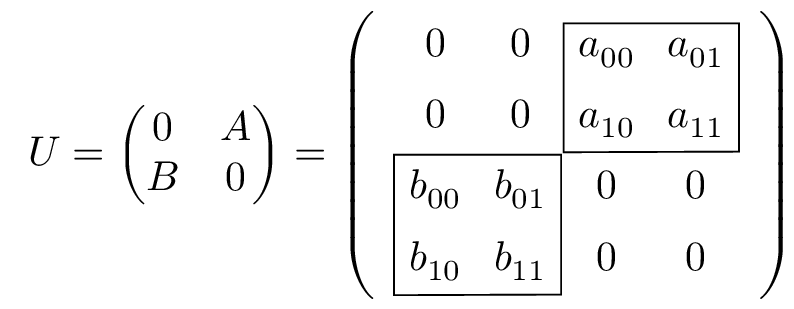
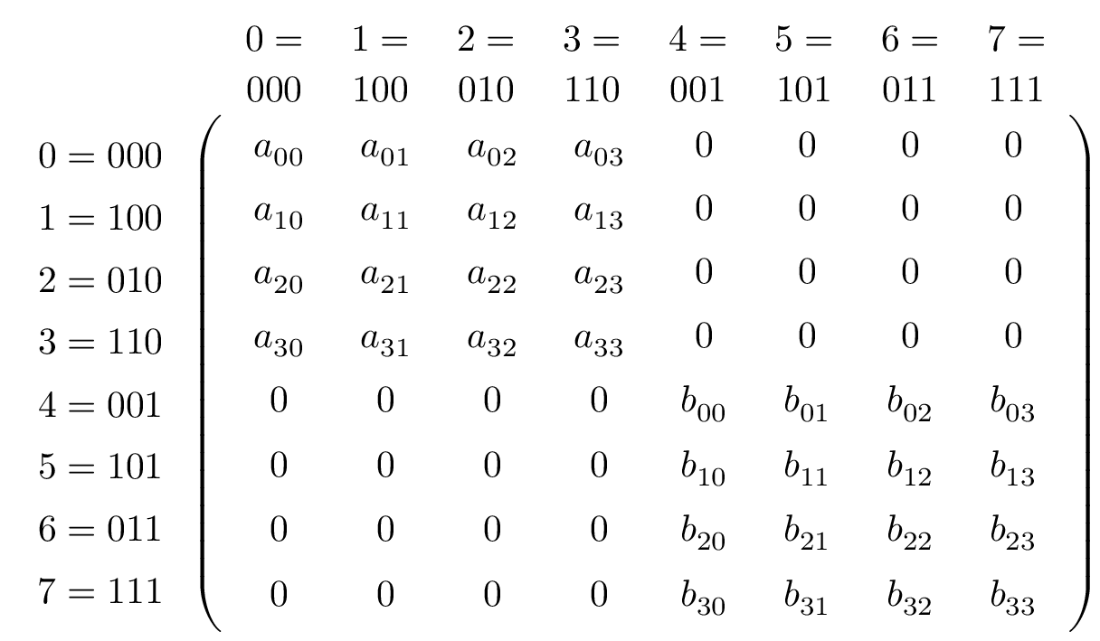
The row and column indices of an \(8 \times 8\) block-diagonal matrix. The indices are written in binary using little endian notation: the least significant bit is written first. The top left and bottom right blocks group the elements for which the most significant (the last) bit of the row index equals that of the column index, and is \(0\) for the top left block and \(1\) for the bottom right block.
Summary
- Quantum operations that make up an algorithm can be expressed in different ways. On the conceptual level, the operations are described in terms of the problem solved by the algorithm and its input parameters.
- When writing the code, these operations are implemented in a quantum programming language as sequences of primitive gates, language constructs, and library operations available in that language.
- On the lowest level, the gates used in the high-level program are represented as sequences of low-level instructions native to the hardware device and/or the error correction scheme used with the hardware.
- The goal of the unitary implementation task is to convert the matrix description of a unitary operation into a sequence of quantum gates that implements the unitary described by this matrix.
- Unitary operations can be implemented recursively, by decomposing their matrices as products of matrices of special shapes and implementing each of these matrices using controlled variants of unitary operations acting on fewer qubits.
- Many quantum algorithms are hybrid, combining classical and quantum computation; getting the cosine-sine decomposition as a step of unitary implementation is one example. It is important for a quantum programming language to express hybrid computations efficiently.
- We can use quantum simulators and the way they allow us to access quantum states during the program execution to get the matrices implemented by quantum operations and test that a quantum operation implements the right matrix.

 Quantum Programming in Depth ebook for free
