The chapter explains contextual prompting as the use of information inside the prompt itself to guide a model’s behavior at inference time. It frames this around in-context learning, where the model does not get retrained but instead extends the pattern established by the prompt. In that sense, prompt design becomes a lightweight way to shape outputs without the cost and complexity of fine-tuning.
It then contrasts zero-shot prompting with few-shot prompting. Zero-shot is the default and cheapest option: it uses instructions alone and works well when the task matches the model’s training distribution. Few-shot prompting adds example input-output pairs when zero-shot results are inconsistent, domain-specific, or too loosely formatted, especially for tasks like classification, structured extraction, and format conversion.
A major emphasis is how to design few-shot examples effectively. The chapter recommends keeping examples consistent in format, using only a small number of examples, and choosing them to cover diverse cases, important boundaries, and likely failure points. It also notes that example order, label coverage, and realistic data quality all affect performance, and it briefly introduces more advanced variants such as contrastive prompting, few-shot reasoning, and retrieval-based example selection.
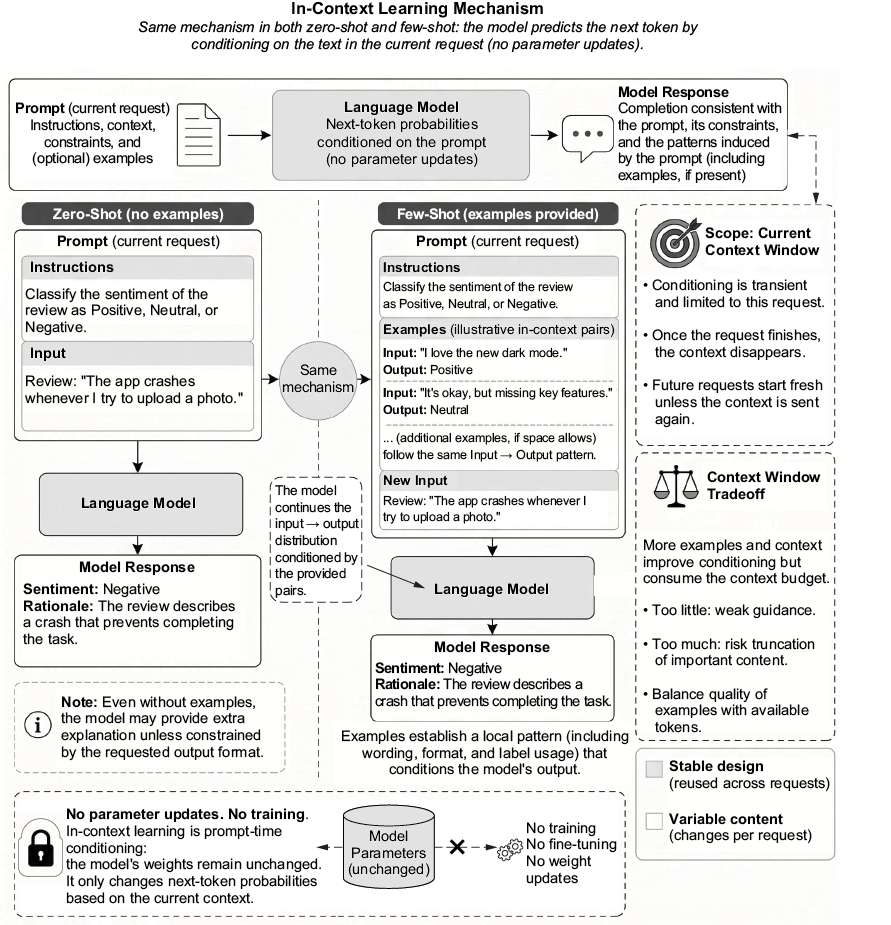
In-context learning mechanism: zero-shot prompting relies on instructions and the model’s training distribution, while few-shot prompting adds input–output examples that condition behavior at inference time without updating model weights.
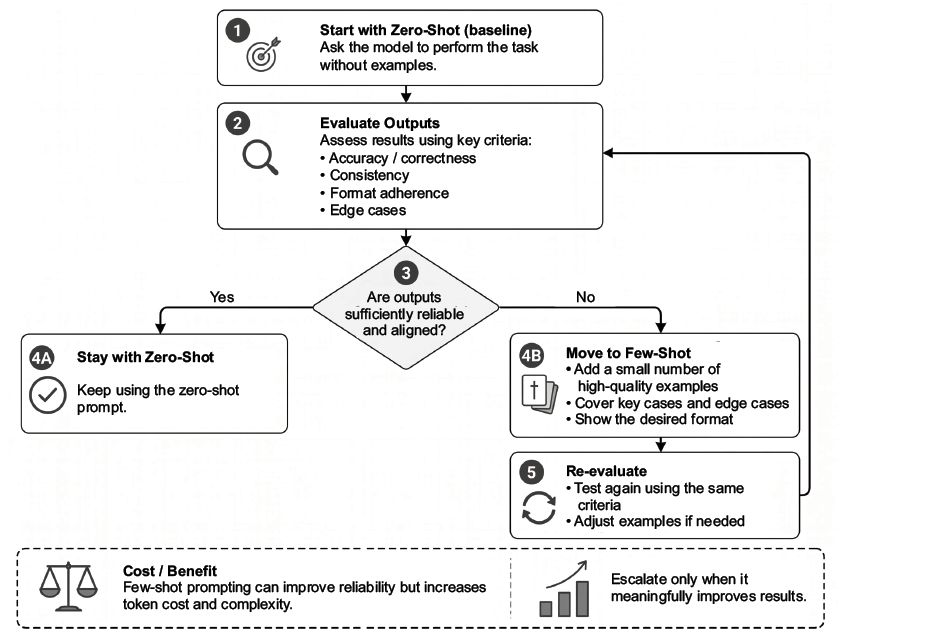
Zero-shot to few-shot decision path. Start with zero-shot prompting, evaluate consistency and domain fit, then add few-shot examples when outputs require stronger format control, domain-specific labeling, or edge case handling.
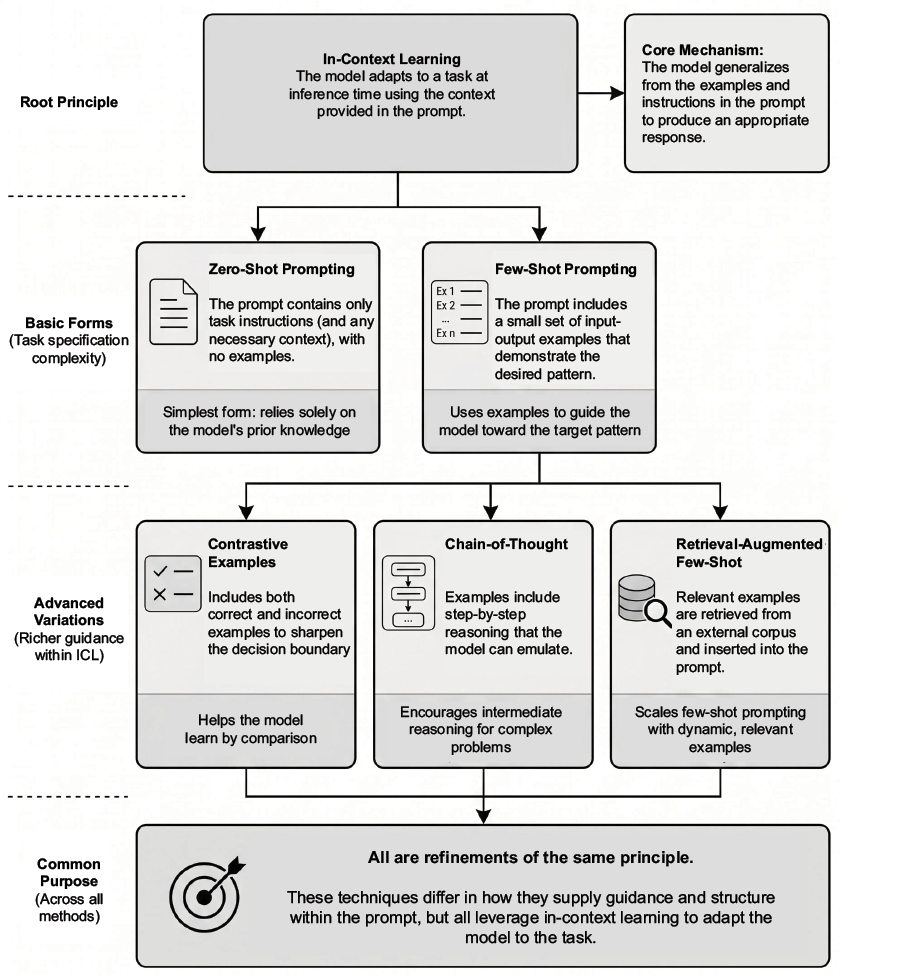
Contextual prompting taxonomy. In-context learning supports zero-shot prompting; few-shot prompting; and advanced few-shot variations such as contrastive examples, few-shot reasoning, and retrieval-selected examples.
Summary
In-context learning is the mechanism behind few-shot prompting.It is distinct from fine-tuning: adaptation happens at prompt time without weight updates.
Zero-shot prompting is your baseline. Start with instructions only, then escalate to few-shot prompting when domain conventions or output consistency require it.
Few-shot prompting works by pattern demonstration. It is strongest for classification, structured extraction, and domain-specific labeling tasks.
Output reliability depends on example design. Keep formatting consistent, cover distinct labels or input patterns, and include representative edge cases.
FAQ
What is contextual prompting?Contextual prompting is the practice of putting relevant information directly inside the prompt to guide the model’s behavior for a specific request. It uses the prompt itself, rather than model retraining, to shape the output at inference time.How does in-context learning relate to few-shot prompting?In-context learning is the mechanism that makes few-shot prompting work. The model uses the examples in the prompt as a temporary pattern to continue, without changing its weights.How is few-shot prompting different from fine-tuning?Few-shot prompting adapts behavior within a single request by adding examples to the prompt. Fine-tuning changes model weights and usually requires curated data, compute, and deployment overhead.When should I start with zero-shot prompting?Zero-shot prompting is the default starting point for any task. It is best when the task is well covered by the model’s training data and does not require extra examples for consistency or domain-specific conventions.What are the main benefits of zero-shot prompting?Zero-shot prompting offers maximum flexibility, the lowest token cost, and sufficient accuracy for many common tasks. It works especially well for standard summarization, sentiment analysis, format conversion, and general knowledge questions.When is few-shot prompting a better choice than zero-shot?Use few-shot prompting when zero-shot results are inconsistent, when the task uses domain-specific categories or formats, or when the output must follow a precise structure. It is especially useful when instructions alone do not capture the needed conventions.Which tasks benefit most from few-shot prompting?Few-shot prompting is most effective for tasks that reward consistency, such as classification, structured extraction, format conversion, and domain-specific labeling. Open-ended generation tasks usually benefit less.How many examples should I use in a few-shot prompt?Usually one or two concise examples are enough. One example can establish the format, and a second can add a contrasting or boundary case.Why is format consistency important in few-shot examples?If examples use different structures, the model receives conflicting signals about the desired output shape. Consistent formatting helps the model produce more predictable and automation-friendly responses.What should I consider when selecting few-shot examples?Choose examples for content diversity, edge case coverage, and label coverage tradeoffs. With limited examples, include distinct patterns and at least one boundary case, and test omitted labels separately if needed.
pro $24.99 per month
access to all Manning books, MEAPs, liveVideos, liveProjects, and audiobooks!

 Prompt Engineering in Practice ebook for free
