Prompt patterns are presented as reusable strategies for getting more reliable, higher-quality results from language models, building on the earlier foundations of structure and language. The chapter frames them like software design patterns: they are transferable methods that shape how the model approaches a task, not just how the prompt looks.
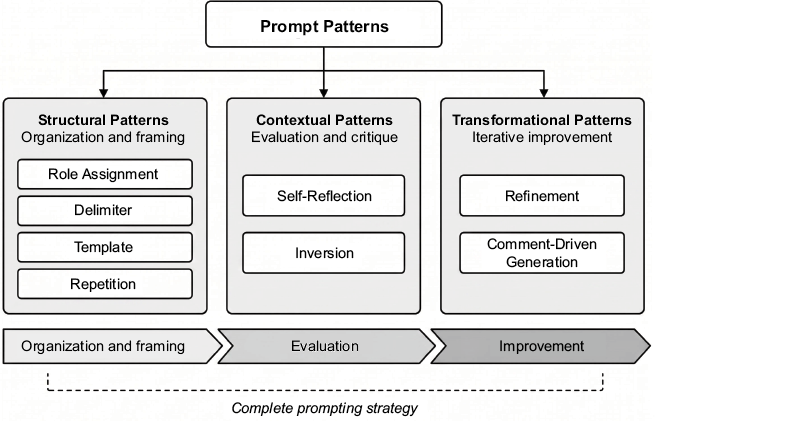
The chapter groups eight patterns into structural, contextual, and transformational categories. Structural patterns such as role assignment, delimiters, templates, and repetition help organize prompts, improve consistency, and boost first-pass accuracy, while contextual patterns like self-reflection and inversion expose gaps and blind spots by having the model critique or question content from different perspectives.
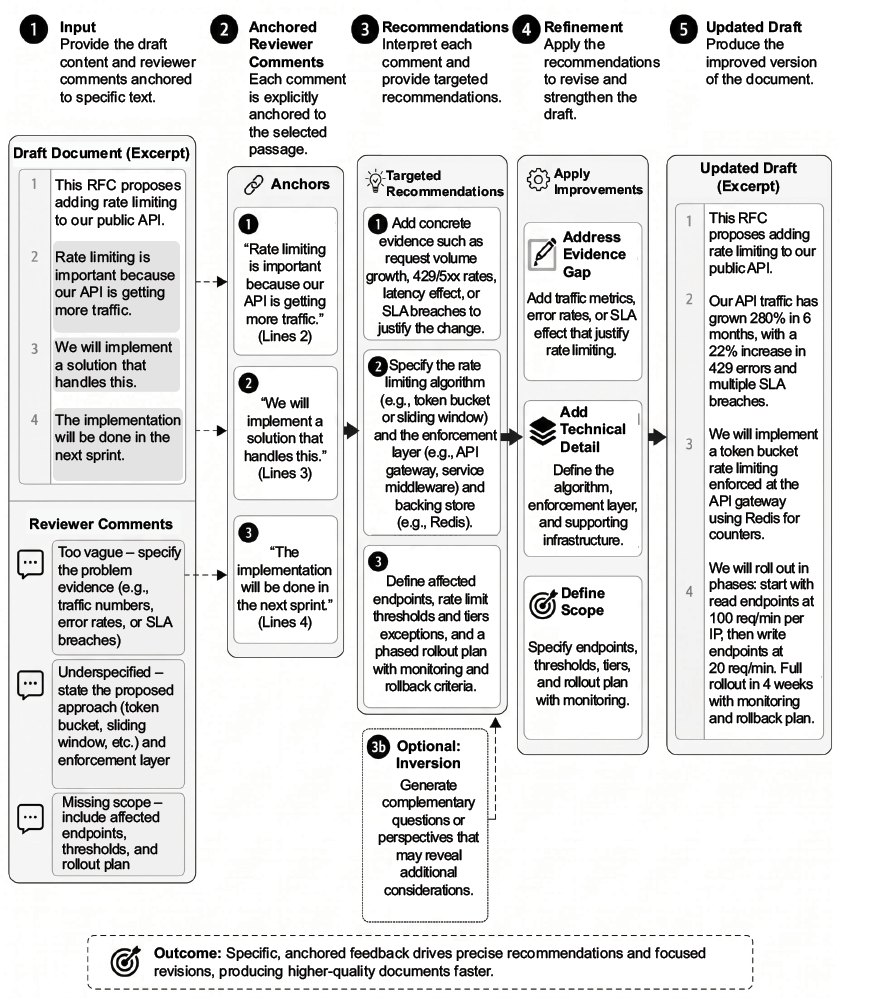
The final set of patterns focuses on improving existing content through refinement and comment-driven generation, turning critique into concrete revisions. Across the examples, the chapter emphasizes that the best prompting often comes from combining patterns: use one to structure the input, another to surface weaknesses, and another to revise the result into something more complete, maintainable, and production ready.
Prompt pattern taxonomy showing structural, contextual, and transformational patterns
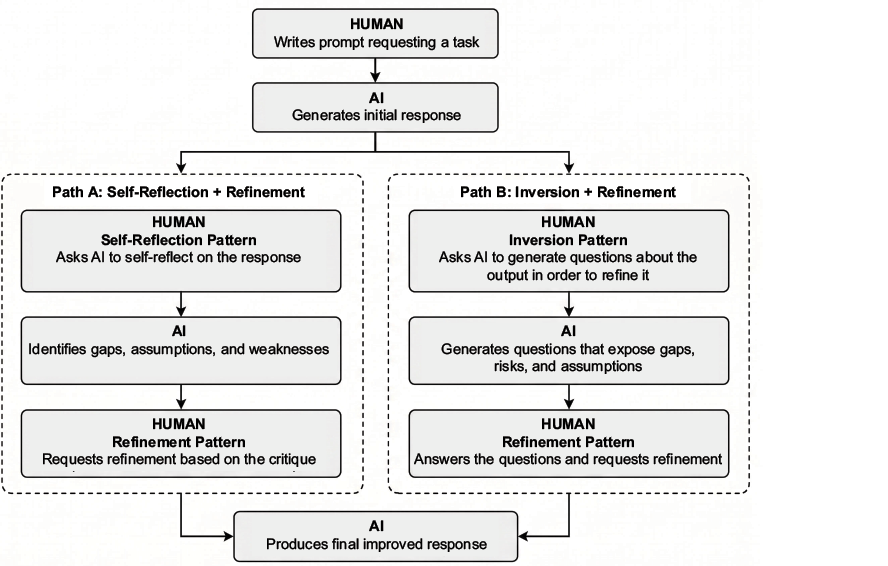
Evaluation-to-improvement workflow from initial output to refined result
Comment-driven generation workflow from anchored feedback to updated draft
Summary
Systematic patterns eliminate trial-and-error prompting. Role assignment activates domain expertise immediately, while delimiter organization prevents template errors that waste revision cycles.
Template and repetition patterns ensure professional consistency. Structured outputs integrate directly with business workflows, and repeated prompts can improve first-response accuracy in nonreasoning configurations.
Self-reflection and inversion patterns catch expensive mistakes before implementation. Systematic evaluation reveals overlooked gaps while external questioning exposes blind spots that internal review misses.
Multistep workflows combine patterns for complex challenges. Self-reflection identifies weaknesses that refinement systematically fixes, while inversion and comment-driven generation expose and organize gaps before revision.
Pattern mastery transforms AI interaction from unreliable iteration into predictable professional results. Transferable methodologies work across domains, eliminating costly revisions while ensuring consistent quality outcomes.
FAQ
What are prompt patterns in Chapter 4, and why are they useful?Prompt patterns are repeatable strategies for solving common prompting problems. They work like design patterns in software: instead of changing only wording or format, they change the model’s approach to the task. Their main value is transferability—you can reuse the same pattern across different domains and tasks.What are the three categories of prompt patterns in this chapter?The chapter groups eight patterns into three categories: structural, contextual, and transformational. Structural patterns include role assignment, delimiter, template, and repetition. Contextual patterns include self-reflection and inversion, while transformational patterns include refinement and comment-driven generation.When should I use the role assignment pattern?Use role assignment when you want the model to adopt a specific persona, expertise, or voice before completing the task. It is especially helpful for specialized knowledge, specific audience targeting, and more credible domain-aware responses. The book recommends using it in almost every prompt when the role can improve output quality.How does the delimiter pattern help with complex prompts?The delimiter pattern clearly separates instructions from variable content so the model can process each part more reliably. It is especially useful for prompts with logs, code, multiple data sources, or long content that needs clear boundaries. Common delimiters include triple backticks, Markdown headings with separators, and XML tags.What is the difference between the delimiter pattern and the template pattern?The delimiter pattern organizes inputs, while the template pattern controls the output structure. Delimiters help the model understand where each input source begins and ends, but templates define the sections the response must fill. In short, one improves input clarity and the other improves output consistency.How does the repetition pattern improve accuracy?The repetition pattern asks the model to read the full prompt twice, which can help important details receive more attention. It is useful when the key information appears early, when the model must retrieve details from the middle of a long prompt, or when first-response accuracy matters. The tradeoff is higher token usage and possible latency increase.What does the self-reflection pattern do?Self-reflection asks the model to critique its own output after generating it. This helps reveal gaps, assumptions, and missing details before the result is finalized. It is best for complex analysis, strategic recommendations, and high-stakes outputs where extra quality control is worth the cost.What is the inversion pattern used for?The inversion pattern flips the task so the model generates questions instead of a direct answer. This helps surface blind spots by bringing in external perspectives, such as a security engineer, SRE, or junior developer. It is useful when you want critique before presenting an idea, proposal, or document.How does the refinement pattern work in a workflow?Refinement is the improvement phase that follows analysis such as self-reflection or inversion. It takes specific feedback and updates the original content accordingly. The book emphasizes that refinement should not be used alone; it works best after actionable critique has already identified what needs to change.What is comment-driven generation, and when should I use it?Comment-driven generation applies targeted feedback to selected passages of content, often in a structured review workflow. It is useful when you need multiple specific revisions rather than a full rewrite, such as improving RFCs, code review responses, or technical documentation. The key advantage is that each comment stays anchored to the exact text it refers to.
pro $24.99 per month
access to all Manning books, MEAPs, liveVideos, liveProjects, and audiobooks!

 Prompt Engineering in Practice ebook for free
