11 Managing prompts in production
The chapter introduces prompt management as the practical discipline that keeps prompts reliable after they are written. It argues that prompts should be treated like production software artifacts, not disposable text, because they can sprawl across tools, lose version history, and become hard to update, debug, or trust. Through examples of duplicated prompts, missing ownership, and slow incident response, it shows how unmanaged prompts create confusion and failures that are costly to trace.
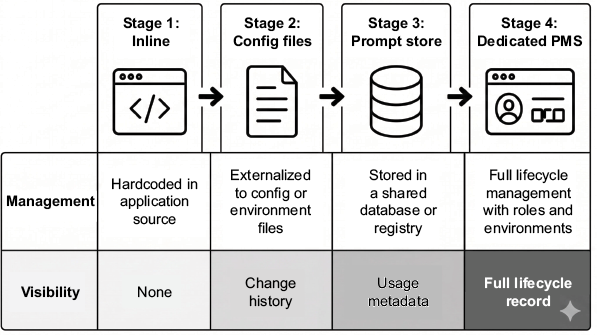
To address this, the chapter presents a maturity journey and a structured lifecycle for prompts. Teams may begin with inline prompts, then move to version-controlled files, a shared prompt store, and eventually a dedicated prompt management system as needs grow. Across these stages, the same core practices matter: clear metadata, versioning, testing, approvals, deployment through aliases, observation of usage and change patterns, deliberate improvement, and explicit retirement. The chapter emphasizes that stronger management makes good process easier and makes bad process visible.
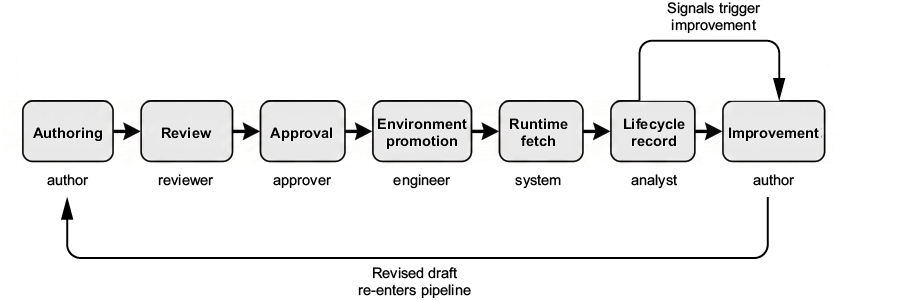
It also explains how lightweight governance and collaboration prevent prompt drift without creating unnecessary friction. Roles, approval paths, audit trails, and rollback procedures help teams change prompts safely while still allowing domain experts and other nondevelopers to contribute. Finally, the chapter shows how to read management signals such as edit frequency, reviewer activity, test coverage, and usage patterns to decide what needs attention next, and it closes by cataloging common failure modes like prompt sprawl, blind updates, metadata gaps, shadow edits, and overcomplicated all-in-one prompts, along with concrete fixes for each.
The prompt management maturity journey
The prompt lifecycle pipeline
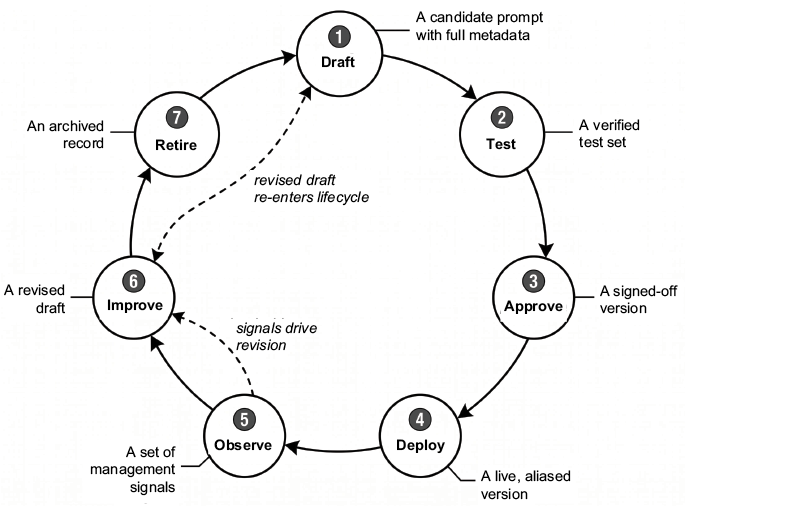
The prompt lifecycle with seven phases and feedback loops
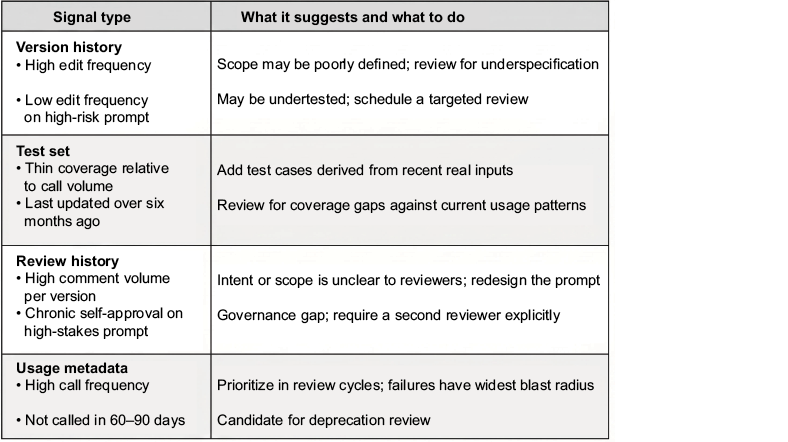
Prompt health signals and the actions they imply
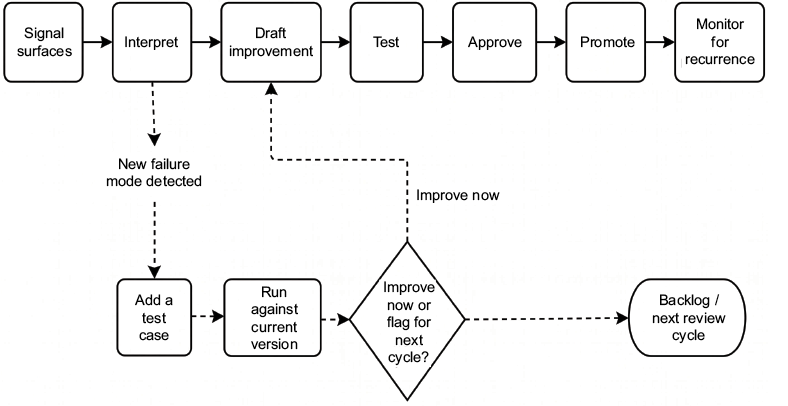
The prompt improvement loop, including the edge case path
Summary
- Prompt sprawl is the natural outcome of treating prompts as throwaway strings: they multiply, diverge, and become untraceable until a regression makes the cost of that approach concrete.
- The maturity journey provides a four-stage diagnostic framework (inline, config files, prompt store, dedicated PMS) for assessing where your team is and identifying the next practical step without implying that stage 3 is the required destination.
- The prompt lifecycle (draft, test, approve, deploy, observe, improve, retire) is a repeatable seven-phase workflow that applies at every stage of management maturity and is the primary mechanism for keeping prompt behavior reliable as requirements evolve.
- Governance exists to enable velocity: clear ownership, a defined approval path, and a reliable audit trail enable teams to make changes faster and with more confidence than teams operating without them.
- Management signals (version history, test set coverage, review records, and usage metadata) are sufficient to prioritize improvement work without any external monitoring infrastructure, because they are produced by the management process itself.
- The 10 anti-patterns in this chapter are early warning signs: recognizing a pattern in your team’s practice is the first step toward addressing it, and most mitigations require discipline rather than new tooling.

 Prompt Engineering in Practice ebook for free
