17 Thrift in the Enterprise
This chapter surveys how Apache Thrift addresses enterprise-scale needs in polyglot, distributed systems. It highlights why real-world architectures adopt multiple languages—by design, evolution, greenfield projects, acquisitions, testing, and performance—and shows how Thrift’s language-agnostic IDL helps future‑proof microservice interfaces. The IDL provides concise, implementation-free contracts that double as documentation, enable code generation across many languages, and add rigor and type safety. Examples from industry trends and projects illustrate how aligning languages to problem domains and decoupling services via clear contracts improves scalability, maintainability, and developer productivity.
The discussion situates Thrift among service styles—stateful distributed objects (now uncommon), function-oriented RPC, and resource-oriented REST—contrasting RPC’s operation-centric contracts with REST’s resource and HTTP-method semantics. While REST gains ubiquity and web infrastructure advantages, Thrift offers a unified, strongly-typed interface model and consistent tooling. Side-by-side implementations of the same API show that even with HTTP and JSON, generated Thrift serializers outperform general-purpose REST frameworks; moving to TCP and binary/compact protocols further reduces overhead and latency, with significant gains in throughput and memory footprint. The takeaway is pragmatic: REST is often ideal for public web APIs, but for backend services requiring high performance or constrained environments, Thrift’s protocols and transports deliver clear benefits—subject to validating with production-like workloads.
Beyond request/response services, the chapter demonstrates Thrift’s strengths in messaging: IDL-defined types are self-serializing, enabling seamless cross-language payloads. A Python publisher emits compact-serialized TradeReport messages to RabbitMQ, and a Java consumer deserializes them, illustrating how a single IDL can unify RPC and asynchronous pipelines. The chapter closes with best practices: keep interfaces simple and well-namespaced; prefer self-documenting identifiers and types; evolve safely using structs, unions, and collections; never change literals or reuse field IDs; document and enumerate exceptions; use default requiredness judiciously; and harden I/O stacks by buffering and framing messages while coding to protocol/transport abstractions. Together, these guidelines help teams build efficient, evolvable, and interoperable enterprise systems with Thrift.
- Percentage of developer job listings by language desired per itjobswatch.co.uk

- TradeHistory in WADL
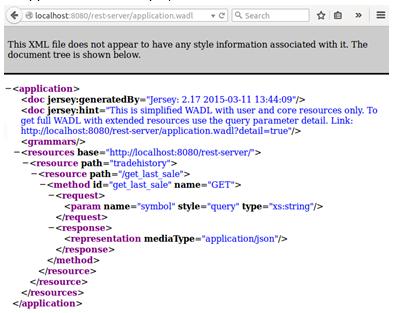
- Calling a REST service from a browser

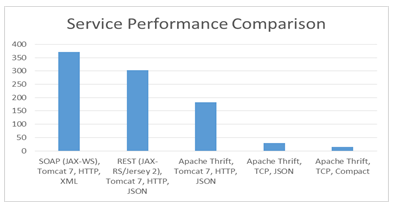
- Number of seconds required to complete 1mm API calls
Summary
Here are the most important points to take away from the chapter:
- Apache Thrift can be used to provide a unified cross language messaging interface
- Apache Thrift offers a crisp but expressive IDL which can be used to define RPC style service interfaces as well as messaging system message structures
- Apache Thrift IDL can be used as a distributed system design tool by application architects
- Apache Thrift provides significant performance benefits and is more memory compact than many comparable service interfaces
- Adopting Apache Thrift best practices can improve the long term viability and maintainability of Apache Thrift based interfaces and systems
FAQ
What role does Apache Thrift play in polyglot enterprise systems?
Thrift provides a language-agnostic interface definition and code generation that let services written in different languages interoperate cleanly. In microservice architectures it decouples implementation language choices, enabling teams to pick the best language per service while keeping contracts stable and shared.When should I choose Thrift over REST?
Use Thrift for high-performance, low-latency, or high-throughput backend services, for resource-constrained environments, or when strong cross-language contracts and efficient binary serialization are priorities. Use REST for public web APIs, broad tool compatibility, browser access, and when HTTP-native behavior and infrastructure (caching, proxies) matter most.How do RPC (Thrift) and REST differ at the interface level?
- Thrift (RPC) decomposes by functions/operations; parameters and returns are typed via IDL.- REST (ROA) decomposes by resources; interactions are modeled as HTTP methods on IRIs and use HTTP semantics (GET/POST/PUT/DELETE, headers, caching).
- Thrift defines its own protocol and usually runs over TCP; REST integrates directly with HTTP infrastructure.
What are the benefits of using an IDL, and why Thrift’s IDL?
- Clear, implementation-free contracts that double as documentation.- Abstraction to reason about APIs without code noise.
- Cross-language support with consistent code generation.
- Type safety and rigor, even for dynamic languages.
- Built-in evolution features (stable field IDs, unions, collections). Thrift’s IDL is compact, expressive, and supported by generators for many languages.
What did the chapter’s performance comparison reveal?
Under identical conditions: a JAX-RS REST+JSON servlet was slowest among the non-SOAP options; a Thrift servlet using JSON was noticeably faster; a Thrift TCP server using JSON improved throughput by an order of magnitude; a Thrift TCP server using binary protocol roughly doubled performance again. SOAP (HTTP+XML) was slowest overall. Results build intuition only—real workloads require their own benchmarks.How do transports and protocols affect Thrift performance?
- Transport: Avoid HTTP/Tomcat when you need maximum throughput; raw TCP with Thrift servers is faster and lighter.- Protocol: Prefer TBinaryProtocol or TCompactProtocol for speed and smaller payloads; JSON is human-readable but slower to parse.
- Framing (TFramedTransport) adds safety and enables nonblocking servers.
How can I use Thrift with messaging systems?
Serialize Thrift structs (for example, TradeReport) into a byte array using a protocol (often TCompactProtocol) and send it as the message body (e.g., via RabbitMQ). Any consumer in any supported language can deserialize the payload with the same Thrift type definition, enabling cross-language pub/sub or queues.What IDL best practices does the chapter recommend?
- Keep interfaces simple and self-documenting; use clear names and appropriate base types.- Use alphanumeric .thrift filenames and define a namespace for all targets.
- Give all fields explicit positive IDs; don’t rely on map/set ordering; use base types as map keys.
- Prefer string/binary over list<byte> for efficiency.
How should I evolve Thrift interfaces safely?
- Use structs to add/remove attributes; use unions to vary representation types; use collections to vary cardinality.- Don’t change ordinals, defaults, or constants; comment out deleted fields and never reuse their IDs (same for enum members).
- Prefer returning a struct from service methods to allow future additions without breaking clients.
What coding and service design practices improve robustness?
- Code to interfaces (TTransport/TProtocol) rather than concrete classes when possible.- Always buffer transports; use TFramedTransport to bound message sizes and enable nonblocking servers.
- Be explicit about exceptions: define and list all exceptions a method may throw.
- Use default requiredness for fields and parameters; mark fields required only when immutable to the interface; avoid default values on optional fields.

 Programmer’s Guide to Apache Thrift ebook for free
