5 Designing MongoDB schema
MongoDB’s flexible, document-oriented model lets teams evolve schemas without downtime, but thoughtful design is still essential for performance, scalability, and maintainability. Effective modeling starts with understanding the application’s workload and dominant query patterns, then shaping documents around how data is accessed and displayed rather than purely logical normalization. Mapping relationships (one-to-one, one-to-many, many-to-many) and planning the right indexes help ensure efficient reads and writes as requirements grow.
Choosing between embedding and referencing hinges on data size, access locality, and update frequency: embed small, frequently co-accessed details to minimize round trips; reference large, independently accessed, or many-to-many data to avoid duplication and oversized documents. The chapter demonstrates this thinking with an Airline Route Management System and surveys a toolbox of schema design patterns—subset, computed, extended reference, bucket, attribute, approximation, archive, outlier, pre-allocation, document versioning, schema versioning, and tree—each trading consistency, read/write performance, storage, and maintenance in different ways. The key is to match patterns to real access paths while guarding against document bloat and excessive joins.
To keep flexible schemas safe, JSON Schema–based validation enforces required fields, types, and formats, with controls for validation scope and behavior (reject or warn) and the ability to bypass temporarily for migrations. The chapter closes with anti-patterns to avoid: massive arrays, bloated documents, too many collections, unnecessary indexes, and separating data that is usually read together. Together, workload-driven modeling, judicious embedding or referencing, targeted patterns, and pragmatic validation yield a schema that stays fast, manageable, and resilient as data and usage evolve.
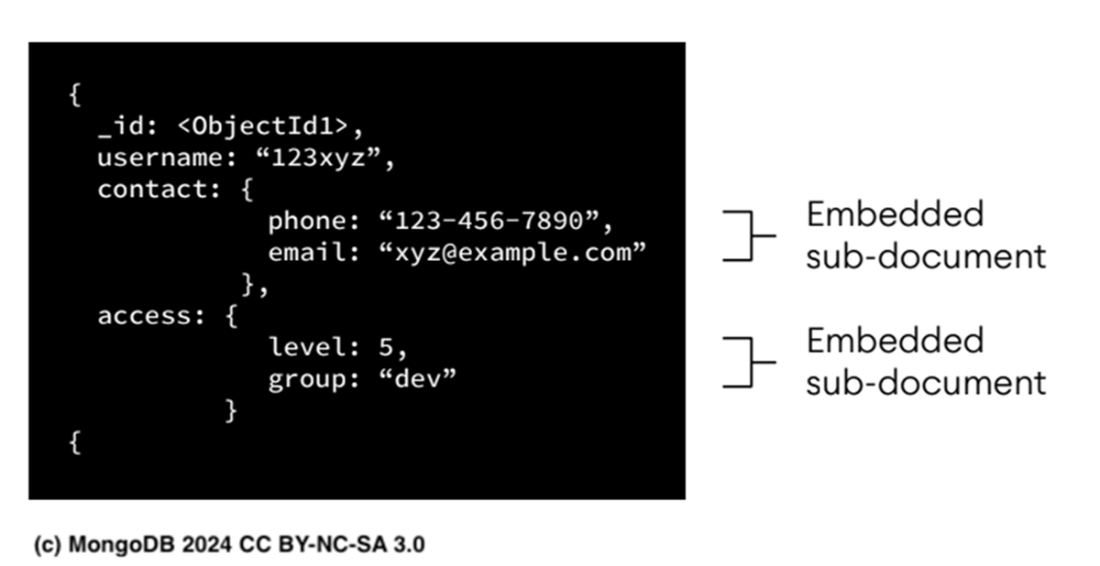
A MongoDB document with embedded sub-documents for contact information and access details.
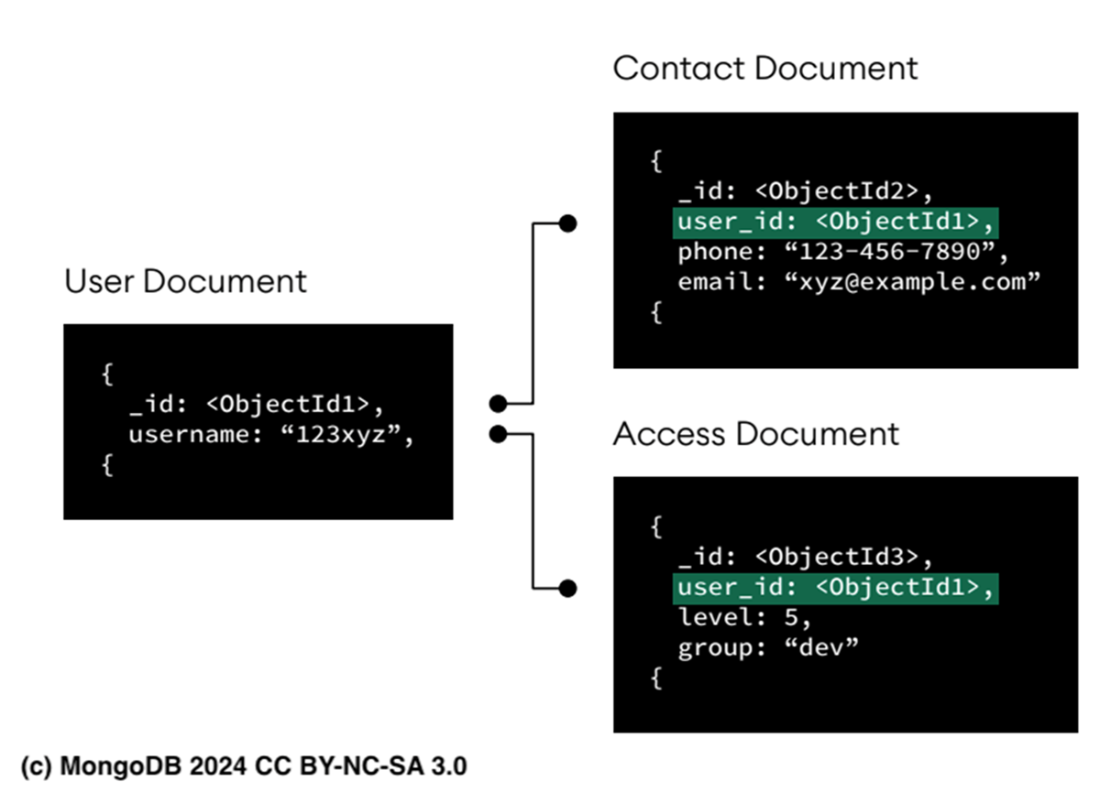
MongoDB can reference documents between two collections.
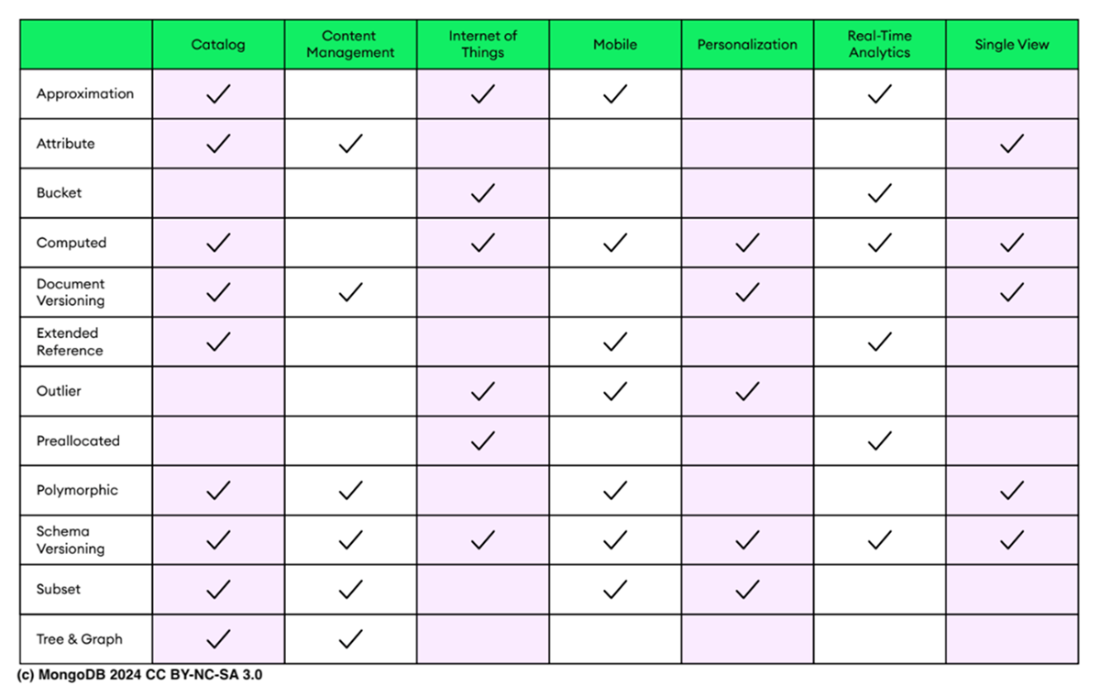
The suitability of different schema design patterns for various use case categories; the right pattern balances data consistency, performance, and complexity.
Summary
- MongoDB's flexible schema design allows for a flexible and dynamic data structure. Unlike traditional databases that need a fixed schema, MongoDB lets documents in the same collection have varied fields and types. This adaptability is beneficial for projects with evolving or unclear data needs.
- While MongoDB is a flexible schema, effective data modeling is still crucial. Proper MongoDB schema design enhances performance, scalability, and maintainability. It requires understanding data relationships, predicting query patterns, and planning for data evolution.
- When designing a schema for MongoDB, it's crucial to recognize its flexibility compared to traditional relational databases. MongoDB allows dynamic changes to the data structure, enabling easier development and scalability, and its data model should be designed based on data access patterns rather than logical connections, emphasizing flexibility and scalability.
- Schema planning involves workload determination, mapping relationships, and implementing design patterns that cater to specific application needs.
- MongoDB offers various schema design patterns, including Approximation, Archive, Attribute, Bucket, Computed, Document Versioning, Extended Reference, Outlier, Pre-allocation, Polymorphic, Schema Versioning, Subset, and Tree.
- Schema validation allows you to set rules for your fields, including permitted data types and value ranges. Once your application schema is defined, schema validation ensures that there are no unexpected changes or incorrect data types.
- After you add schema validation rules to a collection, by default, if an insert or update operation results in an invalid document, MongoDB rejects the operation and does not save the document to the collection. Alternatively, you can configure MongoDB to accept invalid documents and log warnings when schema violations happen.
- There are cases where bypassing schema validation is required, though it comes with the potential risk of adding non-compliant documents to the collection. Several commands, such as insert, findAndModify and update provide the bypassDocumentValidation: true option that skips these validation checks when needed.
- There are also anti-patterns to avoid when working with MongoDB: Massive Arrays, Bloated Documents, Excessive Collections, Unnecessary Indexes, Separating Data Accessed Together.
FAQ
What does MongoDB’s flexible schema mean, and why does schema design still matter?
MongoDB lets documents in the same collection have different fields and types, so you can evolve your model without downtime. But thoughtful design is still crucial to achieve fast queries, scalable writes, and maintainable code. Modeling around how data is accessed (read/write patterns) ensures fewer round trips, effective indexes, and simpler application logic.
How do I organize a MongoDB data model before production?
Follow four steps:
- Determine the application workload (dominant reads/writes, current and future operations).
- Map relationships among entities (one-to-one, one-to-many, many-to-many).
- Apply suitable schema design patterns.
- Create indexes aligned to your queries.
Capture key queries in a simple workload table: Action, Type (read/write), Information (fields), Frequency, Priority.
When should I embed data vs. use references?
Prefer embedding when related data is small, accessed together, or has a “contains” or one-to-many relationship. It improves read performance and enables single-document atomic updates.
Use references when the related entity is often accessed on its own, the relationship is many-to-many, embedding would bloat documents or duplicate lots of data, or you risk breaching the 16 MB BSON limit. For example, embed airline info in route documents, but reference airports that participate in many routes.
How do I map one-to-one, one-to-many, and many-to-many relationships in MongoDB?
- One-to-one: Embed if the data is always accessed together; otherwise reference.
- One-to-many: Embed children in an array when they’re read with the parent; use references if children are large, numerous, or accessed independently.
- Many-to-many: Use references on both sides; join with aggregation ($lookup or $graphLookup) when needed.
What’s the difference between manual references and DBRefs?
- Manual references: Store the foreign document’s _id in a field; your app issues another query or uses $lookup to fetch it. Simple and commonly used.
- DBRefs: A structured reference with $ref (collection), $id (id), and optional $db (database). They may help across collections/databases but still require extra queries to resolve.
Which schema design patterns should I know, and what problems do they solve?
- Subset: Keep frequently used fields close; move the rest elsewhere to shrink working set.
- Computed: Precompute values (counts, averages) at write time to speed reads.
- Bucket: Group many small, time-based events into bucket documents; time series collections do this automatically.
- Approximation: Write aggregated estimates periodically to cut write load.
- Archive: Move cold data to cheaper storage/collections to keep hot data fast.
- Extended reference: Duplicate key fields from referenced docs to avoid joins.
- Outlier: Isolate unusually large/expensive docs to protect typical queries.
- Pre-allocation: Create known structure ahead of time and fill in later.
- Polymorphic: Store related but variant shapes in one collection with a type field.
- Document/schema versioning: Track document history or schema evolution safely.
What is the subset pattern and when should I use it?
Store the most frequently accessed fields in the main document and keep the rest in a separate structure. This reduces document size and speeds up common reads. Example: duplicate airport code/name in each route for quick route queries, while detailed airport data lives in the airports collection.
Trade-offs: You may need to update duplicated fields in multiple places when source data changes.
How does the bucket pattern help with time-series or event data?
Instead of one tiny document per reading/event, group them into bucket documents (e.g., per day or per N readings). This reduces document count, improves index efficiency, and enables faster range queries. Time series collections implement bucketing automatically.
How do I enforce schema rules in MongoDB?
Use JSON Schema validation via a validator on a collection (db.createCollection or collMod). Define required fields, types, and constraints with $jsonSchema. validationLevel controls which documents must comply (e.g., moderate applies to new documents and updates to compliant ones), and validationAction decides whether to reject non-compliant writes (error) or allow them but log a warning (warn).
Can I bypass schema validation, and what are the risks?
Yes. Certain commands and options (e.g., bypassDocumentValidation: true on inserts/updates, findAndModify, $out/$merge) allow bypassing. This can be necessary during restores or migrations, but it risks introducing invalid documents. Subsequent updates must also comply with or bypass the validator.

 MongoDB 8.0 in Action, Third Edition ebook for free
