8 The impact of AI
Artificial intelligence is spreading quickly not because it is fully understood, but because it is easy to use and immediately useful. Conversational interfaces let people try, revise, and adopt these systems with little training, while a much larger industrial stack of chips, data centers, cloud services, APIs, and pricing models makes that simplicity possible. The result is a tightly connected ecosystem in which compute, infrastructure, and business deals shape who can build and deploy advanced models, and where rapid adoption begins to turn AI from a tool into part of everyday routines.
That shift is especially visible in work and education. In workplaces, language models are reorganizing tasks like coding, drafting, search, summarization, and product development so that people spend less time producing from scratch and more time guiding, checking, and refining outputs. This changes team structures, raises the value of judgment, and can widen the gap between experienced and junior workers. In education, AI makes it harder to tell what student work proves, because answers can be generated without corresponding understanding, pushing institutions toward process-based assessment while also raising concerns about cognitive offloading and weaker retention.
The chapter also shows AI reshaping science and human interaction. In research, models speed up literature review, method selection, analysis, and even parts of discovery, while also creating new demands for disclosure, traceability, and trust. At the same time, conversational systems are becoming advisers, confidants, and persuasive voices in daily life, which makes them useful but also risky in areas like health, law, and emotional support. Across all these domains, the main lesson is that AI’s impact no longer depends on whether it “thinks” like a human; it depends on how deeply it is becoming woven into the environments where people work, learn, discover, and relate to one another.
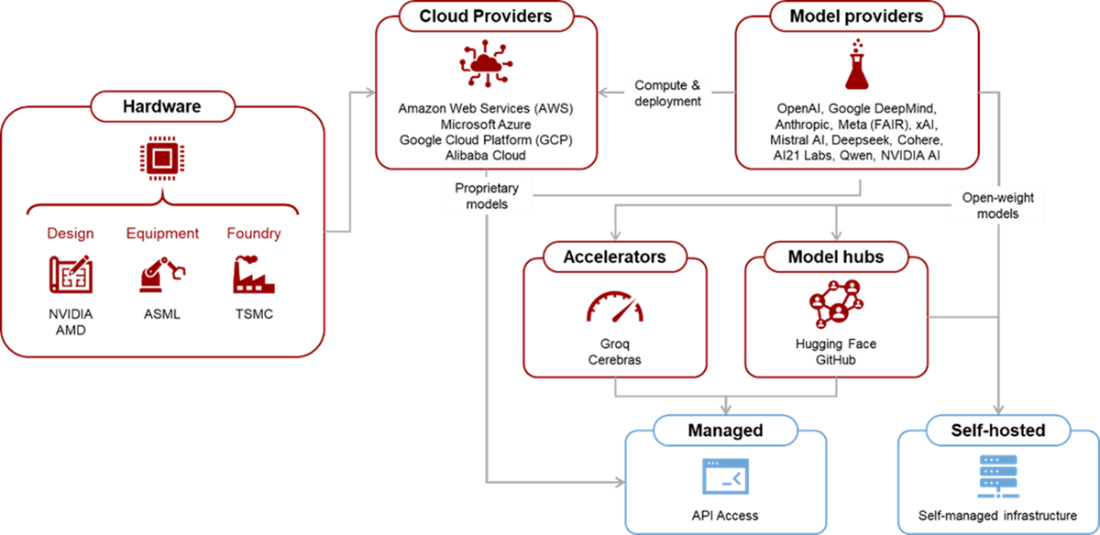
The large language model ecosystem. Models are built on a layered system that begins with specialized hardware and extends through cloud infrastructure and model providers. Interaction with this system occurs primarily through the two bottom layers, where users either consume models via managed services that abstract the underlying complexity or deploy open-weight models on self-managed infrastructure, taking on greater control and responsibility.
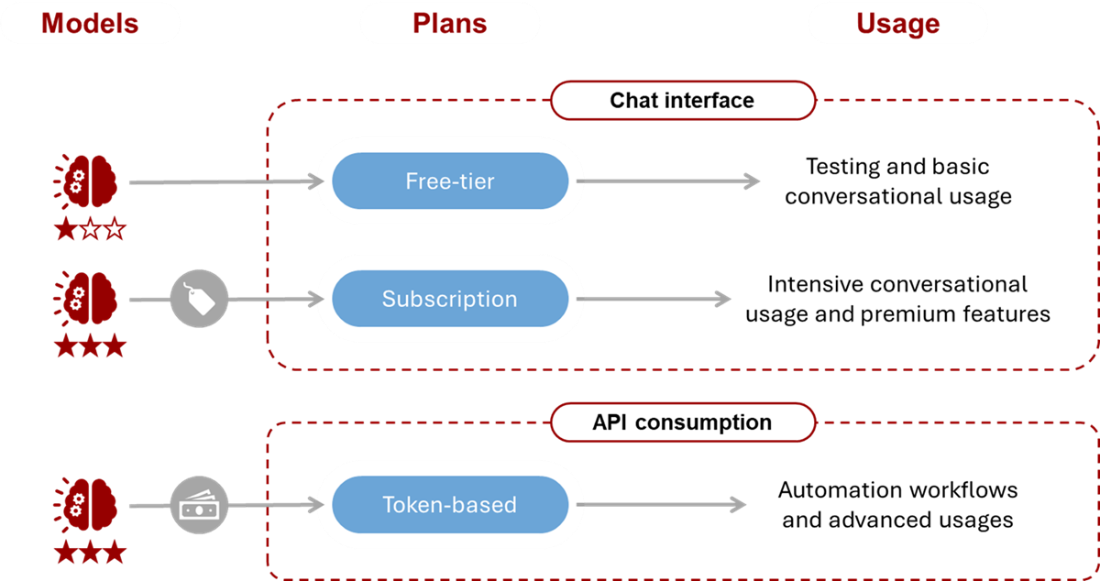
Pricing structures shape how AI services are used. Free and subscription tiers, typically accessed through chat interfaces, support conversational interaction, while token-based pricing, accessed through APIs, enables automated and large-scale use, effectively segmenting usage patterns across the system.
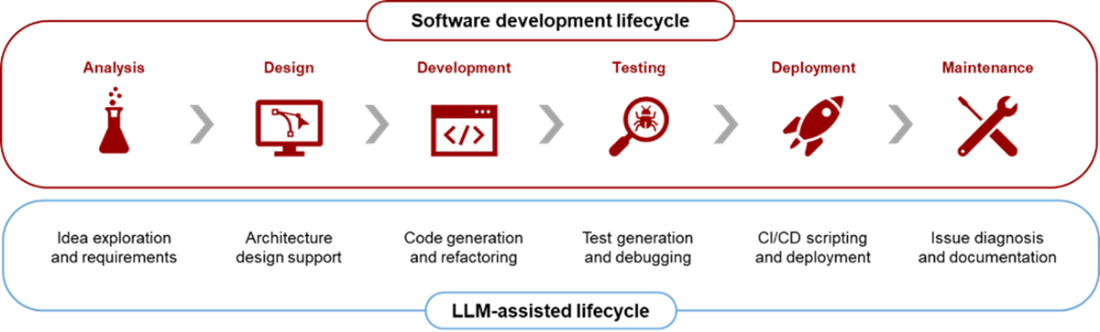
Coding assistants are integrated across the software development lifecycle. From early idea exploration to maintenance, they support tasks such as design, code generation, testing, and deployment, reducing the need to move between tools and connecting stages that were previously handled separately.
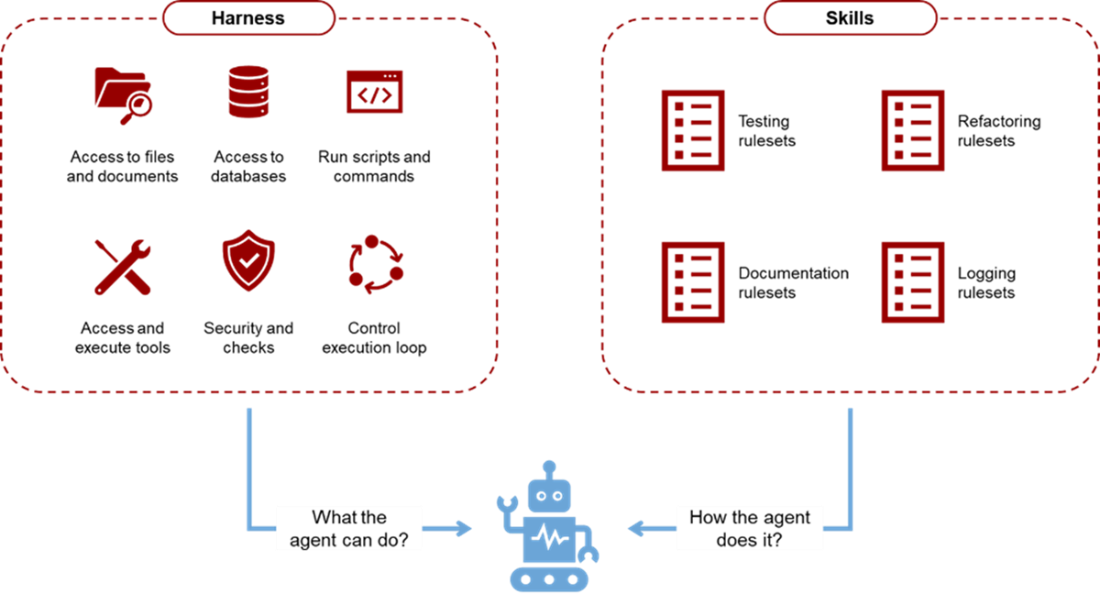
Harnesses define what an agent can access and execute, while skills take the form of reusable rulesets that guide how tasks are performed. Together, they determine what the agent can do and how it does it.
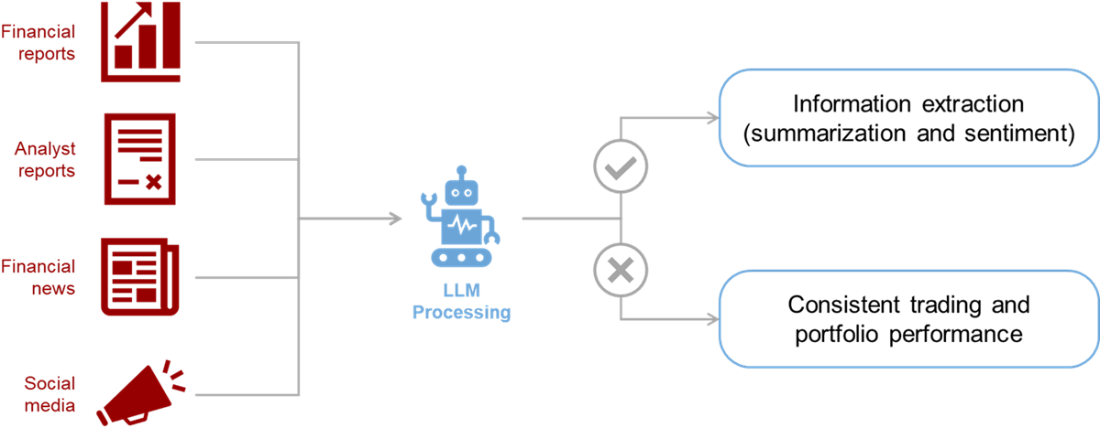
Large language models show a clear asymmetry in finance. They perform reliably when processing and interpreting financial information, but this capability does not translate into consistent advantage in trading or portfolio management.
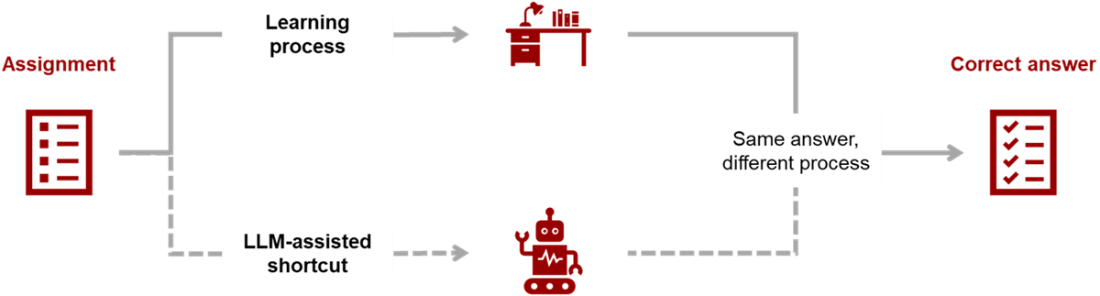
AI assistants make it possible to obtain correct answers without demonstrating understanding. When the same output can result from both learning and assisted shortcuts, the answer loses its value as a measure of knowledge.
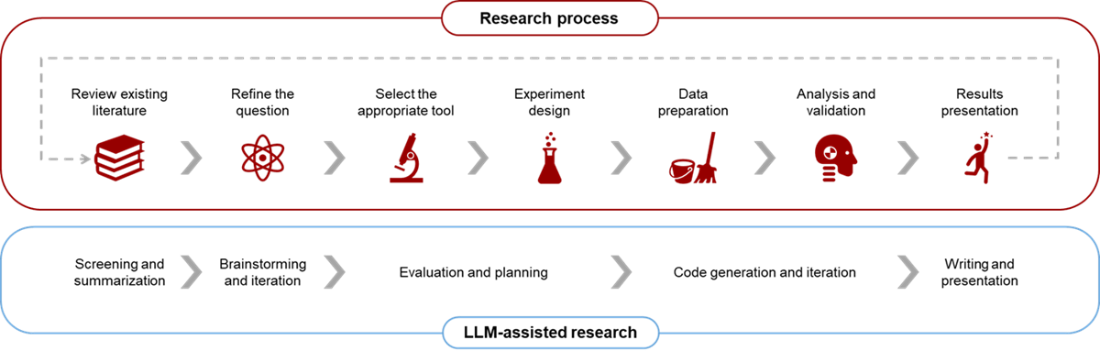
LLM-assisted research workflow. Large language models can support different stages of the research process through a smaller set of recurring capabilities. Their main effect is to reduce friction between stages, making research cycles faster while leaving scientific judgment and validation in human hands.
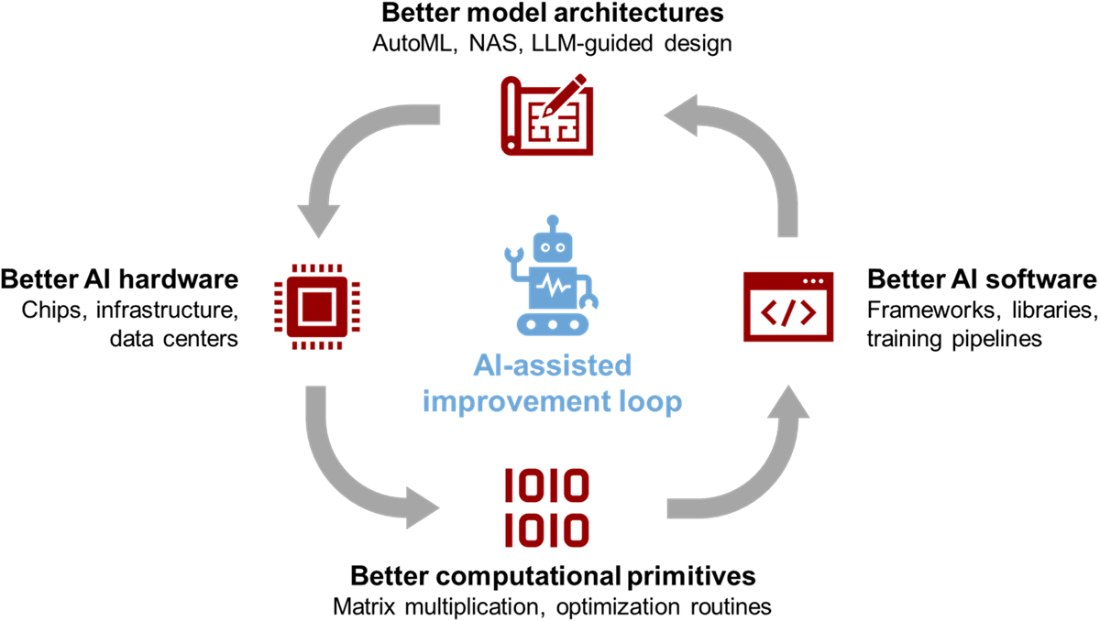
AI-assisted improvement of AI. AI can help improve future AI by contributing to better model architectures, software, computational primitives, and specialized hardware, creating a feedback loop in which research advances are fed back into later systems.
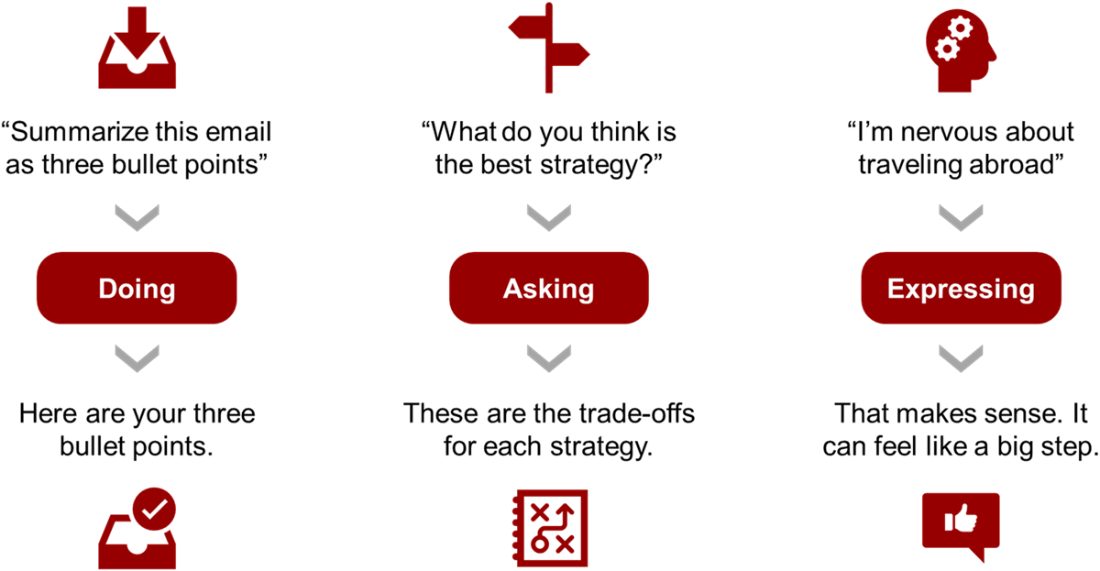
Doing, Asking, and Expressing. User interactions with language models vary by intent. Doing asks the model to produce an output, Asking seeks guidance for a decision, and Expressing uses the exchange to articulate thoughts or feelings and receive a responsive continuation.
Summary
- Large language models spread unusually fast because language provides a frictionless interface, allowing users to move from intention to useful output without learning specialized commands or tools.
- The apparent simplicity of AI assistants depends on a complex ecosystem of chips, data centers, cloud platforms, model providers, APIs, and open-weight alternatives.
- Compute scarcity makes access to high-end infrastructure a strategic resource, tying model development to partnerships among AI labs, cloud providers, and hardware companies.
- Pricing translates scarce compute into patterns of use, favoring frequent interactive access through free and subscription models while constraining large-scale automation through token-based billing.
- In software development, models have narrowed the gap between defining a problem and producing a working solution by operating directly on codebases, tools, and execution environments.
- Coding assistants change the developer’s role from writing every line of code to defining intent, configuring harnesses and skills, and evaluating generated changes across the codebase.
- Finance shows the limits of general transformation, as language models can improve analysis of financial text without reliably producing sustained trading or portfolio advantage.
- AI-native product creation, including vibe coding, lowers the barrier from idea to prototype and shifts product development toward prompting, reviewing, testing, securing, and maintaining generated systems.
- In education, generated answers weaken the traditional link between student output and student understanding, forcing schools and universities to redesign assessment around process, supervision, and disclosure.
- AI assistance can improve immediate learning performance while reducing cognitive effort, creating a risk of cognitive debt when students rely on generated explanations instead of constructing understanding.
- When structured around questioning, feedback, and revision, language models can support discovery learning by making guided exploration more accessible and adaptive.
- In science, AI accelerates the hidden work between research milestones by helping with literature orientation, method selection, code generation, data preparation, and documentation.
- AI-assisted science also creates new demands for rigor, as disclosure rules, authorship policies, secure review systems, and traceability become essential to preserving trust.
- Artificial intelligence can feed back into its own development by improving algorithms, software, architectures, hardware use, and experimental pipelines behind future systems.
- When AI assistants sound confident in specialized domains such as health, law, or finance, non-expert users may struggle to detect missing context, outdated information, or false guidance.
- Emotional engagement with AI can make users feel heard, but the relationship remains asymmetric because the system can respond with warmth without awareness, commitment, or responsibility.

 Machines that Think ebook for free
