5 Back to humans
This chapter explains why human cognition remains the main reference point in debates about artificial intelligence. Even though AI systems are built on very different principles, people naturally describe them in human terms because language, learning, memory, and understanding are easier to interpret through our own minds. The chapter argues that this habit is useful, but also misleading if resemblance in behavior is taken as evidence of similarity in underlying process.
It then shows how artificial neural networks were originally inspired by the brain, but only through simplification. Biological neurons were abstracted into trainable computational units, learning was reduced to changes in connection strengths, and representation was made distributed rather than localized. These design choices helped make neural networks scalable and effective, but they also fixed the limits of what such systems can learn, remember, and represent. The result is a powerful engineering approach shaped by biology without being biologically equivalent.
Finally, the chapter reviews brain-modelling efforts and contrasts them with artificial neural networks. Some work aims for biological detail, some seeks useful computational principles, and some focuses on hardware efficiency through neuromorphic design. Across these approaches, the key message is that human intelligence differs from current AI in crucial ways: humans learn through consequences, generate their own goals, reshape memory through use, and develop along an irreversible history. Artificial networks can mimic aspects of these outcomes, but they do so without agency, lived experience, or understanding in the human sense.
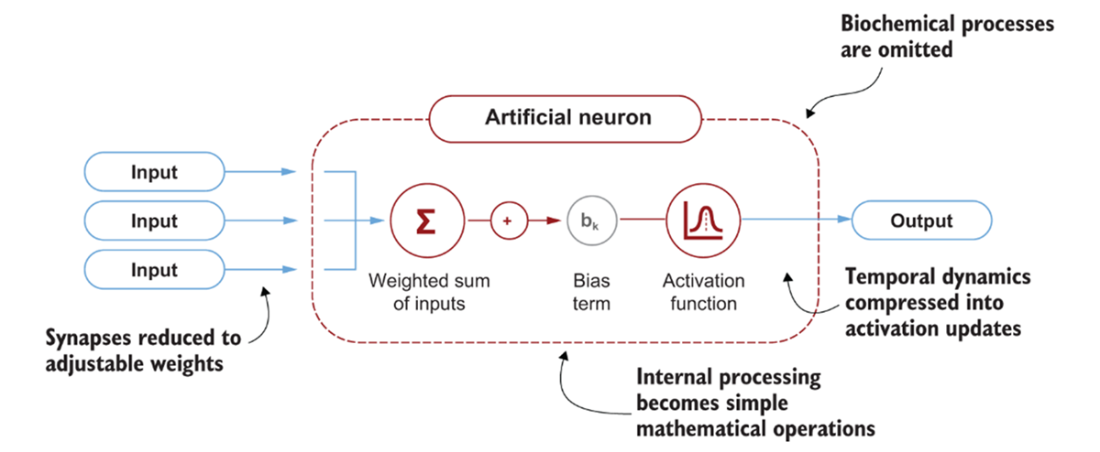
Early neural network research replaced the biological neuron with a simplified computational unit that transforms inputs into outputs through a small set of mathematical operations. This abstraction made it possible to analyze, train, and scale networks using digital computation.
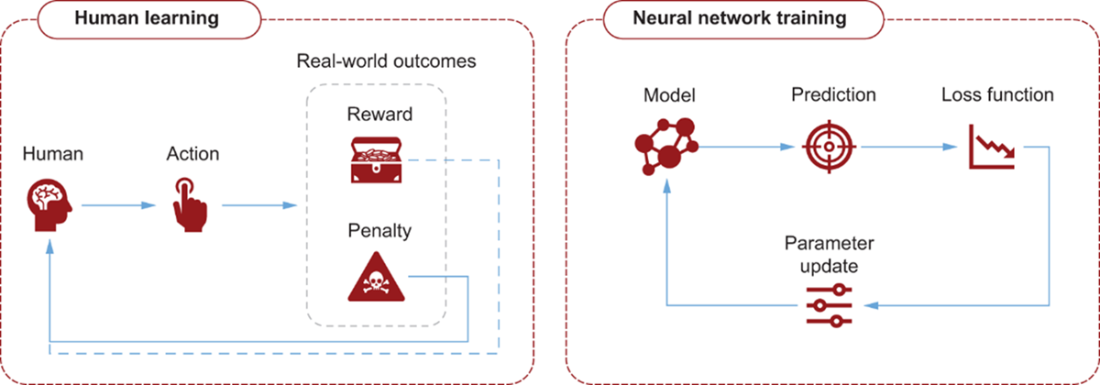
Human learning unfolds through interaction with the world, where actions produce consequences that differ in what they cost and directly shape future behavior, with negative outcomes often exerting stronger influence than positive ones. Neural networks instead learn by minimizing numerical loss functions during training, adjusting parameters through optimization rather than through lived outcomes.
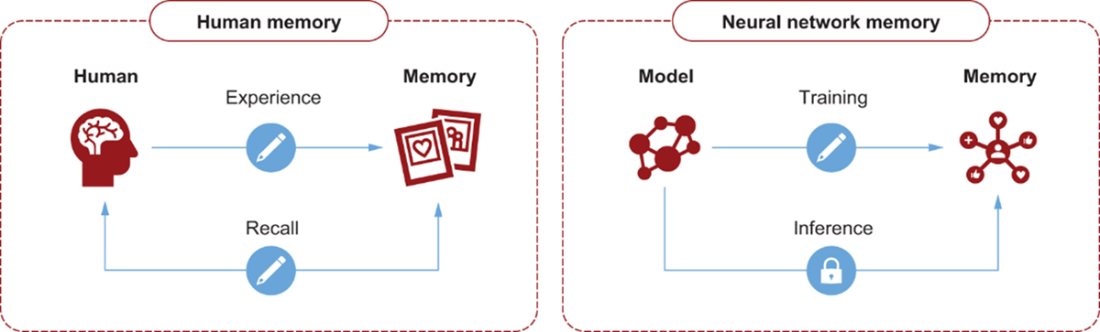
Human memory is reconstructive: experiences form memories that are reshaped each time they are recalled, so remembering can modify the structure that supports future recall. Artificial neural networks instead store prior experience in model parameters created during training. During inference these parameters remain fixed, so using the model does not alter its stored knowledge.
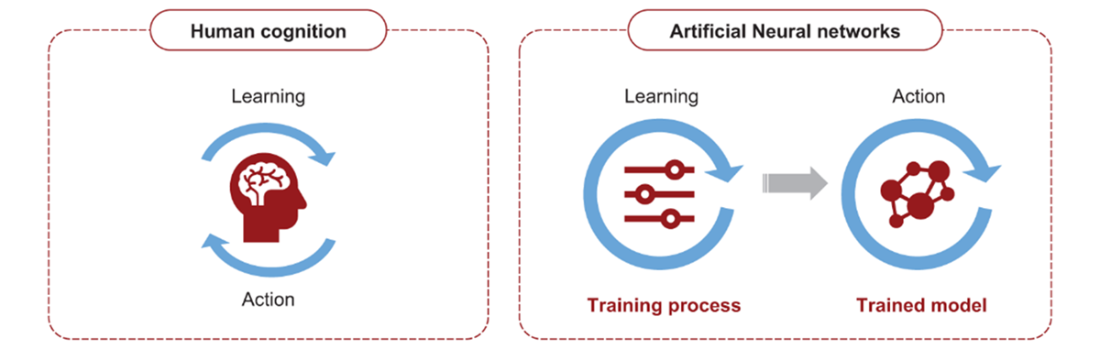
Human cognition continuously updates through interaction with the world, so learning and action form a single loop. Artificial neural networks separate learning from use: parameters are updated during training, after which the trained model performs inference without incorporating new experience.
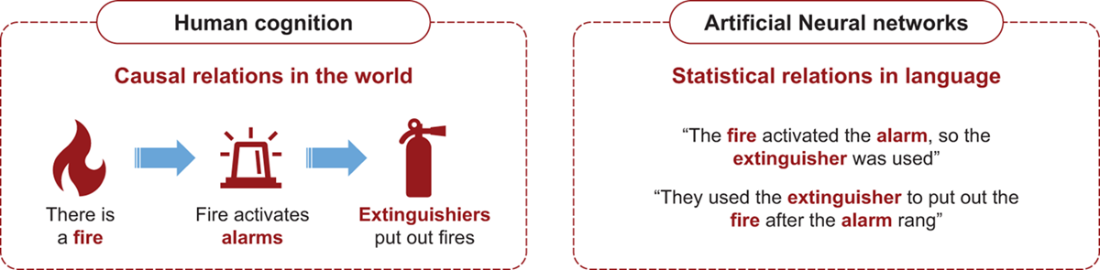
Human language refers to events and objects in the world through concepts grounded in perception, action, and consequence. Artificial neural networks instead learn patterns from indirect records of the world, such as text, images, or other data. As a result, models can generate coherent outputs by connecting representations within those records, without attaching them to a world they directly experience.
Summary
- Discussions of artificial intelligence naturally return to humans because human cognition provides the most familiar reference point for interpreting intelligent behavior.
- The vocabulary used to describe artificial intelligence often borrows from neuroscience because systems that produce language, decisions, or predictions invite interpretation in human cognitive terms, even when the underlying mechanisms differ.
- Artificial neurons emerged as deliberate abstractions of biological neurons, stripping away biochemical processes and complex temporal dynamics and reducing neural activity to mathematical operations over weighted inputs.
- Artificial neurons were designed for scalable training, with fixed internal operations while learning occurs through adjustments to connection weights.
- Artificial neural networks, like biological brains, represent information in distributed patterns of activity rather than storing knowledge as isolated symbolic records.
- The persistence of function after significant pruning in neural networks illustrates the role of redundancy and distributed organization rather than strict reliance on localized components.
- Human and artificial neural systems share computational principles such as distributed representations and weight-based adaptation, which allow past experience to bias responses to new situations without explicit rules.
- The metaphor of describing artificial intelligence using the language of the brain persists due to historical continuity, momentum from early successes, and human tendencies to interpret complex behavior in cognitive terms.
- Brain modelling encompasses multiple research traditions with distinct goals, ranging from explaining biological cognition to inspiring new computational architectures.
- Some modelling efforts emphasize mapping neural wiring, while others explore efficiency, physical constraints, or alternative hardware implementations inspired by neural systems.
- Brain-inspired research expands the design space of computation without determining what forms of organization are ultimately required for intelligence.
- Learning in biological systems is driven by the consequences of action, as mismatches between expectation and outcome reshape future behavior.
- Human learning is guided by consequence and agency, whereas machine learning typically follows externally defined objective functions.
- In humans, learning unfolds continuously alongside action, while artificial systems usually separate training from inference.
- Neural networks learn statistical regularities in their inputs without constructing an explicit model of the world those inputs describe.
- Surface similarity between human and artificial behavior does not imply comparable mechanisms, and treating the two as equivalent risks misunderstanding both the capabilities and the limitations of current AI systems.

 Machines that Think ebook for free
