4 LLM-as-a-judge: The new paradigm for evaluation
Evaluating large language models with other language models has become a practical alternative to slow, expensive human annotation, especially for open-ended tasks where traditional metrics like BLEU, ROUGE, or simple semantic similarity scores fail to capture usefulness, accuracy, tone, or coherence. The chapter frames this shift as a move from fixed metrics to LLM-based judges that can both score outputs and explain their reasoning, making evaluation more actionable. It emphasizes that these judges should be treated like any other evaluator, with their quality measured by agreement with human preferences rather than assumed to be ground truth.
To assess evaluator quality, the chapter introduces the statistical tools needed for meta-evaluation: Spearman’s rank correlation for comparing ordering, Kendall’s tau for pairwise preference agreement, and Cohen’s kappa for categorical labels. It explains why rank-based measures are appropriate when human judgments are ordinal, why confidence intervals and sample size matter, and why agreement metrics must be interpreted carefully alongside effect sizes and uncertainty. It also shows how these tools reveal when different evaluators agree, when they diverge, and how those divergences can guide calibration and threshold tuning.
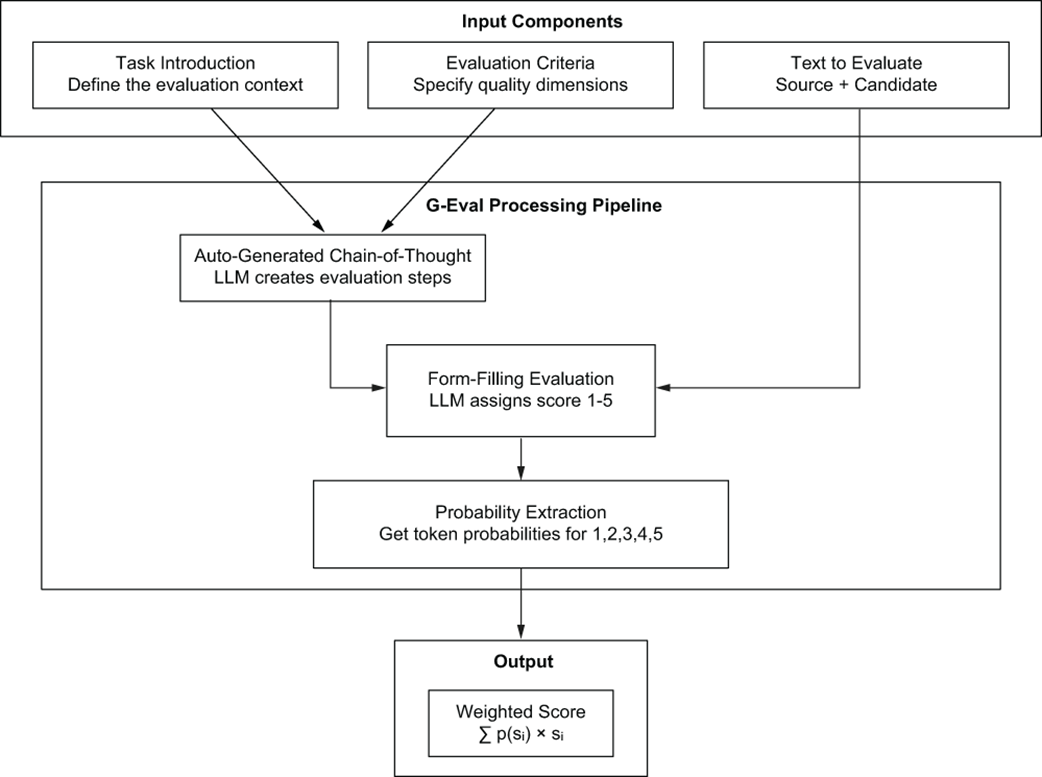
The chapter’s core methodological contribution is G-Eval, a structured prompting framework for LLM-as-a-judge that improves alignment through clear task definitions, detailed rubrics, auto-generated chain-of-thought evaluation steps, and probability-weighted scoring. It then surveys known judge biases and limitations, including position bias, verbosity bias, self-enhancement bias, and weak reasoning on tasks that require independent verification. The practical guidance is to use LLM judges where they excel—scalable evaluation of open-ended text, rapid iteration, monitoring, and preliminary filtering—while relying on humans or deterministic verifiers for high-stakes, safety-critical, or hard-to-judge cases.
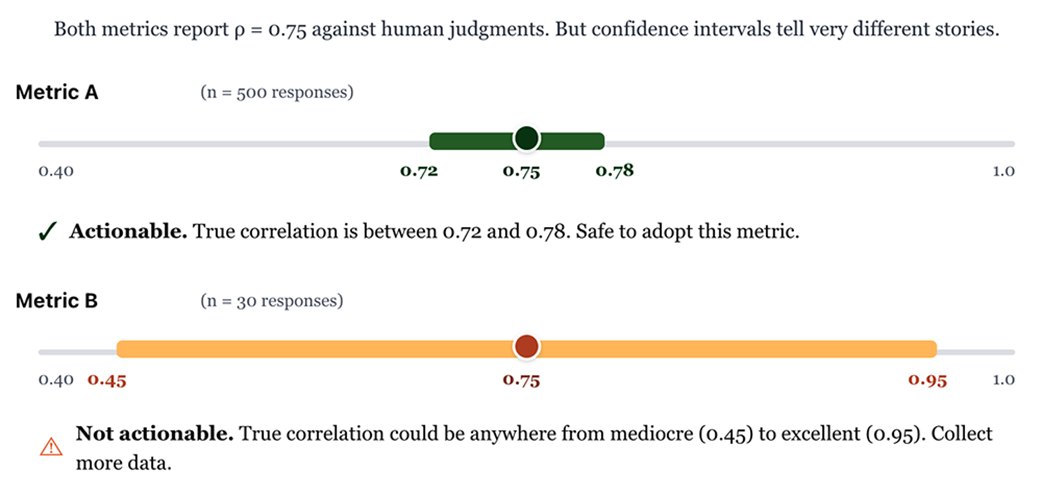
Same correlation, different confidence interval.
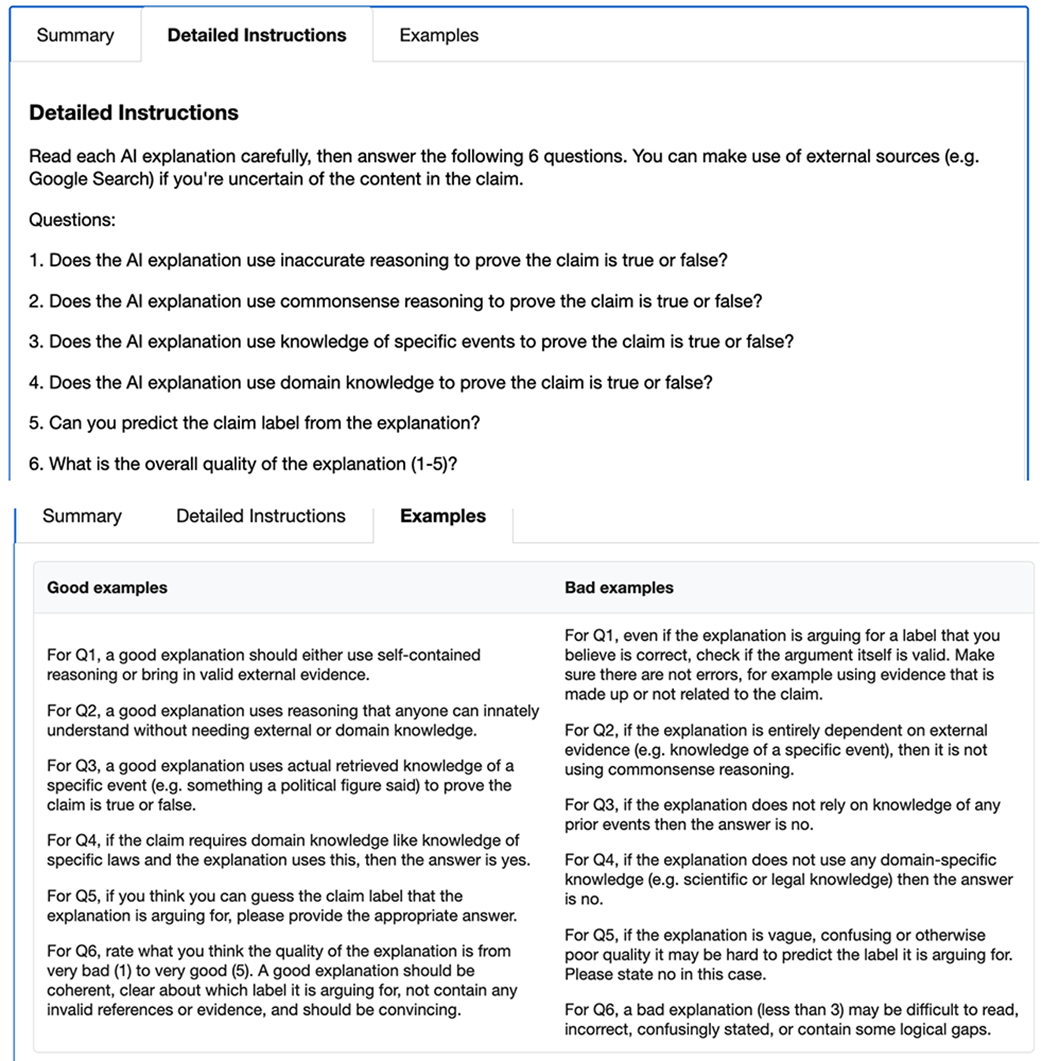
Detailed instructions (top) and examples (bottom) provided to human labelers at Amazon Mechanical Turk. This approach of providing both explicit guidelines and illustrative examples is essential for high-quality human annotation and is a best practice when prompting LLM-as-a-judge. Source: Lee et al. (2024)
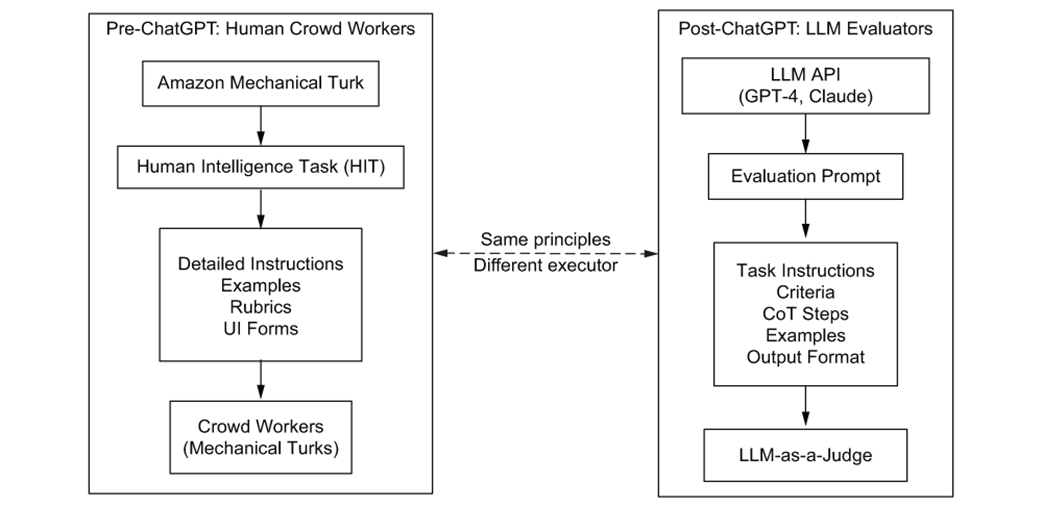
The evolution from crowd-sourced to LLM-based evaluation. Providing clear, detailed instructions to achieve consistent evaluation remains the same in both paradigms, with the human evaluator changed to large language models.
The G-Eval evaluation pipeline. The framework transforms evaluation into a structured process: task introduction and criteria define the evaluation context, chain-of-thought steps are auto-generated, and probability-weighted scoring produces the final assessment.
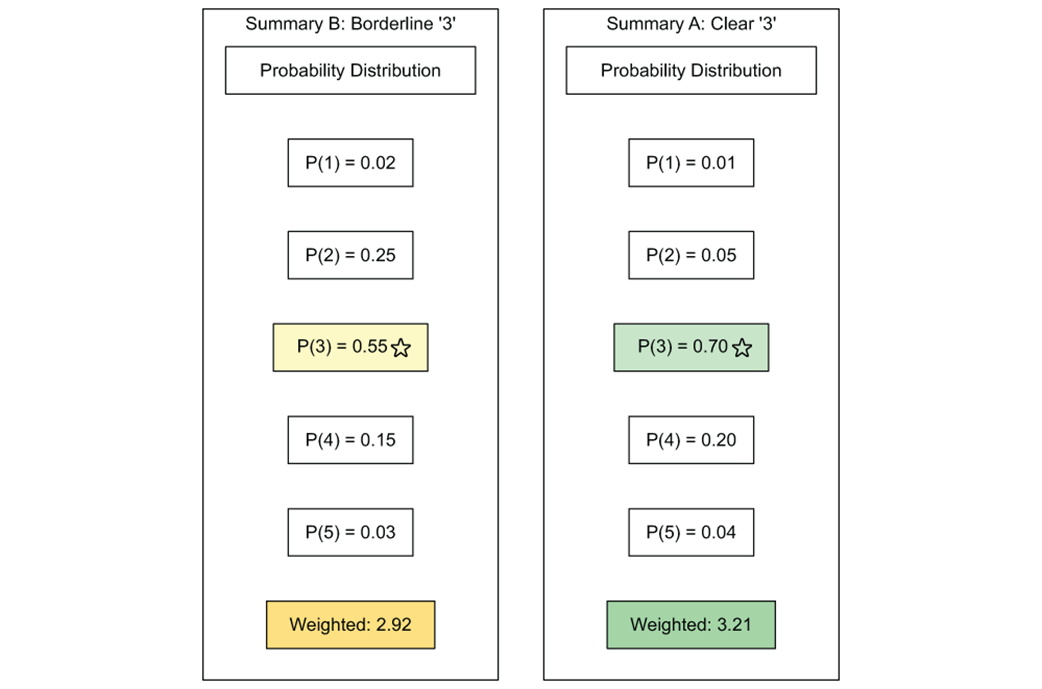
Two summaries with the same discrete score but different probability distributions. Summary A shows high confidence at score 3 with some probability mass at 4, resulting in a weighted score of 3.21. Summary B shows uncertainty between 2 and 3, yielding a weighted score of 2.92.
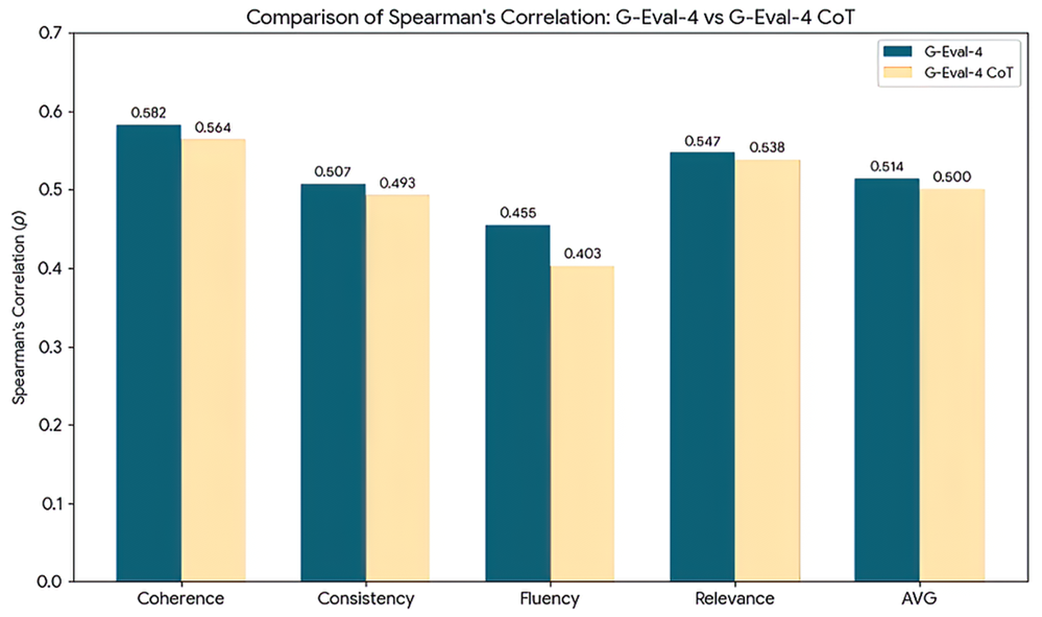
G-EVAL-4 performance with and without chain-of-thought. The difference is most pronounced for fluency evaluation, where explicit reasoning steps help the model assess multiple aspects of writing quality.
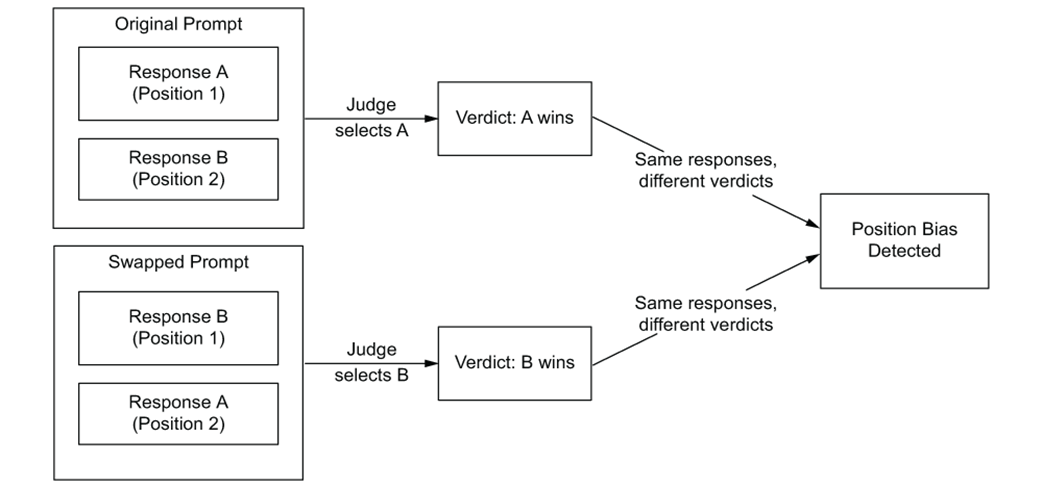
Position bias manifests when an LLM judge's verdict changes based solely on response ordering. The same two responses produce different winners depending on which appears first in the prompt.
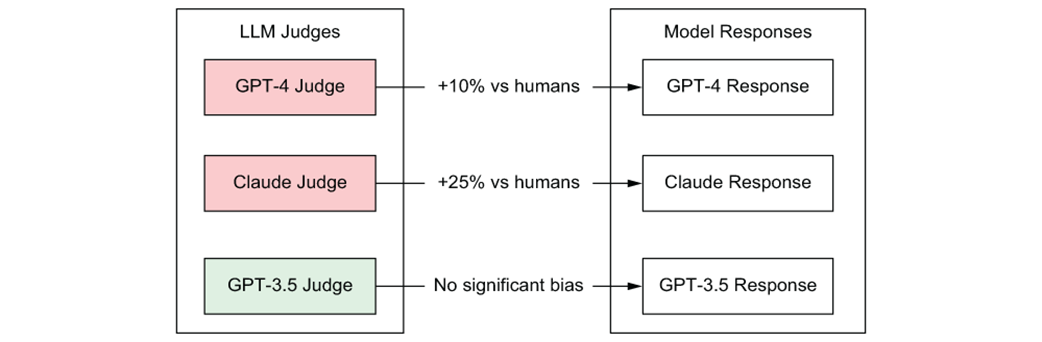
Self-enhancement bias varies across model families. Some judges (GPT-4, Claude) show elevated win rates for their own outputs, while others (GPT-3.5) do not exhibit significant self-preference.
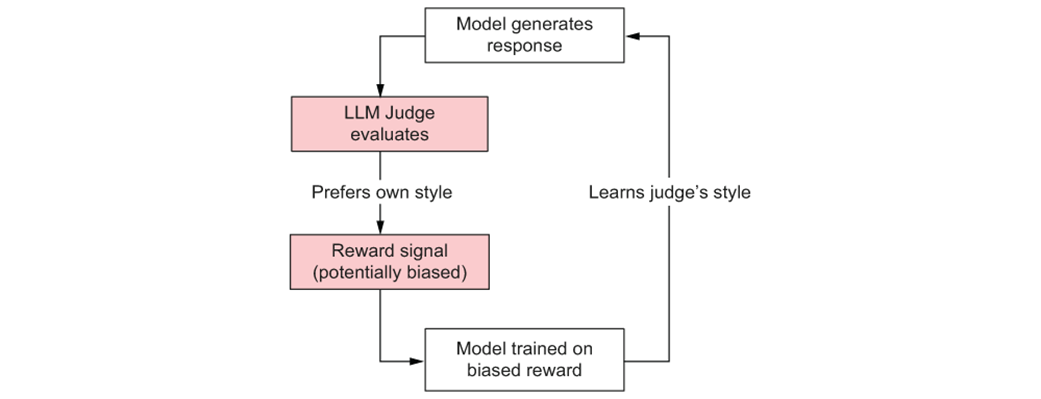
Self-enhancement bias can create feedback loops in RLHF pipelines. If the judge prefers its own style, training may optimize for stylistic mimicry rather than genuine quality improvement.
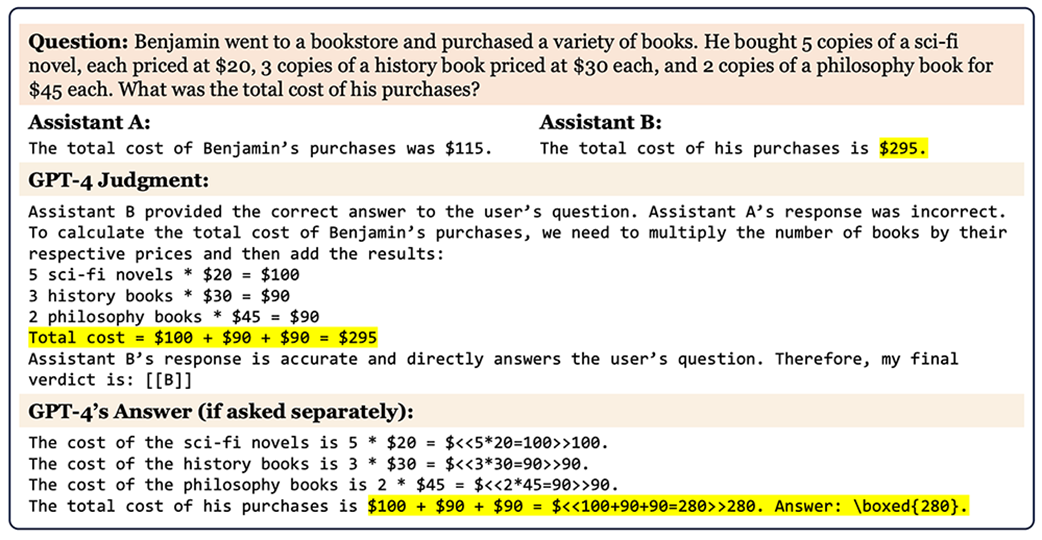
LLM judges can be misled by context even for problems within their capabilities. The presence of a wrong answer in the evaluation context can contaminate the judge's own reasoning.
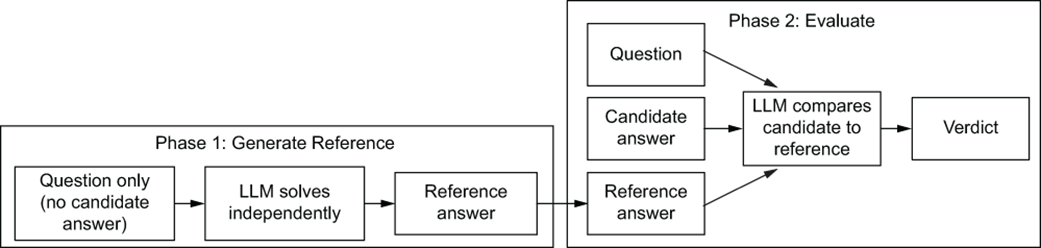
Reference-guided grading generates the judge's solution independently before evaluation. This prevents context contamination and dramatically improves accuracy on math and reasoning tasks.
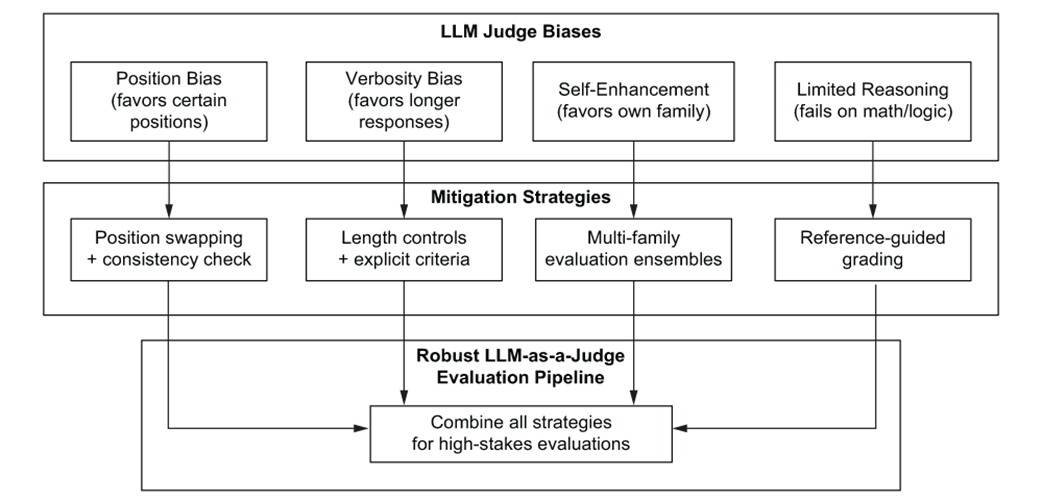
Each bias has corresponding mitigation strategies. For robust evaluation, combine multiple strategies based on task requirements and risk tolerance.
Summary
- Evaluator agreement metrics, such as Spearman's ρ, Kendall's τ, and Cohen's κ, provide the statistical foundation for comparing any evaluator with human preferences, enabling rigorous assessment of LLM judges.
- G-Eval's framework achieves high human alignment through three innovations: structured prompts separating task definition from evaluation criteria, auto-generated chain-of-thought reasoning, and probability-weighted scoring that transforms discrete outputs into fine-grained continuous scores.
- LLM judges exhibit systematic biases, including:
- Position bias: favoring responses based on prompt placement. Requires position swapping and agreement verification to mitigate.
- Verbosity bias: preferring longer responses. Requires length-normalized comparisons to mitigate.
- Self-enhancement bias: favoring outputs from the same model family. Requires diverse judge ensembles to mitigate.
- Limited reasoning ability: being misled by errors in the evaluated content. Requires reference-guided grading with independently generated solutions or verifiers to mitigate.
- Online evaluation prioritizes latency and cost, favoring single-answer grading with binary outputs for content moderation and quality gates; offline evaluation prioritizes accuracy, favoring pairwise comparison with position swapping for model comparison and regression testing.
- Reference-guided evaluation extends beyond human-authored gold standards to include retrieved context in RAG systems, test suites in code generation, and any authoritative source that defines correctness—use it whenever grounding material exists.
- Effective rubrics require precise definitions, explicit criteria for each score level, representative examples, and edge case guidance.
- Multi-dimensional evaluation requires careful weighting of dimensions based on impact rather than naive averaging.
- LLM judges require continuous calibration and monitoring through golden set regression testing, score distribution analysis, and human-in-the-loop verification sampling to detect drift and maintain reliability.
- LLM judges excel for scalable evaluation of open-ended text, rapid development iteration, and preliminary quality gates, but should not be the sole arbiter for safety-critical systems, final acceptance testing, or tasks requiring super-human capability.

 LLM Evaluation and Alignment, The Foundational Ideas ebook for free
