2 The dawn of automatic evaluation: BLEU and ROUGE
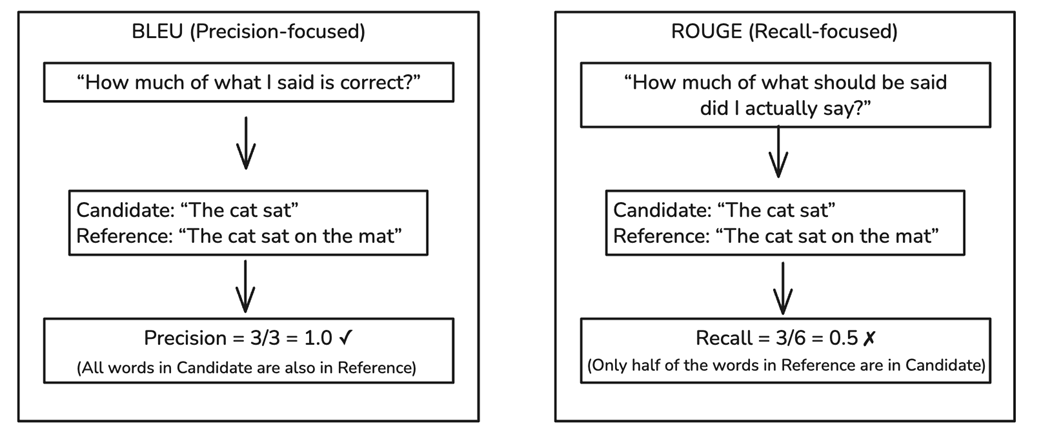
This chapter introduces BLEU and ROUGE as the first widely adopted automatic text evaluation metrics, explaining how they transformed machine translation and summarization from slow, human-only assessment into fast, repeatable scoring systems. BLEU compares candidate translations to human references using lexical overlap, while ROUGE adapts the same basic idea to summarization but emphasizes recall, since summaries should preserve key information even when phrased differently. Both metrics are built on simple observable proxies rather than deep language understanding, and that simplicity made them practical, objective, and useful for rapid iteration.
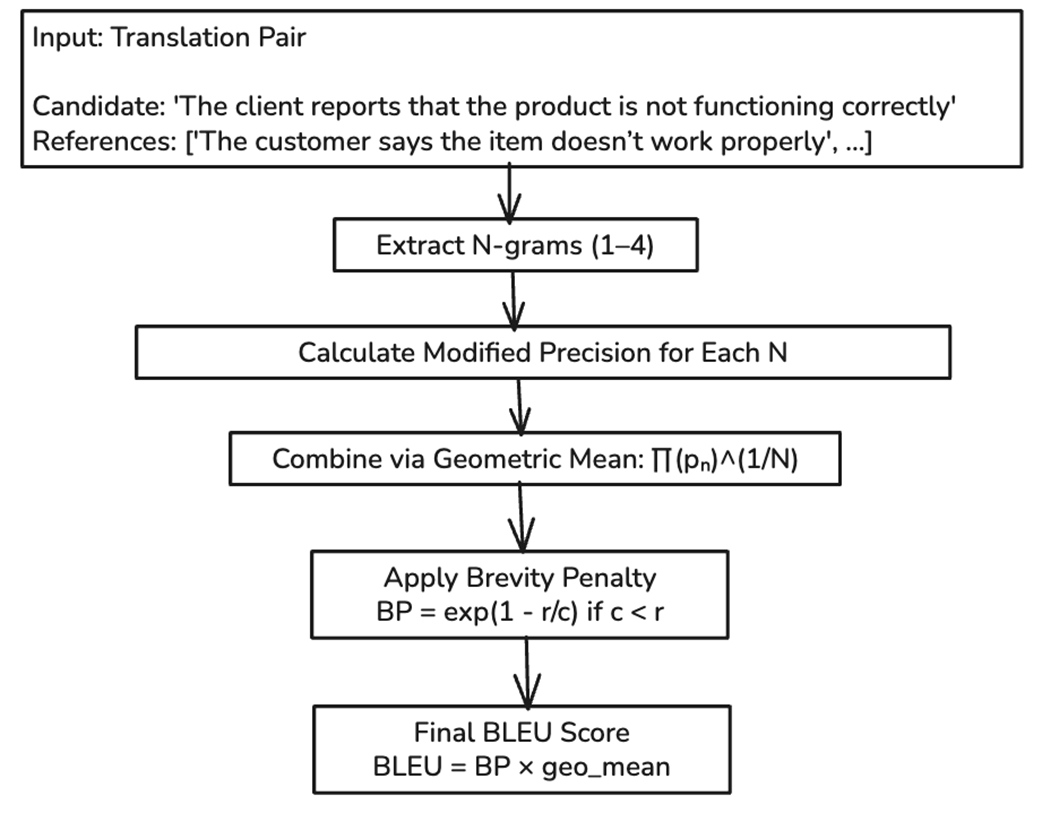
BLEU’s design is presented as a careful response to known failure modes. It uses modified n-gram precision to stop models from gaming the score through repetition, combines multiple n-gram levels with a geometric mean so weak performance at any level is heavily penalized, and adds a brevity penalty to prevent unnaturally short outputs from appearing deceptively strong. These choices reflect a broader evaluation philosophy: start with the simplest useful proxy, anticipate how systems might exploit the metric, and add constraints that enforce balanced, non-degenerate behavior. The chapter also shows how BLEU remains valuable today as a cheap sanity check, a regression signal, and even a tool for contamination detection and reward design in reinforcement learning with verifiable rewards.
ROUGE is then developed as the summarization counterpart to BLEU, shifting the focus from precision to recall because summary quality depends more on covering the important content of the reference than matching its exact wording. The chapter surveys ROUGE-N, ROUGE-L, ROUGE-W, and ROUGE-S, showing how each variant captures different aspects of overlap, ordering, or long-range relationships while using harmonic-mean-style ideas when precision and recall both matter. The closing takeaway is that these classical metrics are limited by their lexical nature, since they cannot truly judge meaning, paraphrase, or semantic equivalence; yet the design principles behind them—task fit, robustness, penalties for gaming, and efficient aggregation—remain highly relevant for modern AI evaluation.
The BLEU evaluation pipeline from input to final score. BLEU takes generated candidates and references, calculates word overlaps for different word segment lengths, combines these scores using a geometric mean, and applies a length penalty to produce the final score.
ROUGE emphasizes recall (how much of the reference is captured). BLEU focuses on precision (how much of the candidate is correct).
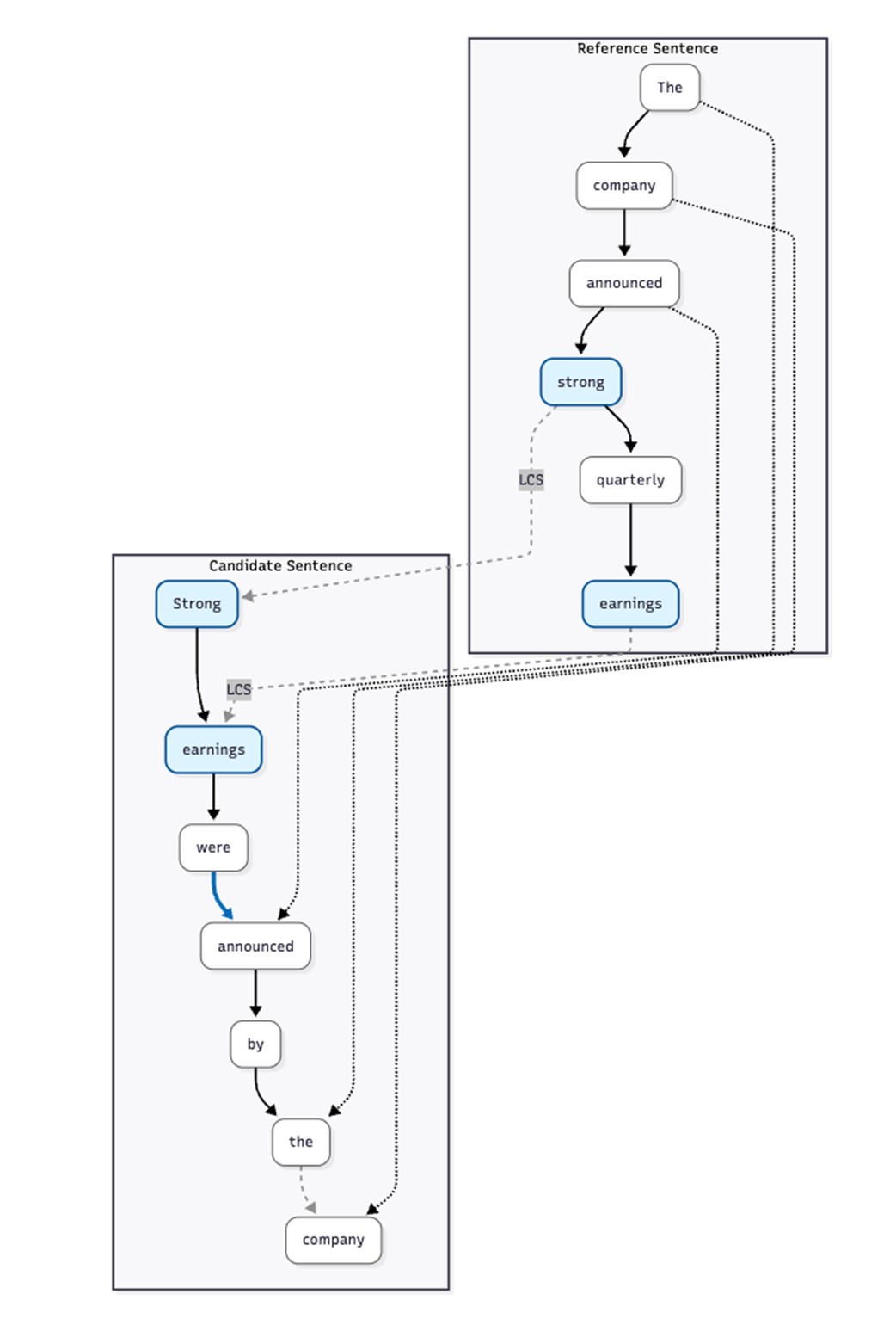
Flow chart of calculating Longest Common Sequence (LCS) on reference sentence "The company announced strong quarterly earnings" and candidate sentence "Strong earnings were announced by the company". The LCS is “strong earnings”, with a length of 2.
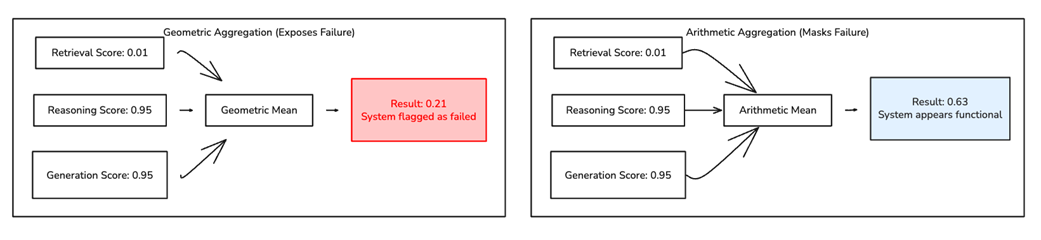
Comparison of aggregation methods for a compound RAG system. The arithmetic mean (left) allows high scores in reasoning and generation to mask a near-total failure in retrieval (0.01), resulting in a deceptive passing score of 0.63. The geometric mean (right) propagates the retrieval failure, pulling the aggregate score down to 0.21 and correctly flagging the system error.
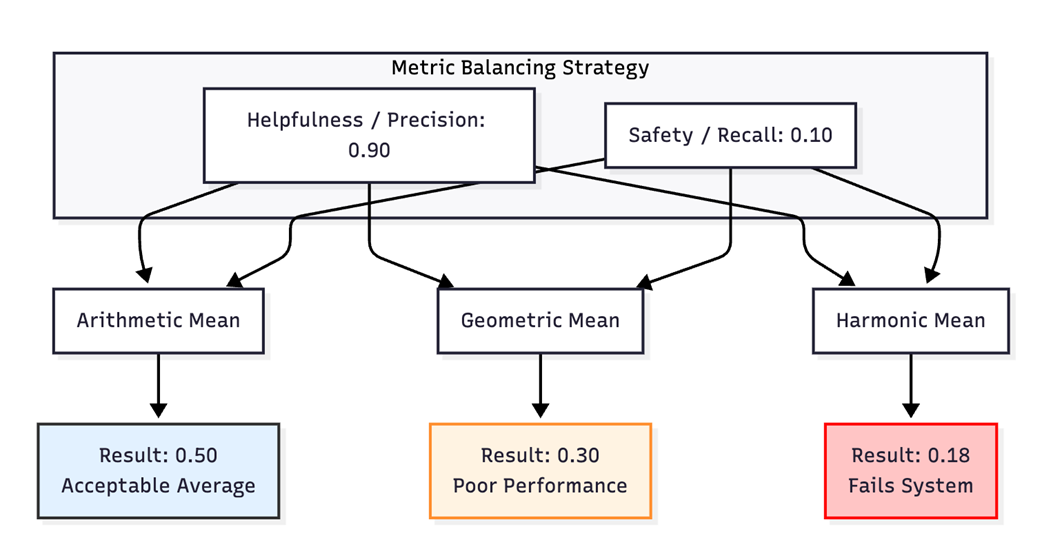
Impact of mean selection on imbalanced objectives. When evaluating a system with high helpfulness (0.90) but low safety (0.10), the choice of mean determines the pass/fail outcome. The arithmetic mean suggests acceptable performance (0.50). The geometric mean imposes a moderate penalty (0.30). The harmonic mean (0.18) enforces the strictest penalty for the imbalance, ensuring safety cannot be compromised for helpfulness.
Summary
- BLEU (Bilingual Evaluation Understudy) revolutionized machine translation evaluation by automating comparison between candidate and reference translations.
- Modified n-gram precision to prevent gaming through word repetition
- Geometric mean to combine n-gram scores, ensuring balanced performance across all linguistic levels
- Brevity penalty to discourage overly short translations
- ROUGE (Recall-Oriented Understudy for Gisting Evaluation) adapted automatic evaluation for summarization by focusing on information coverage rather than exact phrasing.
- ROUGE-N measures n-gram recall between summaries
- Longest Common Subsequence was used in ROUGE-L and ROUGE-W for flexible word order matching with adjustments for consecutive matches.
- Skip-bigram co-occurrences were used in ROUGE-S and ROUGE-SU to account for long-range lexical dependencies.
- Classical metrics remain essential in modern AI evaluation for three key reasons:
- Design principles like geometric means and length penalties apply directly to multi-component AI systems
- Cost efficiency enables real-time monitoring at scale, complementing expensive LLM-as-a-judge evaluation
- Verifiable rewards provide unhackable optimization targets for reinforcement learning
- Key mathematical insights guide metric design:
- Geometric mean's zero-product property ensures component failures can't hide in averages
- F-measure's harmonic mean balances competing objectives more strictly than the arithmetic mean
- Length normalization prevents gaming through output manipulation
- These metrics rely on lexical matching, missing semantic equivalence, and do not recognize paraphrasing, synonyms, or meaning preservation. These limitations motivate the development of semantic similarity metrics and future model-based evaluation methods.
- Practical deployment combines multiple approaches:
- Statistical metrics for continuous monitoring and rapid iteration
- LLM-as-a-judge for periodic quality assessment
- Human evaluation for critical edge cases and final validation

 LLM Evaluation and Alignment, The Foundational Ideas ebook for free
