9 Managing model evolution, drift, and versioning
The chapter explains that deploying an LLM is not the end of the work but the start of an ongoing operational cycle. Even if a model’s weights never change, its environment does: user behavior shifts, domain terminology evolves, base models are updated, and safety boundaries can move. To keep production systems reliable, the chapter emphasizes lightweight but disciplined practices such as model and data versioning, clear audit trails, and a simple registry that records enough metadata to reproduce, promote, or retire each version.
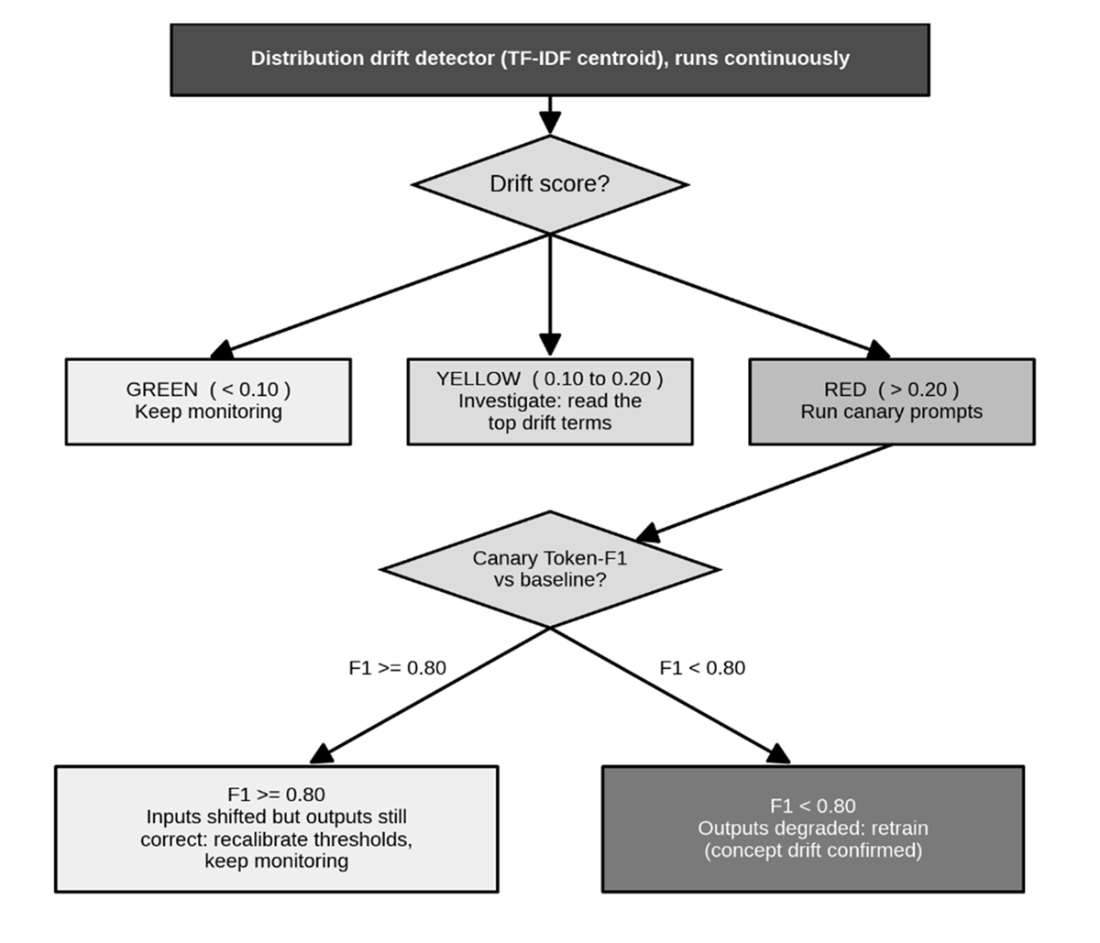
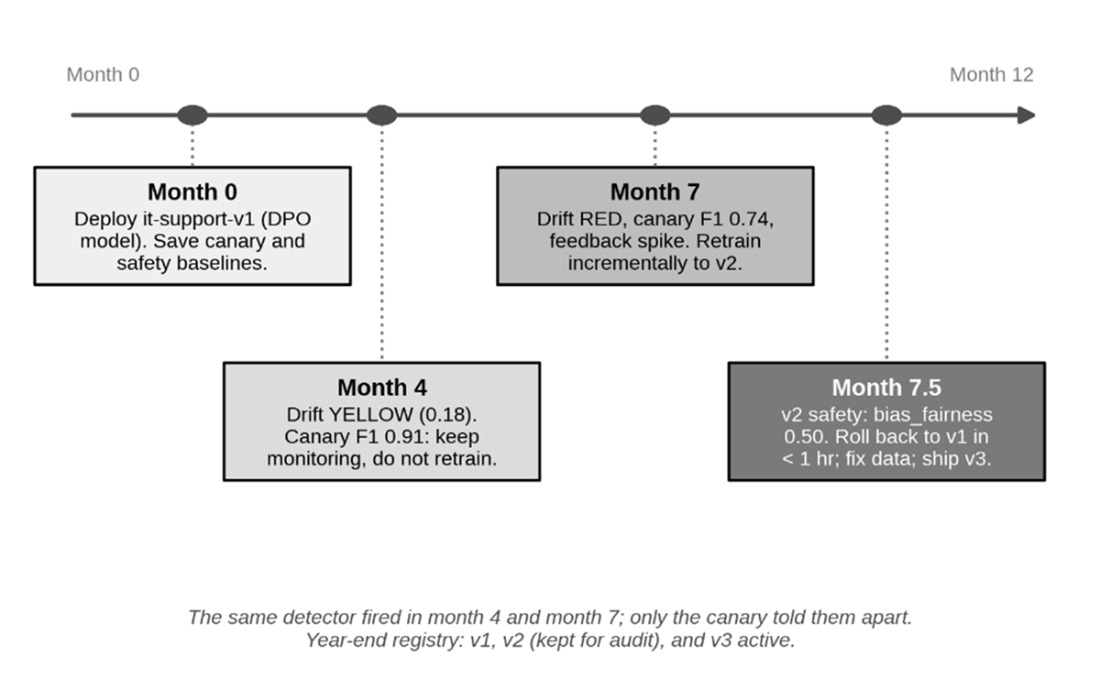
It then shows how to detect degradation before it becomes a visible failure. A cheap, continuous drift detector compares recent and reference prompts using TF-IDF centroid similarity to flag vocabulary and prompt shifts, while canary prompts check whether the model’s behavior has changed on fixed test inputs. The key idea is to treat drift scores as leading indicators and canary regressions as confirming signals, so teams investigate first and retrain only when output quality has truly declined. This same monitoring mindset extends to safety, with monthly red-team testing and production prompt review to catch abuse, jailbreaks, and bias regressions.
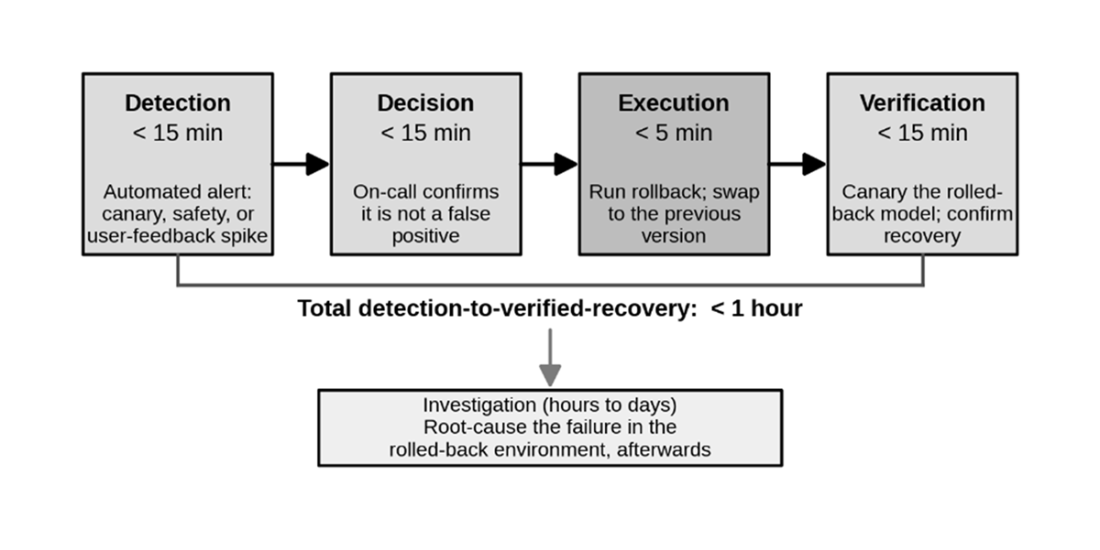
The chapter also covers what to do when things go wrong and how to plan for longer-term change. Rollback must be immediate and rehearsed, with previous model versions kept ready so a bad deployment can be reversed in minutes, ideally through blue-green routing rather than slow reloads. It also warns that upgrading the base model is usually a full retraining effort, not a drop-in swap, so versions must be pinned and upgrades evaluated carefully. Finally, it lays out sustainable maintenance cadences and retraining gates, arguing that the best production systems are built on repeated review, validated retraining, and honest feedback loops rather than one-time deployment success.
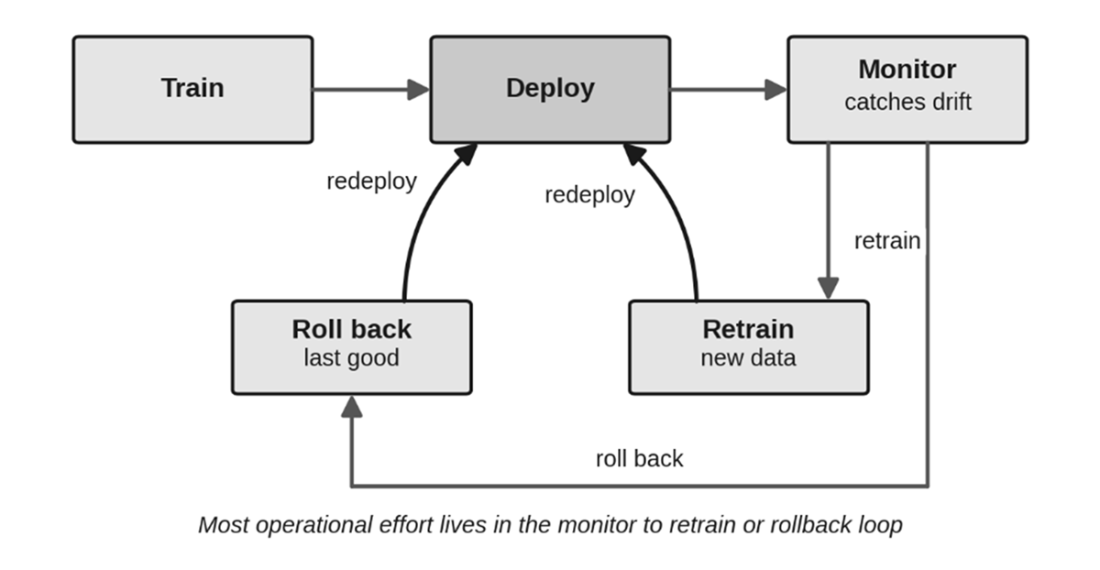
The model lifecycle: train, deploy, monitor, then either retrain or roll back.
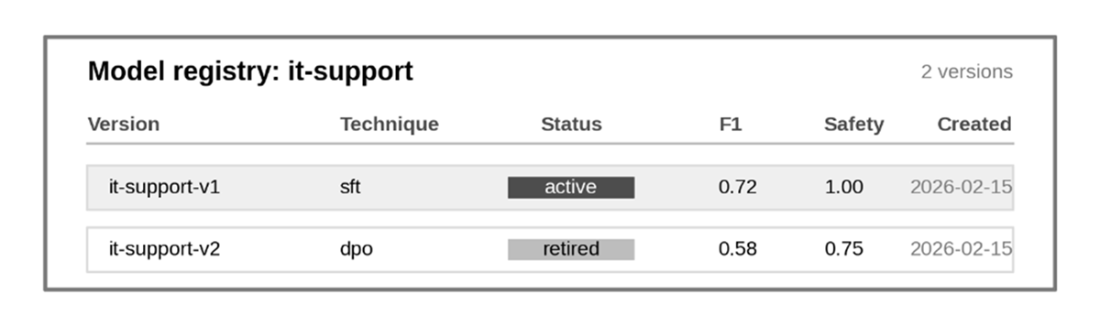
A model registry view backed by a single JSON file you can diff in a pull request.
Responding to a drift signal: a red drift score triggers a canary run before any retrain decision.
Rollback timeline: detection, decision, execution, and verification inside one hour.
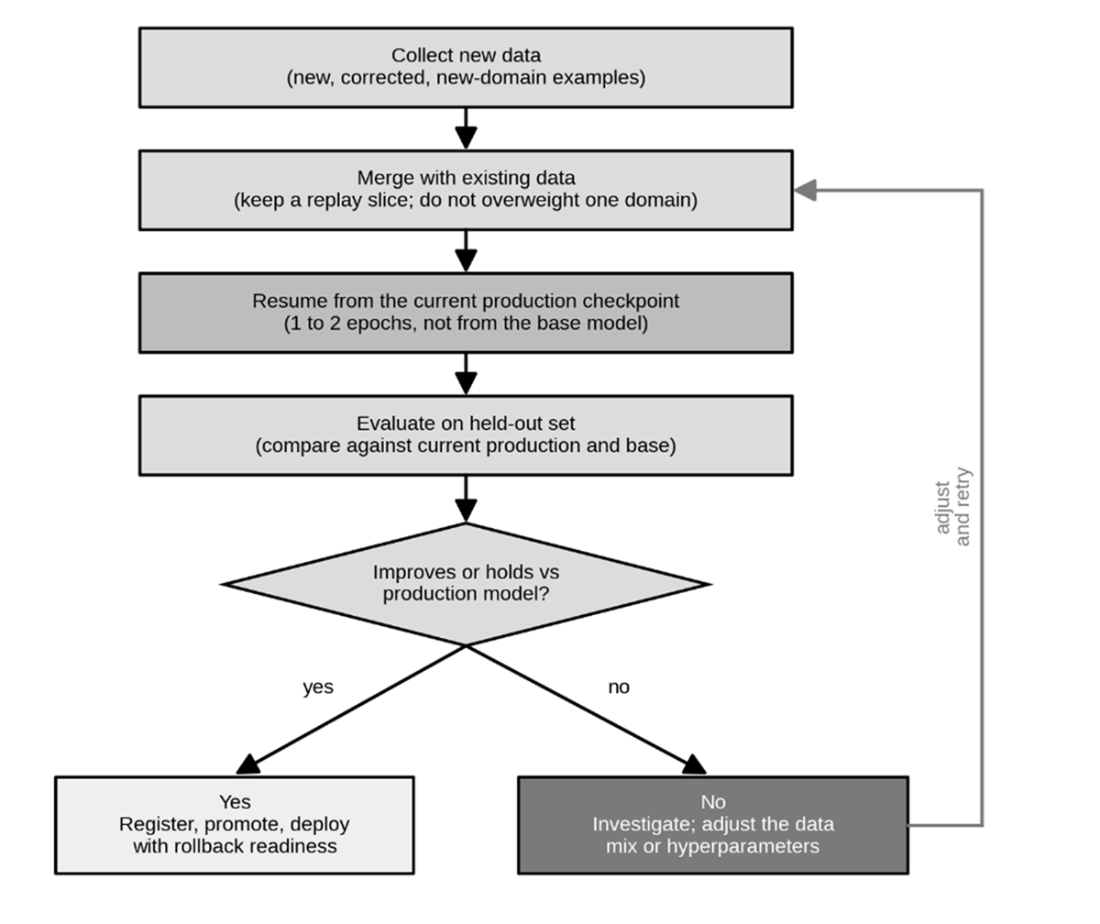
The incremental retraining loop: merge, resume from the production checkpoint, evaluate, and gate before deploying.
One year of the IT support model: two drift alerts, one real degradation, and one sub-hour rollback.
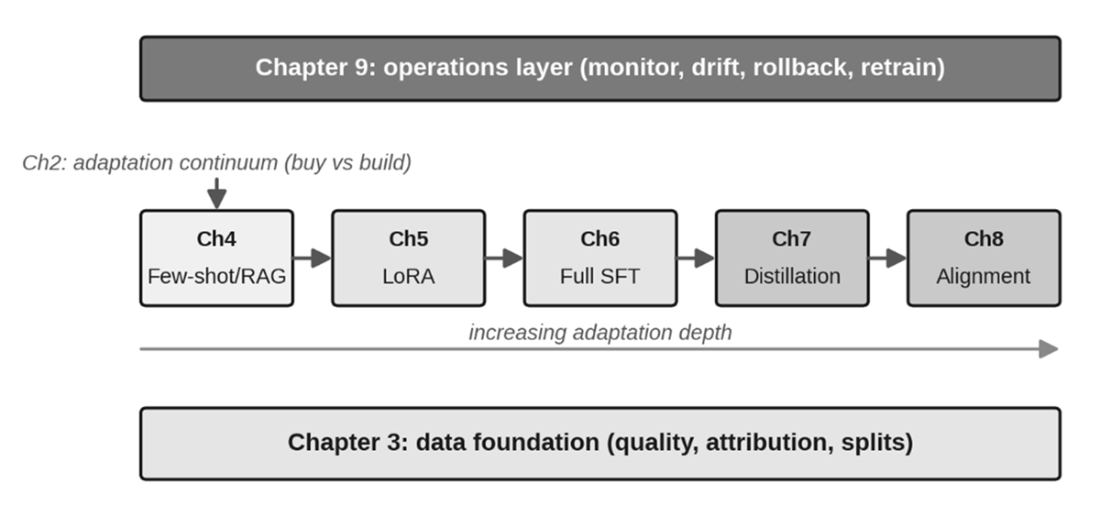
The book’s adaptation continuum, with the operational loop wrapping every rung.
Summary
- A lightweight JSON model registry that tracks version tags, training technique, base model, data hash, checkpoint path, and evaluation metrics provides the audit trail needed for reproducibility, rollback, and regulatory compliance.
- Model drift takes four forms (data drift, concept drift, prompt drift, and model drift), and a TF-IDF cosine-centroid detector combined with periodic canary prompts catches both distribution-level and behavioral degradation.
- Drift detection thresholds must be calibrated to your own data; default values are starting points, and running the detector on your train/validation split establishes your baseline.
- Base model upgrades require re-running the entire fine-tuning pipeline because LoRA adapters, SFT checkpoints, distilled students, and DPO-optimized models are all tied to the specific base model they were trained on.
- A weekly/monthly/quarterly/annual maintenance cadence with assigned responsibilities prevents the set-and-forget failure mode that causes most production model deployments to degrade silently.
- Retraining should be outcome-based rather than schedule-based, starting from the most recent checkpoint and gated through the full evaluation suite before deployment.
- Rollback infrastructure must be in place from day one, with the previous two model versions ready for instant serving and a target of under one hour from detection to verified rollback.
- Continuous safety monitoring with a monthly red-team prompt suite catches new jailbreak techniques and safety regressions that a one-time deployment gate would miss.
- The complete chapter 5 to 9 pipeline forms a coherent progression: LoRA for task adaptation, full SFT for complex structured output and behavioral consistency, distillation for cost reduction, DPO for quality sharpening, and operational monitoring for sustained reliability.

 LLM Customization and Fine-Tuning ebook for free
