5 Parameter-Efficient Fine-Tuning: LoRA and QLoRA
Parameter-efficient fine-tuning offers a practical way to adapt large language models without retraining every weight, keeping the base model frozen while learning a small set of task-specific parameters. Among these methods, LoRA stands out because it is simple, well supported, and effective for many enterprise tasks where prompting alone is not enough but full fine-tuning is too expensive or risky. The chapter emphasizes that this approach is especially useful for small to medium datasets, rapid iteration, and deployment scenarios that benefit from lightweight adapters rather than a monolithic updated model.
The chapter explains LoRA as a low-rank update that learns two small matrices instead of modifying the full model, and it walks through a complete workflow for training, evaluating, and using an adapter. The hands-on example uses an IT support dataset to show how data preparation, message formatting, adapter training, and evaluation fit together, while also demonstrating how hyperparameters such as rank and alpha affect capacity, memory use, and training speed. It shows that a rank of 16 is a strong default for many cases, that overly small or overly large ranks can be inefficient, and that the real limit on quality is often data quality rather than adapter size.
Beyond basic fine-tuning, the chapter highlights safety, memory-constrained training, deployment, and operational decisions. It shows that LoRA can unintentionally weaken refusal behavior if the training data contains only helpful answers, and it recommends explicit safety checks and refusal examples to prevent regressions. QLoRA is presented as the memory-saving variant that loads the base model in 4-bit precision, making fine-tuning feasible on smaller GPUs at a modest speed cost. The chapter closes by comparing tools and managed platforms, explaining when to keep adapters separate or merge them, and underscoring the broader business case: PEFT can deliver strong returns quickly, but only when paired with good data, careful evaluation, and responsible deployment practices.
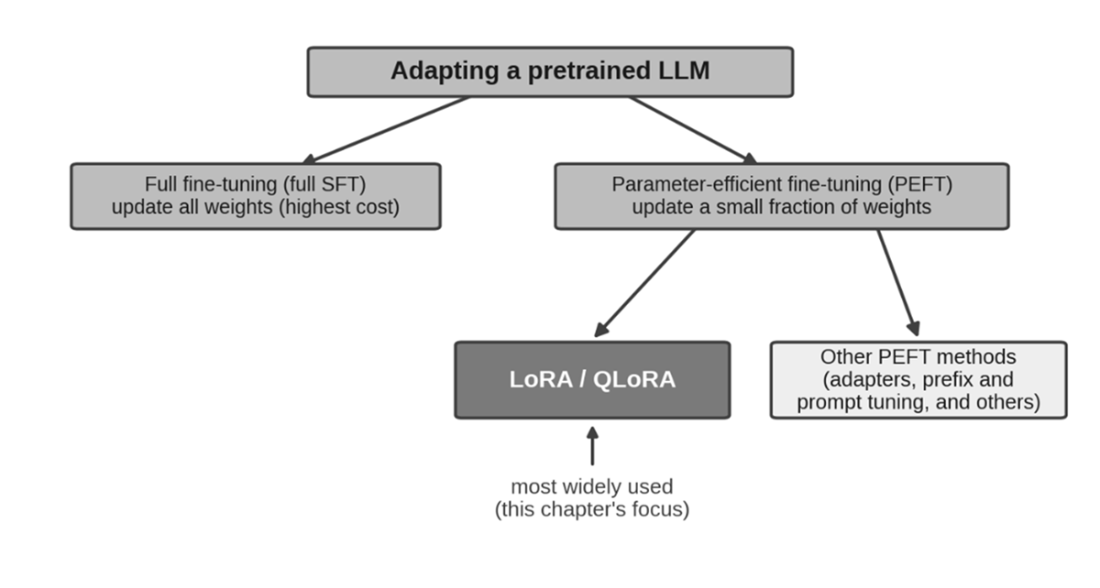
The parameter-efficient fine-tuning family, where full fine-tuning updates every weight while PEFT methods update only a small fraction, with LoRA and QLoRA the most widely used and the focus of this chapter.
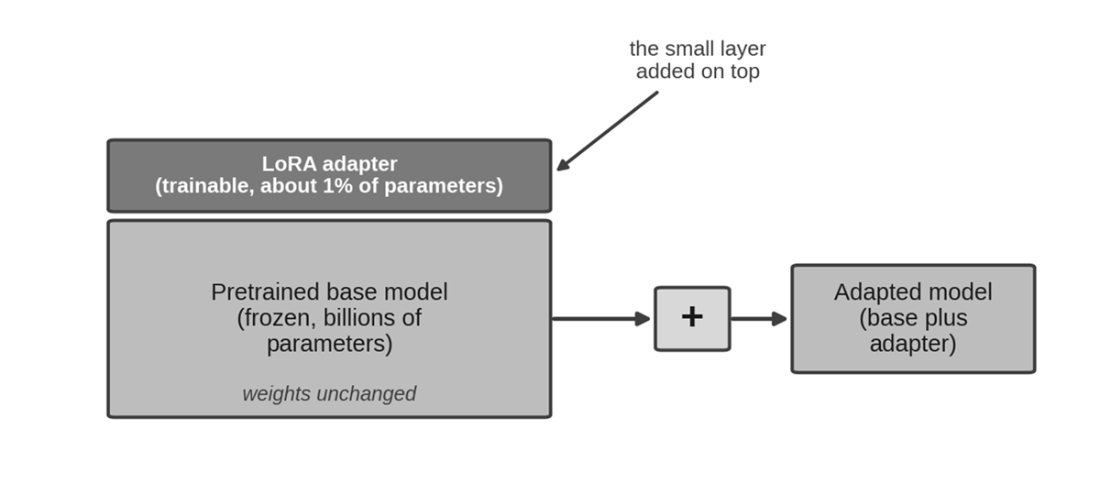
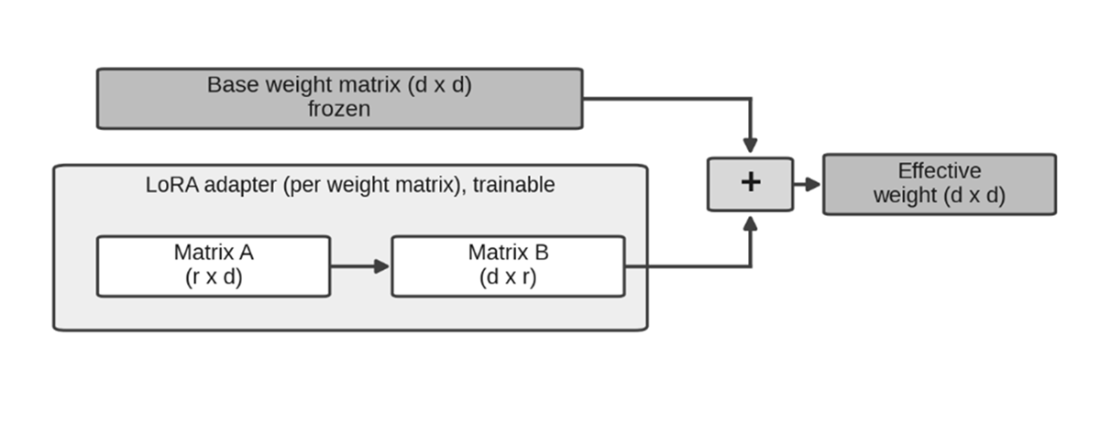
LoRA leaves the pretrained base model frozen and trains only a small adapter added on top, typically about 1% of the parameters, then combines the two at inference to produce the adapted model.
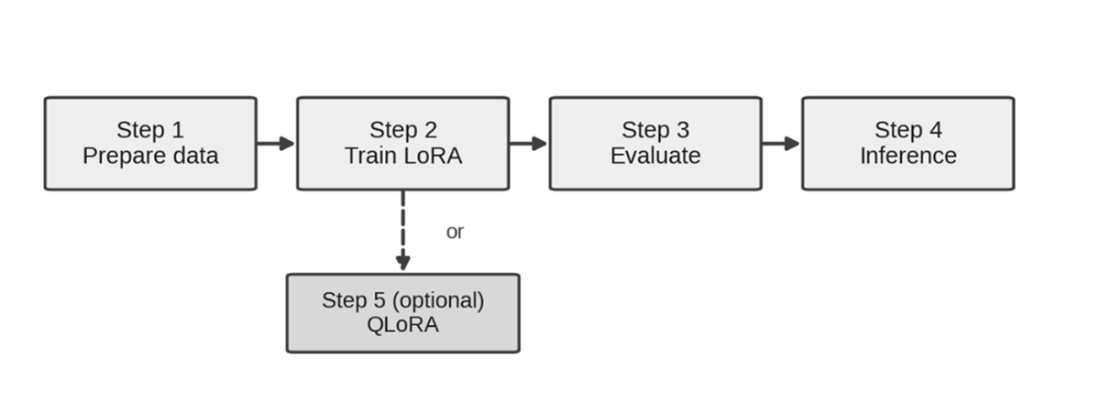
The LoRA fine-tuning workflow this chapter follows, from preparing the data through training the adapter, evaluating it, and running inference, with QLoRA as an optional path for smaller GPUs
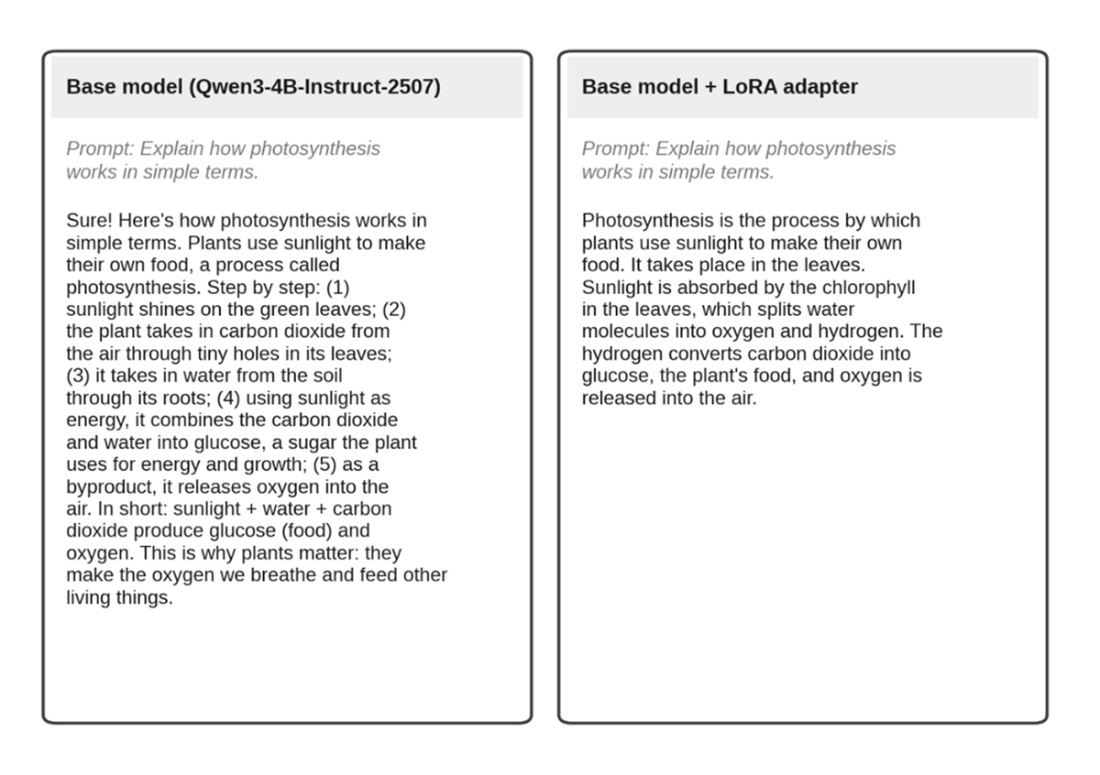
Base model and LoRA-adapter inference for the same prompt
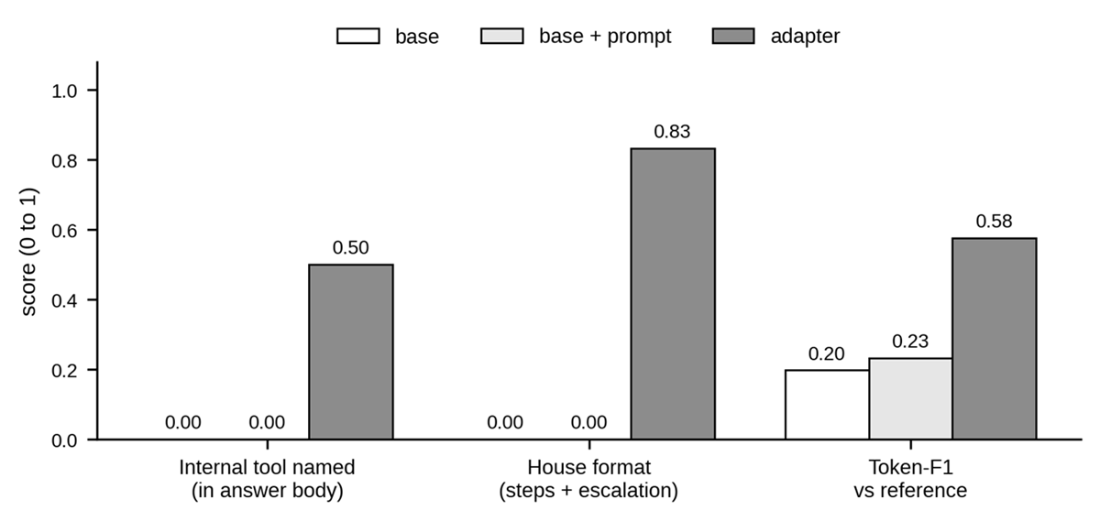
On held-out Contoso IT questions, only the LoRA adapter reaches the house format and names the internal tools, while the base model and a format-prompted base supply neither.
LoRA introduces trainable low-rank matrices without changing the original parameters.
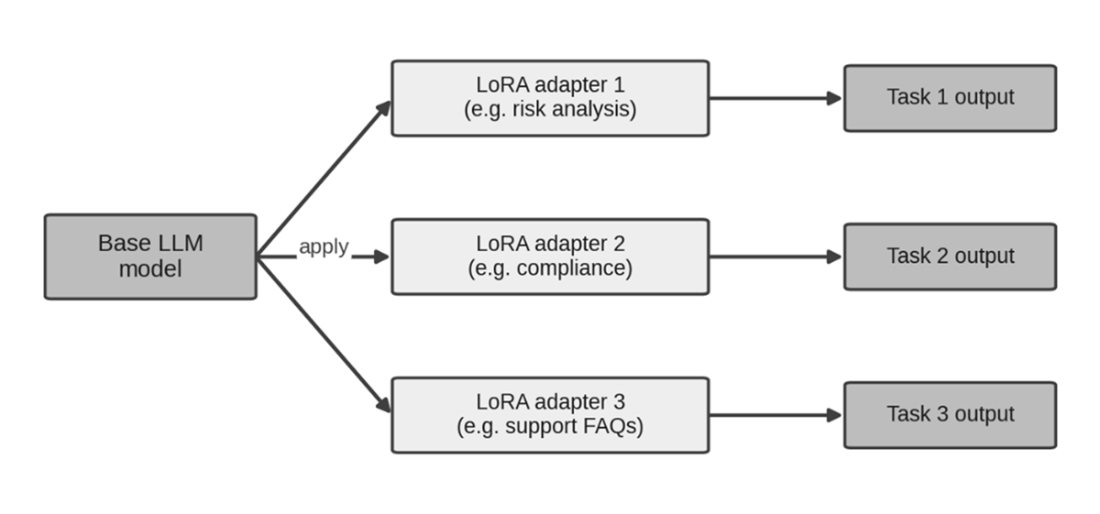
Multi-LoRA adapters enable a base model to use multiple LoRA modules for different tasks.
Summary
- Parameter-efficient fine-tuning (PEFT) adapts large language models by training a small set of additional parameters, avoiding the cost and complexity of updating every weight in the model.
- LoRA (Low-Rank Adaptation) inserts trainable low-rank matrices into frozen model layers, typically coming close to full fine-tuning quality at roughly one-tenth the compute cost.
- QLoRA extends LoRA by loading the base model in 4-bit precision, reducing GPU memory requirements by approximately 4x and making fine-tuning feasible on consumer-grade hardware.
- Safety regressions are a real risk after fine-tuning: always evaluate the adapted model against known harmful prompts and include explicit refusal examples in training data.
- The same LoRA recipe generalizes across adaptation targets, from task-specific Q&A to a house answer style, and it combines with the retrieval techniques of chapter 4 when a task also needs external knowledge.
- Enterprises should start with LoRA for most adaptation projects, graduating to full supervised fine-tuning in chapter 6 only when LoRA’s capacity ceiling demonstrably limits task performance.
- A growing ecosystem of frameworks (Hugging Face PEFT, Axolotl, LLaMA-Factory, Unsloth) and managed platforms (Azure Foundry, Vertex AI, SageMaker) makes LoRA accessible to teams at every scale.
FAQ
What is LoRA in parameter-efficient fine-tuning?
LoRA, or Low-Rank Adaptation, is a PEFT method that freezes the pretrained base model and trains only a small set of added low-rank matrices. This lets you adapt a model for a new task without updating all of its weights.
Why is LoRA considered parameter-efficient?
LoRA typically trains only about 1% of the model’s parameters, rather than the full model. That makes training cheaper, faster, and more memory efficient while still preserving most of the base model’s capabilities.
When should I choose LoRA instead of full fine-tuning?
Choose LoRA when you have a small-to-medium dataset, limited GPU resources, or need rapid iteration. It is often the best default choice when prompting is no longer enough but full supervised fine-tuning would be too costly or risky.
What do the LoRA hyperparameters rank and alpha control?
Rank (r) controls the adapter’s expressivity: higher ranks can learn more complex changes but use more memory and compute. Alpha (α) controls the strength of the adapter’s influence, often set to about 2 × r.
What LoRA rank is a good starting point?
The chapter recommends starting with r=16 for most use cases. Lower ranks like 4 or 8 are better for simple style or format changes, while higher ranks like 32 or 64 are only worth trying if performance plateaus and the task is truly capacity-bound.
How does QLoRA differ from regular LoRA?
QLoRA combines LoRA with 4-bit quantization of the base model. The adapters are still trained normally, but the quantized base model dramatically reduces GPU memory requirements, making fine-tuning possible on smaller hardware.
When should I use QLoRA instead of regular LoRA?
Use QLoRA when GPU memory is limited, especially under about 12 GB, or when you want to fine-tune larger models on consumer hardware. Regular LoRA is preferred when you have enough memory and want faster training or possibly slightly better quality.
Can changing LoRA rank fix safety regressions?
No. The chapter shows that reducing rank did not fix the safety drop caused by missing refusal examples in the training data. Safety problems usually require data changes, such as adding explicit refusal examples and re-evaluating the model.
What metrics should I use to evaluate a LoRA-adapted model?
The chapter emphasizes Exact Match, Token-F1, and safety refusal rate. Exact Match is strict, Token-F1 measures partial overlap, and refusal rate checks whether the model still rejects harmful prompts.
What files are saved after training a LoRA adapter?
After training, you usually get adapter configuration files, adapter weights, tokenizer files, and training logs. The full base model is not duplicated; at inference time, you load the base model separately and attach the adapter.

 LLM Customization and Fine-Tuning ebook for free
