Appendix B. Minimally Qualified Readers and Deep Learning Basics
This appendix orients readers on who the book is for and the baseline skills needed. It targets practitioners and data scientists with intermediate Python proficiency—familiarity with data types, control flow, functions, classes, and installing/importing packages. A basic understanding of machine learning and deep learning concepts (such as losses, activation functions, and optimizers) is expected, but no prior PyTorch or generative AI experience is required. Early material introduces PyTorch through fundamentals and a hands-on end-to-end project, preparing readers to build generative models that create images, text, numbers, shapes, and audio.
The appendix then summarizes core deep learning ideas. Neural networks consist of input, hidden, and output layers; those with many hidden layers are considered deep. Common layer types include dense (fully connected) layers, convolutional layers that efficiently detect local spatial patterns with shared weights and translation invariance, and recurrent networks designed for sequences that carry information across time steps. Activation functions provide the nonlinearity that makes these models powerful: ReLU passes positive inputs, sigmoid maps values to 0–1 for binary decisions, softmax converts vectors into class probability distributions, and tanh outputs values between −1 and 1.
Finally, it outlines the training process: split data into train, validation, and test sets; iteratively update parameters to minimize a loss on the train set; monitor validation performance each epoch and stop when improvements stall to limit overfitting; and evaluate final generalization on the test set. It reviews key losses—MSE/L2 and MAE/L1 for regression, binary cross-entropy for binary classification, and categorical cross-entropy for multi-class—and explains how the learning rate governs convergence speed and stability. The discussion of optimizers spans mini-batch stochastic gradient descent and Adam, which adapts per-parameter learning rates from gradient moments and is effective for large models and datasets.
Figure B.1 The structure of a neural network. A neural network is composed of an input layer, zero, one, or more hidden layers, and an output layer. Each layer contains one or more neurons. Neurons in each layer are connected to those in the preceding and subsequent layers, with the strength of these connections represented by weights. In this figure, the neural network features an input layer with three neurons, two hidden layers with six and four neurons respectively, and an output layer with two neurons.
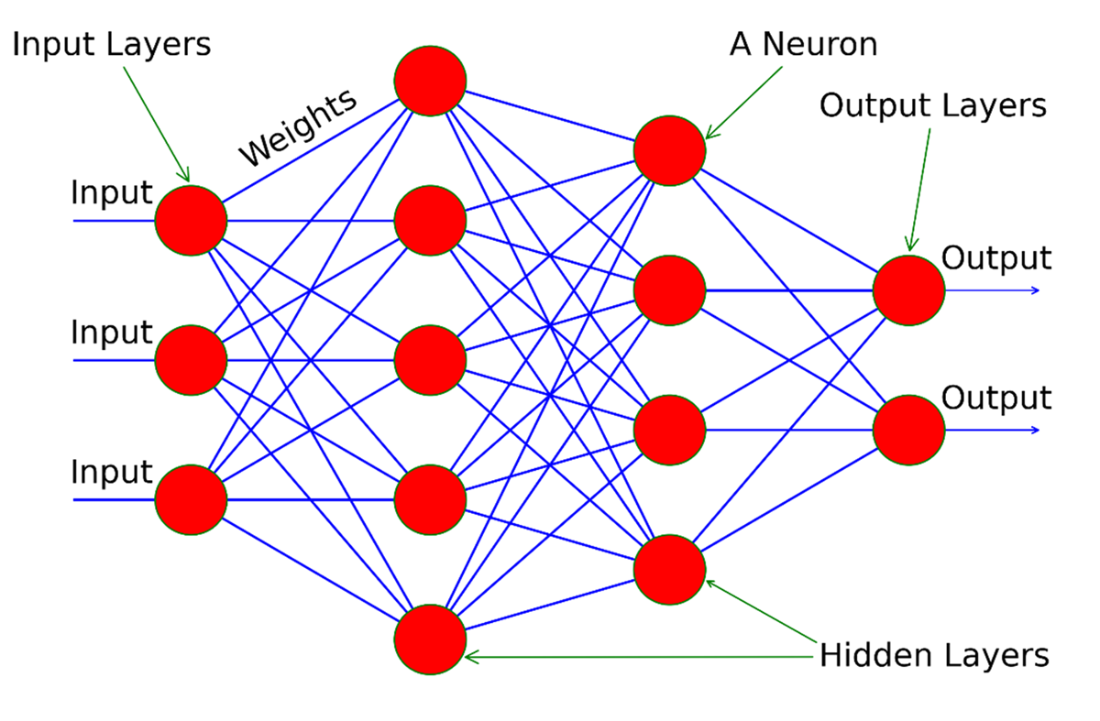
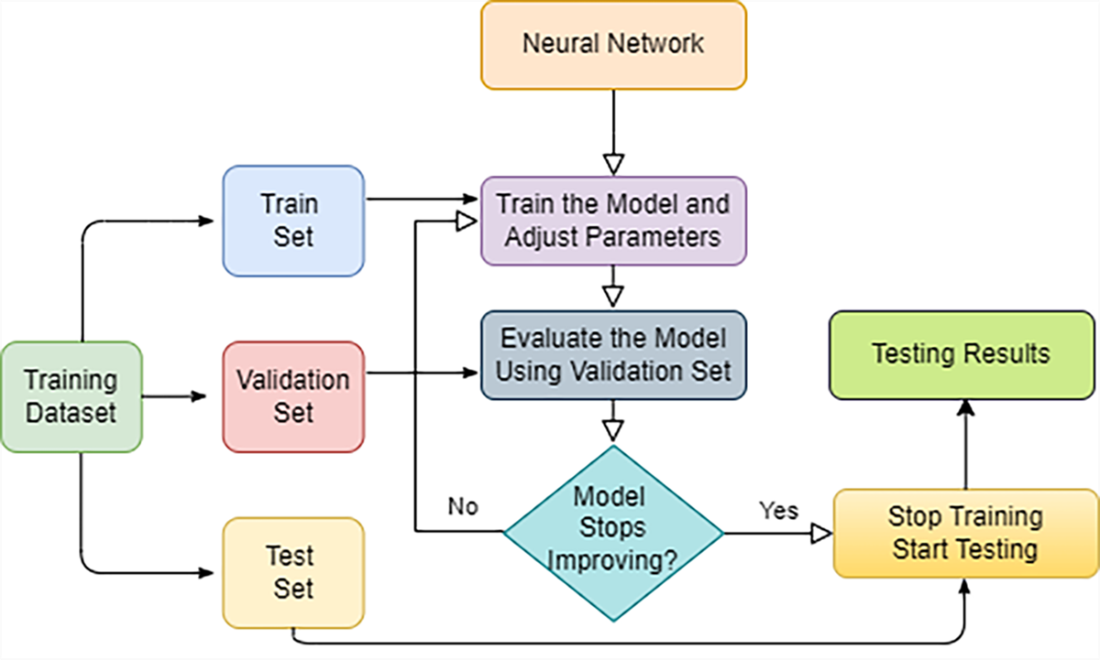
Figure B.2 How to train a neural network. The training dataset is divided into three subsets: the train set, the validation set, and the test set. The process for training a neural network involves the following steps. In the training phase, the train set is used to train the neural network and adjust its parameters to minimize the loss function. During each iteration (epoch) of training, the model updates its parameters based on data in the train set. In the validation phase of each iteration, the model is evaluated using the validation set. The performance on the validation set helps determine if the model is still improving. If the model's performance on the validation set continues to improve, the next iteration of training proceeds using the train set. If the model's performance on the validation set stops improving, the training process is stopped to prevent overfitting. Once training is complete, the trained model is evaluated on the test set. This evaluation provides the final testing results, giving an estimate of the model's performance on unseen data.
FAQ
Who is the intended audience for this book?
This book targets machine learning enthusiasts and data scientists with intermediate Python skills who want to learn generative AI to create novel content (images, text, numbers, shapes, audio) for real-world applications and career growth.What Python knowledge should I have before starting?
You should be comfortable with core Python: data types (int, float, string, bool), control flow (if/elif/else), loops (for/while), functions, classes, and installing/importing third‑party packages. If you need a refresher, see https://www.w3schools.com/python/.Do I need prior experience with PyTorch or generative AI?
No. Chapter 2 introduces PyTorch from the ground up (including its basic data types) and walks you through an end‑to‑end deep learning project to prepare you for building generative models later in the book.What machine learning background is expected, and how can I fill gaps?
A basic understanding of neural networks and deep learning is helpful—especially concepts like loss functions, activation functions, and optimizers. The appendix reviews these at a high level. For deeper study, consider “Deep Learning with PyTorch” by Stevens, Antiga, and Viehmann (2020).How does machine learning differ from rule‑based AI, and where does deep learning fit?
Rule‑based AI relies on manually programmed rules. Machine learning learns patterns from examples. Deep learning is a subset of ML that uses deep neural networks to learn complex relationships directly from data.What is the basic anatomy of a neural network, and what makes it “deep”?
A neural network has an input layer, one or more hidden layers, and an output layer. Each layer contains neurons connected by weighted links. A network is considered “deep” when it has many hidden layers, which generally increases its capacity to model complex patterns.What types of layers are common, and when are they used?
- Dense (fully connected): every neuron connects to every neuron in the next layer; general‑purpose building block.- Convolutional (CNN): locally connected with shared weights (filters), efficient for images, captures spatial features and offers translation invariance.
- Recurrent (RNN): designed for sequences; outputs depend on current input and prior context, enabling a form of memory.
What are activation functions and which ones are commonly used?
Activation functions introduce nonlinearity so networks can learn complex relationships.- ReLU: passes positive values, zeroes negatives; widely used for hidden layers.
- Sigmoid: maps to 0–1; common for binary outputs.
- Softmax: converts a vector to a probability distribution; used for multi‑class outputs.
- Tanh: outputs in −1 to 1; useful when data are centered around zero (e.g., certain image pipelines).
How do you train a neural network and why split data into train/validation/test sets?
Training iteratively updates parameters to minimize a loss on the training set. After each epoch, performance is checked on a validation set to monitor progress and prevent overfitting (e.g., early stopping when validation no longer improves). A separate test set, held out until the end, provides an unbiased estimate of real‑world performance.Which loss functions and optimizers are commonly used, and how does learning rate affect training?
- Losses: MSE (L2) and MAE (L1) for regression (MAE is more robust to outliers); binary cross‑entropy for binary classification; categorical cross‑entropy for multi‑class tasks.- Optimizers: SGD updates weights along the negative gradient (often with mini‑batches); Adam adapts learning rates per parameter using gradient moments and works well for large models/data.
- Learning rate: too high can cause divergence/oscillation; too low makes training slow. Adam helps with adaptive step sizes.

 Learn Generative AI with PyTorch ebook for free
