Overview

8 AI and The Data Lifecycle

In this chapter, AI moves from being a helpful one-off tool to becoming part of the full data pipeline. Building on earlier examples of sentiment analysis, data cleaning, and transformation, the chapter shows how AI can support extraction, enrichment, validation, and loading across the data lifecycle. The central idea is that AI is most valuable when it is integrated into repeatable workflows rather than used only for isolated tasks.

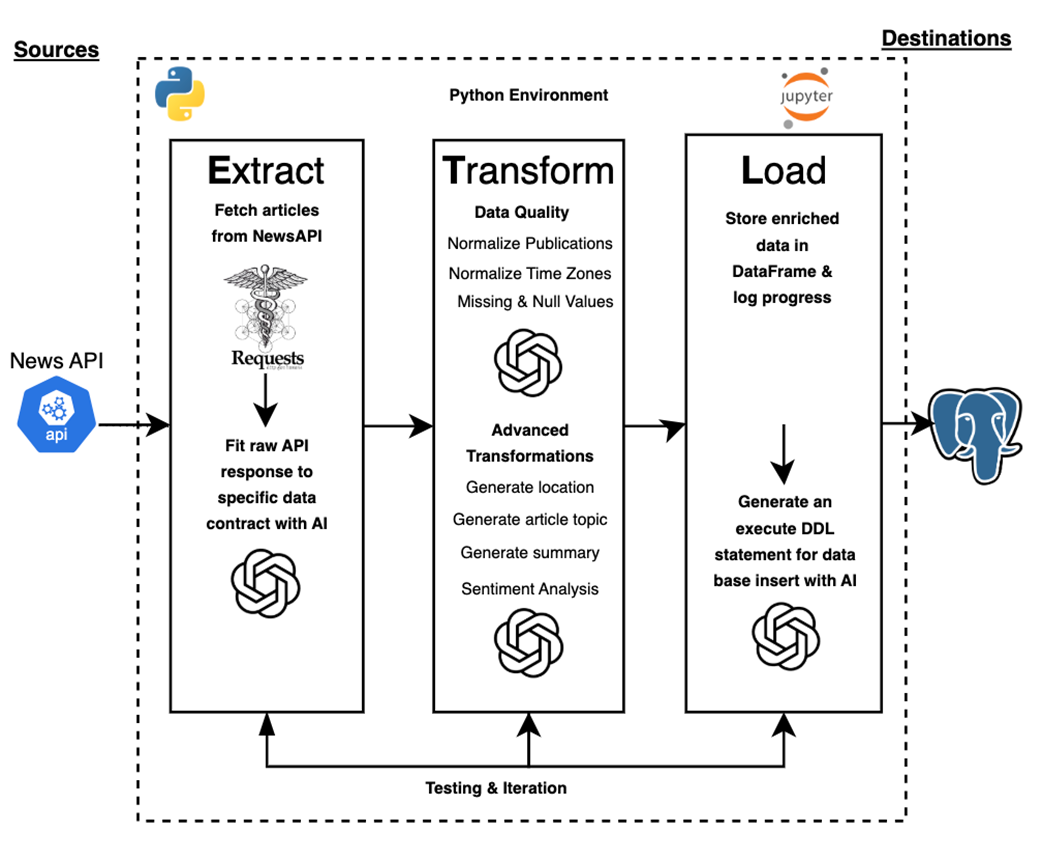
The chapter frames this approach through ETL, with news articles pulled from the News API and stored first as raw JSON so no context is lost. AI is then used to extract structured fields such as source, title, summary, and publish date, while also adding sentiment analysis. After that, a transformation stage applies AI to normalize dates and time zones, assign topic and region labels, and produce cleaner, more consistent records ready for downstream use.

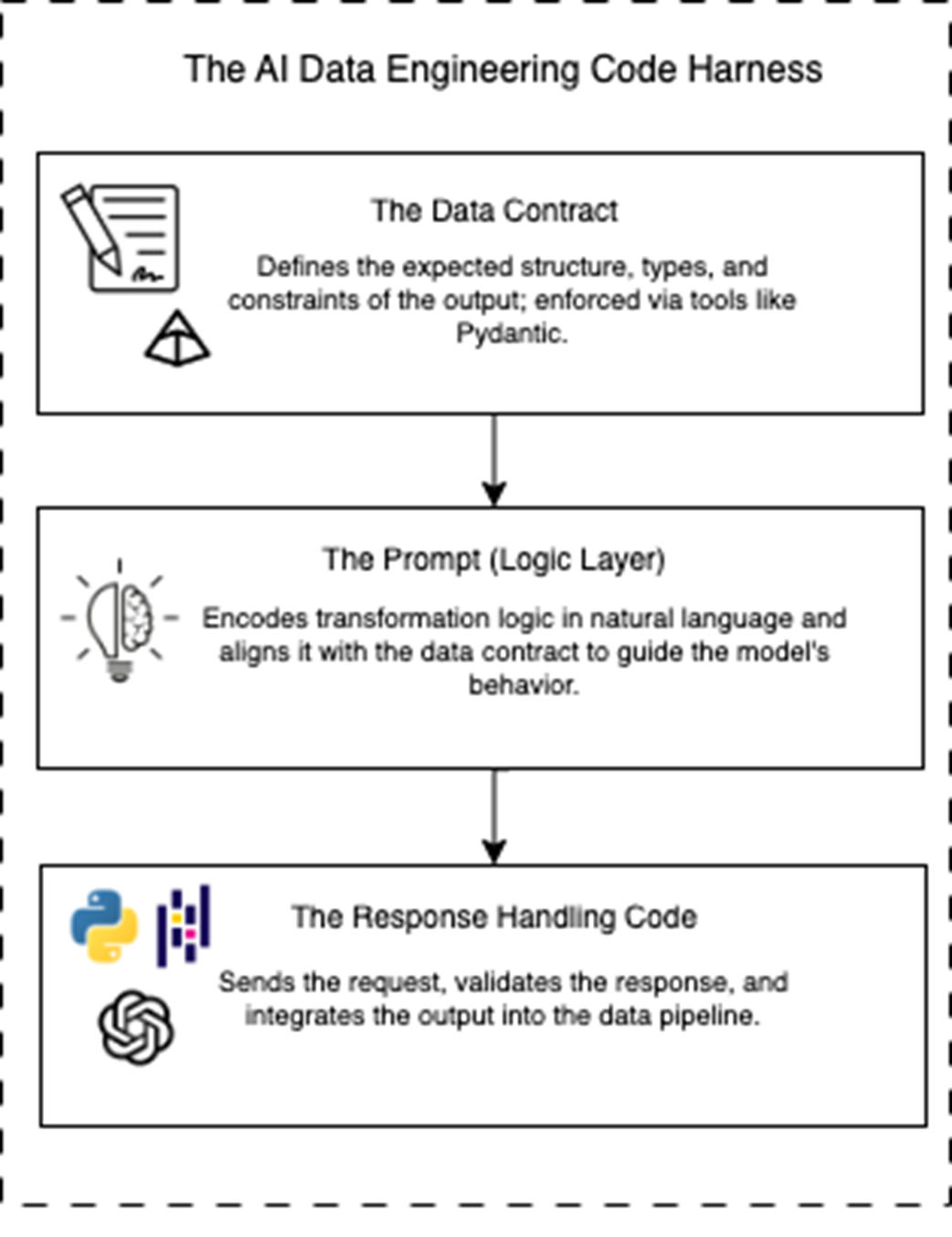
To make this practical and scalable, the chapter introduces orchestration and an AI harness pattern built from three parts: a data contract, a prompt that encodes the logic, and response-handling code that validates and operationalizes the output. This same pattern is then extended to generate SQL DDL and load enriched records into PostgreSQL, reducing brittle hand-written code. The chapter closes with a lab that applies the approach to Disney news, reinforcing how AI can power end-to-end data engineering workflows in a structured, production-friendly way.

Traditional AI‑assisted data pipelines often position AI as a single processing step, such as sentiment analysis or classification, while libraries like requests and pandas handle the rest of the workflow. This chapter expands that model by integrating AI throughout the entire data lifecycle—Extract, Transform, and Load. In this architecture, AI helps shape raw API responses into a consistent schema, applies data‑quality and enrichment transformations, and even generates database commands for loading results into PostgreSQL. Rather than serving as a one‑off tool, AI functions as an intelligent layer that collaborates with traditional Python components to deliver a complete, automated pipeline.
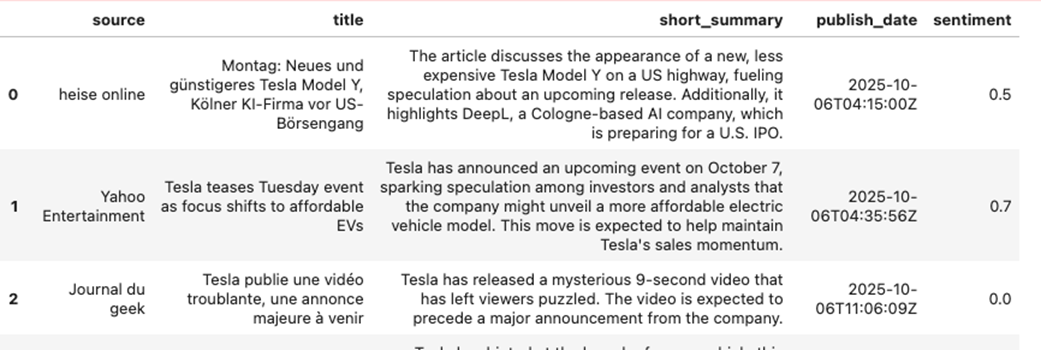
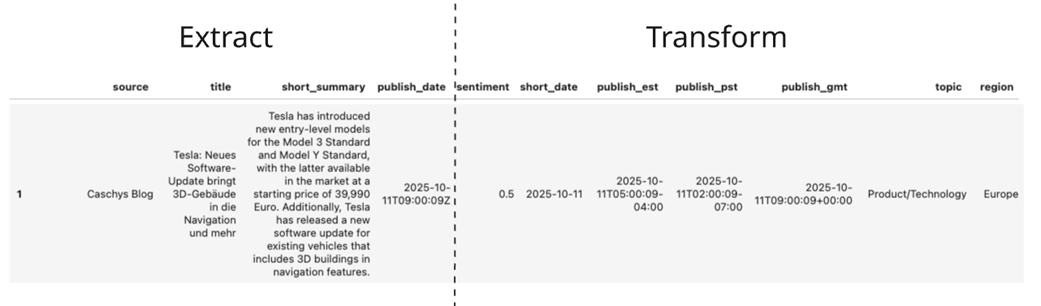
Structured DataFrame showing results from AI-powered extraction. Each row contains fields parsed from the raw JSON using a schema-based prompt, along with a sentiment score generated from the article summary.
This diagram illustrates the three key components of the AI harness pattern: the data contract, which defines the structure and constraints of the expected output; the prompt (logic layer), which encodes transformation rules in natural language; and the response handling code, which operationalizes the output and connects it back into the data pipeline. Together, these components create a repeatable, flexible, and semantically aligned framework for using AI in structured data workflows.
Output after applying the AI transformation harness. Original extracted values are preserved alongside newly generated enrichment fields like topic, region, and time zone–aligned dates.
Lab Answers

Refer to the Chapter 8 Lab Jupyter Notebook for full answers (8_lab.ipynb).

1. Extract: Building the News Extraction Agent

2. Transform: Structured Data Extraction with AI Agents

3. Enrich: Quality, Categorization & Disney Business Line Agent

4. Schema Generation: AI-Powered DDL Creation

5. Load: Write Enriched Data to Postgres

FAQ

What is the main idea of Chapter 8 in Learn AI Data Engineering?Chapter 8 shows how AI moves from being a single helper task to being integrated across the full data lifecycle. It demonstrates AI for extraction, transformation, validation, and loading in an end-to-end ETL pipeline.
What does ETL mean, and why is it used in this chapter?ETL stands for Extract, Transform, Load. In this chapter, it is the main framework used to organize the pipeline because it fits well with AI-powered extraction, enrichment, validation, and database loading.
How is the raw News API data handled before AI processes it?Instead of flattening the response immediately, the chapter stores each article as a full JSON object in a DataFrame. This preserves context and makes it easier for AI to extract structured fields later.
Why does the chapter use a pydantic model for extracted articles?The pydantic model acts as a data contract. It defines the expected schema so the AI output is typed, predictable, and easier to use in downstream processing.
What is an AI harness in this chapter?An AI harness is a reusable pattern that combines a data contract, a prompt, and response-handling code. It helps turn AI outputs into structured, validated results that fit into data pipelines.
What kinds of transformations does AI perform in the transformation stage?AI is used to normalize timestamps, create derived date fields, assign topic labels, infer region, and enrich the data with consistent, schema-conforming outputs for later use.
Why are temperature and max_tokens important in AI calls?max_tokens limits response length, which is useful for short structured outputs. temperature controls randomness; a low value like 0.3 makes results more consistent and deterministic for data engineering tasks.
How does the chapter use AI to generate SQL for loading data?The chapter gives AI a schema description and asks it to generate a PostgreSQL CREATE TABLE statement. This reduces manual SQL writing and helps adapt to schema changes more easily.
Why is response handling important when loading AI-generated data into PostgreSQL?Response handling validates and parses the AI output, prepares parameterized INSERT statements, and batch-loads rows safely into the database. It ties together the model output and the actual storage system.
What is the purpose of the Disney lab in Chapter 8?The Disney lab asks learners to build a complete AI-powered news pipeline that extracts Disney articles, transforms and enriches them, classifies business lines, generates a database schema, and loads the data into Postgres.

pro $24.99 per month

  • access to all Manning books, MEAPs, liveVideos, liveProjects, and audiobooks!
  • choose one free eBook per month to keep
  • exclusive 50% discount on all purchases
  • renews monthly, pause or cancel renewal anytime

lite $19.99 per month

  • access to all Manning books, including MEAPs!

team

5, 10 or 20 seats+ for your team - learn more


choose your plan

team

monthly
annual
$49.99
$499.99
only $41.67 per month
  • five seats for your team
  • access to all Manning books, MEAPs, liveVideos, liveProjects, and audiobooks!
  • choose another free product every time you renew
  • choose twelve free products per year
  • exclusive 50% discount on all purchases
  • renews monthly, pause or cancel renewal anytime
  • renews annually, pause or cancel renewal anytime
  • Learn AI Data Engineering ebook for free

choose your plan

team

monthly
annual
$49.99
$499.99
only $41.67 per month
  • five seats for your team
  • access to all Manning books, MEAPs, liveVideos, liveProjects, and audiobooks!
  • choose another free product every time you renew
  • choose twelve free products per year
  • exclusive 50% discount on all purchases
  • renews monthly, pause or cancel renewal anytime
  • renews annually, pause or cancel renewal anytime
  • Learn AI Data Engineering ebook for free