10 Introduction to Web Scraping
The chapter introduces web scraping as the bridge between clean, structured data sources and the messy reality of information embedded in HTML pages built for human readers. Using RuckZone’s need to build a rich product database as the running example, it shows why scraping matters when APIs are incomplete, unavailable, costly, or too restrictive, and emphasizes that scraping is only appropriate for publicly available content you are allowed to use. The core idea is the “gap” between how a product looks in a browser and how a data engineer needs it to appear in a table or DataFrame.
To make that problem concrete, the text walks through turning a simple product list into a structured catalog with fields such as product name, brand, description, price, weight, image, category, and product URL. It explains that the work starts with preparing input data, creating search keys, manually finding stable product URLs, and inspecting HTML to identify where useful fields live. This manual process reveals how time-consuming and inconsistent human-driven discovery can be, especially across hundreds of products and multiple websites.
The chapter then introduces the basic scraping toolchain: requests for fetching HTML and BeautifulSoup for parsing and cleaning it. It demonstrates how to retrieve a page, strip away irrelevant content, inspect the parsed structure, and extract fields like title and price using selectors and fallback logic. It also highlights the main limitation of traditional scraping at scale: every site is different, so extraction rules become brittle and maintenance-heavy, which sets up the later chapters where AI will be used to normalize inconsistent HTML into a consistent schema.
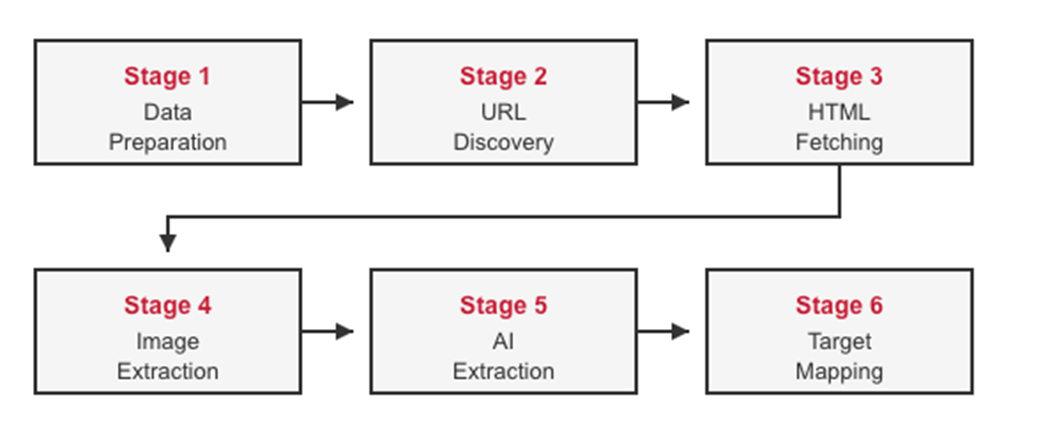
The Product Enrichment Pipeline transforms raw product data into fully attributed catalog entries through six sequential stages. The process begins with Data Preparation, where source records are cleaned and standardized, followed by URL Discovery to identify relevant product pages across the web. HTML Fetching retrieves the page content, which then feeds into Image Extraction to capture product visuals. The AI Extraction stage leverages machine learning to parse and interpret unstructured content, extracting key attributes like dimensions, materials, and specifications. Finally, Target Mapping aligns the enriched data to the destination schema, producing catalog-ready records.
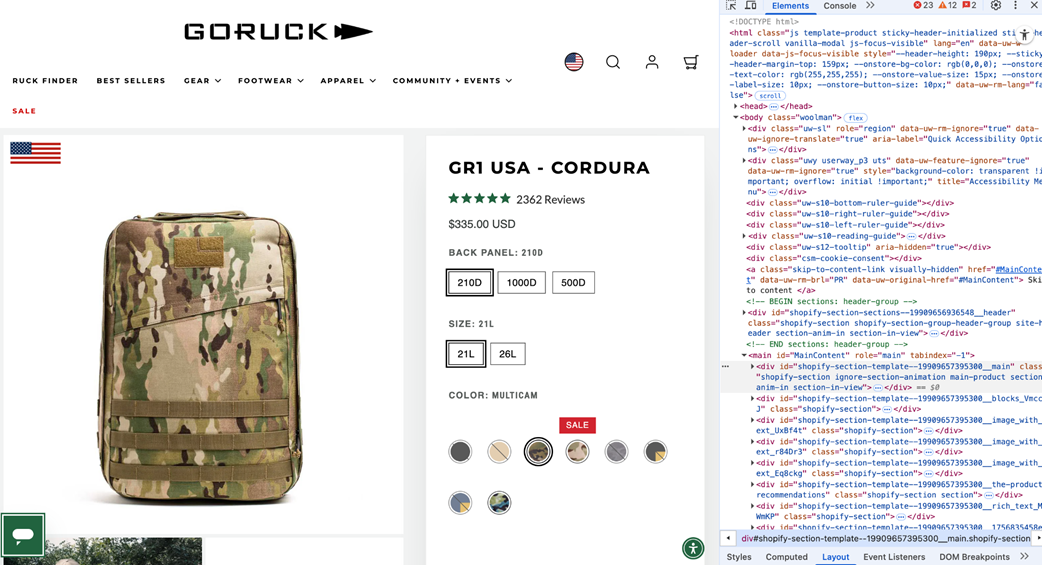
Understanding a webpage's underlying structure is essential for effective data extraction. This view shows a GORUCK product page alongside its HTML source in the browser's developer console, revealing the complex nested elements, class names, and data attributes that encode product information like pricing, color variants, and sizing options. While humans can easily interpret the visual presentation on the left, programmatically extracting that same information requires navigating a dense tree of markup that varies across every e-commerce platform. AI models excel at parsing these structures—identifying patterns, adapting to inconsistent formatting, and mapping disparate HTML schemas to standardized product attributes without requiring hand-coded rules for each website.

 Learn AI Data Engineering ebook for free
