12 Private equity: Investing in startups
This chapter reframes startups as a form of private equity and guides programmers to think like investors. It explains why early-stage investing pairs extreme risk with the potential for outsize returns, contrasting a founder’s product-centric bias with an investor’s focus on business models, scalability, and exits. The startup journey is mapped from pre-seed MVPs financed by friends and family, through seed-stage validation and traction, to Series A–C scaling where institutional capital, operational discipline, and burn-rate management dominate. Because private investments are illiquid, the path to a significant exit (acquisition or IPO) is central, which also underpins the industry’s “fail fast” mindset and the emphasis on backing exceptional founders.
The chapter then surveys the main investment vehicles and how access and incentives differ. Venture capital funds aggregate institutional limited partners and charge management and performance fees while providing networks, strategy, legal structuring, and preparation for future rounds. Angels without fund-scale capital can collaborate through syndicates that form special-purpose vehicles to pool checks and place a single entity on the cap table, often paying a one-time admin fee plus carry to the lead. Sovereign wealth funds appear as policy-driven actors cultivating national startup ecosystems. Along the way, the text clarifies how funding expectations evolve: pre-seed relies on personal belief, seed requires incorporation, first hires, and customer traction, and later rounds demand systematized growth and a credible path to market leadership and exit.
Finally, it offers practical tools for choosing startups. Traditional valuation is hard when firms are pre-profit, so investors mix methods (comparables, precedent deals, VC method, and high-discount-rate DCF) with judgment, while tracking dilution across rounds to understand how ownership changes as value grows. A programmatic “scoring” approach complements finance by weighting non-financial signals: incubator/accelerator pedigree, founders’ track records and resilience, advisor quality, existing investors, clients and partnerships, country-of-origin dynamics, domain trends and regulatory exposure, economic moats, capital intensity and burn rate, monetization strategy and network effects, and each company’s north star metrics. The takeaway is to blend quantitative modeling with qualitative assessment, maintain skin in the game, and accept that a few big winners must pay for many inevitable failures.
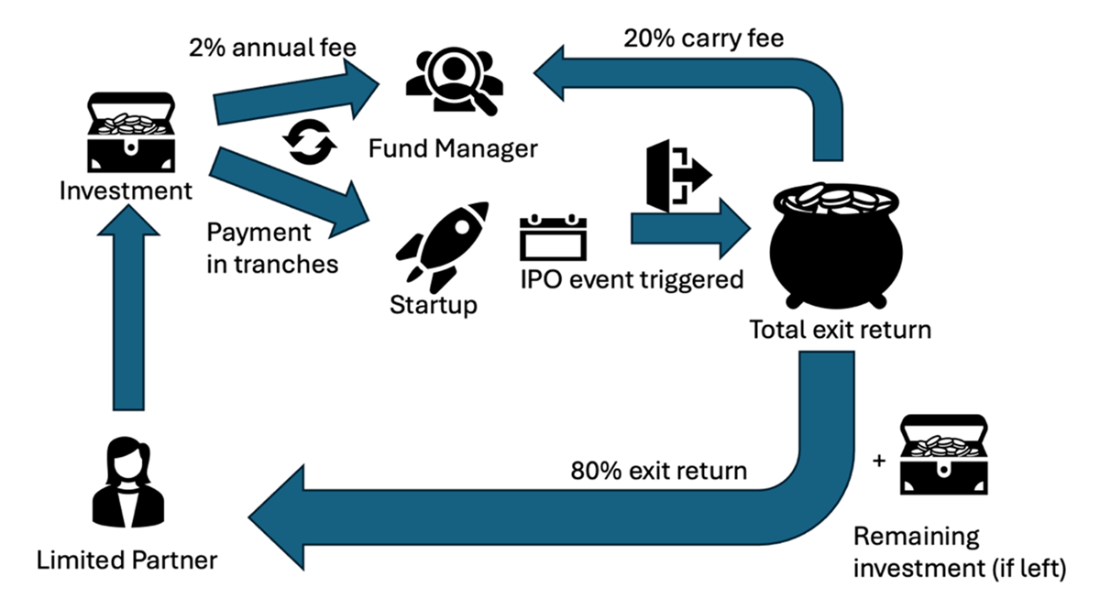
Shows the simplified money flow. Eighty percent of the profits and your investment, minus the annual fees, will be returned to you.
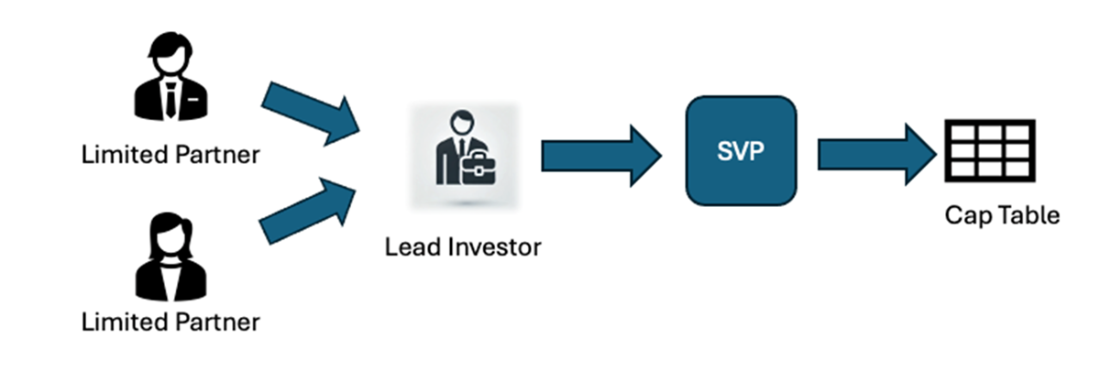
Shows how a lead investor’s job is to represent all investors when forming an SVP that will be registered on a startup’s cap table.
Summary
- Investing in startups may be the riskiest investment, but it can pay off tremendously if the venture is successful.
- Some experts in venture capital say you invest in people and business models, less in the product.
- Startups progress through distinct stages, each with specific investment requirements.
- Pre-seed startups often serve as a reference point for founders with an idea and who are working on a minimum viable product (MVP) to demonstrate the product’s potential.
- Seed startups are companies that aim to transform a successful MVP into a full-fledged product that can be sold to customers.
- Series A companies typically have paying customers; their primary role is to develop and refine a working product for the mass market or to meet the advanced requirements of customers.
- Series B companies must retain their existing customers and strive to expand into new markets.
- Series C companies have gained some market dominance and primarily strive for a successful exit, typically through an acquisition or an Initial Public Offering (IPO).
- Most founders view non-successful exits as badges of honor, which can help attract more investments.
- VC-backed startups don’t exist to grow slowly. If a company takes venture capital, the goal is to get acquired or go public.
- Retail investors can’t directly invest in a prominent VC’s likely next unicorn, but if you have enough capital, you can still gain exposure to private equity through VC funds.
- There are various startup valuation methods. DCF values startups based on their future expected cash flows, which are discounted for risk.
- Investors and fund managers of a venture capital (VC) firm expect a startup to work hard towards achieving an exit.
- Angel syndicates are alternatives to VCs and enable investors with smaller check sizes to invest in startups.
- A lead investor of an angel syndicate commonly incorporates a special purpose vehicle (SPV) that, when invested in a startup, is added to a startup’s cap table.
- VCs don’t just look at DCF; they compare it to market trends and past acquisitions.
- Each funding round adds new shares, reducing existing ownership percentages. This is known as dilution, and it is an inevitable consequence in venture-backed startups.
- You can use data and programming skills to score startups on non-financial aspects.
- For a scoring model of startups, you can explore parameters such as the success chance based on the incubator/accelerator, founders, existing investors, clients, strategic partnerships, country of origin, domain, regulations, economic moats, capital intensity, burn rate, business model, network effect, and individual north stars.
FAQ
How do pre-seed and seed stages differ, and what do investors expect at each?
Pre-seed focuses on building and validating an MVP, typically funded by founders, friends, and family. It’s highly relationship-driven and extremely risky; investors look for founder commitment and “skin in the game.” Seed is business-first: formal incorporation, first customers, early hires, signs of traction and scalability, and speed of execution. Pitches may include market sizing (TAM/SAM/SOM), but investors scrutinize evidence over speculation.Should I trade advice or occasional help for equity at the pre-seed stage?
Generally no. Occasional advice-for-equity is like buying a lottery ticket. Startups demand either capital or sustained, mission-critical effort. Cash contributions are measurable and carry known risk; sporadic help rarely justifies meaningful ownership.What role do incubators and accelerators play, and how should investors interpret them?
They provide space, mentorship, and structure that help founders turn ideas into businesses. Many incubated startups still fail; for founders it’s valuable learning, for investors it’s high risk. Accelerator/seed readiness signals: incorporated entity, MVP in hand, early customer traction, and urgency to scale.What changes as startups move from Series A to Series C?
- Series A: Refine the model, scale product, prioritize growth over profits, manage burn to reach the next stage.- Series B: Expand markets, build org structure, sharpen strategy, show a clearer path to profitability while still growing.
- Series C: Establish market leadership, expand internationally, consider acquisitions, and prepare for a major exit.
What is an exit and why is it crucial in startup investing?
An exit converts illiquid private equity into cash or tradable stock. Common types: IPO and acquisitions (often high returns), fire sales (partial recovery), and shutdowns (no recovery). Because many startups fail and capital is locked up for years, a few big exits must pay for the rest—hence the focus on speed, scalability, and even acqui-hire outcomes.Why invest in private equity/startups instead of sticking to index funds?
Private equity offers the possibility of outsized returns (e.g., backing future unicorns) due to less efficient, less-known markets. Risks are much higher and liquidity is low. Beyond returns, VC-backed startups drive innovation and enable the next wave of public companies. For most investors, it’s a high-risk allocation alongside, not instead of, diversified public markets.How do venture capital funds, angel syndicates, and sovereign wealth funds differ?
- Venture capital funds: Pooled institutional money, invest across many startups (often later stages), charge management and performance fees, and actively support fundraising, strategy, and governance.- Angel syndicates: A lead investor forms an SPV to pool smaller checks into one line on the cap table; participants pay a one-time admin fee and share in upside via carry.
- Sovereign wealth funds: State-owned vehicles that deploy national capital, often to build startup ecosystems or diversify economies; individuals typically don’t invest directly but can back startups these funds support.

 Investing for Programmers ebook for free
