4 AI and the creative economy: Innovation and intellectual property
Generative AI is reshaping the creative economy by democratizing the production of high-quality text, images, audio, and video—collectively, synthetic media. While this opens powerful new avenues for expression and storytelling, it simultaneously amplifies risks: deepfakes erode trust, fuel misinformation, and enable impersonation and harassment, while the “liar’s dividend” lets bad actors dismiss authentic evidence as fake. Technical responses like detection, invisible watermarking, and provenance standards help but are imperfect and adversarial. As models rapidly improve, safeguarding trust increasingly depends on layered strategies that combine authentication tools, policy and platform governance, and widespread media literacy to evaluate sources, context, and intent.
Across creative workflows, AI is becoming a collaborator rather than just a tool. In marketing, brands use text-to-image and multimodal systems to accelerate content and experiment with co-creation, even as backlash warns against generic outputs and labor displacement. Visual art embraces AI for rapid iteration and immersive installations, while filmmaking deploys it from previsualization to postproduction—raising ethical questions about posthumous performances, consent, and authorship. Music showcases real-time human–AI improvisation, artist-sanctioned voice models, and AI-generated videos alongside contentious unauthorized voice clones. These shifts broaden access and aesthetics but surface hard debates over identity, attribution, creative control, and the value of human labor.
Law and policy are racing to catch up. Copyright and fair use sit at the center: training on vast online corpora can be viewed as transformative, yet lawsuits probe memorization, market harm, and style imitation. Image datasets and stock archives test boundaries of consent, trademarks, and authors’ rights; code models challenge open source licenses and scraping norms. Meanwhile, open source releases and permissive data practices accelerate innovation but complicate harm mitigation. A parallel data economy is emerging as creators license footage, voices, and likenesses, and intermediaries broker content for model training—alongside disputes over publicity rights and consent. The near-term trajectory points to a negotiated balance of licensing, attribution, transparency, and technical safeguards that preserve innovation while compensating and protecting creators.
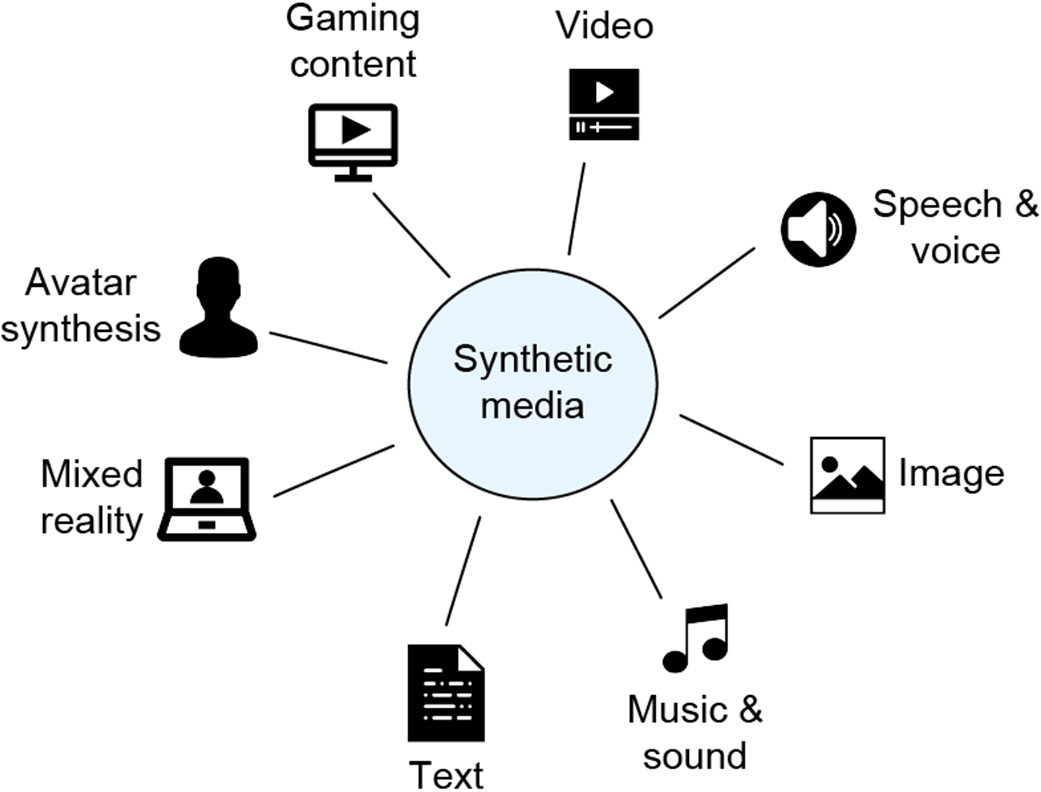
The landscape of synthetic media
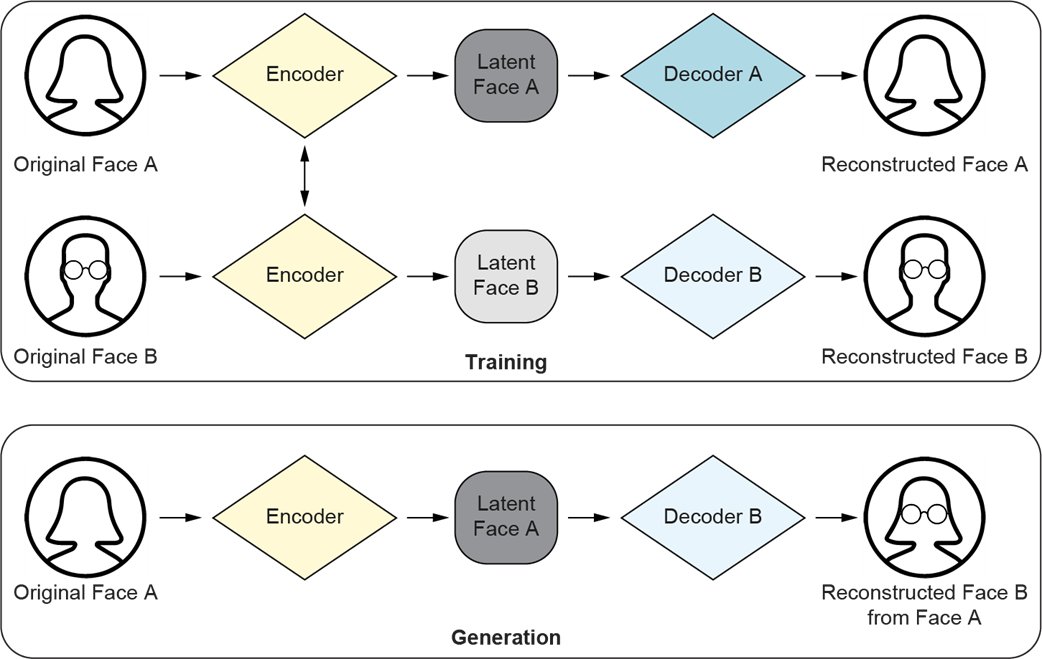
Deepfake creation using autoencoders with a single encoder and two decoders
Creation of GANs using a generator and a discriminator
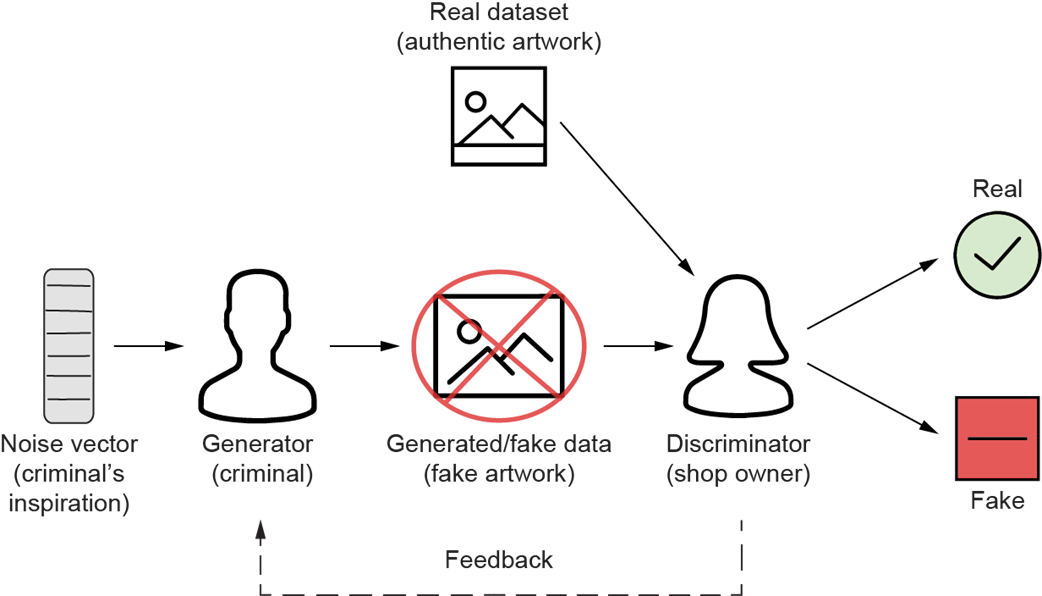
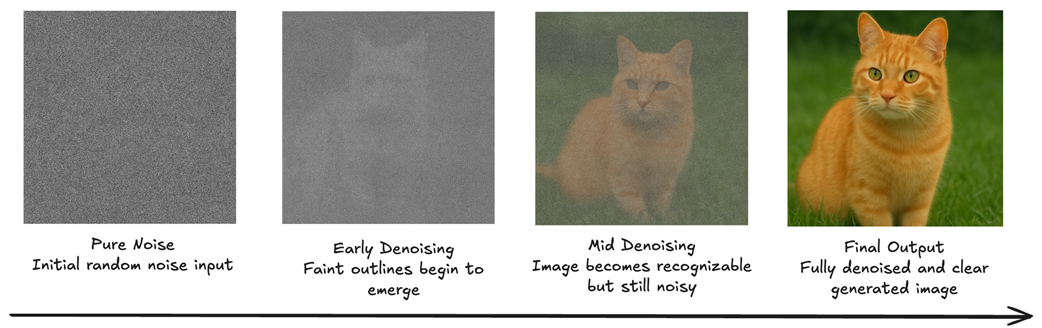
Image generation through gradual denoising in diffusion models
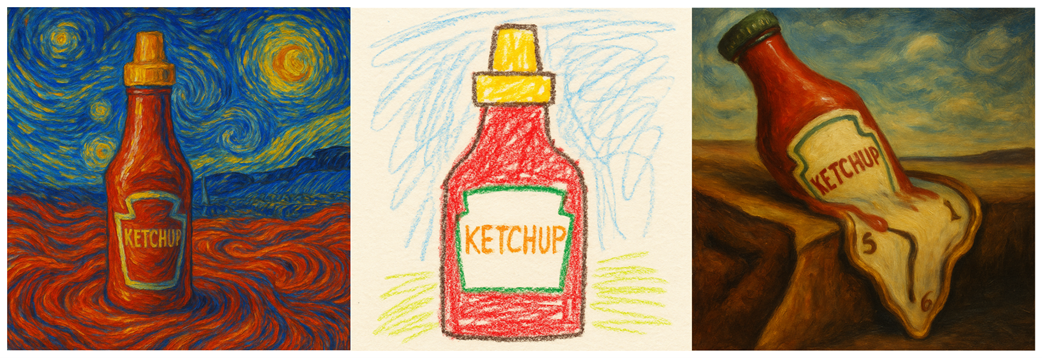
AI-generated interpretations of ketchup: a Van Gogh-style painting of a swirling ketchup landscape, a crayon drawing of a ketchup bottle by a toddler, and a surrealist painting of a ketchup bottle melting over a clock
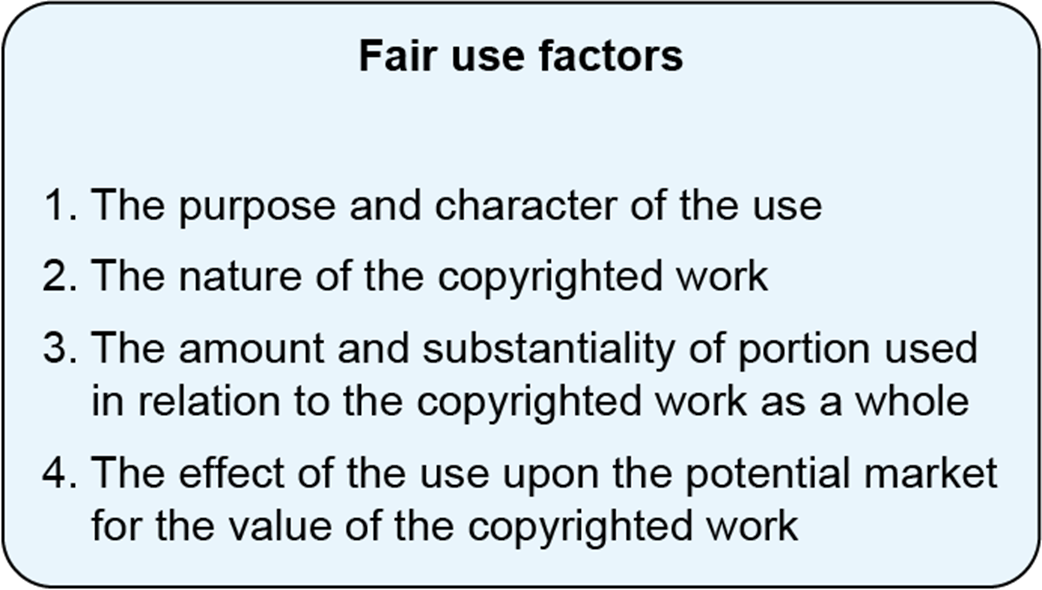
The four factors that determine fair use of copyrighted materials [47]
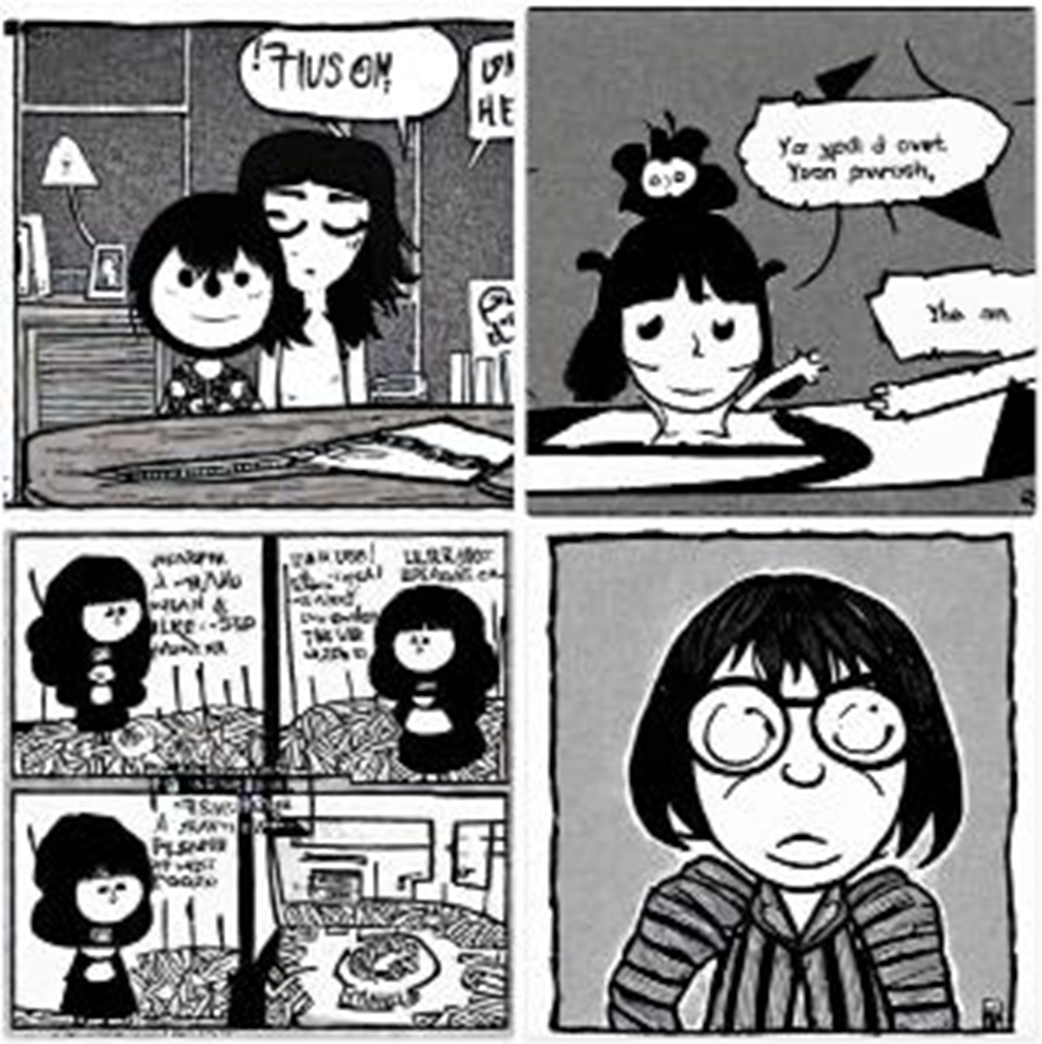
An AI-created image using an open source image-generation model with the prompt “Sarah Andersen webcomic.”
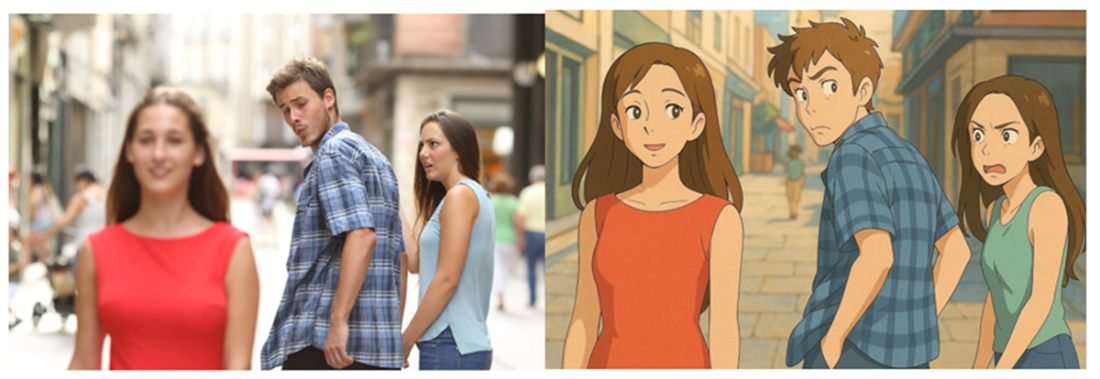
The popular “distracted boyfriend” meme [59], reanimated in the style of Studio Ghibli by OpenAI’s GPT-4o model [60]
Summary
- Synthetic media and AI-generated media are umbrella terms for content created or modified using AI, including text, image, video, voice, and data.
- Autoencoders, GANs, and diffusion models are commonly used techniques for generating or altering images and videos.
- Synthetic media empowers widespread creativity but poses serious privacy and trust risks.
- Detecting synthetic media is an increasingly difficult, adversarial task that requires combining technical tools, authentication methods, policy, and public education to preserve trust and verify what’s real in an era of AI-generated content.
- Generative AI is reshaping creative industries by expanding access to powerful tools and enabling new forms of expression.
- The rise of generative AI has also raised unresolved legal questions about how copyright applies to training data and AI-generated outputs.
- The growth of open source models has accelerated innovation and complicated efforts to enforce intellectual property rights and control how these tools are used.
- As AI tools make it easier to replicate human likeness and style, creators are exploring new licensing models and data marketplaces, opening up monetization opportunities while raising questions about scale, consent, and the future value of authentic human data.
FAQ
What is synthetic media, and how is it different from “deepfakes”?
Synthetic media (AI-generated media) is any content created or modified with AI—text, images, audio, video, or data. “Deepfakes” originally referred to AI that mimics a specific person’s face or voice, often to deceive. Today, synthetic media spans creative, benign, and harmful uses; “deepfake” still carries a strong association with deception.Which AI techniques are most used to create synthetic images and video?
- Autoencoders: compress an image into latent features and reconstruct it; commonly used for face-swapping.- GANs: a generator and discriminator compete, pushing outputs toward realism.
- Diffusion models: start from noise and iteratively denoise to form images/video; now dominant for quality, diversity, and control.
What opportunities does synthetic media create for the creative economy?
- Democratizes creation: high-quality visuals, audio, and video without big budgets.- Accelerates workflows: rapid concepting, iteration, and localization.
- Expands storytelling: new aesthetics, interactive/immersive formats, and collaborative human–AI creation.
- Privacy-preserving creativity: e.g., face anonymization for sensitive documentaries.
What are the key risks of synthetic media?
- Erosion of trust and the “liar’s dividend” (authentic evidence dismissed as fake).- Privacy and identity harms: impersonation, harassment, non-consensual explicit content, fraud, and espionage.
- Economic disruption: job displacement and shifts in creative labor markets.
- Institutional impacts: challenges for journalism, law, and public discourse.
How is synthetic media detected, and why is it so hard?
- Current signals: artifact analysis (pixel/physics/semantic inconsistencies), physiological/biometric cues (blinks, speech cadence), and contextual checks (metadata, reverse image search).- Challenges: rapid model improvement, limited generalization to new manipulations, adversarial “arms race,” and spoofed or stripped metadata.
What tools go beyond detection to authenticate content?
- Invisible watermarking: model-embedded, machine-readable signals to flag AI-generated assets.- Provenance standards: cryptographic signatures (e.g., C2PA) documenting creation and edits.
- Policy and platform labeling: government guidance and platform disclosure rules.
- Limits: watermarks can degrade or be removed; detection tools aren’t universal; standards and enforcement vary.
How is generative AI changing creative workflows in marketing, art, film, and music?
- Marketing: faster asset production, brand experimentation, and personalization; rise of virtual influencers.- Visual arts: accessible tools for concepting and finished works; immersive, data-driven installations.
- Film: AI-supported storyboarding, effects, background generation; ethical debates over likeness and posthumous performances.
- Music: live human–AI improvisation, voice models for creative extension—and controversies over unauthorized cloning.
Who owns AI-generated content, and how does copyright and fair use apply?
- Copyrightability: US policy generally denies protection to purely AI-generated works; human-authored elements may qualify case by case.- Training data: often argued as transformative fair use (analogous to searchable book scanning), but verbatim regurgitation risks infringement and market harm.
- Fair use factors: purpose/character (including transformative), nature of the work, amount used, and market impact—balanced holistically.
What legal and policy developments are shaping AI, creativity, and IP?
- Ongoing lawsuits involving major LLM and image-model providers over training on copyrighted works and output use.- High-profile image cases (e.g., stock photography claims) and code-related suits testing open source license terms.
- Industry and labor rules (e.g., writing credits) clarifying attribution and human oversight.
- Government actions encouraging labeling/watermarking and transparency obligations.
What can creators and data owners do about consent and licensing in the AI era?
- Individual licensing: deals for likeness, voice, or archives; opt-out/opt-in mechanisms where available.- Data marketplaces/alliances: intermediaries for structured, consented licensing and clearer usage terms.
- Rights of publicity: legal protections over name, image, and voice (jurisdiction-dependent).
- Open source and data licenses: set permitted uses and obligations; web content access often legal if publicly available, but licenses still govern reuse and distribution.

 Introduction to Generative AI, Second Edition ebook for free
