The chapter explains that data annotation is not just a technical step but a people-management problem: models need large volumes of human feedback, and the right workforce depends on task complexity, data sensitivity, scale, and urgency. Simple, high-volume tasks can be handled by crowdsourced workers, specialized or regulated tasks often require contract workers with domain training, and the most difficult edge cases are best handled by in-house experts. The chapter also stresses that annotation may involve both creating labels from scratch and reviewing model predictions, so planning for annotation should begin alongside algorithm design.
A central message is that annotators produce better work when they are treated with respect and given salary, security, and ownership. Fair pay, reliable work, and transparency are framed as both ethical obligations and practical necessities for quality. The chapter warns against exploitative pay-per-task arrangements, emphasizes that workers should understand the purpose and impact of their work, and encourages direct communication so that feedback can flow both ways. For in-house teams, it recommends smoothing workloads, running annotation sessions with diverse staff, and using experts to refine guidelines and handle changing edge cases.
The chapter also compares different workforce models and shows how to combine them strategically. Outsourced workers can provide flexibility and expertise, but only if compensation, advancement, and communication are handled carefully; crowdsourced workers offer fast scaling, but are the most vulnerable to exploitation and require especially clear, efficient instructions. End users, volunteers, games, and model-generated labels can sometimes contribute annotations too, but each comes with limits and bias risks. Finally, the chapter explains how to estimate annotation volume and cost using pilot data, orders-of-magnitude thinking, and active learning, while recognizing that refining the annotation process often takes weeks and may require multiple rounds of iteration before large-scale labeling can begin.
Data annotation is the process of creating unlabeled data, either by labeling unlabeled data or reviewing labels generated from a model.
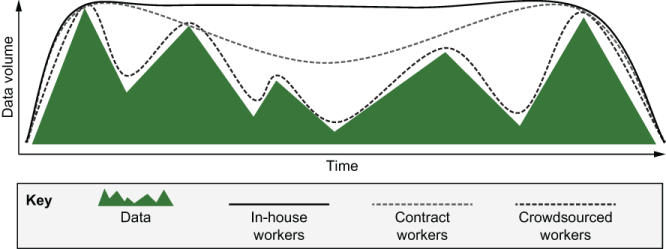
An overview of the three main types of workforces you can use to annotate data, in-house workers, contract workers, and crowdsourced workers, where the main trade-off is flexibility versus expertise.
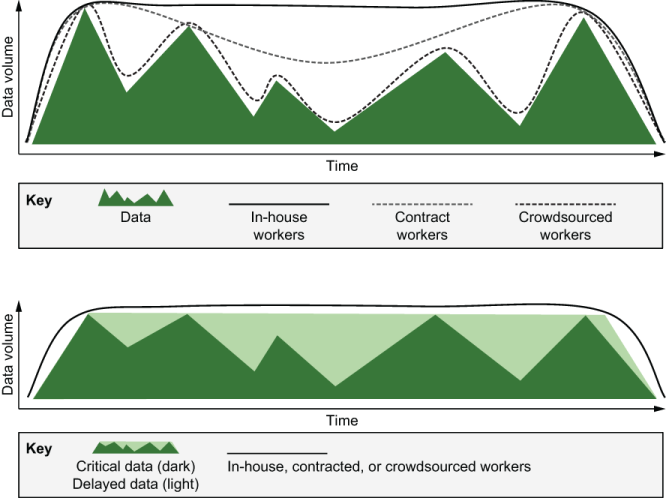
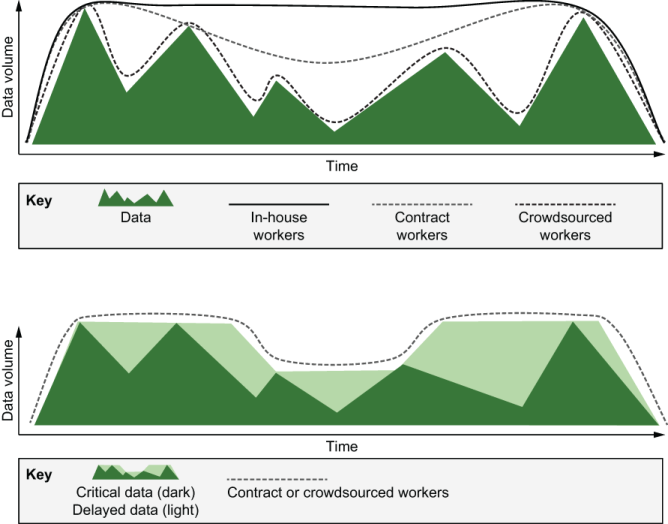
Smoothing your work for in-house workers. When data comes in bursts for reasons that you can’t control, it can be smoothed out, with the most critical data annotated first and the other data annotated later. The bottom graph shows the annotation workload smoothed out.
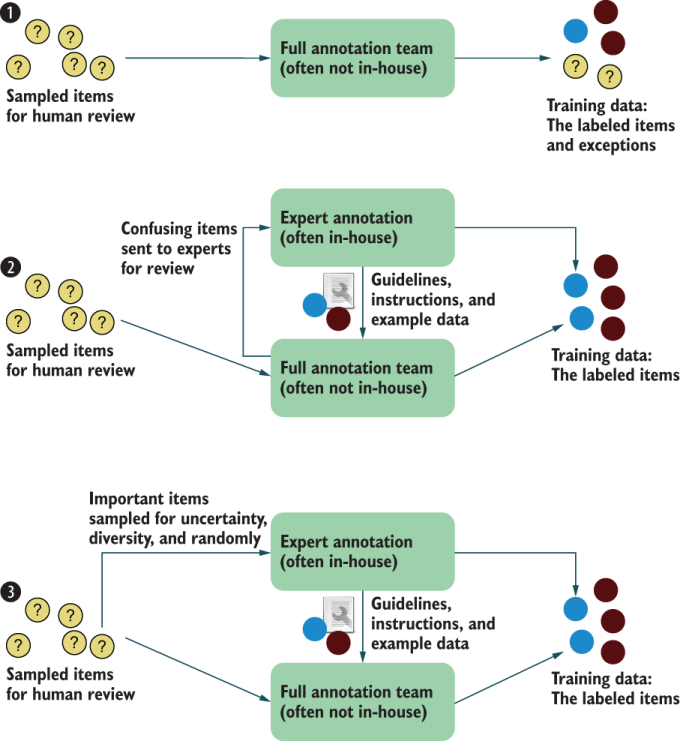
Three workflows for in-house annotation. The top workflow is recommended only for pilots; it doesn’t use in-house annotators and ignores items that are hard to annotate. The second example is the most common in industry: hard examples are redirected to experts for human review. This approach works fine if you have data that is fairly consistent over time. If your data is changing quickly, the third method is recommended. In this method, the expert annotators are looking for potential new edge cases with diversity sampling and uncertainty sampling before the main annotation process happens; then these examples and updated guidelines are passed to the main annotation team. This method is the only one that ensures that the guidelines are not trailing the actual data. The expert annotators also annotate some randomly selected items for quality-control reasons that we will cover in chapter 8.
Smoothing your work for outsourced workers. If you can’t fully smooth out the data volume, you might be able to smooth it out enough to fit the scale at which outsourced workers can scale up and down.
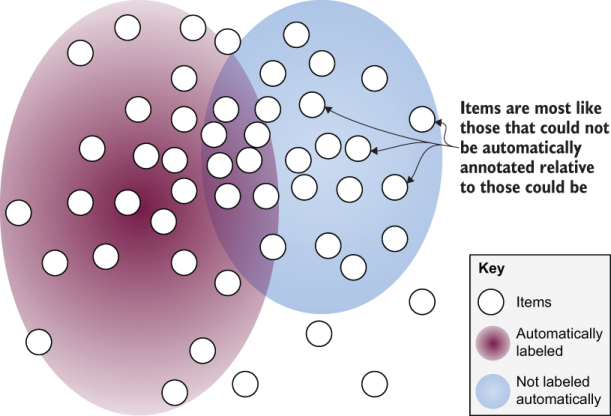
Using computer-generated annotations and then augmenting them with representative sampling. If you have a separate model for your task, you can autogenerate labels with that model. It is best to focus on highly confident predictions and (if you can access them) predictions with high activation in your network: model-based outliers. Then use representative sampling to identify the items that you couldn’t label automatically and sample those items for human review.
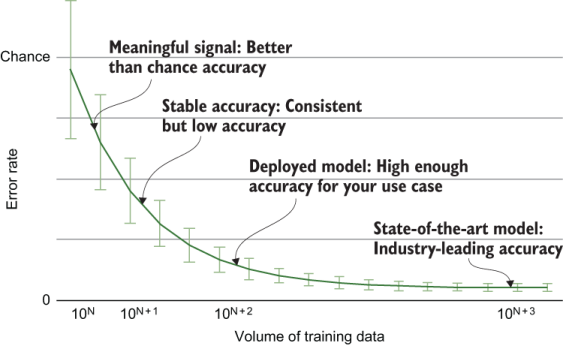
The orders-of-magnitude principle for training data. Estimate an order of magnitude more data to move from meaningful signal to stable accuracy to deployed model and to state-of-the-art model. Use this principle as a benchmark to estimate the amount of data you need before you start seeing what your actual increase in accuracy looks like as you start annotating data.
Summary
- There are three main types of workforces for annotation: in-house, outsourced, and crowdsourced. Understanding these workforces will help you choose which workforce or combination is best for your tasks.
- The three key principles of motivating annotators are salary, security, and transparency. Understanding how to apply these principles to different workforces will ensure that you get the best possible work by having the happiest possible workforce.
- You can consider some nonmonetary compensation systems, including application end users, volunteers, and computer-generated data/annotations. You may want to consider these alternative workforces when you are constrained by budget or need special qualifications.
- Don’t apply graduate-student economics to your data labeling strategy.
- The orders-of-magnitude principle lets you estimate your total annotation volume requirements. This principle helps you plan your annotation strategy with meaningful early estimates that you can refine as you continue.

 Human-in-the-Loop Machine Learning ebook for free
