Overview

10 Ethics on Using GPT

The chapter surveys the ethical terrain around using GPT-like systems, emphasizing that these models mirror the internet’s mix of valuable knowledge and harmful biases. Because they readily reproduce patterns from their training data, LLMs can reinforce stereotypes, misinformation, and outdated views, raising the question of when and how they should be used at all. The authors frame the issues at both macro and micro levels: systemic concerns about how deploying LLMs shapes society and future models, and practical concerns for everyday use, ownership, and accountability. Across these themes runs a common thread: users and institutions must weigh benefits against risks and accept that some degree of misalignment with personal values is inevitable.

Two particularly thorny concerns are highlighted. First, copyright and licensing: models trained on code under “infectious” licenses (like the GPL) can expose users to downstream obligations or violations, especially if outputs replicate or are materially derived from licensed material—yet tracing provenance is often infeasible. Second, “poisoning the well”: if AI-generated content increasingly populates the web, future models risk mode collapse—overfitting to the most common patterns and losing diversity and nuance. Absent reliable watermarking or robust provenance practices, distinguishing human from AI content remains difficult, compromising data quality and evaluation. Human-in-the-loop augmentation and domain tools can inject novelty and quality, but shifting user behavior (for example, fewer high-quality forum Q&As) threatens the replenishment of the very data that made LLMs useful in the first place.

The chapter also examines labor impacts and value alignment. Historically, new technologies create jobs long term while disrupting them short term, yet LLMs may disproportionately pressure white-collar, creative, and “knowledge work” roles; which jobs change and how remains hard to predict. Societal responses—ranging from legal protections for certain professions to transparency labels for AI-assisted products—will shape outcomes. Finally, alignment via techniques like RLHF raises the unresolved question of whose values a model reflects; proprietary preference datasets limit scrutiny, and perfect customization could enable misuse. Because control methods are intrinsically dual-use, the authors argue for pragmatic threat modeling, co-evolving safeguards, and a focus on equitable outcomes while acknowledging unavoidable misalignment and uncertainty.

A classic gendered trope is that men are doctors and women are nurses. This is reflected in language and thus learned by the mode. Ideally, it would respond that the question is ambiguous, but instead, the bias of data leads to a bias in outputs.
figure
You can think of text or images as coming from a “distribution” of data, where variety and interesting content almost necessarily comes from the “tails” of the distribution (i.e., the less common parts of the distribution) as the most common words/content are often fillers/connectors, like the word “the”. Our models do not learn non-existent things, and they can not learn everything in the distribution, so a sample from the model will invariably lose some of these interesting details. If repeated, the distribution “collapses” to just the most common components.
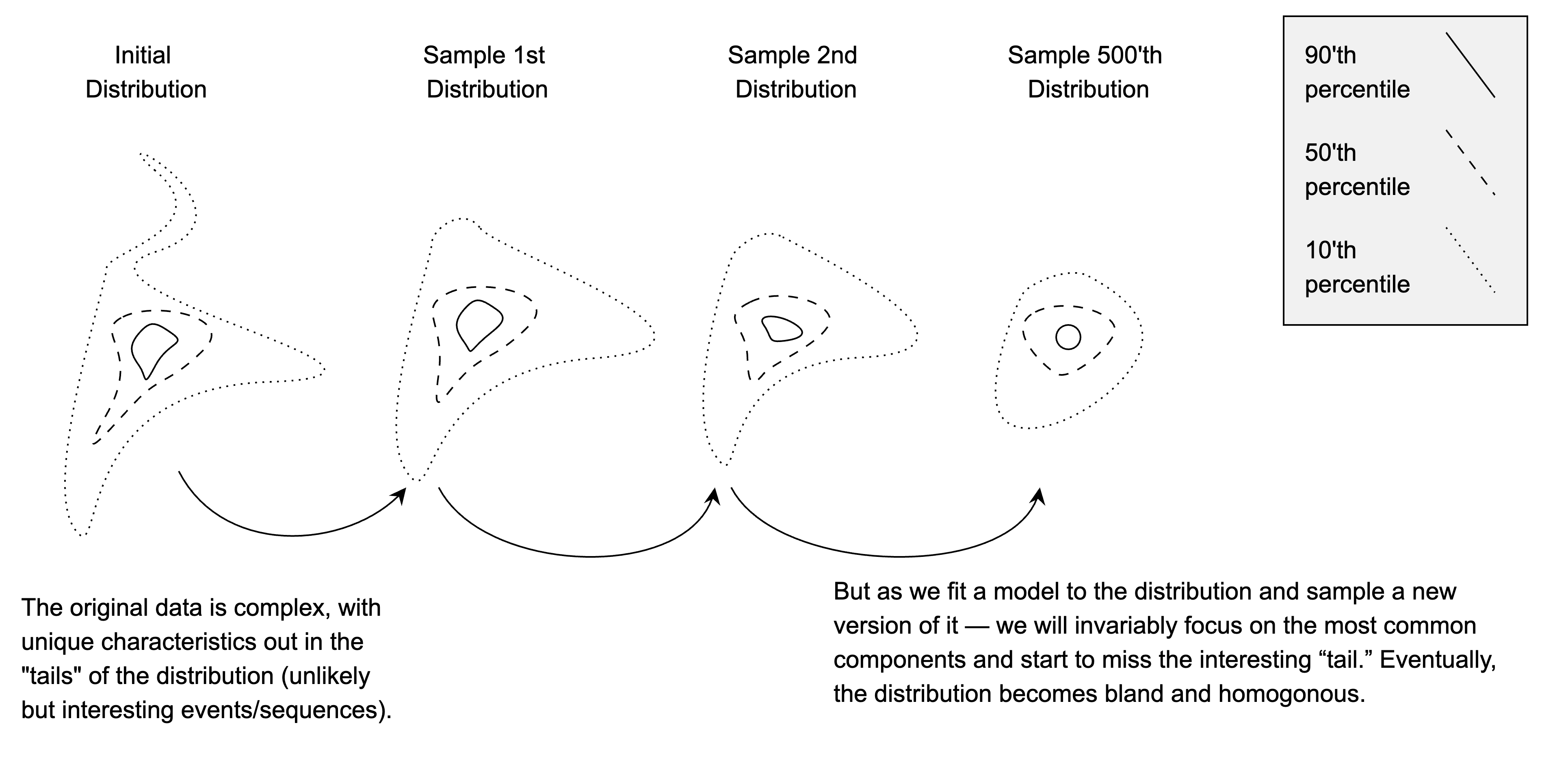
figure

Summary

  • LLMs inputs can impact their outputs in non-trivial and ethically ambiguous manners, potentially creating a legal risk that you are using copyrighted material unwittingly or preventing us from training better LLMs by “corrupting” the internet as a training source.
  • LLMs will most likely create net-new jobs for society in the long term unless they dramatically depart from historical technical innovation, but the nature of which jobs are impacted and how to address them is not as clear.
  • The cost of creating LLMs means that most people will ultimately use an LLM that is not aligned with all their preferences, and the difficulty of alignment may, in fact, be useful in preventing bad actors from accomplishing their goals.

FAQ

What does it mean that “GPT is a mirror of its inputs”?LLMs learn patterns from large internet datasets, which include biases, misinformation, and outdated worldviews. They can reproduce these patterns (e.g., gendered assumptions) unless carefully mitigated, because they reflect the data they were trained on.
Can we “fix” biased or harmful outputs, and is it ethical to use LLMs anyway?Technical mitigations exist but are imperfect and can introduce their own failures. Since models trained on undesirable data tend to propagate it, the ethical question is whether and how to use LLMs given these risks—requiring safeguards, human oversight, and context-aware policies.
Does the license of input data (like GPL code) affect the license of LLM outputs?It’s unsettled. Cases range from: (1) verbatim regurgitation of GPL code likely requiring GPL compliance; (2) seemingly novel but potentially derivative outputs, where obligations are unclear; to (3) the extreme claim that any model trained on GPL code outputs GPL. The ethical and legal boundaries remain ambiguous.
What risks do I face if an LLM reproduces GPL-licensed or copyrighted code verbatim?You may be obligated to comply with the original license and could face infringement claims, yet provenance is hard to detect. Organizations must judge their risk; good practices include code review, license scanning, keeping prompts/outputs auditable, and avoiding blind copy-paste from models.
How can retrieval or similarity search help manage licensing risk in AI-assisted coding?Retrieval-augmented methods and similarity checks can surface potential sources or near-matches in training-like corpora, supporting attribution and license compliance decisions. While not foolproof, they improve visibility into whether output resembles licensed material.
Do LLM outputs “poison the well” for future training data?Yes, if AI-generated content floods the web, future models may overfit common patterns (mode collapse), degrading diversity and quality. This can make successive models less useful unless we maintain ways to inject genuinely new, diverse signals into training data.
Would watermarking AI outputs help prevent data contamination?Potentially. Simple, robust-enough watermarks (e.g., subtle character choices like homoglyphs) can flag likely AI text for most practical cases, aiding filtering and detection (e.g., for teachers). Though imperfect and bypassable, they can meaningfully reduce contamination and misuse.
How are LLMs changing data ecosystems (e.g., Q&A sites), and why is that ethically relevant?LLMs can reduce user contributions to sources like StackExchange, slowing the creation of high-quality training data. Communities may ban AI answers or seek verified, hybrid approaches. Respecting platform autonomy while sustaining healthy data ecosystems is an ethical balancing act.
Do LLMs create or destroy jobs, and which workers are most affected?Historically, technology creates new jobs over time but can cause short-term shocks. Impacts are complex (tech, regulation, competition). With LLMs, white-collar and creative roles may face more near-term pressure (e.g., illustrators), while some professions gain tools and productivity. Outcomes are uncertain; labeling and transparency can help consumers and workers navigate trade-offs.
Whose values are LLMs aligned to, and why is this a dual-use concern?RLHF uses proprietary datasets shaped by labelers and providers, so models reflect those actors’ norms. Perfect user-specific alignment is infeasible and, if possible, could empower malicious uses. Alignment research is dual-use; evaluating threat models and surrounding safeguards is essential.

pro $24.99 per month

  • access to all Manning books, MEAPs, liveVideos, liveProjects, and audiobooks!
  • choose one free eBook per month to keep
  • exclusive 50% discount on all purchases
  • renews monthly, pause or cancel renewal anytime

lite $19.99 per month

  • access to all Manning books, including MEAPs!

team

5, 10 or 20 seats+ for your team - learn more


choose your plan

team

monthly
annual
$49.99
$499.99
only $41.67 per month
  • five seats for your team
  • access to all Manning books, MEAPs, liveVideos, liveProjects, and audiobooks!
  • choose another free product every time you renew
  • choose twelve free products per year
  • exclusive 50% discount on all purchases
  • renews monthly, pause or cancel renewal anytime
  • renews annually, pause or cancel renewal anytime
  • How Large Language Models Work ebook for free

choose your plan

team

monthly
annual
$49.99
$499.99
only $41.67 per month
  • five seats for your team
  • access to all Manning books, MEAPs, liveVideos, liveProjects, and audiobooks!
  • choose another free product every time you renew
  • choose twelve free products per year
  • exclusive 50% discount on all purchases
  • renews monthly, pause or cancel renewal anytime
  • renews annually, pause or cancel renewal anytime
  • How Large Language Models Work ebook for free