Overview

5 Redefining amplification

This chapter reframes algorithmic amplification as a problem of measurement, power, and interpretation rather than a single fixed quantity. Using analogies like Flatland and the blind men and the elephant, it argues that amplification is a complex phenomenon that can only be understood through multiple perspectives and metrics. The chapter stresses that defining what to measure is itself an act of power, since controlling the metric also shapes the story platforms can tell about their impact.

The text explains why amplification should still be measured despite uncertainty: it helps researchers understand recommender systems, compare different kinds of users and platforms, and detect unusual changes over time. Rather than seeking one perfect number, the goal is to monitor trends and spot anomalies, such as sudden shifts in exposure during an election or other sensitive events. In this sense, amplification becomes a practical tool for oversight and investigation, especially when platform behavior may be distorted by manipulation or hidden incentives.

To make the concept usable, the chapter introduces several operational definitions from both the producer and reader sides. On the producer side, it discusses measures such as A/B test-based ratios, normalized impressions, and the out-of-network ratio to see how much algorithmic distribution boosts content beyond direct followers. On the reader side, it proposes feed analysis to check whether what users see reflects what they follow or whether the system is overemphasizing certain voices. Across all of these, the chapter emphasizes multi-stakeholder input, privacy safeguards, and the need for real-time monitoring so amplification can support transparency without becoming a surveillance tool.

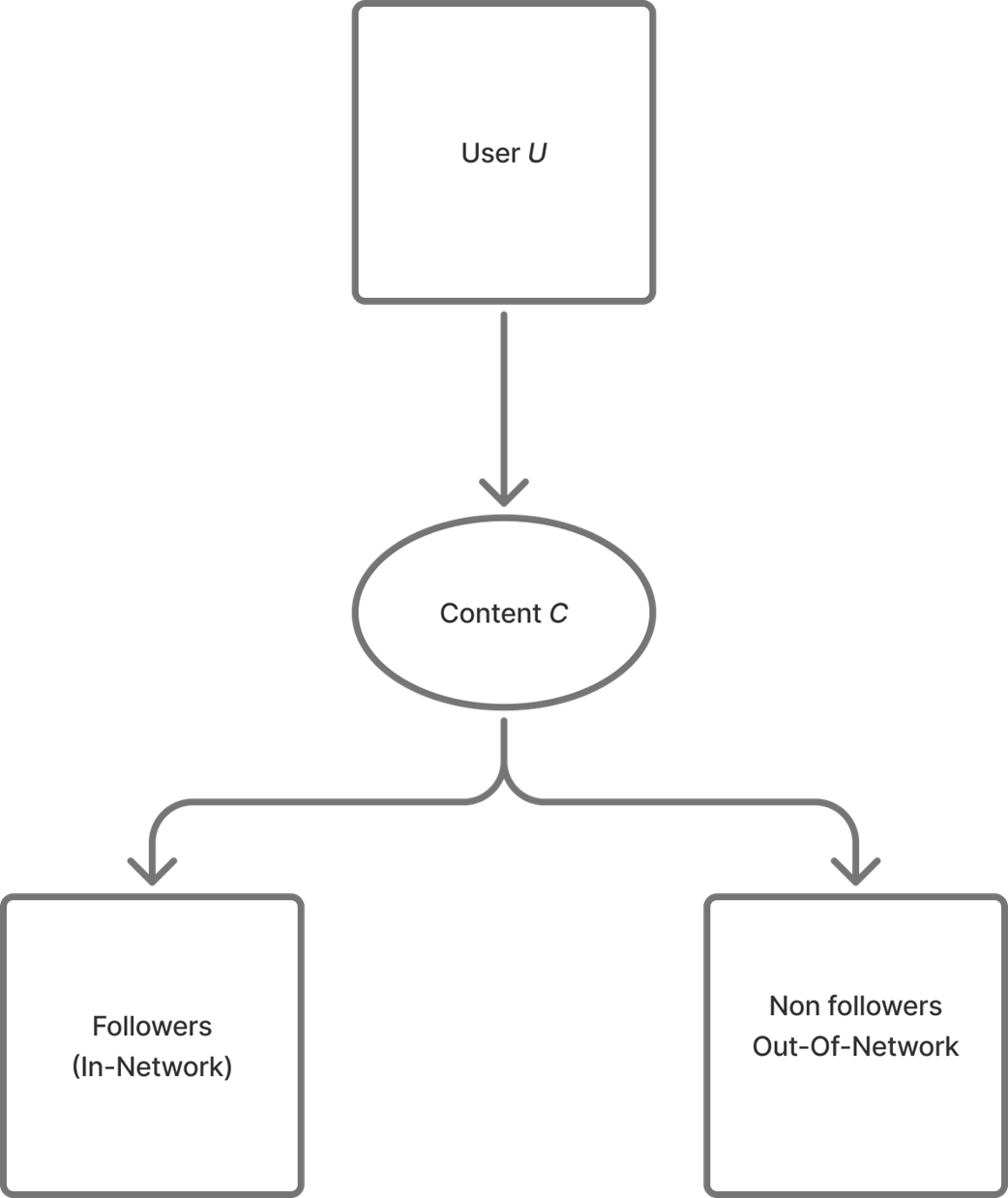
When a user U produces some content C, that content can be delivered to others in two different ways. First, it will be added to the pool of in-network content for users who follow U directly. At the same time, it might be algorithmically flagged as content with high relevance (or high probability of engagement) for users who don’t follow U directly. In that case, it will be inserted in the out-of-network bucket and be ranked accordingly. In neither case is there a guarantee that other users will see C, as it will compete for a spot with all the other content.
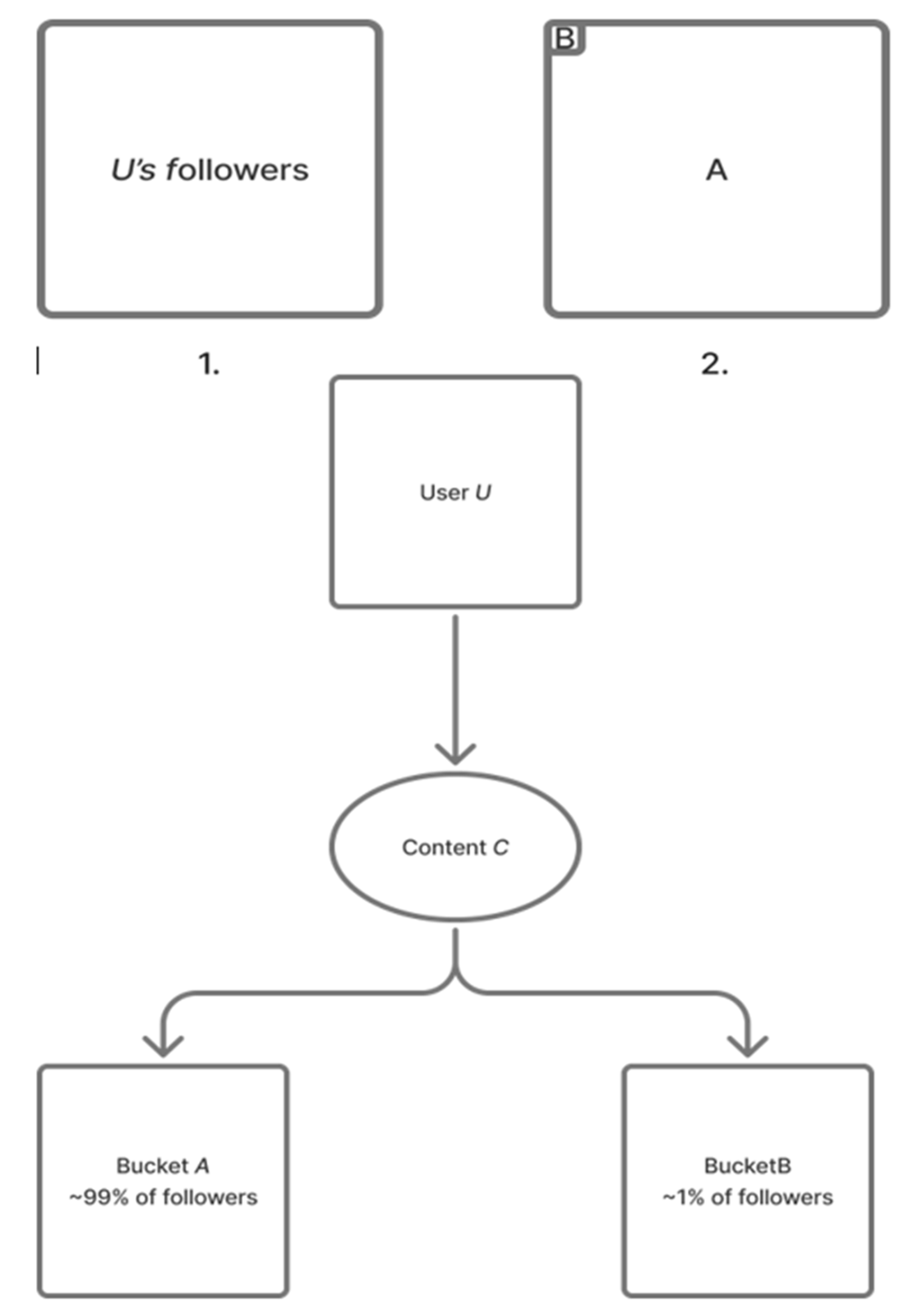
The distribution of U’s followers. Let’s assume that an A/B test is being run, in which A is the baseline—receiving 99% of traffic—and B is the new model, receiving only 1%. If U has enough followers, we can assume that 1% of them are in bucket B, and 99% are in A. This also implies that 99% of impressions are generated by users in bucket A and only 1% from B. Any deviation from this 1/99 ratio can be attributed to algorithmic amplification.
Summary

  • Algorithmic amplification can be used as a tool to measure the extent to which a recommender system deviates from its baseline. In that respect, it can be used as a tool to detect anomalies (including attempts at manipulation) for online platforms.
  • Algorithmic amplification lacks a single, definitive definition. Each definition is a new measuring tool that helps to better understand how the recommender system works. It’s important to strike a balance between usefulness and information.
  • Multiple stakeholders, especially those from historically marginalized communities, should be involved in defining amplifications.
  • A piece of content can be seen by either people who follow its producer directly or by others if the content is deemed interesting enough to be broadcast. The latter is due to a higher intervention by the algorithm, and it should be taken into account when measuring amplification.
  • Amplification can (and should) be defined both on the author's and on the reader’s side, as they highlight different concerns.
  • From the author's side, amplification can be measured via an A/B test, using normalized impressions, or using the Out-of-Network ratio of impressions.
  • From the reader's side, amplification can highlight whether the recommendations in the feed reflect the distribution of possible content.

FAQ

What is algorithmic amplification, and why is it important to measure?Algorithmic amplification refers to the extra exposure content or creators receive because of recommender systems. Measuring it matters because platforms shape what people see, which can affect culture, politics, and public discourse.
Why can’t amplification be fully understood with a single number?Amplification is a complex phenomenon with multiple dimensions, so one metric can only capture part of the picture. Like the “blind men and the elephant,” different measurements reveal different aspects of the same system.
What makes amplification different from measuring physical quantities like temperature or speed?Unlike physical quantities, amplification is not directly observable or universally defined. It depends on platform behavior, user context, and measurement choices, so it requires careful operationalization.
Why should amplification be monitored over time rather than measured only once?Because platforms change constantly, the goal is to detect shifts and anomalies rather than produce one fixed value. Sudden changes in amplification may indicate manipulation, bugs, or other unusual behavior.
Who should be involved in defining amplification metrics?A multi-stakeholder group should help define and validate them, including external researchers, civil society, sociologists, and advocacy groups. This helps prevent platforms from controlling the narrative through selective measurement.
What is the difference between in-network and out-of-network content?In-network content comes from accounts a user follows directly, while out-of-network content is recommended by the algorithm from accounts the user does not follow. Out-of-network exposure usually signals stronger algorithmic influence.
What does the “out-of-network ratio” measure?It measures how much of a user’s or post’s exposure comes from algorithmic recommendations rather than direct followers. A higher ratio means the recommender system is pushing the content to a broader audience.
How do normalized impressions help compare different users?Normalized impressions adjust for differences in follower count and posting behavior, allowing comparison between users with very different audiences and activity levels. This makes it possible to compare a small creator and a major public figure more fairly.
What is the purpose of measuring amplification on the reader side?Reader-side amplification asks whether the feed reflects what a user actually follows, or whether the algorithm is distorting that balance. It helps identify whether certain topics or sources are being over-promoted in the user’s feed.
Why is amplification useful as an anomaly-detection tool?Because unexpected spikes or drops in amplification can reveal platform manipulation, changes in ranking behavior, or other issues needing investigation. It serves as an early warning signal rather than a final explanation.

pro $24.99 per month

  • access to all Manning books, MEAPs, liveVideos, liveProjects, and audiobooks!
  • choose one free eBook per month to keep
  • exclusive 50% discount on all purchases
  • renews monthly, pause or cancel renewal anytime

lite $19.99 per month

  • access to all Manning books, including MEAPs!

team

5, 10 or 20 seats+ for your team - learn more


choose your plan

team

monthly
annual
$49.99
$499.99
only $41.67 per month
  • five seats for your team
  • access to all Manning books, MEAPs, liveVideos, liveProjects, and audiobooks!
  • choose another free product every time you renew
  • choose twelve free products per year
  • exclusive 50% discount on all purchases
  • renews monthly, pause or cancel renewal anytime
  • renews annually, pause or cancel renewal anytime
  • Hidden Influences ebook for free
