4 Algorithmic amplification: Measuring RecSys
Recommender systems shape what people see by deciding which content gets attention, time, and visibility, but measuring whether they are doing this “well” is far more difficult than it first appears. The chapter explains that amplification cannot be judged with simple, objective standards because concepts like quality, fairness, and value are abstract, context-dependent, and often impossible to define universally. To measure amplification at all, one must choose a baseline and a unit of comparison, yet even apparently simple baselines, such as reverse chronological ordering, are not neutral and can favor prolific producers over others.
The chapter then shows why recommender systems are hard to evaluate because they learn preferences indirectly from user behavior. Since platforms infer taste from clicks, watches, likes, and other engagement signals, they rely on proxy metrics that only imperfectly represent actual user value. This creates a construct-validity problem: engagement may reflect curiosity, outrage, habit, promotion, or constraint rather than genuine satisfaction. Testing also remains limited, because historical data can only reveal how users responded to past recommendations, not how they would have behaved under different ones, which is why platforms resort to live A/B tests on small user samples.
Finally, the text emphasizes that recommender systems are socio-technical systems shaped by feedback loops between users and algorithms. What the system recommends affects what users see and engage with, and those interactions in turn train the next version of the system, producing self-reinforcing dynamics such as rich-getting-richer effects. These loops make it difficult to separate human choice from algorithmic influence and complicate labeling efforts, since determining what content or users count as pro- or anti-policy, for example, can be ambiguous, privacy-sensitive, and impossible to do cleanly at scale. The overall message is that measuring algorithmic amplification requires grappling not only with technical metrics, but also with uncertainty, context, and the mutual shaping of people and platforms.
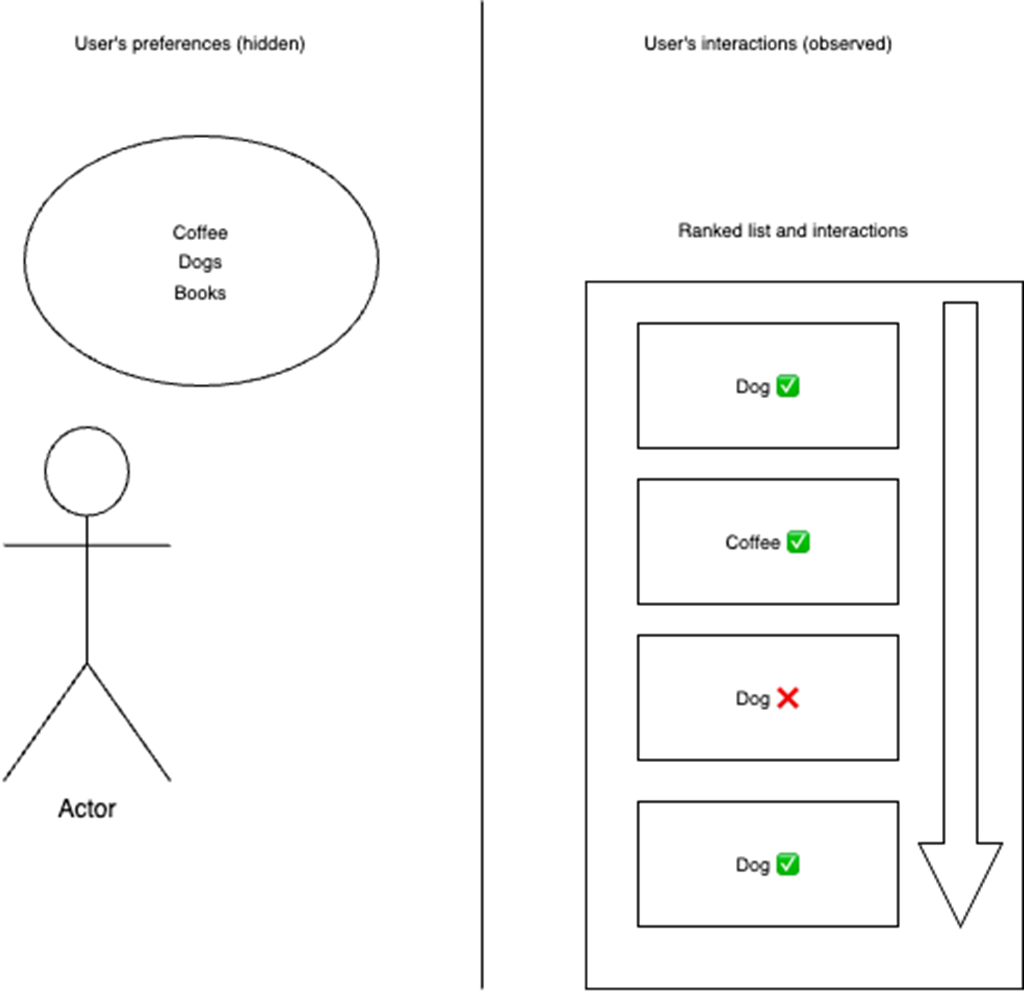
Recommender systems learn our preferences by observing our interactions with the items they present. There is no guarantee that all the preferences will be appropriately accounted for. In this figure, the user is a book lover, but the system is unaware of their preferences, and it’s reinforcing the known ones.
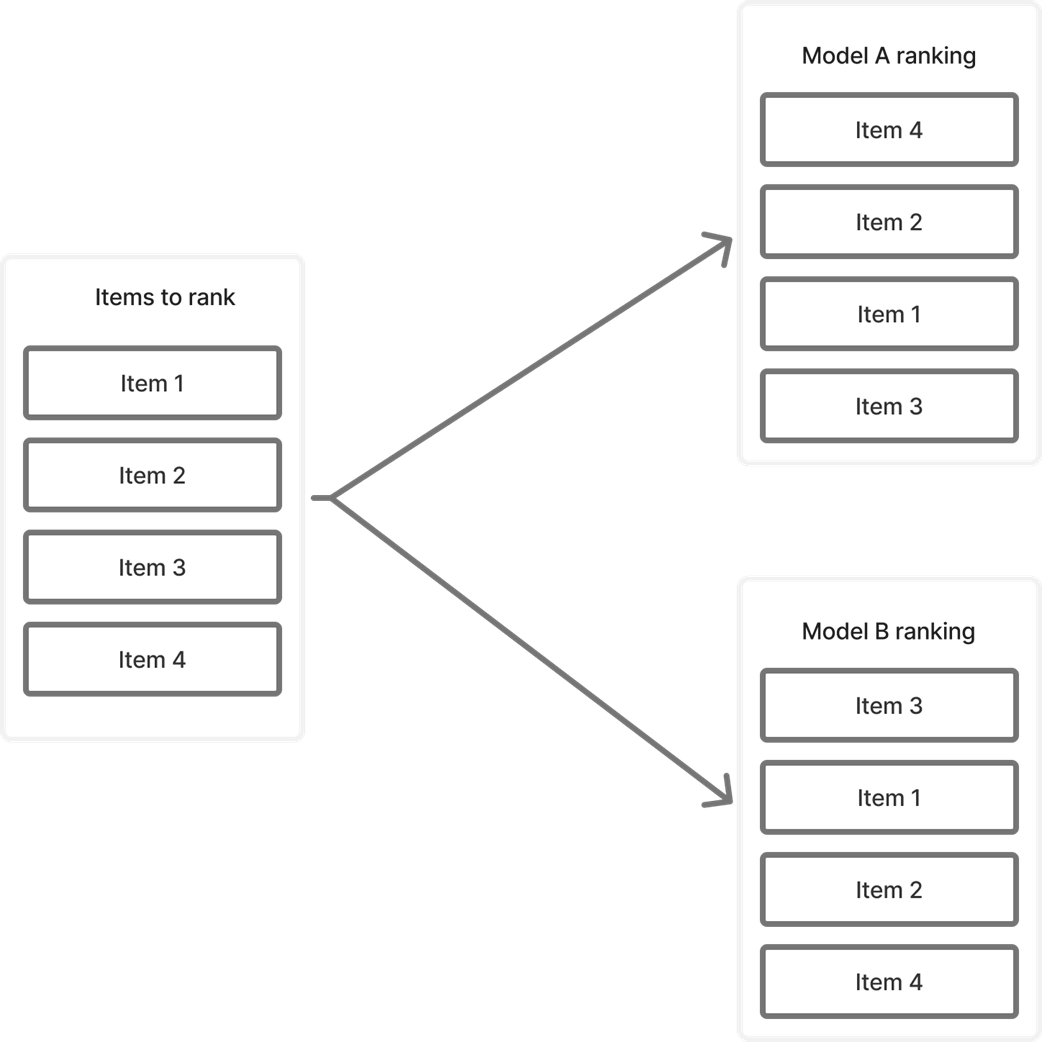
During an A/B test, the same set of items is ranked by two different models. Though they both use the same pool for the ranking, the order in which they appear can be wildly different. When the pool is big enough, items that are ranked too low will not be seen by users, effectively removing them from users’ attention.
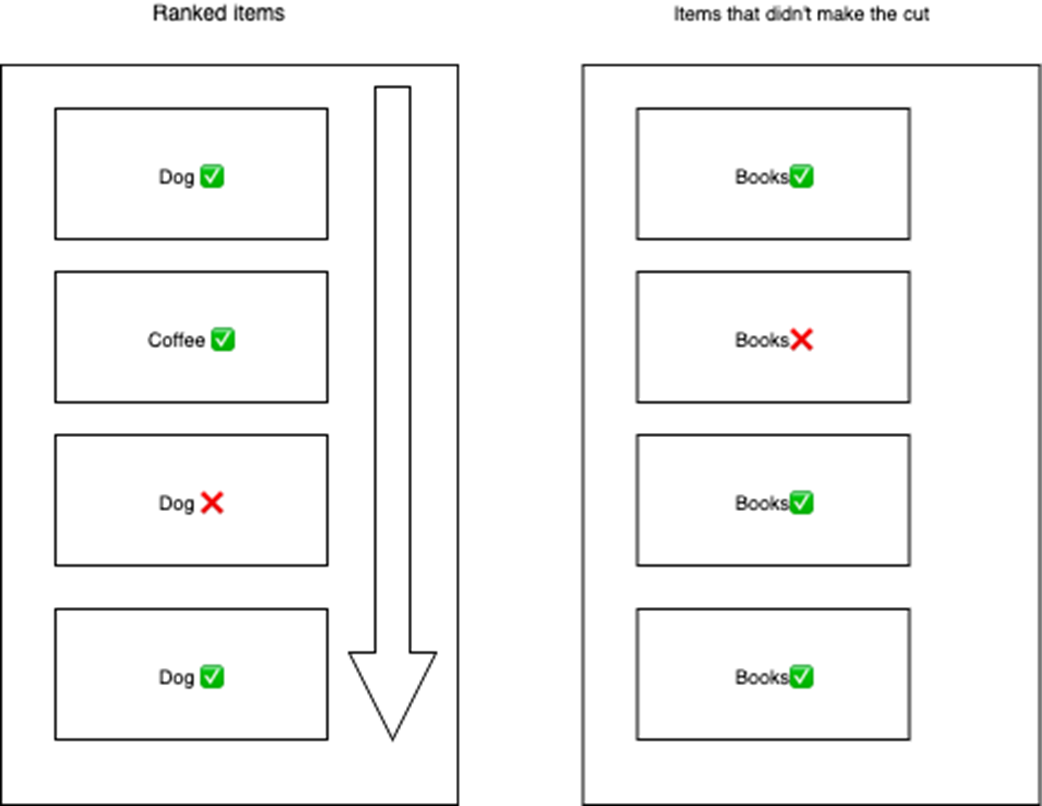
Generally, users interact only with the items presented to them. Very likely, there were many other items that users would have interacted with if they had been shown to them. Because the algorithm is learning via past interactions, it’s possible that certain topics (like the Books topic here) were never presented to the users, thus completely missing one of their interests.
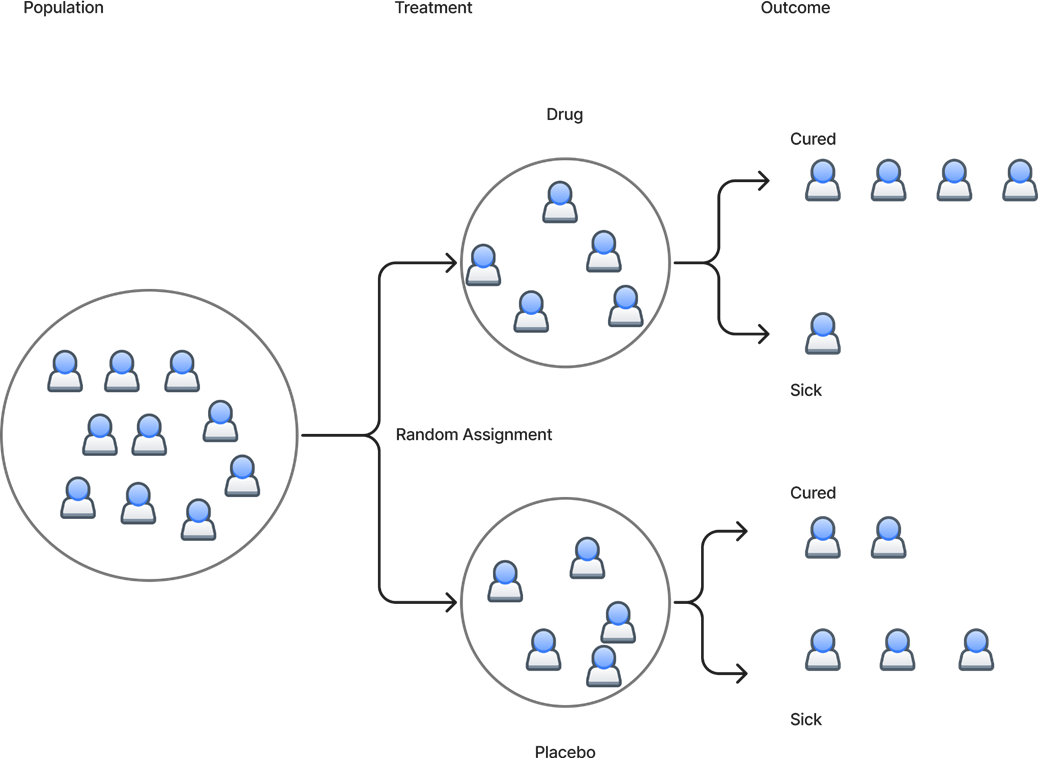
Randomized controlled trial in medicine: Patients are randomly split into two groups and, without their knowledge, assigned either the drug or the placebo. The effects on the population are later measured to understand the effects of the drug. In this example, we assume that a population has an ailment for which a new drug has been developed. The drug is given to a random subset of the population, and then the effects are compared with those who didn’t receive the drug. It is vital to do so to understand the baseline of remission. In this case, we can see how the drug is associated with doubling the number of people who are cured.
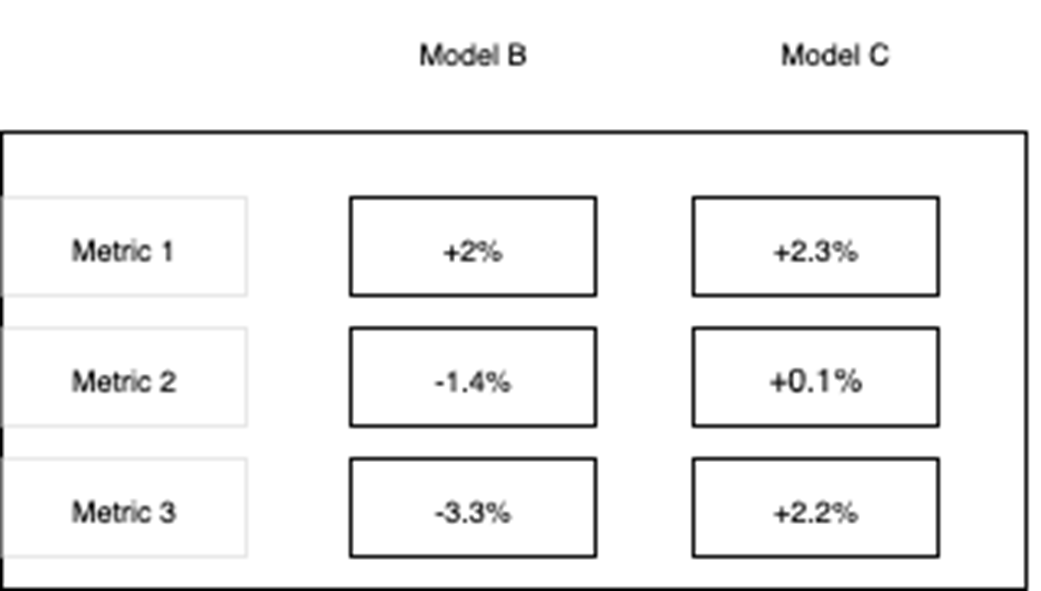
A dashboard comparing three models during an A/B test. Model A is considered the baseline (usually, the system that is currently being used). A few measurable metrics are selected, and the performance of models B and C is reported in comparison to model A. The choice of model depends on what the metrics represent: If it’s desirable for them to increase (for example, if they are tracking the number of users or the amount of time spent), then model B is better. On the other hand, if they are tracking some negative interactions—such as abuse on the platform—model C is preferable because it decreases those.
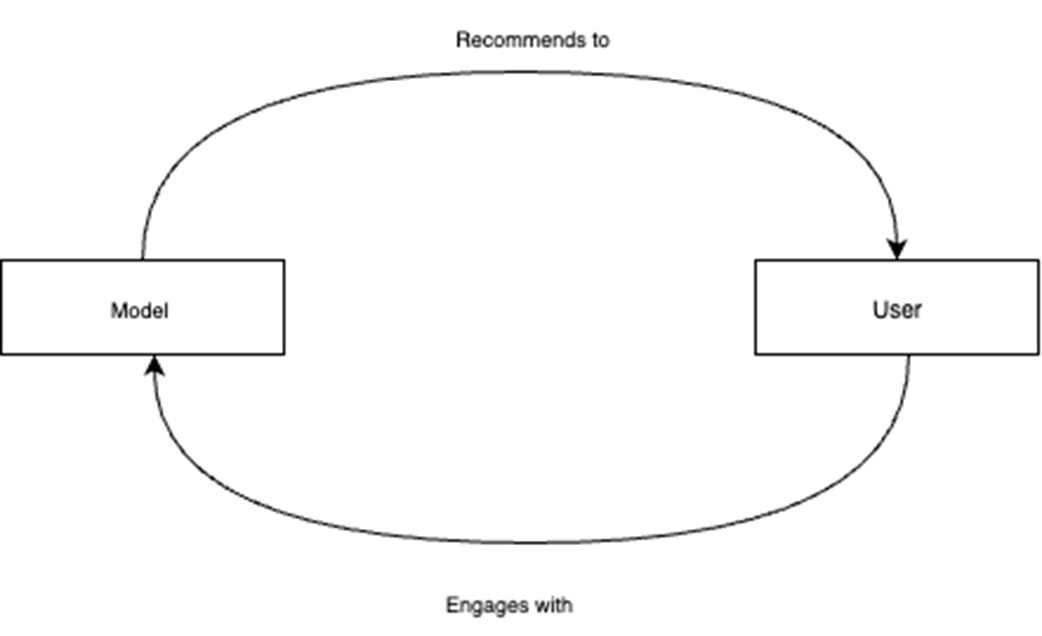
The feedback loop between the recommendation system and the user. They are in a circular feedback loop, in which the output of one is the input for the other. Whatever the system outputs (the recommendations) is what the users see. At the same time, the user's output (what they interact with) serves as the input for the recommender system, allowing for a better understanding of users’ preferences.
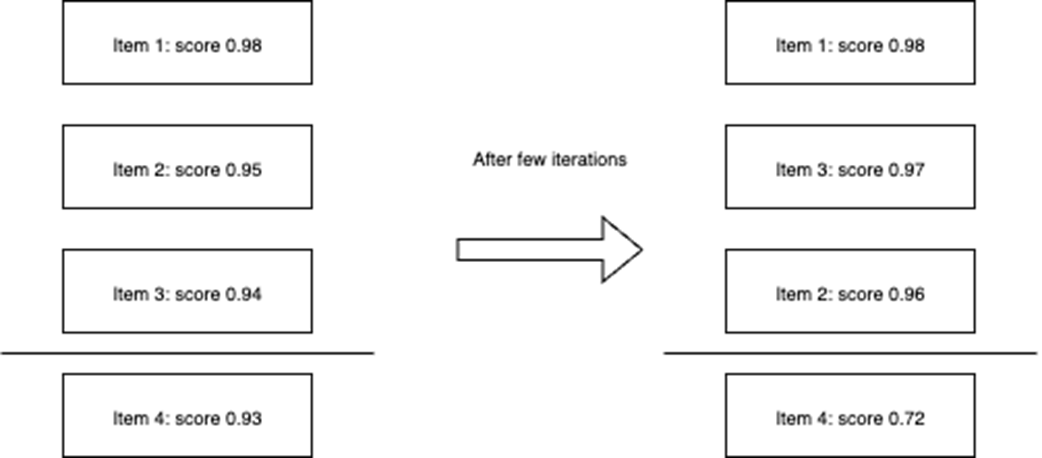
How the rich-getting-richer effect might start. At the start of the cycle, all four items are rightly equally evaluated by the model—as denoted by their similar scores. Assuming that people will only see—and thus interact with—the first three items, those would be recorded as positive interactions—unlike Item 4. After a few cycles, the difference in scoring will be greater, thus reinforcing the cycle. Profile suggestions in social media are an example where only a few recommendations are shown.
Summary
- Algorithmic amplification measures how much additional exposure a piece of content receives because of the algorithmic distribution.
- Recommender systems deal with human preferences, which are not only evolving but also pose an obstacle to finding an objective measure of content quality.
- Such preferences are also learned implicitly by the system, which records interactions with past items. As a result, our understanding of such preferences is biased by past recommendations.
- The tight relationship between RecSys and its users complicates matters because it’s impossible to disentangle the contribution of users or the algorithm: The output of one constitutes the input of the other.
- A baseline, measuring a neutral state, is needed to determine whether a piece of content is getting more or less distribution than it should. Due to the personalized nature of RecSys, no universal baseline exists against which to measure recommender systems. However, reverse chronological order is usually used as a baseline.
- Another challenge is labeling elements at scale: To measure the amplification of a topic, we would need to identify all relevant content or users.
- To decide whether a new system should be shipped to all users, platforms use A/B tests in which they divert a small portion of traffic to both the new and old model and compare the results against a set of predetermined metrics, usually around engagement and retention.

 Hidden Influences ebook for free
