This chapter pivots from how electronic health records (EHRs) generate data to what that data means, defining clinical informatics as the discipline that aligns messy, real-world care with the precise world of computable data. Its central aim is to ensure health information is both clinically faithful and machine-readable so it can be processed, exchanged, and reused safely across settings. By foregrounding ontology and semantics, the chapter frames clinical informatics as the work of preserving meaning as data moves between people, departments, and systems—turning narrative clinical intent into standardized, actionable information.
The text explains why a single universal clinical ontology is neither feasible nor desirable: modern medicine’s specialization, varying levels of granularity, and constant evolution (highlighted by the rapid emergence of COVID-19 concepts) demand multiple, complementary vocabularies. Health IT therefore combines the “Golden Triad” of terminologies to build a computable clinical narrative: SNOMED-CT captures who the patient is clinically (problems, findings, procedures) in a rich polyhierarchy; LOINC encodes what was observed or asked (labs, vitals, documents, surveys) using a six-attribute model that makes observations unambiguous across sites and devices; and RxNorm standardizes how conditions are treated by providing shared, machine-readable drug identities and relationships across ingredient, clinical drug, and brand layers. Together they support a common workflow pattern in which LOINC-coded evidence informs SNOMED-CT conclusions that guide RxNorm-coded therapies.
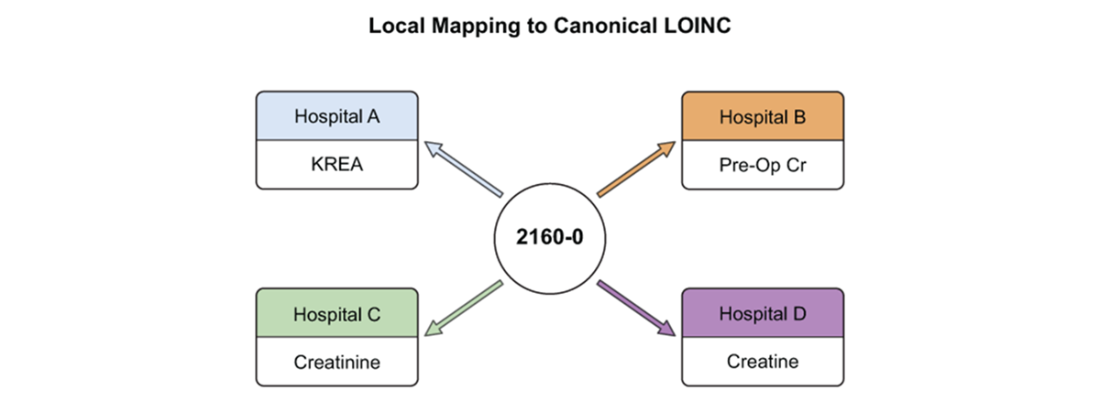
From an implementation standpoint, the chapter stresses practical discipline around identifiers, versions, and structure: use SNOMED-CT concept IDs (not strings), manage editions and subsets; treat LOINC as the canonical key while retaining local codes, and leverage its six attributes for querying and validation; persist both local medication IDs and RxNorm RxCUIs, choose the appropriate RxNorm term type for the task (ingredient vs. clinical/brand drug), and rely on RxNorm’s named relationships rather than string matching. The unifying message is that clinical informatics is the engineering of semantic reliability—reducing ambiguity so downstream decision support, reporting, safety checks, and interoperability operate on data whose meaning is explicit, consistent, and preserved end to end.
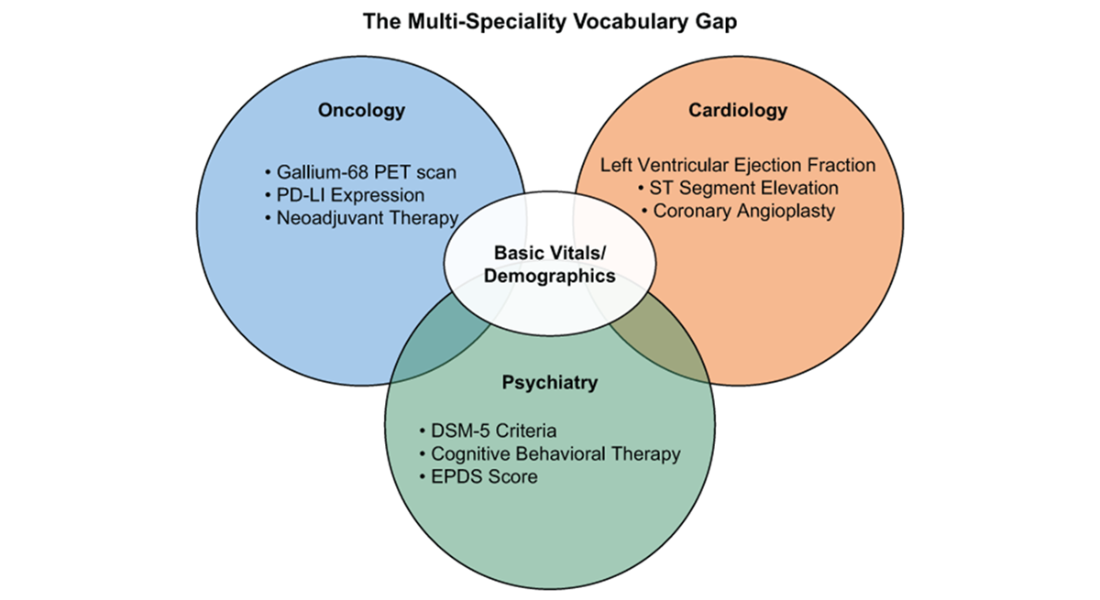
Illustrating the vocabulary gap that makes a single universal clinical ontology impossible.
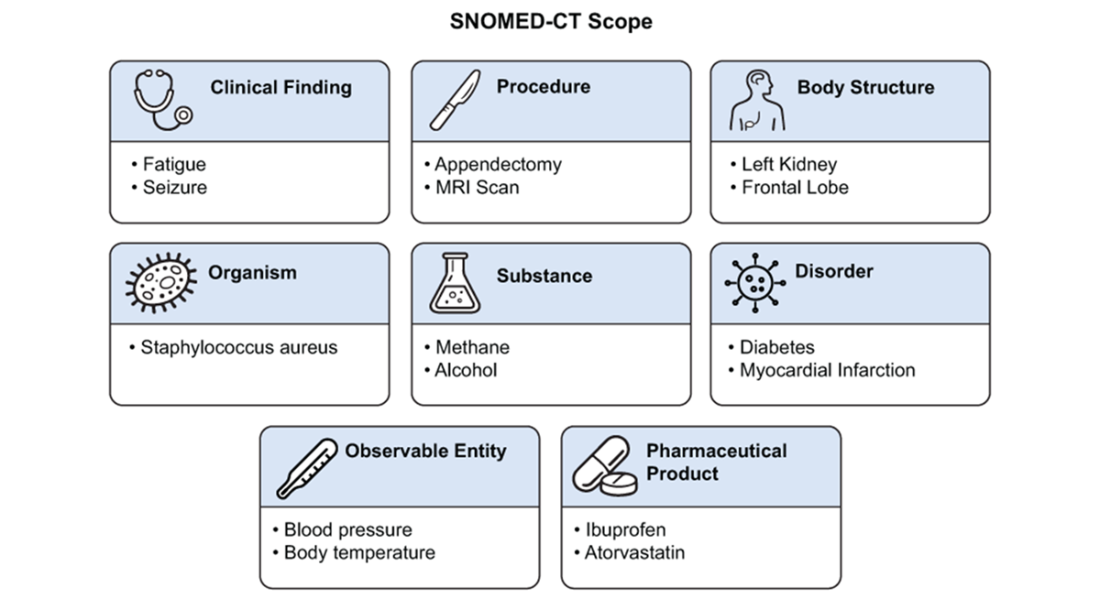
The primary clinical axes and categories covered within the SNOMED-CT terminology.
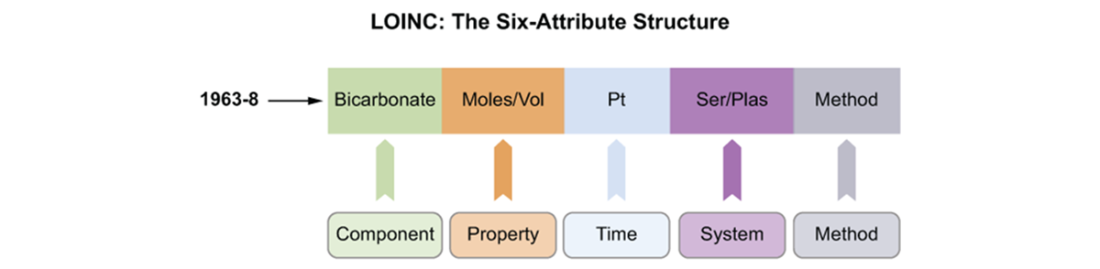
The six-attribute "anatomy" of a LOINC observation code.
LOINC as the canonical hub for disparate local laboratory codes.
Summary
Clinical informatics is fundamentally about ontology and semantics. Clinical informatics ensures health data is not only captured but interpreted and applied consistently across care settings and systems.
No single ontology/terminology can cover the breadth of modern medicine as specialities diverge in vocabularies and granularity. Moreover, medicine evolves and health IT therefore leverages multiple terminologies in combination.
The role of the core clinical terminologies is to represent the clinical story in a computable way: SNOMED-CT for diagnoses and other clinical concepts (problems, findings, procedures), LOINC for observations/questions (labs, vitals and clinical measurements) and RxNorm for medication identities able to be exchanged and interpreted reliably across systems.
Semantic meaning is what allows downstream logic, analytics and decision support to interpret health data reliably and consistently, reducing clinical ambiguity, errors and ultimately improving patient outcomes.
FAQ
What is clinical informatics and why does it matter?Clinical informatics aligns real-world clinical care with the digital world of data models, codes, and software so that what clinicians document is both clinically faithful and machine-readable. Its purpose is to capture health data in standardized, computable forms that can be safely processed, exchanged, and reused across settings to support decisions, workflows, and analytics.Why can’t a single universal clinical ontology cover all of medicine?Modern medicine is highly specialized and constantly evolving. Each domain (e.g., oncology, cardiology, psychiatry, ICU nursing) emphasizes different concepts and levels of granularity. A single ontology would be either too generic to be useful or too dense to be usable, and it would struggle to keep pace with new diseases, treatments, and policies (as seen during COVID-19).What is the “Golden Triad” of terminologies and how does it model care?The Golden Triad uses three complementary code systems to capture a computable clinical narrative: SNOMED-CT for who the patient is clinically (problems/findings/diagnoses), LOINC for what was observed or asked (labs, vitals, documents, survey questions), and RxNorm for how the patient is treated (standardized medications). Together, they preserve meaning across systems.How does SNOMED-CT represent clinical meaning?SNOMED-CT assigns each concept a stable numeric identifier with human-readable descriptions and organizes concepts via “is-a” relationships in a polyhierarchy. This lets a single concept inherit meaning from multiple parent categories, supports documentation at the right detail, and enables grouping for analytics and decision support (e.g., subarachnoid hemorrhage under intracranial hemorrhage and cerebrovascular disorders).What are practical implementation tips for SNOMED-CT?- Track the exact edition and release; concepts can be deprecated and replaced over time.
- Use curated subsets/value sets instead of the entire terminology.
- Anchor application logic on concept IDs, not display strings (which can change or be localized).What does a LOINC code actually capture?Each LOINC code is a structured definition of an observation using six attributes: Component, Property, Time, System, Scale, and Method. LOINC also organizes related tests into panels (e.g., CBC panel) and groups codes into classes, enabling precise, interoperable queries and results interpretation across labs, devices, and EHRs.How do SNOMED-CT and LOINC work together in a clinical workflow?Clinicians ask questions using LOINC-coded observations (e.g., bicarbonate, anion gap, ketones). Based on results, they record clinical conclusions as SNOMED-CT-coded problems/diagnoses. This moves from observed data (what was measured) to what is clinically true about the patient, enabling downstream CDS and reporting.What is RxNorm and how should local medications be mapped to it?RxNorm standardizes drug identities so medication data can be shared and interpreted across systems. Map local orderables to RxNorm, and persist both the local ID (drives internal workflow) and the RxCUI (portable semantic key). Choose the appropriate term type (e.g., IN/MIN vs. SCD/SBD) to match the use case.How do RxNorm relationships support safety and interoperability?RxNorm encodes named, bidirectional relationships (e.g., has_ingredient/ingredient_of, has_tradename/tradename_of) to navigate between ingredient, clinical drug, and branded concepts without string parsing. This underpins allergy checks, therapeutic duplication detection, medication reconciliation, and consistent analytics.What does “preserving semantic meaning” mean in practice?It means capturing data as standardized, coded concepts (not just free text) so systems can interpret and act on it predictably. When diagnoses, observations, and medications carry stable identifiers with defined structures, interfaces are reliable, validation happens at boundaries, and downstream logic (alerts, routing, analytics) is safe and consistent.
pro $24.99 per month
access to all Manning books, MEAPs, liveVideos, liveProjects, and audiobooks!

 Healthcare IT ebook for free
