7 Event-Driven Architecture (EDA): Temporal Decoupling and Asynchronous Communication
This chapter explains why synchronous service-to-service calls can turn a distributed system into a fragile dependency chain. When every step must happen immediately, one slow or unavailable service can stop the entire workflow, creating temporal coupling and the familiar “distributed monolith” problem. The chapter’s central fix is to stop demanding instant action and instead publish facts that other services can handle later, which is the core idea behind event-driven architecture and temporal decoupling.
It then introduces the main roles in an event-driven system: a producer that emits an event, a broker that reliably stores and routes it, and one or more consumers that react asynchronously. The text carefully distinguishes commands from events, showing that commands are directed requests for a specific action, while events are broadcast facts about something that already happened. From there, it develops publish-subscribe as the key pattern for reducing coupling, allowing new services to react to the same event without changing the original sender, while also emphasizing the practical tradeoff of eventual consistency.
The chapter also focuses on the operational realities that make event systems work in practice: queues versus topics, partitions, ordering constraints, delivery guarantees, backpressure, acknowledgments, retries, and dead letter queues. It stresses that reliable architectures depend on idempotent consumers, careful event design, correlation IDs for tracing, and infrastructure features such as duplicate detection and transactional outbox support. The Apollo 13 story reinforces the larger lesson that logs, telemetry, and correlation are not optional extras but essential tools for understanding and recovering from failure in distributed systems.
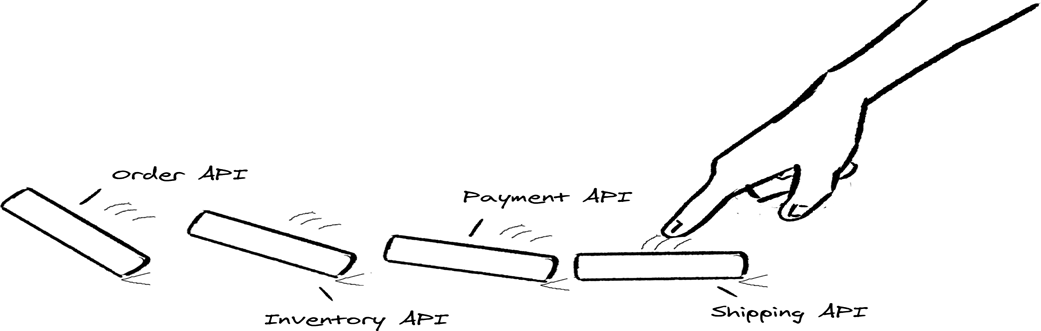
The Distributed Monolith: When services are coupled in time, a failure at the bottom of the chain topples everything above it.
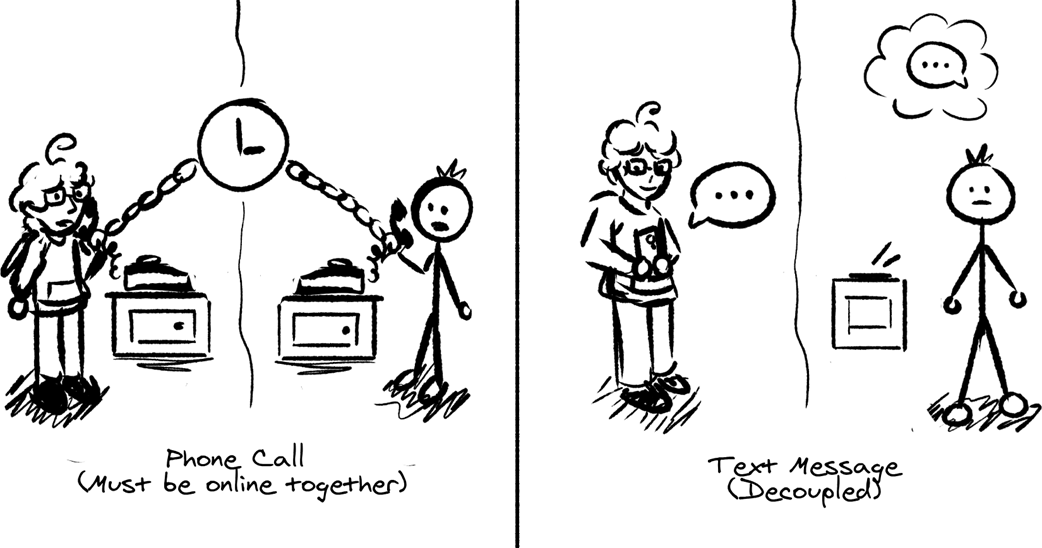
Synchronous coupling requires both parties to be present. Asynchronous decoupling allows the receiver to sleep while the sender keeps working.
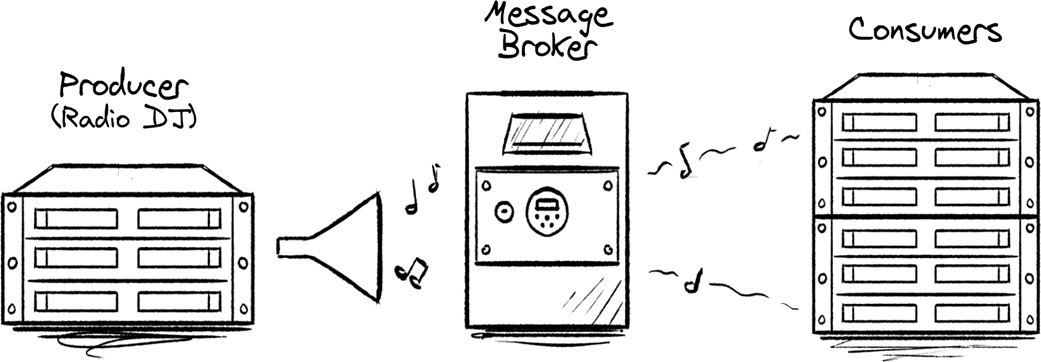
The Broker acts as the buffer. The Producer speaks to the Broker, not the Consumer.
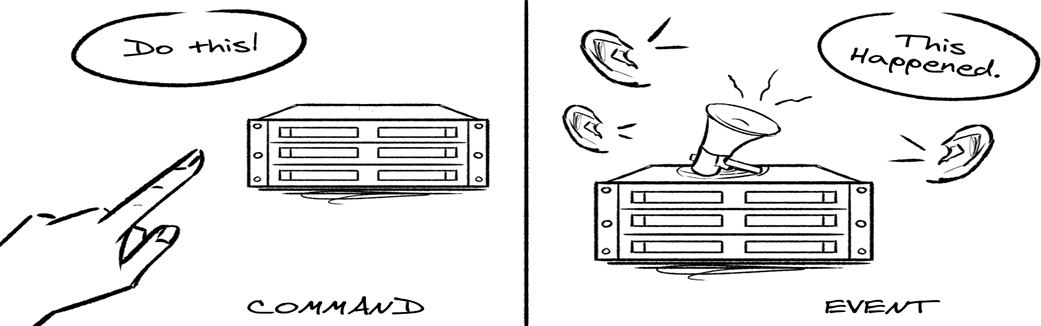
Commands are directed instructions (Coupled). Events are broadcast facts (Decoupled).
Open/Closed Principle in action: We can add the Rewards and Analytics services without ever touching the code in the Order Service
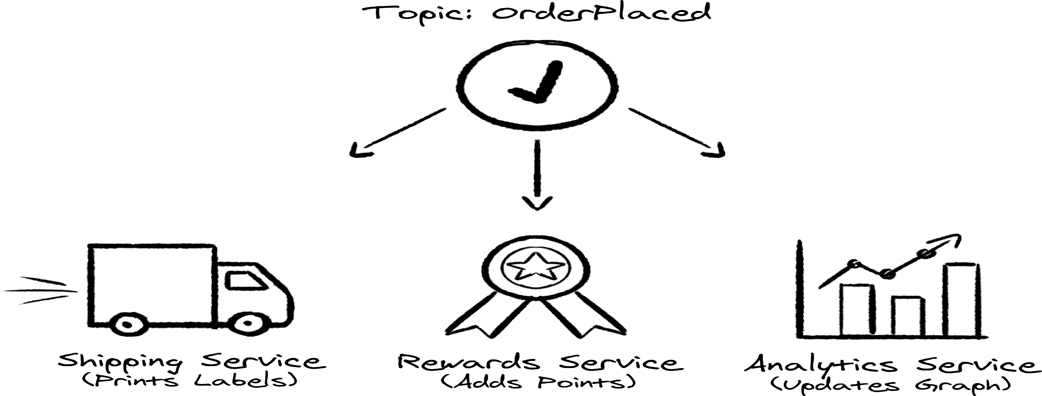
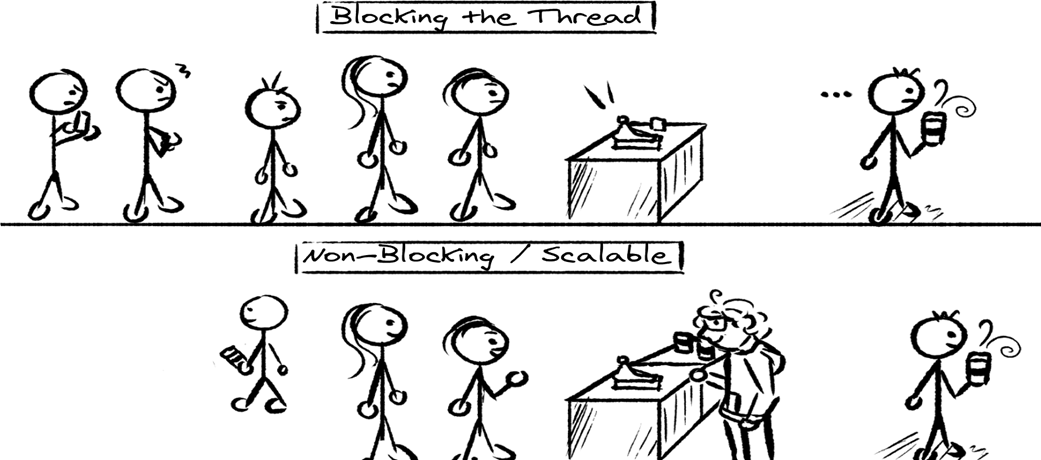
Synchronous systems block the line (the CPU) until the work is done. Asynchronous systems take the order and promise to do the work later.
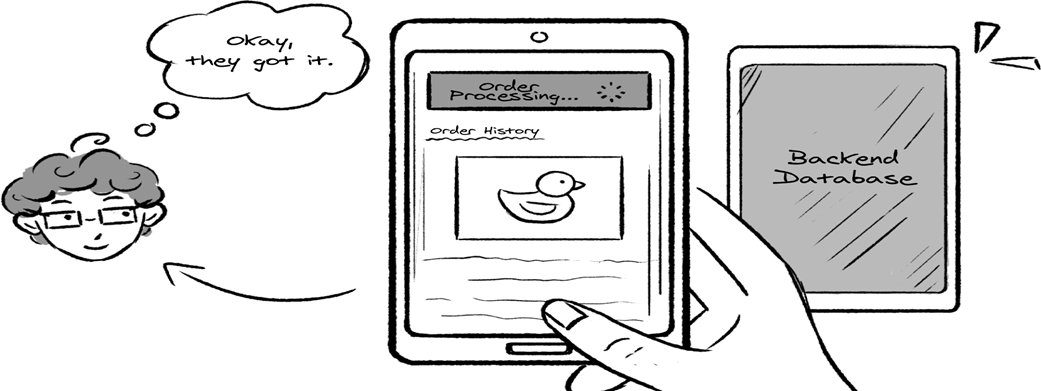
Client-Side Intelligence (Optimistic UI) at work. We show the user the success state before the server has actually finished the work.
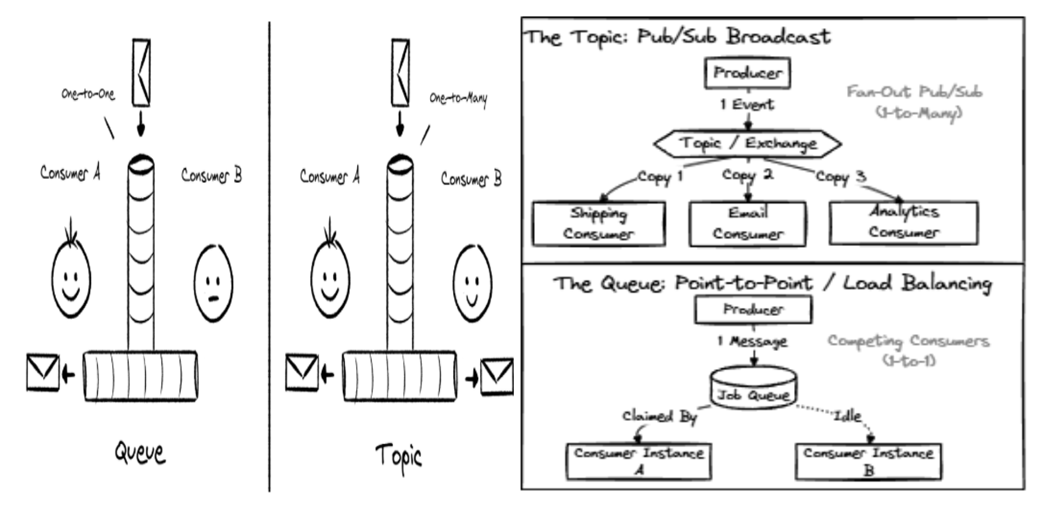
Queues vs. Topics. In a Queue model, Competing Consumers load-balance tasks across multiple workers, ensuring that each message is claimed and processed by only one worker (1-to-1). In contrast, a Topic acts as a prism using a Fan-Out (Pub/Sub) approach to broadcast and duplicate a single event (1-to-Many). This allows multiple distinct services (such as Shipping, Email, and Analytics) to receive their own copies of the event and react to it independently.
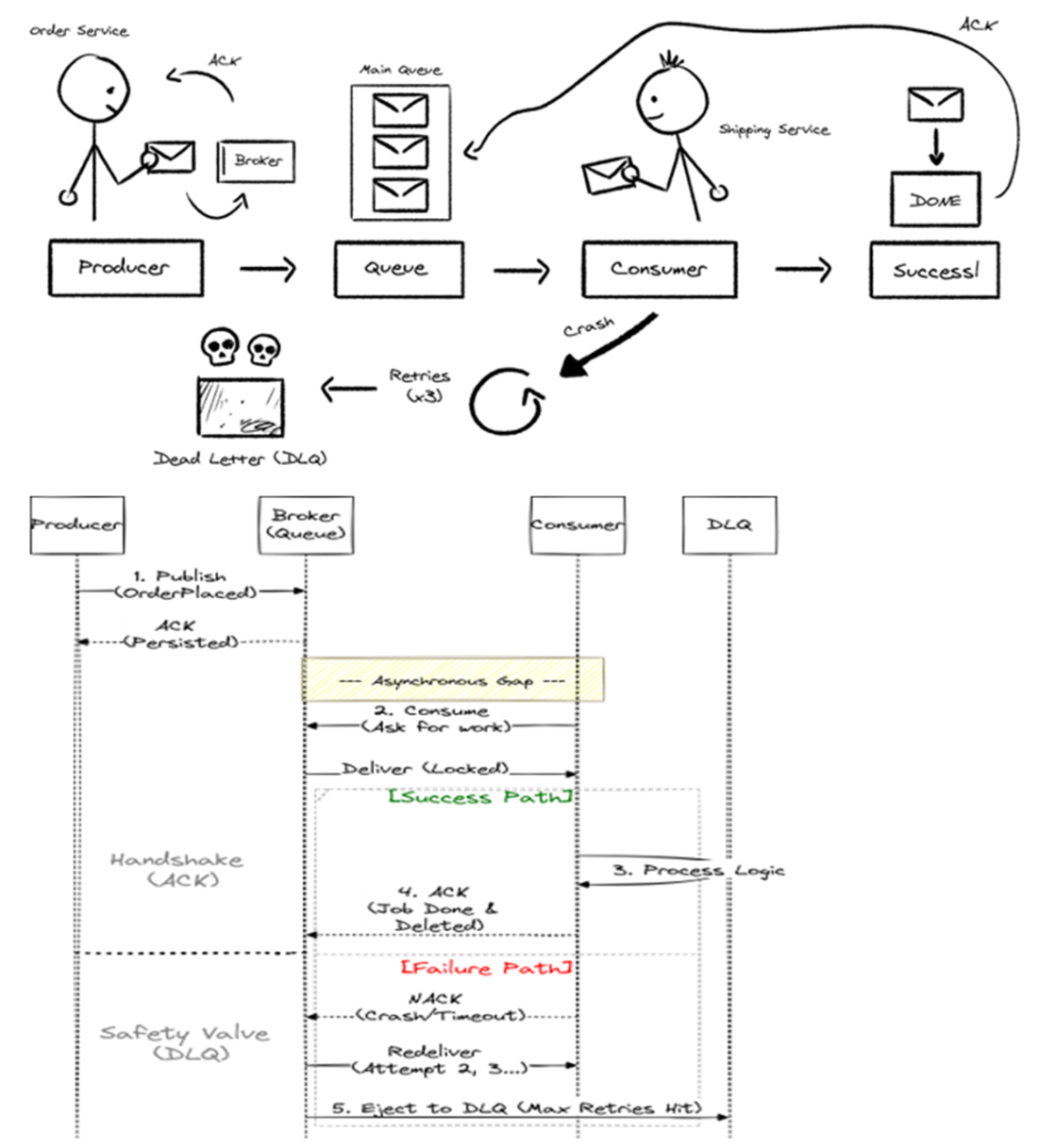
The Relay Race: The Order Service hands off the baton. The Critical Handshake (the first 'ACK') ensures the message is safely persisted in the Queue before the Order Service leaves. When the Shipping Service is ready, it grabs the baton, processes it, and sends a final ACK to delete the message. If the Shipping Service repeatedly drops the baton, the Safety Valve kicks in: failed attempts are routed to the Dead Letter Queue (DLQ) so they don't block the rest of the line, sitting safely until you can fix and re-send them.
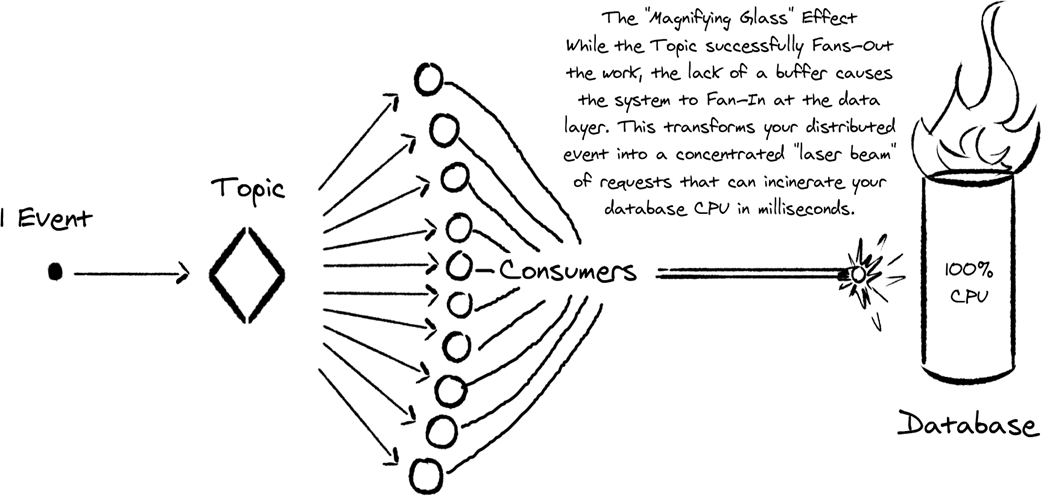
The Fan-Out Trap: One million simultaneous database requests triggered by a single moment of human excitement can accidentally crash your own system.
Recap
- Event-Driven Architecture (EDA): A design paradigm where services communicate asynchronously by broadcasting "Events" (facts about the past) rather than sending direct "Commands." This eliminates Temporal Coupling, meaning the Sender does not need the Receiver to be online to complete a transaction.
- The Players: The architecture relies on three distinct roles: the Producer (who emits the event and immediately moves on), the Broker (the infrastructure that holds the message safely), and the Consumer (who wakes up to process the message when ready).
- Decoupling is the Goal: We move from Synchronous to Asynchronous not just for performance, but to break the temporal dependency between services. We want the Order Service to continue functioning even if the Shipping Service is unavailable.
- The "Gap" is Real: In an Event-Driven world, there is always a time gap between "Event Fired" and "Event Processed." We stop fighting this gap and start designing for Eventual Consistency.
- The Broker is the Buffer: The Message Broker (Queue) acts as the shock absorber for your system. It stores data securely during outages, preventing data loss when a consumer fails.
- The PACELC theorem updates the old CAP theorem, reminding us that even when the network is healthy, we must still choose between Latency and Consistency.
- Events are History: An Event is a "News Report" of something that has already happened. It must be named in the past tense (OrderPlaced), be immutable, and contain only the data needed for the story.
- Safety First: We rely on Acknowledgments (ACKs) to guarantee message delivery and Dead Letter Queues (DLQs) to catch "poison pills" that would otherwise cause our consumers to crash in an infinite loop.
- Observability is Survival: As we learned from Apollo 13, you cannot debug a distributed system by "looking at the code." You must implement Structured Logging and Correlation IDs to reconstruct the story from the telemetry.
- Moving to Event-Driven Architecture requires a mental re-wiring from "Command and Control" (telling services what to do) to "Choreography" (announcing what happened and letting services react).

 Grokking Software Architecture ebook for free
