13 Architecting for the Delivery Lifecycle (CI/CD): Building Automated Gates for High-Velocity Software Delivery
Software delivery is presented as an architectural concern rather than an afterthought, because the way a system is built determines how safely it can be tested, packaged, deployed, and rolled back. The chapter argues that deployability is a first-class quality: if code requires fragile manual steps, late-night checklists, or risky coordination to reach production, then the architecture itself is failing. CI/CD is framed as the mechanism that turns design intent into a repeatable delivery conveyor belt, with automated verification, immutable artifacts, and controlled release processes replacing human guesswork.
The chapter then compares major deployment and release techniques for moving traffic without downtime. Rolling updates are efficient but can temporarily mix versions; blue-green deployments provide near-instant cutover and rollback at the cost of duplicate infrastructure; and canary deployments reduce blast radius by exposing new code to only a small slice of users before a wider rollout. It also emphasizes the crucial distinction between deployment and release, using feature flags and dark launches to separate shipping code from exposing functionality. Because live traffic and evolving databases can diverge, the chapter stresses backward-compatible data migration discipline through the expand/contract pattern, along with safeguards such as inversion toggles and circuit breakers.
To prevent architectural decay, the chapter promotes automated guardrails embedded directly into the CI pipeline. Fitness functions and static analysis tools enforce rules like layer isolation, naming conventions, dependency boundaries, and flag retirement, helping teams resist both human fatigue and AI-generated boundary violations. The chapter also treats environment promotion as a progression of confidence, weighing staging against testing in production based on compliance needs, decoupling maturity, and routing control. Finally, DORA metrics are used as a feedback system for the architecture’s health, and the Knight Capital failure is cited as a cautionary example of how missing automation, manual deployment, and ignored dead code can create catastrophic business loss in minutes.
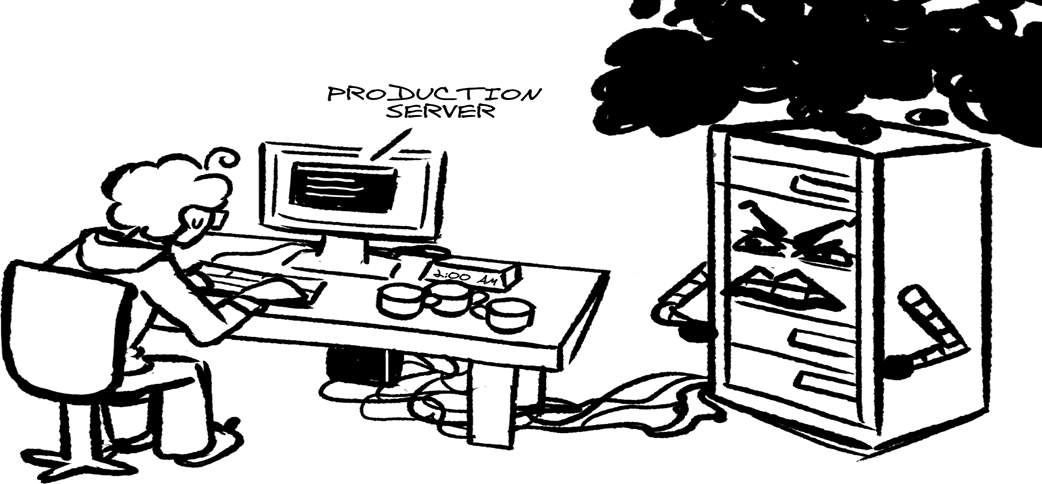
The "ClickOps" Gauntlet: Manually deploying code without automated verification is a high-stakes, high-stress gamble that invites human error.
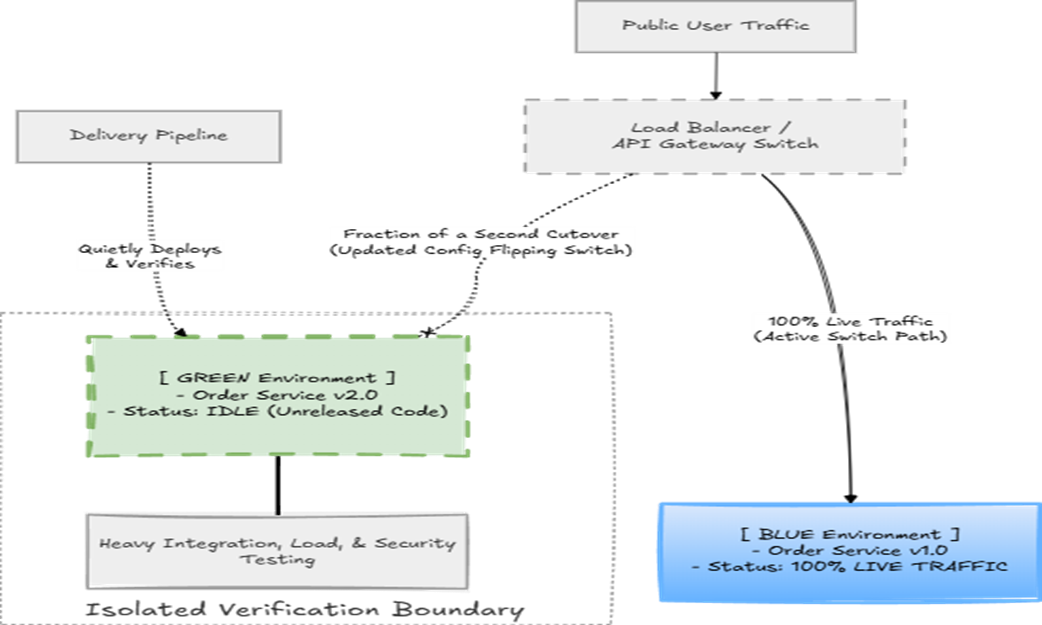
Blue-Green Deployment: The ultimate safety switch. By maintaining an isolated, duplicate environment (Green), you can deploy and verify new code out of sight. When ready, a fraction-of-a-second configuration change at the routing layer instantly swings 100% of live traffic over, providing a zero-downtime cutover with an instant rollback path if things go wrong.
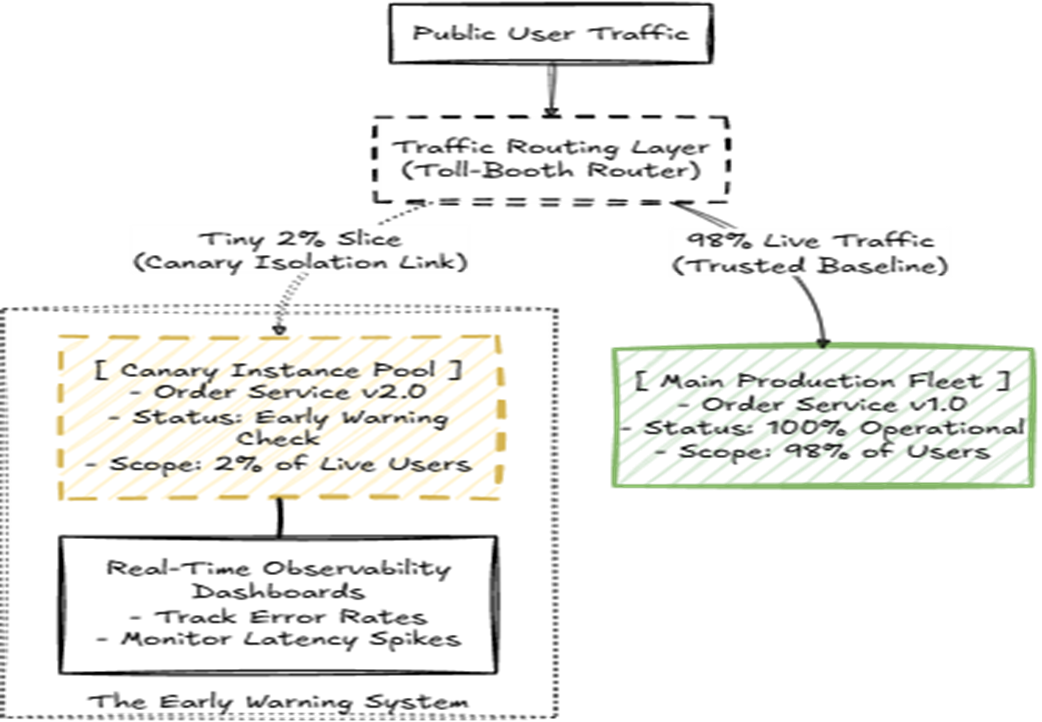
Canary Deployment: Routing a small, controlled slice of production traffic to new code allows you to validate system behavior before a full-scale rollout.
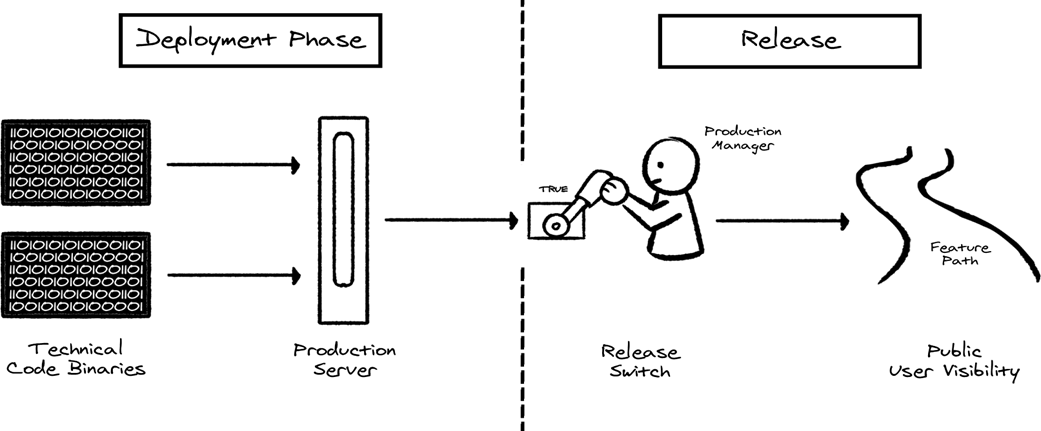
Separation of Concerns: Deployment is the technical operation of placing files on a server; Release is the business decision to expose those files to your users.
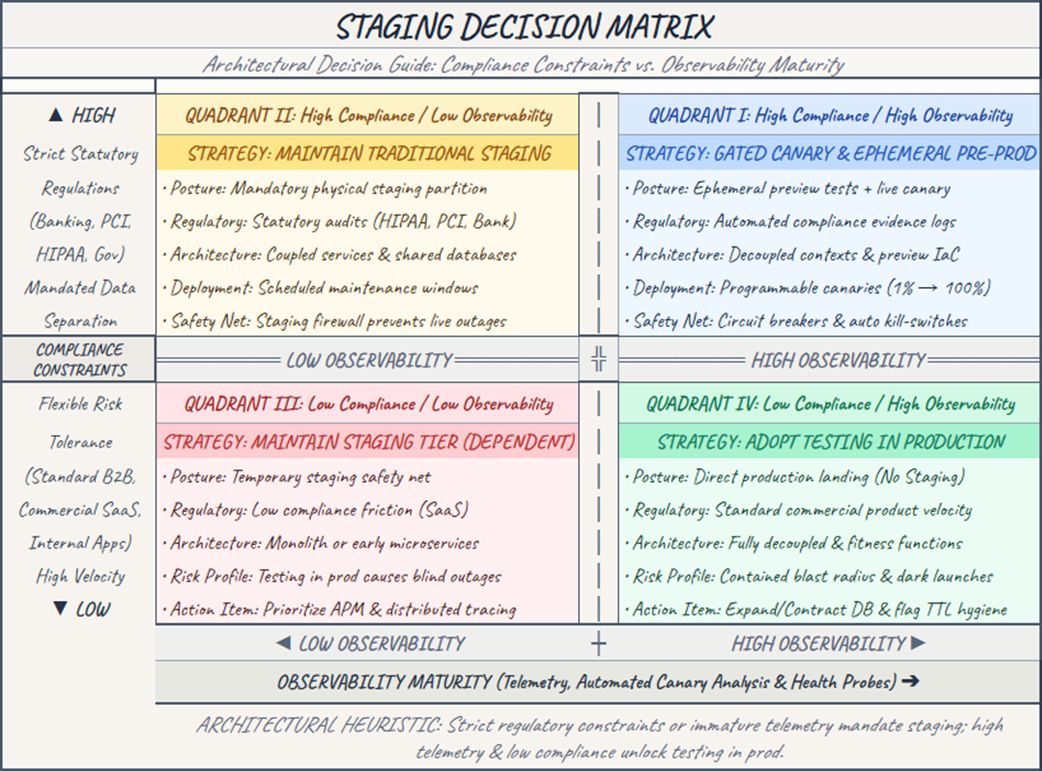
Choosing Your Environment Strategy: Your architectural decision to maintain a physical staging gate depends on your specific compliance and maturity constraints.
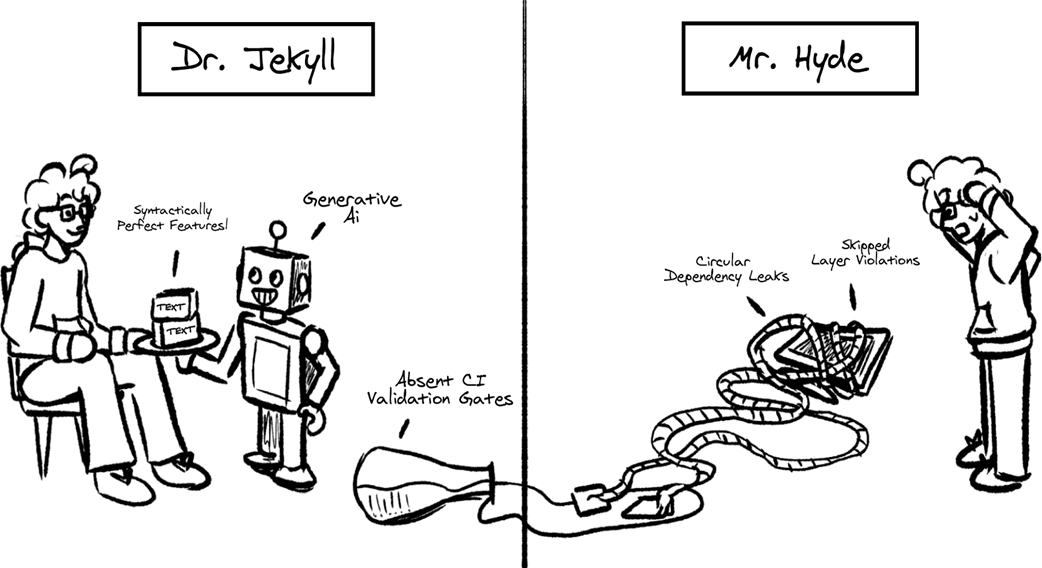
Drinking the serum of unverified speed: When your release pipeline lacks automated architectural validation gates, generative velocity transforms a well-intentioned architect into an accidental arsonist of microservice boundaries.
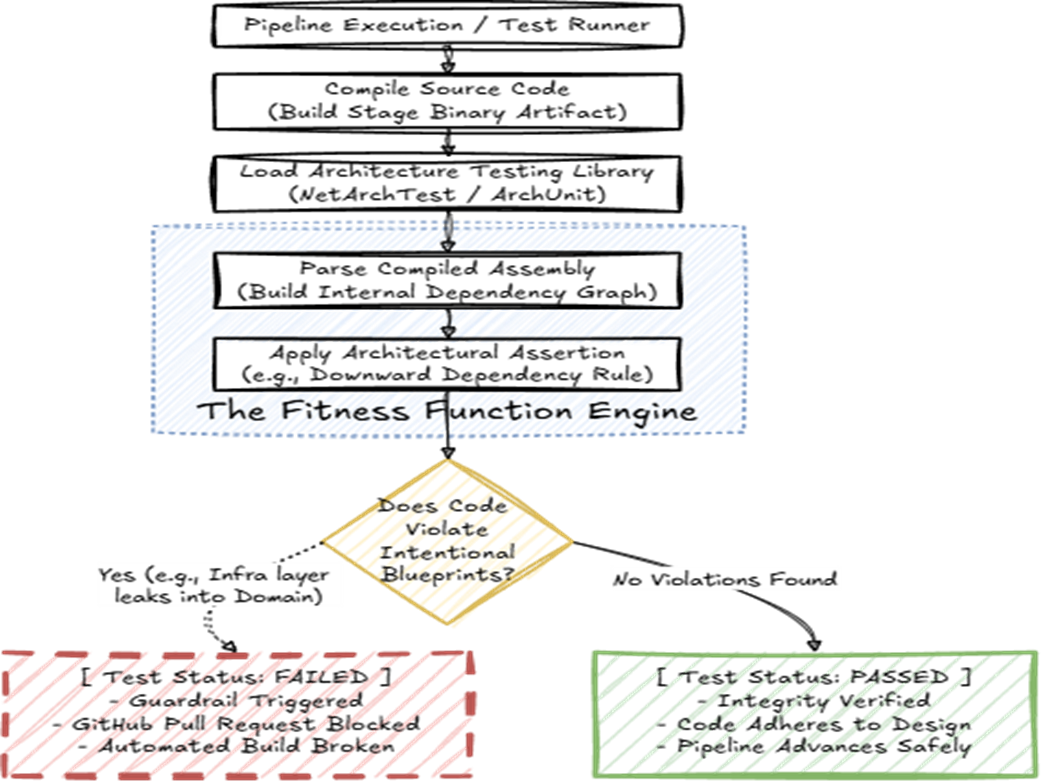
Architectural Fitness Functions: Automated guardrails for design integrity. By using libraries like NetArchTest or ArchUnit, your pipeline programmatically parses compiled binary artifacts into an internal dependency graph. It evaluates this graph against rules like the Downward Dependency Rule, instantly blocking non-compliant pull requests and preventing structural decay without relying on manual code reviews.
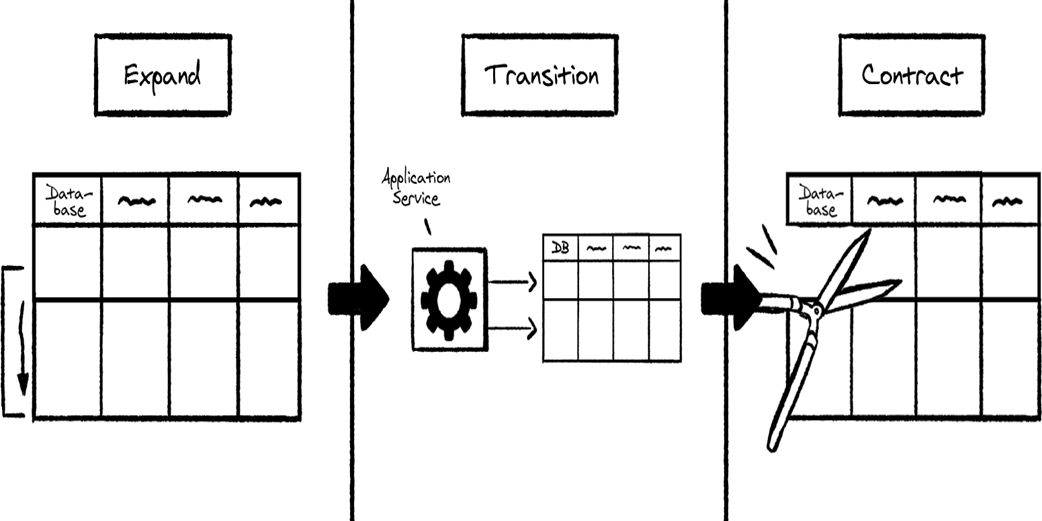
Expand/Contract Pattern: By breaking schema changes into a non-destructive sequence, you ensure backward compatibility and eliminate the risk of database-driven outages.
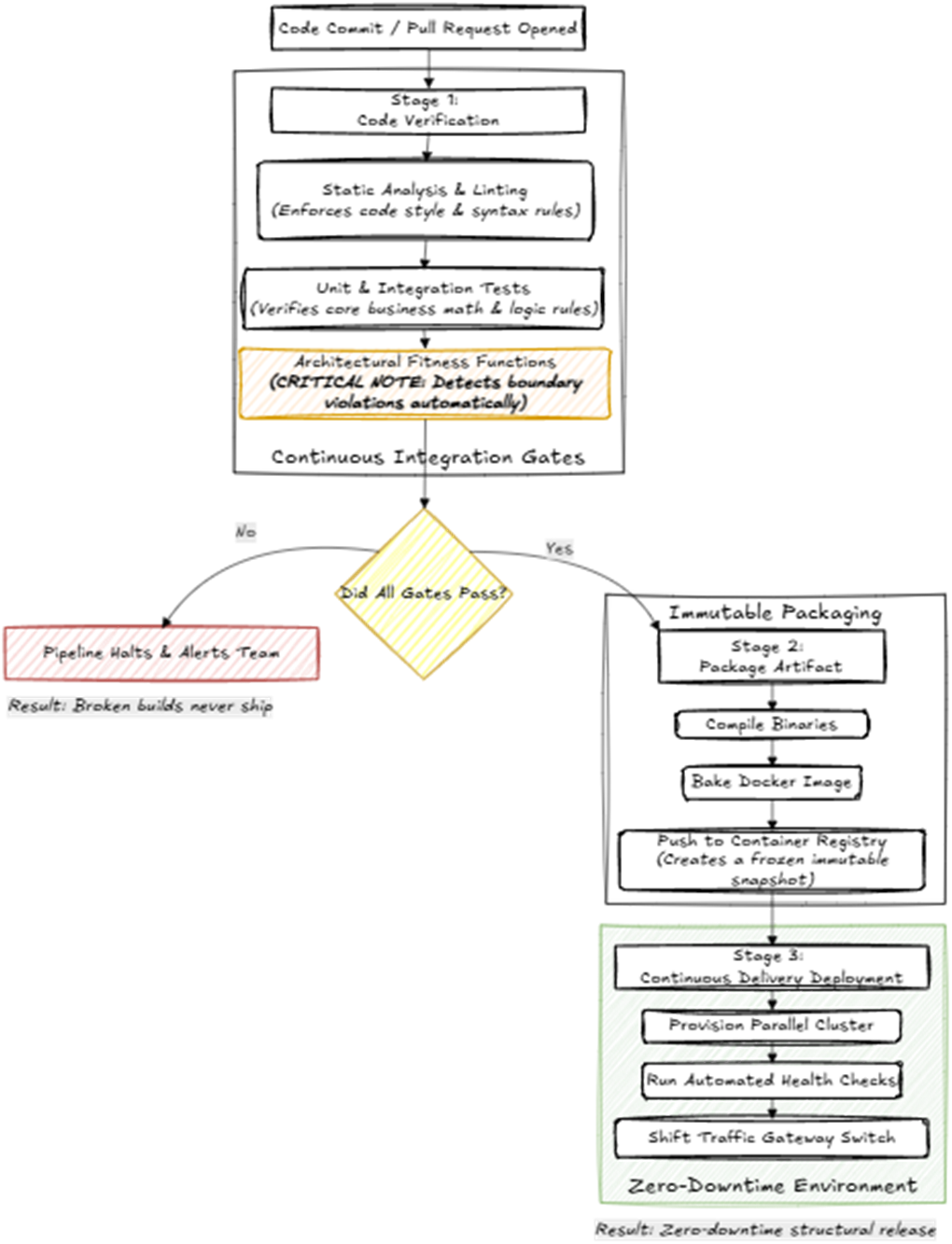
The Automated Conveyor Belt: Your CI/CD pipeline transforms raw code into a verified, immutable artifact through a series of relentless quality gates
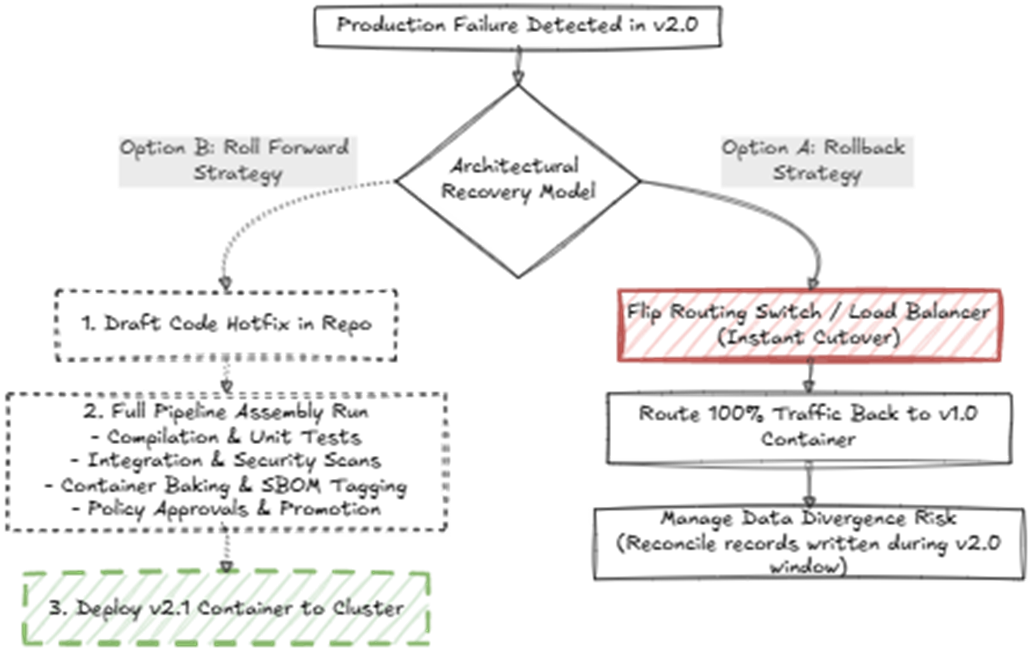
Rollback vs. Roll Forward Recovery Mechanics. A Rollback performs an instantaneous network routing cutover back to a known stable image (v1.0), trading data reconciliation complexity for immediate recovery speed. A Roll Forward processes a code fix (v2.1) through the complete assembly line, requiring full pipeline execution before production recovery occurs.
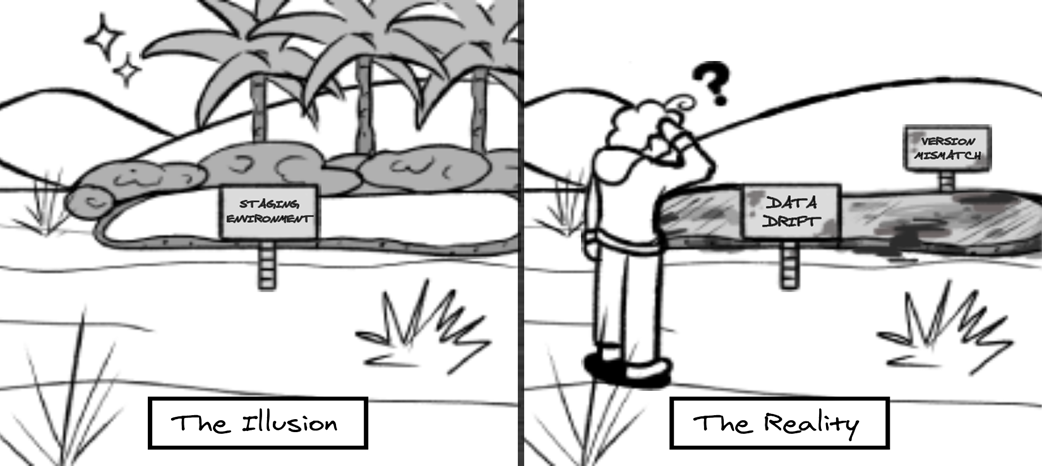
The Staging Dilemma: Traditional staging often promises perfect parity, but in reality, it frequently drifts from production, offering a false sense of security.
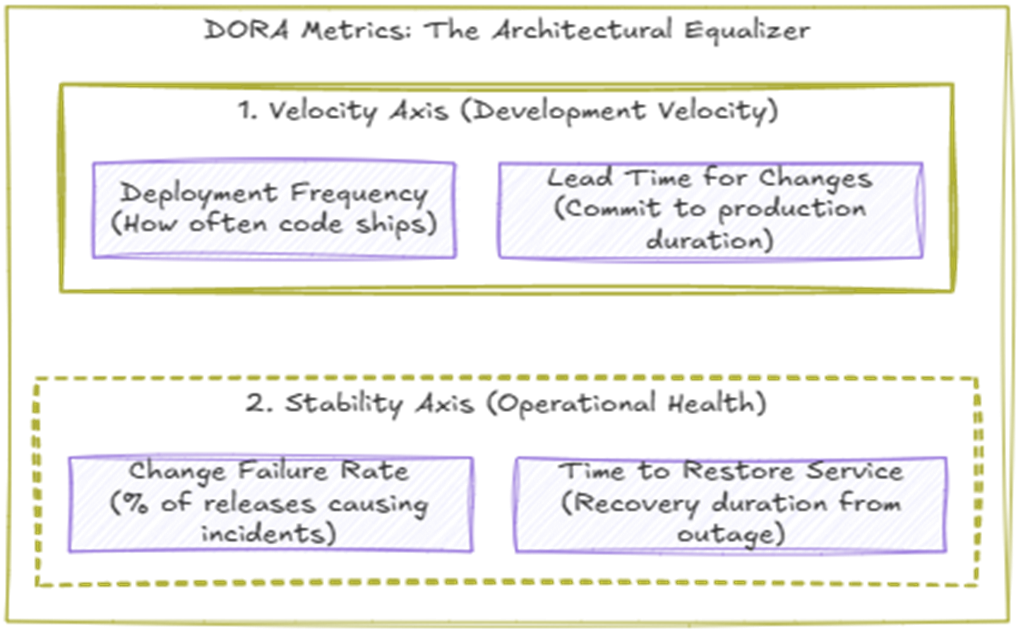
The Dual Axes of DORA Metrics. High-velocity development metrics (Deployment Frequency and Lead Time) are continuously counterbalanced by operational stability metrics (Change Failure Rate and Time to Restore Service).
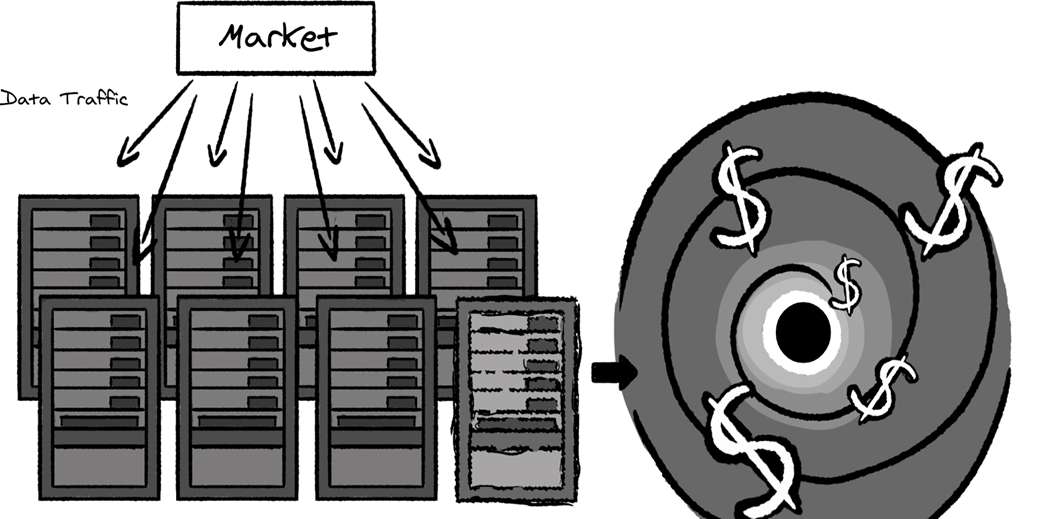
The Knight Capital Failure: Because no automated deployment verification checked that all eight servers were synchronized, one mismatched node acted like an automated firehose for unauthorized trades.
Recap
- Deployability is an Architectural Responsibility: Your code structure directly shapes your delivery pipeline's architecture. Pristine, decoupled logic lines fail to deliver real-world business value if shipping code requires a fragile, human-driven 40-step checklist at 2:00 AM.
- Infrastructure Swaps via Network Routing: Modern zero-downtime architectures avoid updating code engines in-flight by replacing or mutating active server configurations sequentially or in parallel worlds:
- Rolling Updates cycle container instances, batched one by one, keeping costs minimal but exposing the fleet to dual-version state mixing.
- Blue-Green Deployments maintain identical live (Blue) and idle (Green) staging pools to enable millisecond cutovers and near-instant rollbacks, at the cost of an infrastructure premium.
- Canary Deployments mitigate systemic risk by routing a small percentage (e.g., 2%) of real production requests to new code, thereby optimizing blast radius containment before a universal rollout.
- Separating Deployment from Release: A mature continuous delivery loop isolates the engineering act of placing files on a server from the product decision to reveal logic to users. Wrapping unreleased code inside conditional code branches controlled by dynamic data toggles enables Dark Launching and shields the system from blind rollbacks.
- Governance Must Be Automated Code: Vigilance does not scale across growing engineering squads. To protect your blueprints from structural drift and code decay, you must embed automated Architectural Fitness Functions (such as NetArchTest or ArchUnit) directly into your continuous integration gates to automatically fail builds that attempt to cross package boundaries.
- Data Requires Parallel Change: Swapping code binaries takes milliseconds; mutating database layouts requires a phased, disciplined lifecycle. The Expand/Contract Pattern fragments breaking data refactorings into an Expand phase (adding new slots without touching legacy schemas), a Transition phase (writing dual data formats and migrating logs), and a Contract phase (dropping deprecated structures once all nodes match the code state).
- Environment Paths Build Structural Confidence: High-velocity architectures treat the delivery runway as a tool to turn individual intent into collective consensus. Immutable, versioned container artifacts are progressively promoted through a disciplined chain of trust, advancing securely from a Local Workspace to a shared cloud Dev Pool, and finally moving into a Production Landing fleet guarded by fine-grained routing logic.
- DORA Metrics Diagnose System Coupling: Your delivery speed and production stability are directly constrained by your dependency charts. Evaluating your Deployment Frequency, Lead Time for Changes, Change Failure Rate, and Time to Restore Service provides your architecture with an unbiased feedback signal proving whether your service decoupling is succeeding under production pressure.

 Grokking Software Architecture ebook for free
